Smalls' Series B deck is a masterclass in category positioning. By explicitly contrasting the crowded $26B fresh dog food market with the underserved $11B cat food segment, Smalls establishes itself as the clear incumbent in a niche with high barriers to entry. The deck leans heavily on the 'picky eater' problem, citing 90 palatability studies and 16 formulations to demonstrate product-market fit. Financially, the narrative is driven by exceptional retention—95% of customers at the two-year mark remain at year three—and a 10x increase in production capacity. While the version of the deck show…
Key takeaways
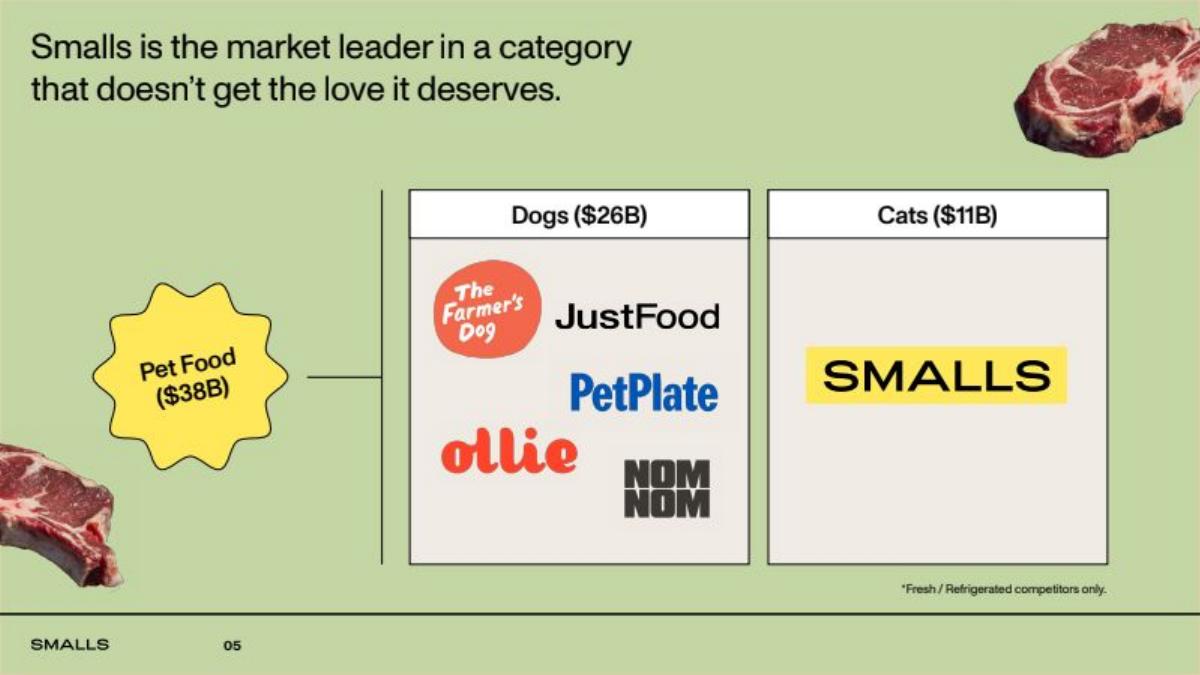
- Smalls positions itself against a $38B total pet food market, specifically targeting the $11B cat segment where it claims market leadership (Slide 05).
- The company highlights a 10x increase in production capacity through a new state-of-the-art manufacturer as a key growth unlock (Slide 10).
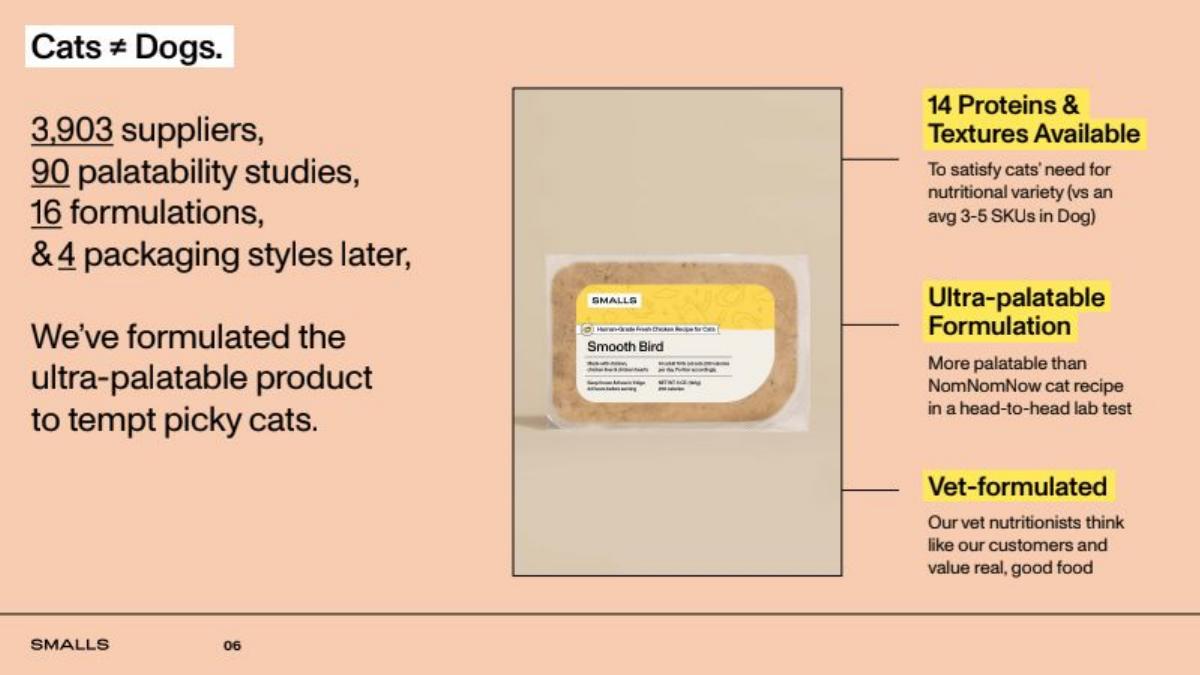
- Product development is cited as a moat, involving 3,903 suppliers and 90 palatability studies to solve for 'picky cats' (Slide 06).
- Retention is the deck's strongest metric, showing that 95% of customers who reach the 2-year mark remain active at the 3-year mark (Slide 15).
- The business model is highly recurring, with 86% of total revenue coming from subscriptions (Slide 09).
- Smalls uses a 'land and expand' strategy, moving from 'cat food brand' to 'cat brand' by targeting the 65% of cat owner spend currently going to litter, toys, and services (Slide 19).
- The leadership team features deep D2C and retail experience from brands like Thinx, Walmart, Jet, and Buffy (Slide 09/Team).
- The deck explicitly asks for $12.5M to reach a specific (though redacted) revenue milestone and build out specialized R&D and Retail talent (Slide 21).
The Category King Strategy
Smalls' pitch deck is a textbook example of how to pitch a D2C brand in a post-iOS14 world. Rather than focusing solely on top-line growth at any cost, the narrative centers on supply chain defensibility, category specialization, and extreme customer loyalty. By the time an investor reaches the final slide, Smalls has attempted to prove that they don't just sell cat food—they own the relationship with the cat owner.
Slides 02-03: The Market Problem
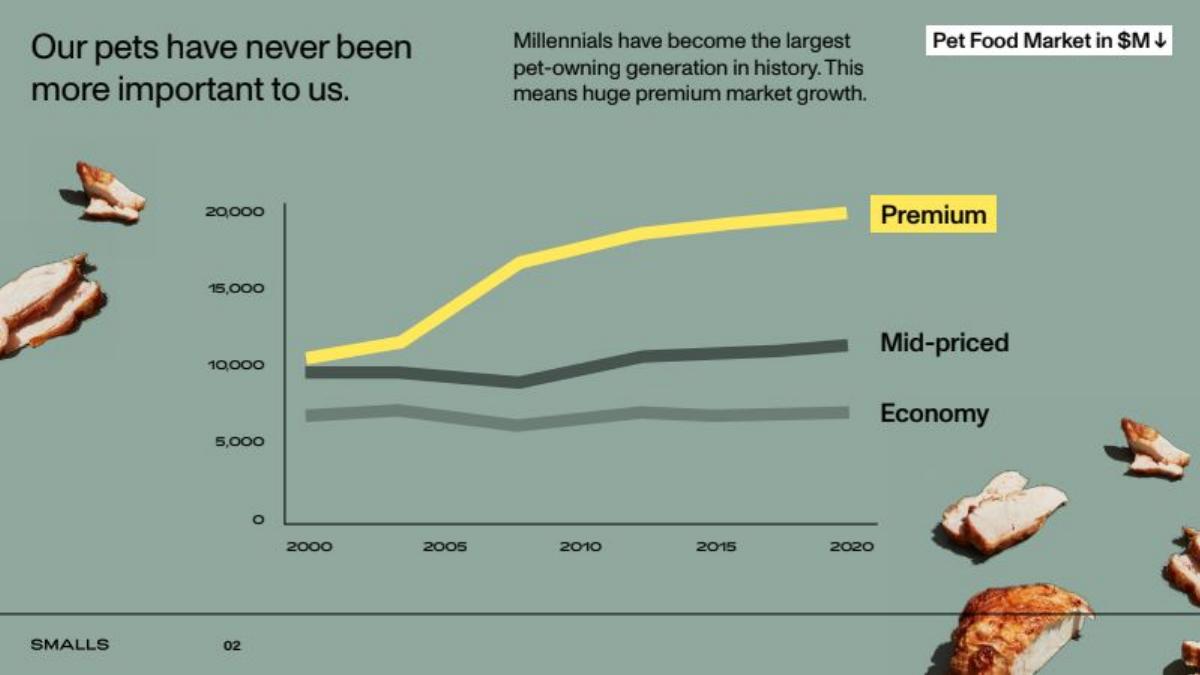
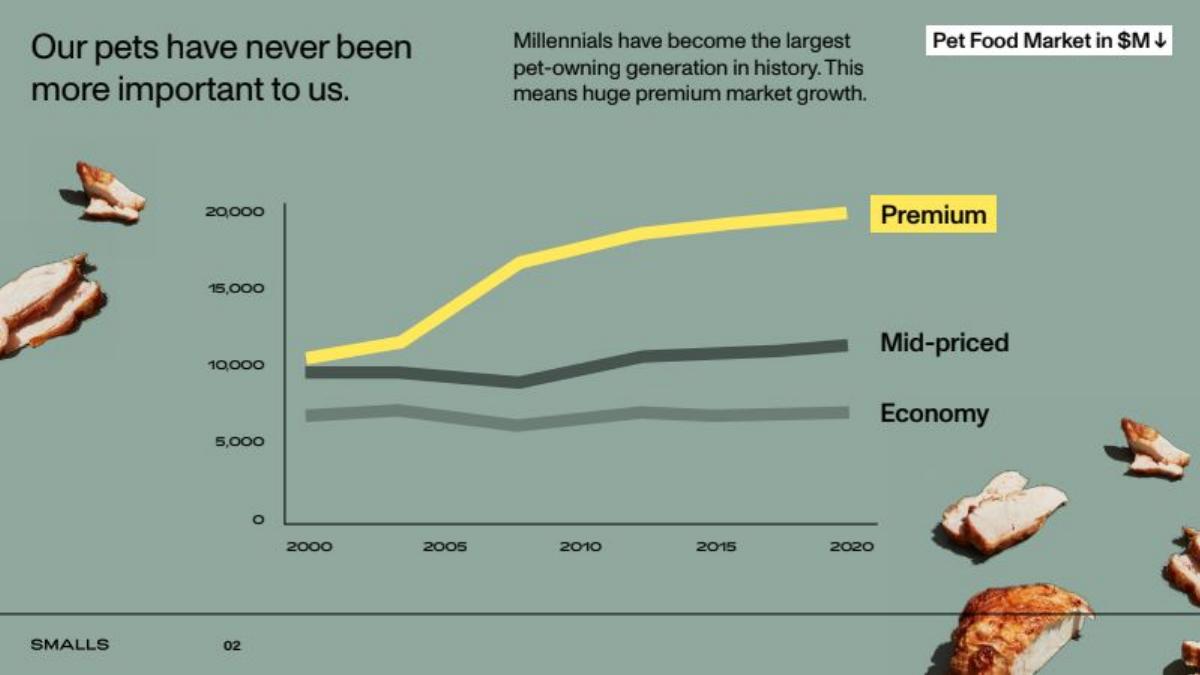
The deck opens by framing the 'humanization of pets' trend. Slide 02 uses a line graph to show that the 'Premium' pet food market has grown from roughly $10B in 2000 to $20B in 2020, significantly outpacing 'Mid-priced' and 'Economy' tiers. The slide attributes this to Millennials becoming the largest pet-owning generation in history.
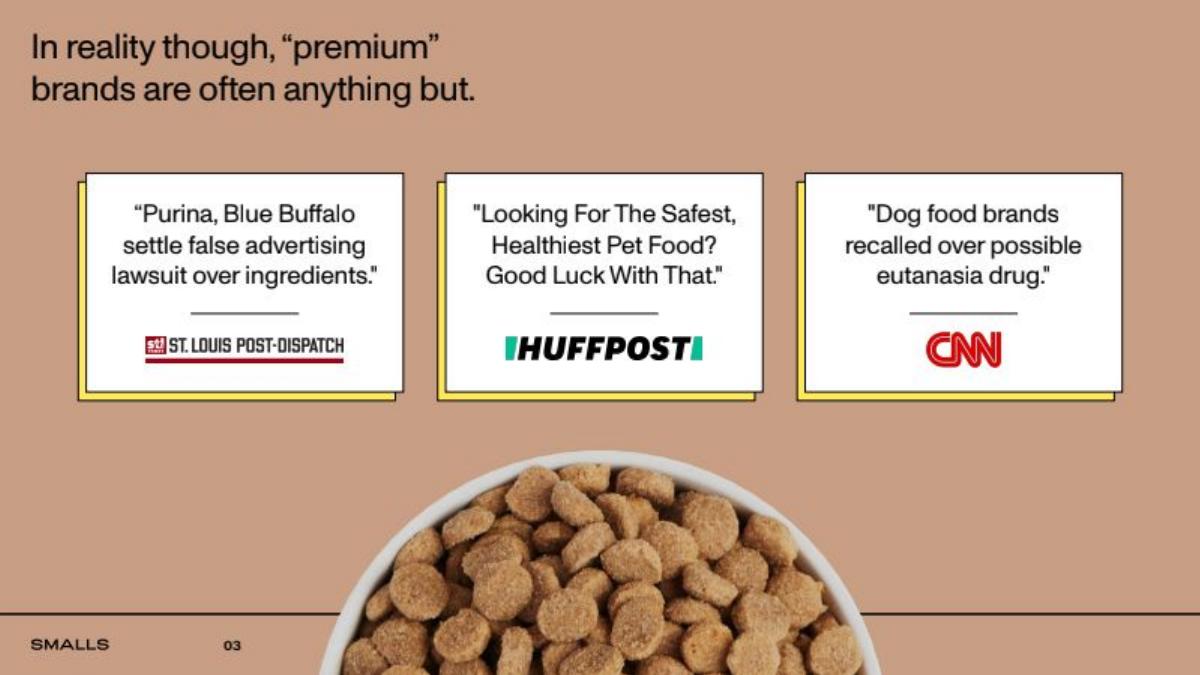
Slide 03 introduces the 'villain' of the story: the incumbent 'premium' brands. By citing headlines from the St. Louis Post-Dispatch, HuffPost, and CNN regarding false advertising lawsuits and recalls involving euthanasia drugs, Smalls creates an immediate emotional and logical need for a safer, more transparent alternative.
Slides 04-06: The Solution and Differentiation
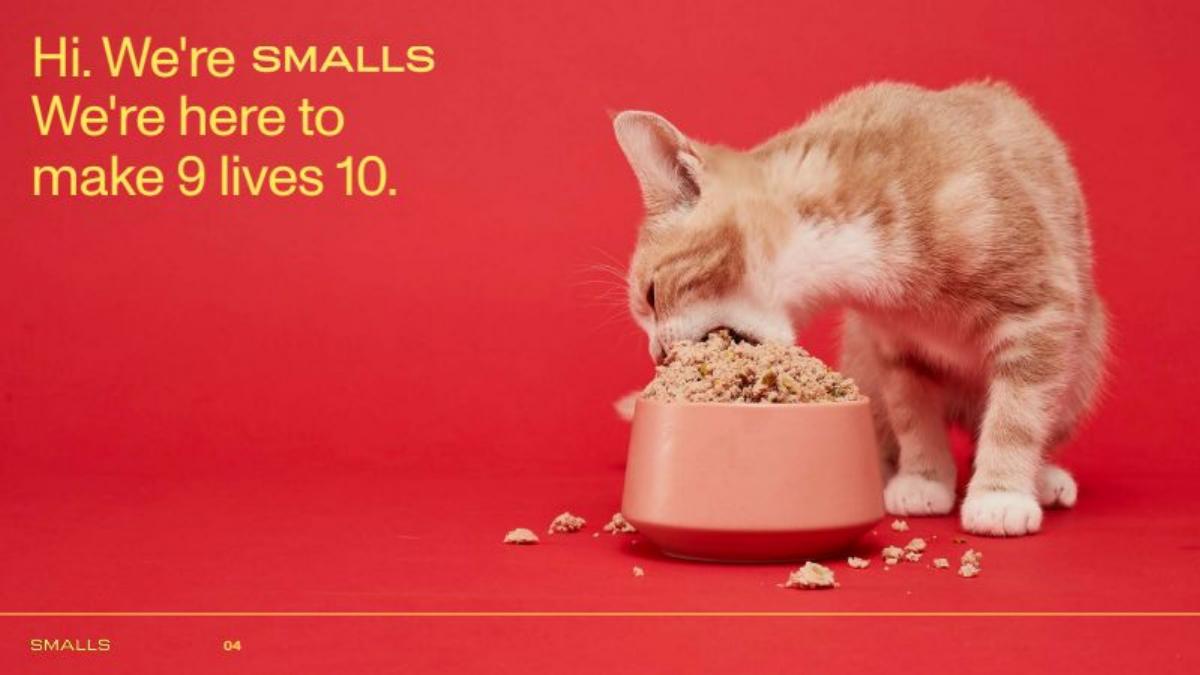
Slide 04 introduces the brand with the mission 'to make 9 lives 10.' This is followed by a critical positioning slide (Slide 05) that justifies the company's existence. It breaks the $38B pet food market into Dogs ($26B) and Cats ($11B). While the dog side is crowded with well-funded players like The Farmer’s Dog and Ollie, the cat side shows only Smalls. This 'blue ocean' strategy is the core of the Series B pitch.
Slide 06 addresses the technical difficulty of the category. Cats are notoriously picky eaters. Smalls highlights that they evaluated 3,903 suppliers and conducted 90 palatability studies to create 16 formulations. They claim their product is 'more palatable than NomNomNow cat recipe in a head-to-head lab test,' providing a rare piece of direct competitive benchmarking.
Slides 07-10: Operations and Inflection Points
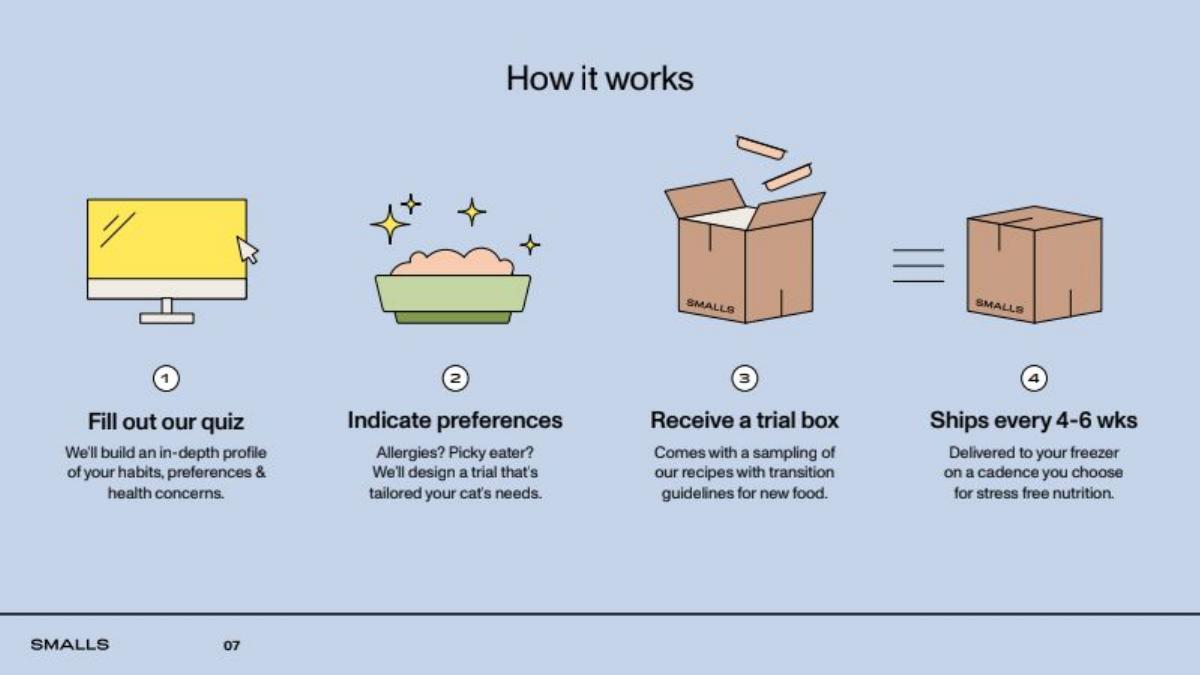
The 'How it works' slide (Slide 07) outlines a standard D2C subscription flow: quiz, preferences, trial box, and recurring shipments every 4-6 weeks. However, the real meat of the operational story is on Slide 10. Smalls shows a video of a production line and states they have 'unlocked growth by moving to a new, state-of-the-art manufacturer, increasing production capacity by 10x.' For a Series B company, proving that the supply chain can handle the next order of magnitude in growth is essential.
Slides 09-12: Traction and Unit Economics
Slide 09 (labeled as 09, though the deck has some numbering inconsistencies) presents the 'Growth Inflection Point.' It shows a graph of Annual Run Rate (ARR) with a sharp upward trajectory starting in Q3 2021. The slide notes that 'supply constraints have led to bumpy acquisition' in the past, which frames the previous capacity increase as the solution to a historical bottleneck. Key metrics listed include 2x growth over the last 6 months and a high recurring revenue percentage of 86%.
Slide 12 reinforces this by stating they have '8Xed our subscriber base since 2020 while keeping CAC in check.' Although the specific CAC dollar amounts are redacted as '$XX', the visual trend line for active subscribers shows consistent quarterly growth through Q4 2021.
Slides 13-16: The Retention Moat
One of the most impressive sections of the deck covers customer loyalty. Slide 13 shows a customer acquisition mix across seven channels, noting that less than 1/3 of the paid mix comes from their primary channel. This diversification is a hedge against rising ad costs on platforms like Meta.
Slide 15 is the 'money slide' for retention. It uses a cohort layer cake chart to show 'almost zero long-tail churn.' The standout stat is that 95% of customers active at the 2-year mark remain active at the 3-year mark. This level of retention is rare in D2C and suggests a very high Lifetime Value (LTV), which is projected on Slide 16 as an 'excellent RLTV outlook' over 60 months.
Slides 18-21: The Vision and The Ask
The deck concludes by expanding the scope of the business. Slide 18 signals the transition from a 'Cat Food Brand' to a 'Cat Brand.' Slide 19 backs this up with data: food only accounts for $11B of the $30B US Cat Care market. The remaining $19B is spent on litter, toys, treats, and services. Slide 20 shows 'healthy attach rates' for treats and toys even without explicit incentives, providing a clear path to increasing Average Order Value (AOV).
The final 'Ask' on Slide 21 is for a $12.5M round. The investment highlights summarize the deck: doubled business in 6 months, 10x production capacity, and excellent long-tail retention. The funds are earmarked for brand expansion, omnichannel exploration, and hiring specialized R&D and Retail talent.
What Smalls Does Well
Category Contrast: By showing the 'Dogs vs. Cats' slide, they immediately answer 'Why now?' and 'Why you?' in a way that makes the dog food market look saturated and the cat food market look like an untapped goldmine. · Honesty about Friction: Acknowledging that supply constraints caused 'bumpy acquisition' (Slide 09) builds credibility. It turns a past weakness into a reason for the current raise. · Retention as a Moat: In D2C, retention is everything. The 95% retention stat between years 2 and 3 is a powerful indicator of product-market fit that offsets concerns about high initial CAC. · Visual Consistency: The deck uses a sophisticated, 'human-grade' aesthetic with high-quality food photography and a clean color palette that mirrors the premium brand identity.
What is Missing
Unit Economics Detail: While the deck mentions 'XX% margins' and '$XX CAC,' the redacted nature of this version makes it hard to judge the actual health of the contribution margin. A Series B investor would need to see the path to profitability. · Retail Strategy: The deck mentions 'explore omnichannel' and 'Retail talent,' but lacks a specific slide on their retail roadmap or current wholesale performance, which is usually a major component of a Series B D2C story. · Detailed Team Bios: Slide 09 (Team) shows impressive logos (Walmart, Thinx, Jet), but lacks bullet points on specific achievements or tenures for the leadership team.
What Founders Should Copy
The 'Inflection Point' Narrative: If you have recently solved a major bottleneck (like manufacturing capacity), make that the centerpiece of your growth story. It explains why the future will look different from the past. · Cohort Layer Cakes: Use Slide 15 as a template. Showing how old cohorts continue to contribute revenue years later is the most effective way to prove a sustainable subscription business. · The 'Wallet Share' Expansion: Don't just pitch the market you are in today. Show the 'adjacent' dollars (Slide 19) to prove that your ceiling is much higher than your current product line suggests.
Frequently asked questions
- How much did Smalls raise and at what stage?
- According to the catalogue facts, Smalls raised $19M in a Series B round in 2023. The deck itself (Slide 21) mentions a target investment of $12.5M, suggesting the round may have been oversubscribed or expanded during the fundraising process.
- Who are Smalls' main competitors according to the deck?
- Slide 05 identifies fresh/refrigerated competitors. While it lists several players in the $26B dog food space—The Farmer’s Dog, JustFood, PetPlate, Ollie, and Nom Nom—it positions Smalls alone in the $11B cat food box, claiming market leadership in that specific niche.
- What is Smalls' customer retention rate?
- Smalls demonstrates exceptional long-term retention. Slide 15 shows a cohort analysis where 95% of customers who have been with the brand for two years remain customers at the three-year mark, resulting in what the company describes as 'almost zero long-tail churn.'
- What is the primary use of funds for this round?
- As stated on Slide 21, the $12.5M (target) was intended to transition the company from a 'cat food brand' to a 'cat brand,' invest in omnichannel marketing, and hire specialized talent in R&D, Engineering, and Retail.
- How does Smalls acquire customers?
- Slide 13 shows a diversified growth engine across at least seven different channels. A key highlight is that less than one-third of their paid mix now comes from a single (unnamed) primary channel, indicating a move away from over-reliance on Facebook/Instagram ads.