Slip.stream enters the market as a mediator between the music industry and the creator economy, specifically targeting the 'friction' caused by DMCA takedowns on platforms like Twitch and YouTube. The deck highlights a three-pronged monetization strategy involving music assets, creators, and musicians, supported by a library that launched with 50,000 royalty-free tracks and 40,000 sound effects. Traction is the deck's strongest suit, reporting 17 billion TikTok views generated by users and over 1 million minutes of music streamed by gamers within just six months. While the deck excels at demo…
Key takeaways
- The platform launched with a catalog of 50,000 royalty-free tracks and 40,000 sound effects to provide 'creator-safe' music (Slide 4).
- Slip.stream reports reaching 17 billion views on TikTok generated by its users within the first six months (Slide 5).
- The user base includes over 40,000 monthly creators globally, with 40% of those being live-streaming gamers (Slide 5).
- Monetization is diversified across three pillars: music asset royalties, creator subscriptions, and musician distribution fees (Slide 3).
- The deck identifies a specific pain point in the 'friction' between big music companies and platforms, citing DMCA takedowns on Twitch (Slide 2).
- Growth strategy involves partnerships with high-profile artists like T-Pain and JVKE, and gamers like Pokimane and Faze H1ghsky1 (Slide 6).
- The platform claims to offer the 'largest pre-cleared catalog for Creators in the world' (Slide 4).
- Musicians are incentivized to join by retaining ownership while gaining promotion through creator content channels (Slide 3).
Executive Summary: The Bridge Between Labels and Streamers
Slip.stream positions itself as a critical infrastructure layer for the creator economy. As digital platforms like Twitch and YouTube became more aggressive with DMCA (Digital Millennium Copyright Act) enforcement, a massive gap opened between the music industry's desire to protect intellectual property and the creator's need for high-quality, safe background music. Slip.stream’s deck focuses heavily on this 'friction' and presents a platform that serves as a clearinghouse for rights-cleared music. With 17 billion TikTok views generated in its first six months, the deck leans on massive top-of-funnel engagement metrics to prove that creators are hungry for their solution.
Slide 1: The Value Proposition
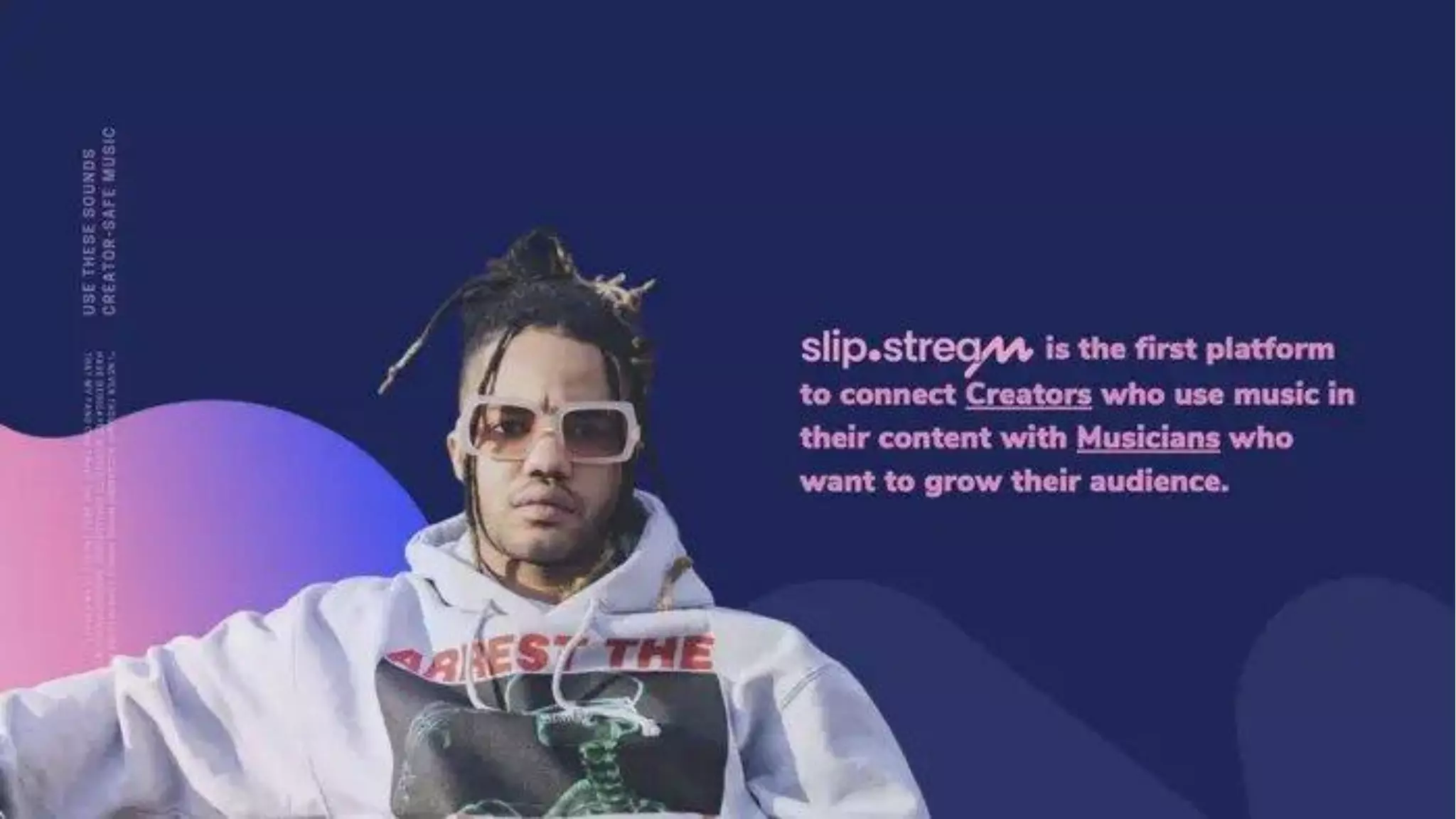
The opening slide establishes Slip.stream as the 'first platform to connect Creators who use music in their content with Musicians who want to grow their audience.' The imagery is culturally aligned with the music industry, featuring an artist in a hoodie and sunglasses, signaling that this is a 'cool' tech company, not a legacy corporate entity. The sub-text on the left side of the slide mentions 'Creator-Safe Music,' which is the core product category they are defining. This slide is effective because it immediately identifies the two sides of their marketplace: the supply (musicians) and the demand (creators).
Slide 2: The Problem – Industry Friction
Slide 2 is a 'social proof' problem slide. Instead of using bullet points to describe the problem, Slip.stream uses a collage of headlines and tweets. It cites articles about YouTubers and record labels 'fighting' and Twitch having to 'make peace with the music biz.' It also includes tweets from high-profile artists like 21 Savage and Lil Tecca, who expressed frustration over their fans being banned for playing their music. This is a powerful way to demonstrate that the problem isn't just theoretical—it is a public, high-stakes conflict involving some of the biggest names in entertainment. It frames Slip.stream not just as a tool, but as a peace treaty.
Slide 3: The Business Model
The 'How we monetize' slide is a comprehensive 3x2 grid that breaks down the Revenue Model and Value Provided for three distinct groups: Music Assets, Creators, and Musicians. Music Assets generate streaming revenue and sync fees. Creators pay subscriptions and licensing fees for access to the catalog. Musicians pay for distribution and production services. This slide is crucial because it shows that Slip.stream is not just a subscription service; it is a multi-faceted media company that participates in the long-term upside of the music it owns or represents. The mention of 'uncapped upside for breakout hits' suggests they are looking for 'hits' within their library, much like a traditional record label would.
Slide 4: Product and Catalog Launch
Slide 4 focuses on the 'kickstart' phase of the platform. It shows a clean, modern UI of the platform featuring an 'Artist Drop' for a musician named Snowy. The slide lists specific inventory numbers: 50,000 royalty-free tracks and 40,000 sound effects at launch. This is a 'defensibility' slide; it shows that the company didn't just build a website, they built a massive library of assets. The claim of being the 'largest pre-cleared catalog for Creators in the world' is a bold competitive moat, provided the quality of the music matches the quantity.
Slide 5: Traction and Growth Metrics
This is the 'money slide' of the deck. It uses large, bold typography to highlight four key metrics after six months of operation: 17B+ Views on TikTok , 40k+ Monthly creators , 1M+ Minutes of music streamed by gamers , and the fact that 40% of users are gamers . These numbers are impressive for a six-month-old company. The TikTok metric is particularly clever because it measures 'earned reach'—it shows that Slip.stream’s music is being carried into the ears of billions of people via their users' content, which is a powerful organic marketing engine.
Slide 6: Expansion and Brand Awareness
The expansion slide lists a 'who's who' of the creator and brand world. It categorizes growth into five buckets: Brands (G Fuel, Estee Lauder), Artists (T-Pain, JVKE), Gamers (Pokimane, Faze H1ghsky1), Platforms (Snapchat, Stir), and YouTubers (Emma Chamberlain, Yes Theory). By listing these names, Slip.stream is signaling its cultural relevance. If these major creators and brands are using or associated with the platform, it validates the product for the millions of smaller 'long-tail' creators who follow them. This slide serves as the 'Go-To-Market' strategy, showing they are targeting the top of the pyramid to influence the rest of the market.
Slide 7: Closing Branding
The final slide is a minimalist branding page featuring an astronaut and the Slip.stream logo. While it doesn't provide new data, it maintains the high-production-value aesthetic of the rest of the deck. However, in a professional fundraising environment, this is usually where an 'Ask' or 'Contact' slide would be. Its absence here suggests this may be a version of the deck intended for public viewing or a general partnership overview rather than a final investor pitch.
What Works in the Slip.stream Deck
Visual Storytelling: The use of real-world headlines and tweets to illustrate the problem (Slide 2) is much more compelling than a list of pain points. It creates a sense of urgency. · Massive Traction: Leading with 17 billion views (Slide 5) is an attention-grabber. Even if those views aren't directly monetized by Slip.stream, they prove the platform's music is 'viral-ready.' · Clear Segmentation: The monetization slide (Slide 3) clearly explains how the company makes money from different stakeholders, which is often a point of confusion in marketplace businesses. · Niche Focus: By identifying that 40% of their users are gamers (Slide 5), they show they understand their 'beachhead' market while still aiming for broader expansion.
What is Missing from the Slip.stream Deck
The Team: There is no slide introducing the founders or the executive team. In early-stage investing, the 'who' is often as important as the 'what.' · The Financials: While the deck shows user growth and views, it does not show revenue figures, gross margins, or customer acquisition costs (CAC). · The Ask: There is no mention of how much money the company is raising, the valuation, or what the milestones for the next 18 months look like. · Competitive Analysis: The royalty-free music space is crowded (Epidemic Sound, Artlist, Soundstripe). The deck does not explicitly state how Slip.stream differs from these established players other than the 'pre-cleared' claim.
What Other Founders Should Copy
The 'Problem' Collage: If your startup is solving a problem that is currently being discussed in the news or on social media, use screenshots of those discussions. It provides external validation that the problem is real and painful. · The Three-Pillar Revenue Model: If your business serves multiple stakeholders, use a grid like the one on Slide 3 to show how you provide value and extract revenue from each. It shows a sophisticated understanding of your ecosystem. · Earned Media Metrics: If your product is used to create other content (like music, design tools, or video editors), track the reach of that final content. '17 billion views' sounds much more venture-scale than '40,000 users.'
Frequently asked questions
- How does Slip.stream solve the DMCA takedown problem?
- Slip.stream provides a 'creator-safe' music library where all tracks are pre-cleared for use in digital content. As shown on Slide 2, the company positions itself as the solution to the 'fighting' between YouTubers and record labels. By owning or securing rights to its catalog of 50,000+ tracks, it ensures that creators can stream or upload videos without the risk of copyright strikes or demonetization.
- What is the primary revenue model for Slip.stream?
- The company utilizes a multi-layered monetization strategy detailed on Slide 3. It generates revenue from 'Music Assets' via streaming and sync fees, from 'Creators' through subscriptions and licensing fees for catalog access, and from 'Musicians' via fees for distribution and promotional services. This creates a circular economy where the platform earns from both the supply (musicians) and demand (creators) sides of the marketplace.
- Who is the target audience for this platform?
- The deck identifies two primary user segments: Creators and Musicians. Within the creator segment, Slide 5 highlights that 40% of users are gamers who live-stream, which they call the 'fastest growing creator segment.' Slide 6 further specifies target sub-groups including YouTubers, TikTokers, and brands like G Fuel and Estee Lauder, indicating a broad B2B and B2C reach.
- What kind of traction did the company see in its first six months?
- The traction reported on Slide 5 is significant for an early-stage startup. In six months, Slip.stream reached over 40,000 monthly active creators and facilitated over 1 million minutes of music streaming by gamers. Most notably, content created using their music generated over 17 billion views on TikTok, demonstrating massive secondary reach and brand exposure.
- What information is missing from this pitch deck?
- The provided slides omit several critical components of a standard venture capital pitch. There is no 'Team' slide detailing the founders' backgrounds, no 'Financials' slide showing historical revenue or burn rate, and no 'Ask' slide specifying how much capital is being raised or the intended use of funds. Additionally, a competitive landscape analysis is absent, which is vital in the crowded royalty-free music space.