Skyflow’s 18-slide deck is a textbook example of a 'team-first' narrative for a highly technical product. Founded in 2019, the company raised $70 million by framing data privacy not just as a compliance checkbox, but as a fundamental layer of the modern cloud stack. The deck relies heavily on the founders' backgrounds at Salesforce and Oracle to build immediate credibility, bypassing traditional traction metrics in favor of architectural vision and market positioning. By comparing their 'Privacy Cloud' to established giants like Okta and Snowflake, Skyflow creates a sense of inevitability. Wh…
Key takeaways
- The deck leads with team pedigree, highlighting the founders' roles as former VPs and CTOs at Salesforce and AthenaHealth on slide 2.
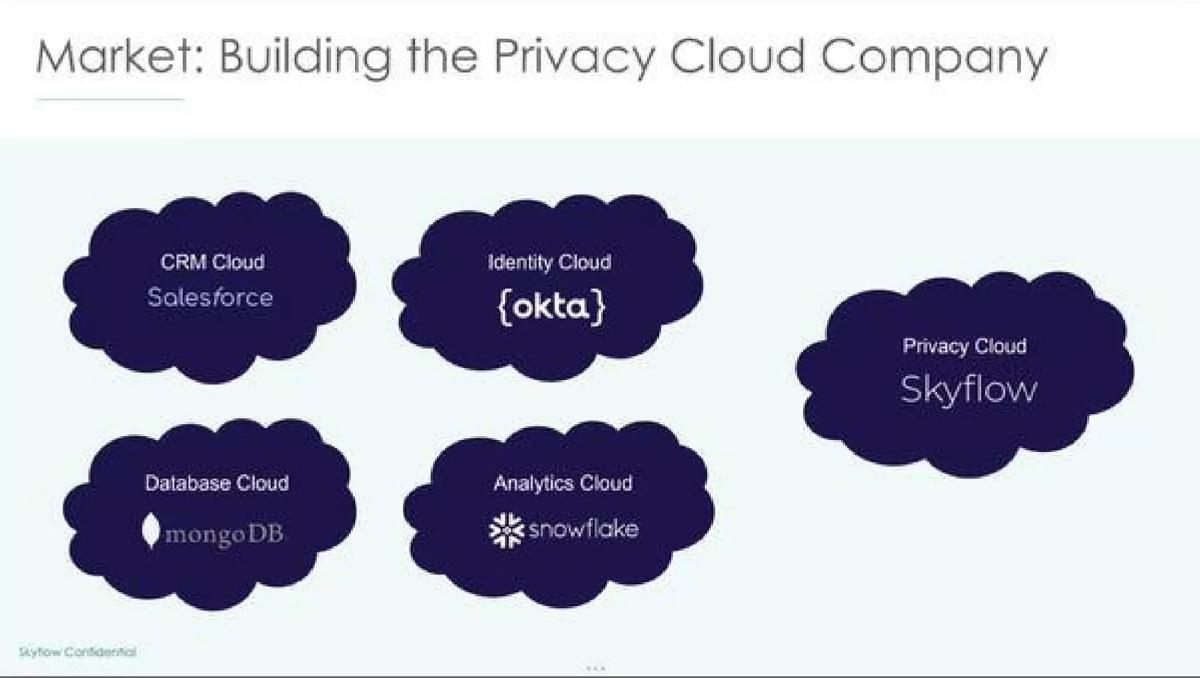
- Skyflow positions itself as the 'Privacy Cloud,' placing its logo alongside Salesforce, Okta, and Snowflake to define a new market category on slide 6.
- The problem is framed through high-profile failures, citing the Equifax and Capital One breaches as catalysts for a new approach on slide 8.
- The solution is validated by 'Big Tech' precedents, noting that Apple and Google have built similar internal vaults for years on slides 10 and 11.
- Technical differentiation is centered on 'Polymorphic Encryption' and the ability to run analytics on fully encrypted data as stated on slide 13.
- The deck uses a 'Stripe for Privacy' analogy, comparing their PII Data Vault to Stripe’s card processing and Twilio’s telephony on slide 12.
- Data residency is a core feature, with slide 14 illustrating how data is physically distributed across US, European, and APAC regions.
- The Go-To-Market strategy focuses on six specific 'entry points,' ranging from recent breaches to microservices rewiring on slide 17.
The Vision of the Privacy Cloud
Skyflow’s Series B pitch deck is a masterclass in enterprise positioning. Founded in 2019, the company set out to solve one of the most persistent problems in software: how to store sensitive PII (Personally Identifiable Information) without creating a massive security liability. The deck, which helped secure a $70,000,000 investment, doesn't lead with growth charts or customer testimonials. Instead, it leads with the inevitability of its category and the elite status of its builders.
Slides 1-4: The Pedigree Play
The deck opens with a simple title slide (Slide 1) stating their goal: "Raising capital to fund 10x growth." This is a bold, high-conviction opening that sets the tone for a Series B. Immediately following the title, Slide 2 introduces the founders, Prakash Khot (CTO) and Anshu Sharma (CEO). The bullet points are a checklist of enterprise royalty: EVP & CTO at AthenaHealth, SVP Engineering at Salesforce, VP Product at Salesforce, and experience at Oracle and Google. By putting this on Slide 2, Skyflow is telling investors that they have already 'been there and done that' at the highest levels of SaaS.
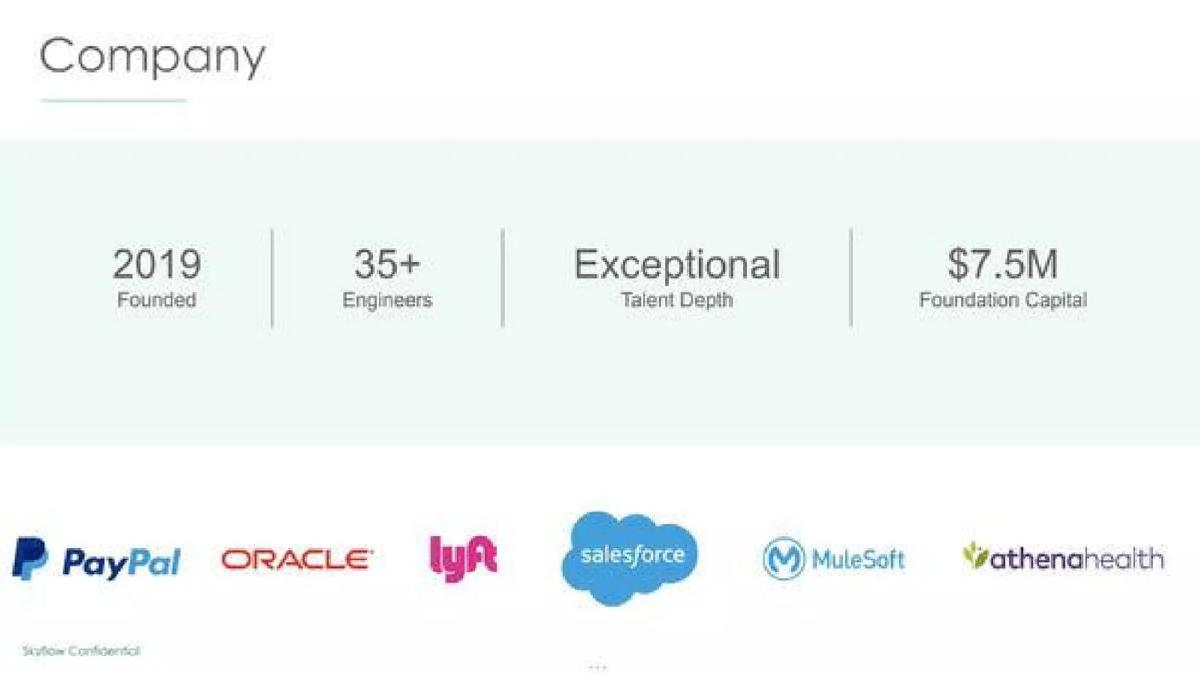
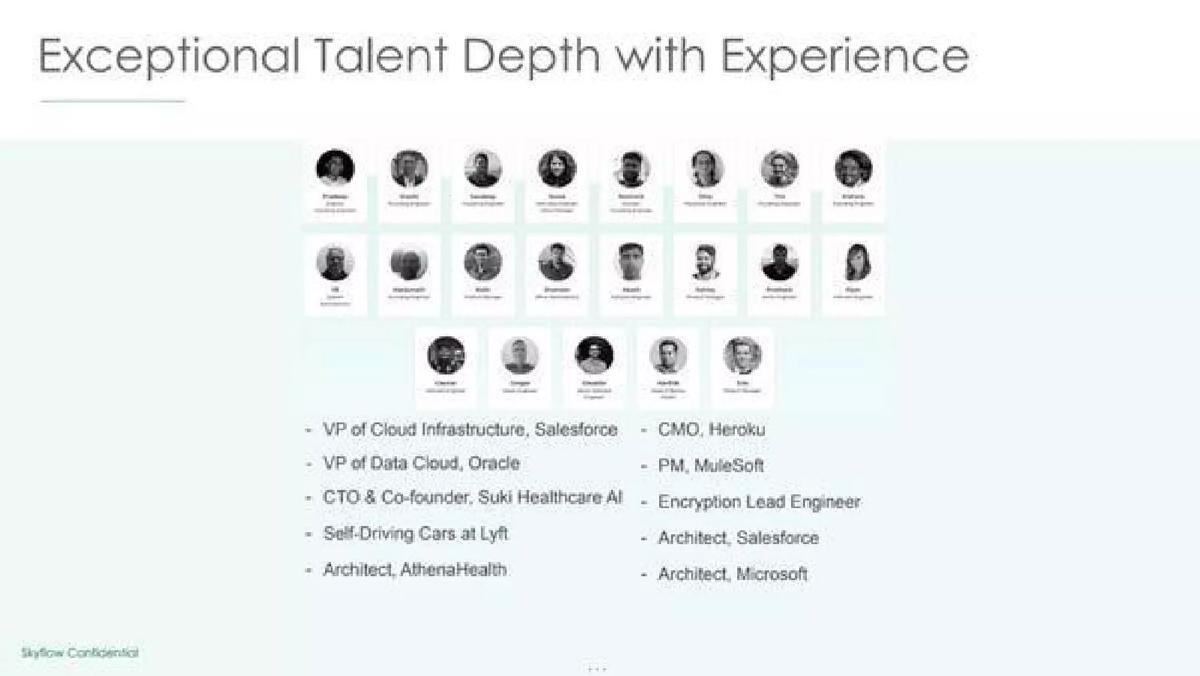
Slide 3 and 4 double down on this 'talent density' narrative. Slide 3 notes the company was founded in 2019, has 35+ engineers, and previously raised $7.5M from Foundation Capital. It features a row of logos—PayPal, Oracle, Lyft, Salesforce—representing where their team members came from. Slide 4, titled "Exceptional Talent Depth with Experience," shows a headshot grid of the team, explicitly listing roles like "VP of Cloud Infrastructure, Salesforce" and "CMO, Heroku." For a technical product like a data vault, this level of social proof is designed to neutralize concerns about execution risk.
Slides 5-7: Defining the Category
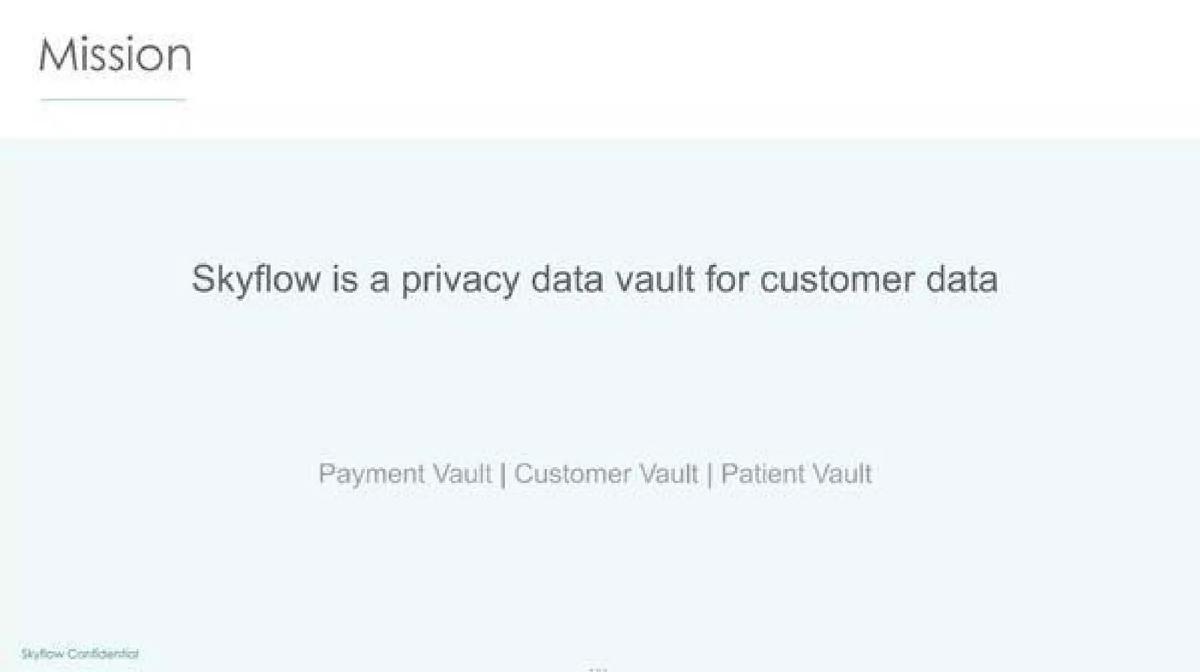
Slide 5 provides a concise mission statement: "Skyflow is a privacy data vault for customer data." It specifies three initial verticals: Payment Vault, Customer Vault, and Patient Vault. This shows a clear path to market—targeting PCI, PII, and PHI data respectively.
Slide 6 is perhaps the most important slide in the deck for valuation purposes. It uses a cloud-bubble diagram to place Skyflow in the same league as Salesforce, Okta, MongoDB, and Snowflake. By labeling Skyflow as the "Privacy Cloud," the founders are not just selling a security tool; they are claiming a new pillar of the enterprise architecture. Slide 7 acts as a transition, asking "What is Skyflow?" to move from the 'Why' to the 'How.'
Slides 8-11: The Problem and the 'Known' Solution
Slide 8 frames the problem through the lens of fear and compliance. It mentions GDPR, CCPA, and "massive fines," while showing headlines of breaches at Capital One and Shopify. The core question posed to the investor is: "How do I know I am not the next Equifax?"
Slide 9 illustrates the "False Choice" CTOs face: the see-saw between securing data and using it. This sets up the 'Aha!' moment for the product. Slides 10 and 11 then provide the ultimate validation. They show that Apple, Google, Goldman Sachs, Netflix, and Capital One have all built their own internal data vaults. This is a brilliant move—it proves that the smartest, most well-funded companies in the world have already decided that a data vault is the correct architectural answer. Skyflow’s implicit pitch is: "We are building for the rest of the world what Apple built for themselves."
Slides 12-16: Product Architecture and API Strategy
Slide 12 uses a powerful analogy: "Simple API's for Hard, Complex Problems." It aligns Skyflow with Stripe (Card Processing) and Twilio (Telephony). This tells an investor exactly what the business model and developer experience will look like. It’s a high-margin, sticky, API-first infrastructure play.
Slide 13 gets into the technical 'moat.' It mentions "Polymorphic Encryption," which allows workflows and analytics to run on fully encrypted data. This is the technical breakthrough that solves the 'False Choice' mentioned earlier. Slide 14 visualizes the "Data Residency" feature, showing how Skyflow can physically store data in specific regions (US, Europe, APAC) to satisfy local laws while providing a unified API to the developer.
Slides 15 and 16 show the platform stack and how it fits into the overall technology fabric. Slide 16 is particularly useful for technical due diligence, showing Skyflow sitting alongside AWS and Okta in the "Data & Compute Fabric" layer, underneath the App Backend. It clarifies that Skyflow is a foundational layer, not an application-level add-on.
Slides 17-18: GTM and Key Benefits
Slide 17 outlines the Go-To-Market (GTM) strategy through "Multiple Entry Points." These are the 'trigger events' that cause a customer to buy, such as a recent breach, moving to the public cloud, or building a new app. This shows that the sales team has a clear understanding of the customer's buying journey. Finally, Slide 18 summarizes the "Key Benefits" into three pillars: Isolate & Protect, Analytics & Workflow, and Developer APIs.
What Works in this Deck
The Category Positioning: By calling themselves the "Privacy Cloud" and comparing themselves to Snowflake and Okta, Skyflow successfully frames the company as a multi-billion dollar opportunity rather than a niche security utility.
The 'Big Tech' Validation: Using Apple and Google’s internal architectures to justify the product's existence is a highly effective way to bypass the 'why now' and 'does this work' questions. It makes the solution feel inevitable.
The Team Slide: In a Series B, investors are looking for a team that can scale. The pedigree shown on Slides 2 and 4 is world-class and likely did 80% of the heavy lifting in the fundraise.
What is Missing from this Deck
Traction Metrics: There is not a single mention of revenue, number of customers, or growth rates. While this information was certainly shared in the data room, its absence from the deck suggests the round was driven by vision and team rather than raw numbers.
Competitive Landscape: The deck doesn't mention other privacy tech startups or legacy encryption providers. It assumes the 'Privacy Cloud' is a blue ocean, which is rarely the case in enterprise security.
The Ask: There is no slide detailing how much they are raising or how they will spend the money. While the catalogue facts state $70M was raised, the deck leaves the 'deal' side of the conversation entirely to the verbal pitch.
What a Founder Should Copy
The 'Stripe for X' Analogy: If you are building an API-first company, Slide 12 is the perfect template. It immediately communicates the complexity of the problem and the simplicity of the solution by referencing companies investors already understand.
The 'Entry Points' Slide: Slide 17 is a great way to show GTM maturity. Instead of saying "we sell to everyone," listing specific trigger events (e.g., "I am moving to the public cloud") shows you understand your customer's internal pressures.
Visualizing the Stack: Slide 16 is a must-copy for infrastructure founders. Showing exactly where your product sits in relation to AWS, the database, and the frontend helps investors visualize the 'stickiness' of the product.
Final Thoughts
Skyflow’s deck is a high-conviction document that relies on the founders' deep expertise to sell a complex, technical vision. It succeeds by making a new category feel like an old necessity. While most founders will need more traction data than is present here, the way Skyflow frames its market and validates its architecture through 'Big Tech' precedents is a strategy that any enterprise startup should emulate.
Frequently asked questions
- Why does the deck focus so much on the team instead of revenue?
- In enterprise infrastructure, especially security and privacy, the 'who' is often as important as the 'what.' Skyflow’s founders (Slide 2) come from Salesforce, Oracle, and AthenaHealth. For a Series B in a complex space, investors are betting on the team's ability to navigate long sales cycles and build mission-critical architecture. The deck uses their 35+ engineers and 'Exceptional Talent Depth' (Slide 4) to prove they can execute on a highly technical roadmap.
- How does Skyflow define its market category?
- Skyflow uses a 'Category by Association' strategy on Slide 6. By visualising themselves as the 'Privacy Cloud' next to the 'CRM Cloud' (Salesforce), 'Identity Cloud' (Okta), and 'Analytics Cloud' (Snowflake), they suggest that a privacy layer is a mandatory component of the modern enterprise stack. This moves the conversation away from being a 'tool' to being a 'platform' that is essential for any digital business.
- What is the 'False Choice' mentioned in the deck?
- On Slide 9, Skyflow argues that CTOs currently face a false choice between securing data and using it. Usually, high security means low utility (data is locked away), while high utility means high risk (data is exposed for analytics). Skyflow’s value proposition is that their vault allows companies to 'Use the Data' while keeping it 'Secure' simultaneously through polymorphic encryption.
- How does Skyflow handle the 'Build vs. Buy' objection?
- Slides 10 and 11 address this by showing that while Apple, Google, and Netflix have built their own data vaults, it is a massive undertaking. By stating the 'Solution is Known,' they validate the architecture but imply that 'Everyone Else' (Slide 13) shouldn't have to build it from scratch. They position Skyflow as the commercialized version of a proven internal Big Tech architecture.
- What is missing from this deck that most founders are told to include?
- This deck is notably missing a 'Traction' slide with MRR or customer logos, a 'Competition' matrix, and an 'Ask' slide detailing the round size and use of proceeds. While the catalogue facts state they raised $70 million, the deck itself functions more as a vision and product manifesto. This is common in high-pedigree Silicon Valley rounds where the 'Ask' is handled in the verbal pitch rather than the static deck.