Pitch Deck Vision Slides: Real Examples and What Works
How real startups write the vision or mission slide: a dated thesis, vision versus mission, a concrete product definition or a bare slogan.
Pitch Deck Vision Slides: Real Examples and What Works
Seven vision and mission slides from real decks, shown in full, compare how founders state where the company is heading and whether an investor can tell what that means in practice.
TL;DR
A vision slide should say what will be true in the world if the company succeeds, specifically enough that an investor can picture it and link it to today's product. The examples below range from a dated thesis (by 2030, APIs will make treasury tools affordable for any company) to a single-line slogan (building the first financial super app). The useful ones name who benefits, what changes and roughly when; the weak ones could sit in any company's deck. If you only have space for one sentence, a clear description of what the product is often does more than an aspirational slogan.
Vision and mission slides from real pitch decks
Each example shows the exact stored slide above its analysis and links to the full teardown. Statements and figures are the companies' own; we have not verified them. Stage and year are not recorded in our collection for these decks unless the slide itself shows a date.
DFS22 vision slide — slide 3
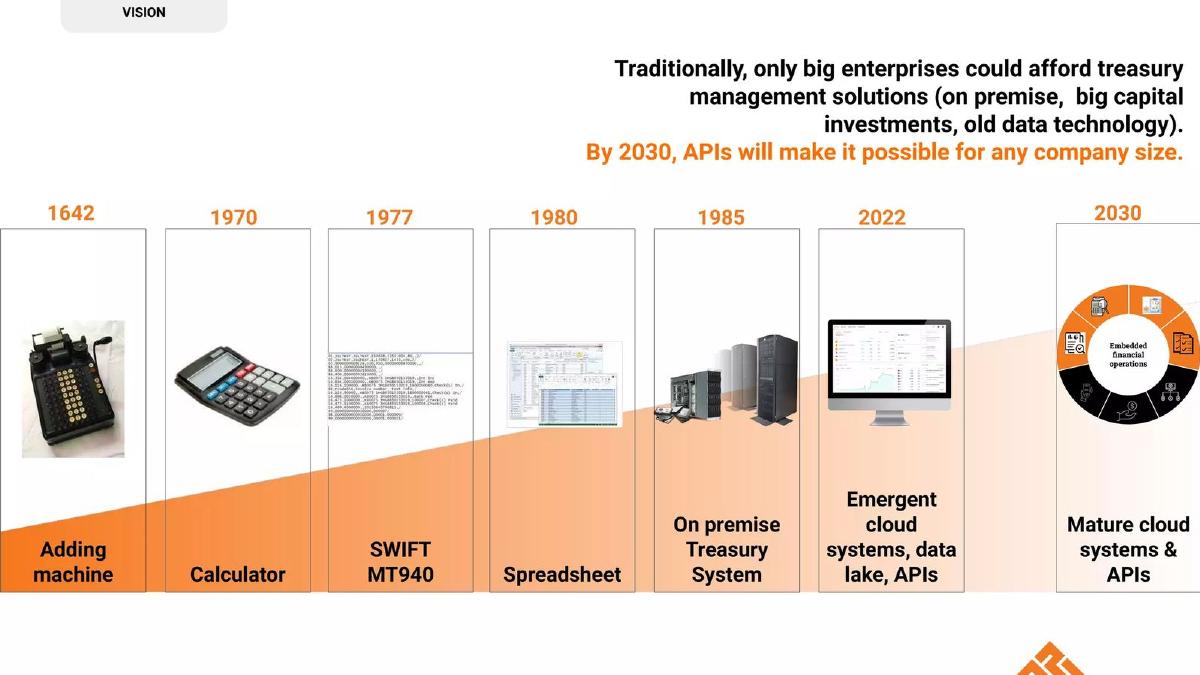
Treasury management software. The slide's timeline includes 2022 as the present step; deck year not otherwise recorded.
DFS22 deck, slide 3. Exact stored slide matched to this analysis.
Our analysis: It states a before and after, a date and a cause (APIs), and the timeline makes the shift feel like the next step in a long sequence. The vision also implies the customer: companies too small for today's systems.
Evidence and limitation: The timeline's early dates are decorative; they do not show why 2030 is the year. Small type on the timeline would be hard to read on a phone.
What a founder can adapt: Write your vision as "today only X can do Y; by [year], [change] will let [wider group] do it".
Supporting analysis
What the deck claims: Labelled "Vision". Text: "Traditionally, only big enterprises could afford treasury management solutions (on premise, big capital investments, old data technology). By 2030, APIs will make it possible for any company size." Below, a timeline of treasury tools with pictures: adding machine (1642), calculator (1970), SWIFT MT940 (1977), spreadsheet (1980), on-premise treasury system (1985), emergent cloud systems, data lake and APIs (2022), and mature cloud systems and APIs (2030).
Presentation choice: It states a before and after, a date and a cause (APIs), and the timeline makes the shift feel like the next step in a long sequence. The vision also implies the customer: companies too small for today's systems.
When it does not fit: The timeline's early dates are decorative; they do not show why 2030 is the year. Small type on the timeline would be hard to read on a phone.
Blockchain-based financial services for businesses. Stage and year not recorded.
Fipto deck, slide 3. Exact stored slide matched to this analysis.
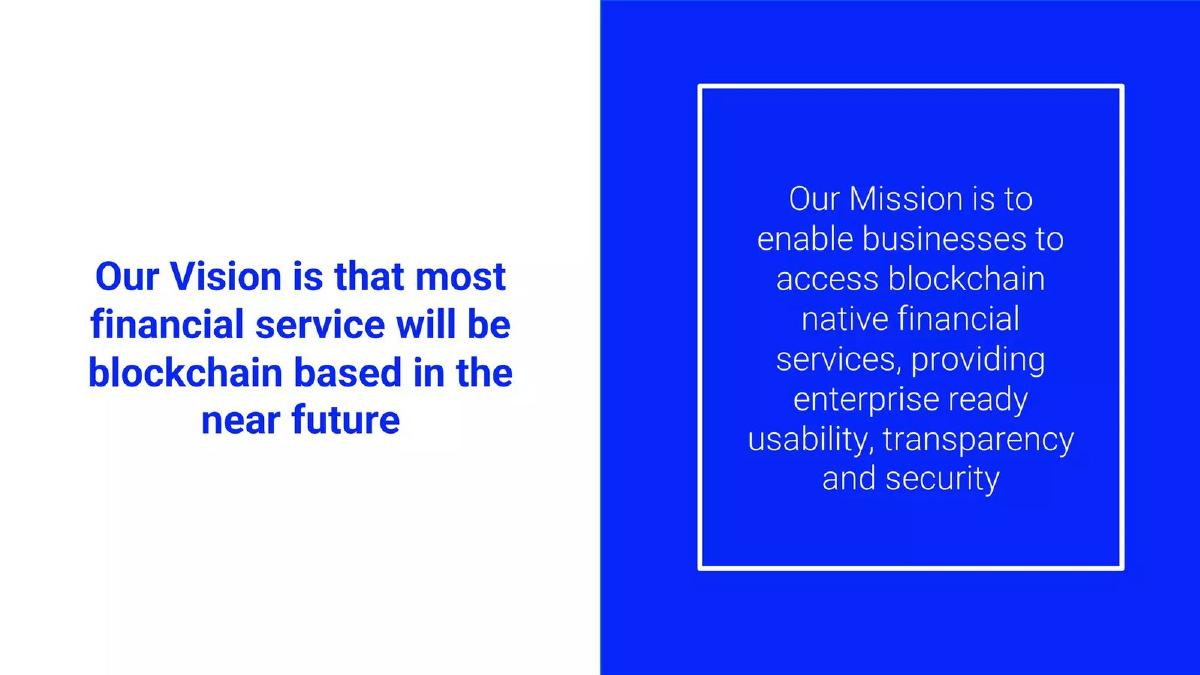
Our analysis: It cleanly separates a belief about the world (vision) from what the company will do about it (mission). An investor can disagree with the first and still understand the second.
Evidence and limitation: "Near future" is undated, and "most financial service" is a large claim with nothing on the slide to support it. "Enterprise ready usability, transparency and security" is generic.
What a founder can adapt: If you use both words, make the vision a claim about the future and the mission a statement of your role in it.
Supporting analysis
What the deck claims: Two halves. Left: "Our Vision is that most financial service will be blockchain based in the near future." Right, on a blue panel: "Our Mission is to enable businesses to access blockchain native financial services, providing enterprise ready usability, transparency and security."
Presentation choice: It cleanly separates a belief about the world (vision) from what the company will do about it (mission). An investor can disagree with the first and still understand the second.
When it does not fit: "Near future" is undated, and "most financial service" is a large claim with nothing on the slide to support it. "Enterprise ready usability, transparency and security" is generic.
Data privacy infrastructure. Stage and year not recorded; the slide is marked "Skyflow Confidential".
Skyflow deck, slide 5. Exact stored slide matched to this analysis.
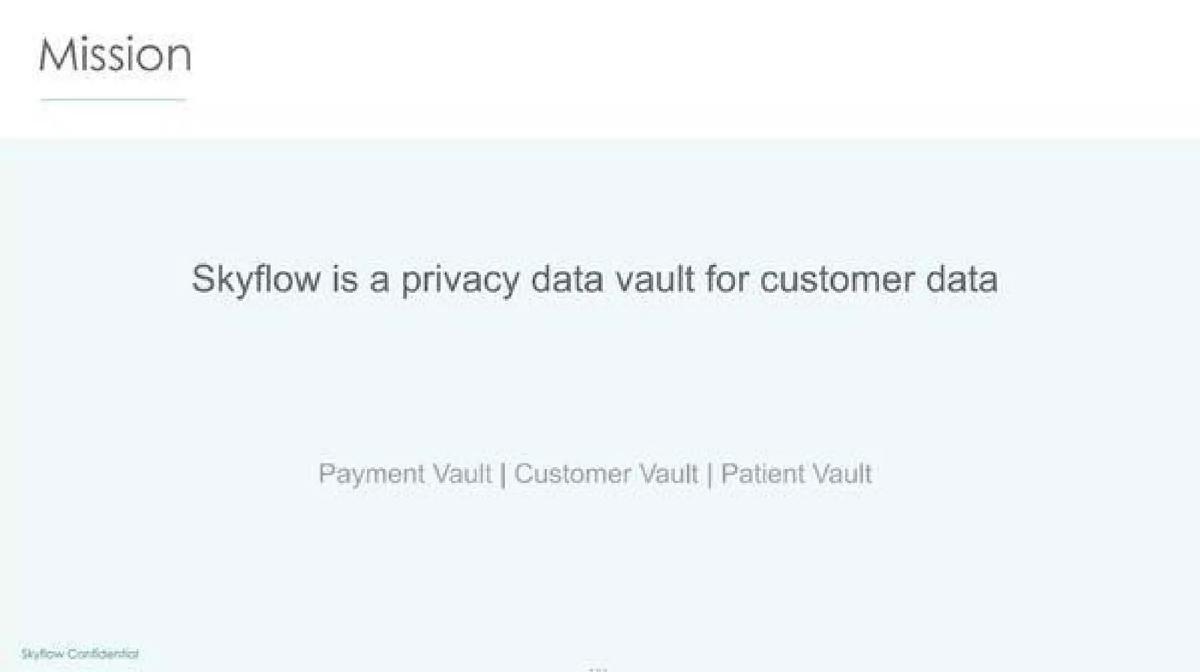
Our analysis: Titled mission, it is really a product definition. That is useful: an investor finishes the slide knowing exactly what the company sells and to which data types.
Evidence and limitation: It does not say what changes in the world or why it matters. On its own, it cannot do the job of showing how big the company could become.
What a founder can adapt: If your vision sentence cannot be tied to a product, lead with a one-line definition instead and let the ambition show through scope (here, three vault types).
Supporting analysis
What the deck claims: Labelled "Mission". One line: "Skyflow is a privacy data vault for customer data", with three products beneath: Payment Vault | Customer Vault | Patient Vault.
Presentation choice: Titled mission, it is really a product definition. That is useful: an investor finishes the slide knowing exactly what the company sells and to which data types.
When it does not fit: It does not say what changes in the world or why it matters. On its own, it cannot do the job of showing how big the company could become.
Data and analytics for fixed-income (lending) markets. The slide footer reads "Confidential, September 2018".
dv01 deck, slide 2. Exact stored slide matched to this analysis.
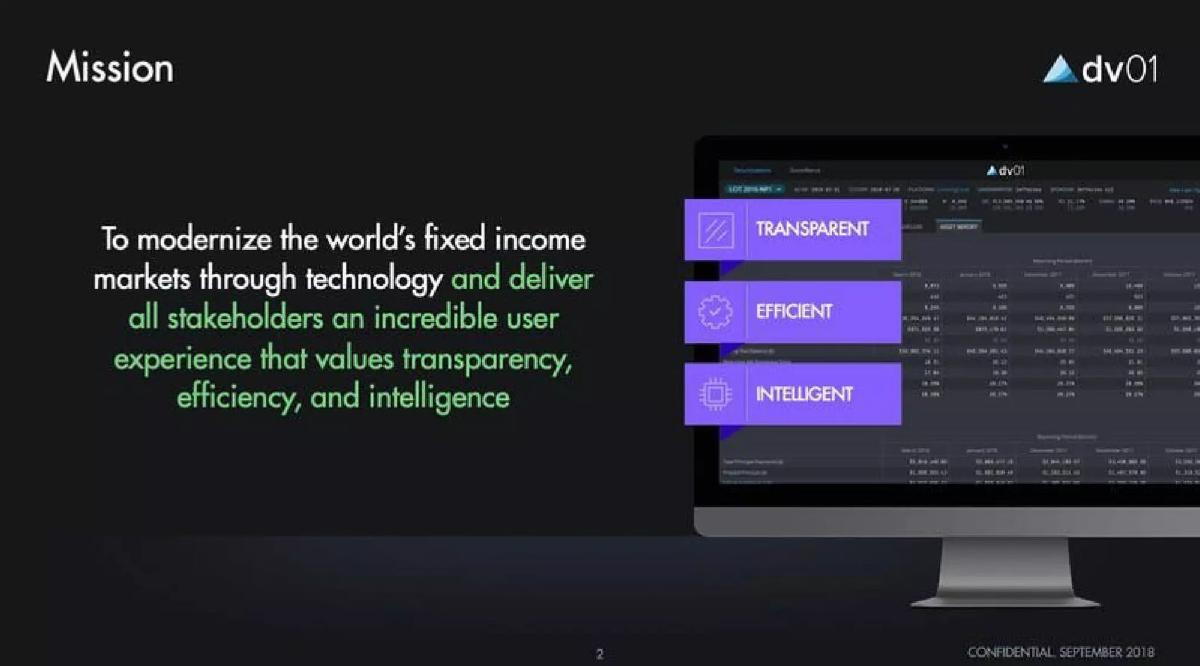
Our analysis: Placing the product screenshot next to the mission links the ambition to something that exists, and the three tags repeat the mission's values in shorthand.
Evidence and limitation: "Modernize the world's fixed income markets" is very broad, and the value words (transparency, efficiency, intelligence) are ones most financial software claims. The screenshot is too small to read.
What a founder can adapt: Pair a broad mission with a real product image so the investor sees the first step toward it.
Supporting analysis
What the deck claims: Labelled "Mission": "To modernize the world's fixed income markets through technology and deliver all stakeholders an incredible user experience that values transparency, efficiency, and intelligence." Beside it, a product screenshot on a monitor with three tags: Transparent, Efficient, Intelligent.
Presentation choice: Placing the product screenshot next to the mission links the ambition to something that exists, and the three tags repeat the mission's values in shorthand.
When it does not fit: "Modernize the world's fixed income markets" is very broad, and the value words (transparency, efficiency, intelligence) are ones most financial software claims. The screenshot is too small to read.
Application security tooling. Stage and year not recorded.
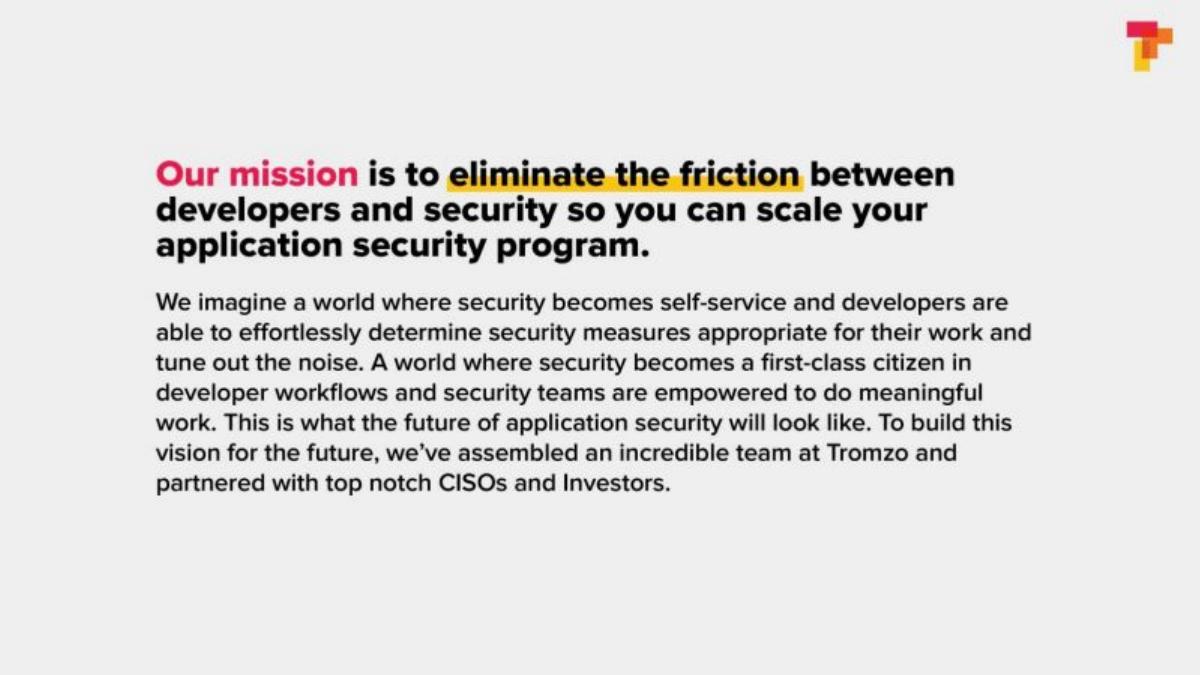
Tromzo deck, slide 3. Exact stored slide matched to this analysis.
Our analysis: The mission names two specific groups (developers and security teams) and the friction between them, which is concrete enough to connect to a product. The paragraph paints the end state.
Evidence and limitation: The paragraph is long for a slide and would likely be skipped in a sent deck. The closing sentence about the team belongs on the team slide.
What a founder can adapt: Name the two parties whose relationship changes, and describe what each can do once your product exists.
Supporting analysis
What the deck claims: A headline mission: "Our mission is to eliminate the friction between developers and security so you can scale your application security program." Below, a paragraph describing a world where security is self-service, developers can determine security measures for their work, and security teams do meaningful work, ending with the team and partners assembled to build it.
Presentation choice: The mission names two specific groups (developers and security teams) and the friction between them, which is concrete enough to connect to a product. The paragraph paints the end state.
When it does not fit: The paragraph is long for a slide and would likely be skipped in a sent deck. The closing sentence about the team belongs on the team slide.
A moderation toolkit for resolving founder conflict. Stage and year not recorded.
Spatz deck, slide 2. Exact stored slide matched to this analysis.
Our analysis: The vision is tied immediately to a reason: a named source and a statistic that frames the problem. That makes the ambition feel grounded rather than decorative.
Evidence and limitation: The quotation and its wording are the company's attribution; we have not checked them against the book. Investors who know the source may check it, so quote precisely. The slide also mixes vision and problem, which can blur both.
What a founder can adapt: Follow the vision sentence with one sourced fact that shows why the change matters.
Supporting analysis
What the deck claims: "Our Vision: To radically increase the decision-making skills of startup teams, and reduce the appalling failure rate." Below, a large quote: "65% of startup teams fail due to founder & team conflict", attributed to Harvard Professor Noam Wasserman, The Founder's Dilemmas.
Presentation choice: The vision is tied immediately to a reason: a named source and a statistic that frames the problem. That makes the ambition feel grounded rather than decorative.
When it does not fit: The quotation and its wording are the company's attribution; we have not checked them against the book. Investors who know the source may check it, so quote precisely. The slide also mixes vision and problem, which can blur both.
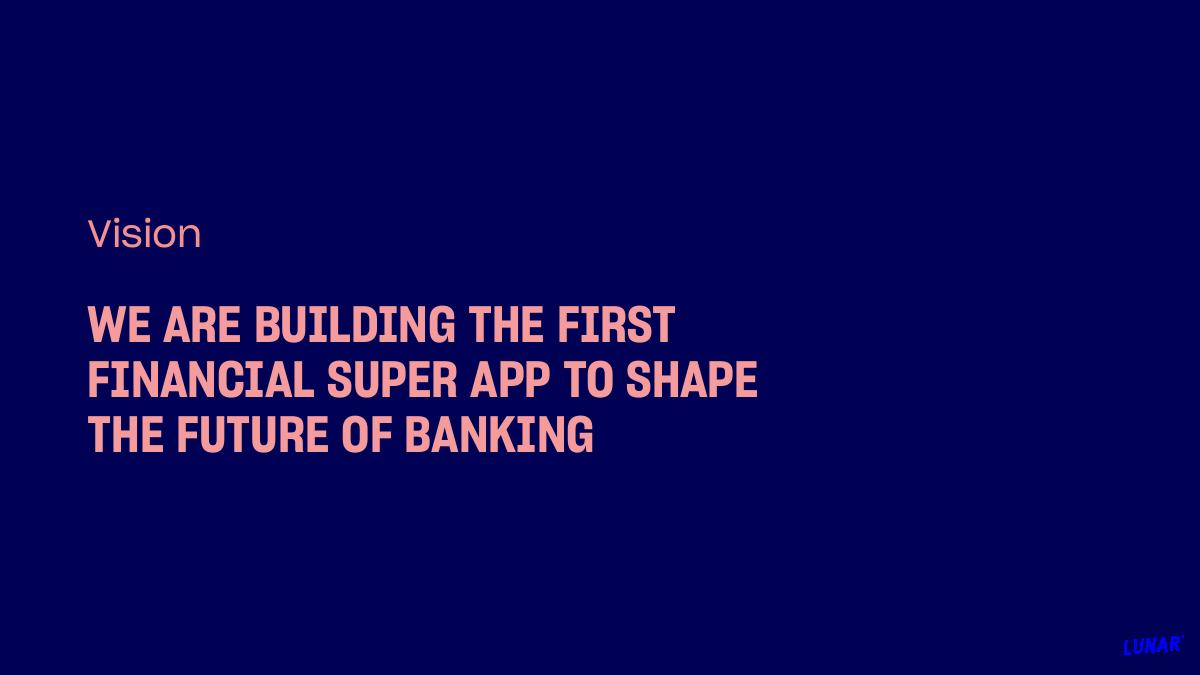
Lunar deck, slide 2. Exact stored slide matched to this analysis.
Our analysis: Included as a contrast. A single bold line is memorable and sets an ambitious frame early in the deck.
Evidence and limitation: "First" is a claim with no support on the slide, and "super app" and "future of banking" do not say who benefits or when. In a sent deck, this slide carries little information.
What a founder can adapt: A slogan slide can work in a live pitch where the founder explains it, as long as later slides say who the customers are and what the "super app" does.
Supporting analysis
What the deck claims: Labelled "Vision", in large capitals: "We are building the first financial super app to shape the future of banking." Nothing else on the slide.
Presentation choice: Included as a contrast. A single bold line is memorable and sets an ambitious frame early in the deck.
When it does not fit: "First" is a claim with no support on the slide, and "super app" and "future of banking" do not say who benefits or when. In a sent deck, this slide carries little information.
Choose based on how much the rest of the deck already explains. The more abstract your product, the more concrete the vision needs to be.
Approach
Best when
What it needs
Main risk
Examples
Dated thesis
A clear change will open the market over time
A before, an after, a year and a cause
Year chosen without reasoning
DFS22
Vision plus mission
The belief and the company's role differ
Two lines doing distinct jobs
Both lines generic
Fipto; Tromzo
Product definition as mission
The product is new or hard to categorise
One exact sentence and scope
No sense of scale
Skyflow; dv01
Vision with evidence
The ambition needs a reason to believe
One sourced fact
Unverified or loose quotes
Spatz
Slogan
Live pitch with detail elsewhere
Later slides that explain it
Empty in a sent deck
Lunar (weaker)
Key Takeaways
Put a date and a mechanism on the vision. DFS22 says "by 2030, APIs will make it possible for any company size" and shows the history that leads there; an investor can test that claim.
Separate vision from mission when you use both. Fipto states a belief about the future (most financial services will be blockchain based) and then what the company does about it; the two lines do different jobs.
A concrete definition can beat an aspiration. Skyflow's "mission" slide is really a one-line product definition plus three product names, which tells an investor more than a slogan would.
Slogans need support elsewhere. Lunar's "first financial super app" is memorable but says nothing about who, how or when; it only works if later slides carry that detail.
Supporting evidence must be checkable. Spatz pairs its vision with a quoted statistic attributed to Noam Wasserman; a quote is persuasive only if the investor can find the source.
Write your vision in three lines
Draft these before choosing wording. If line two could apply to a competitor, make it more specific.
Today. Who can or cannot do what today, and why?
The change. What will be true by a rough date if you succeed, and for whom?
Your role. What does your product do to make that happen, in one sentence?
Copyable framework: Today, only [group] can [do X] because [barrier]. By [year], [wider group] will [do X] because [change]. We build [product] to make that happen.
Illustrative example 1 — written by us
Before: We are revolutionising the future of work.
After: Today, only large firms can afford [capability] because [barrier]. By [year], every [smaller group] will have it through [product type]. We are building [product] for [first customer].
What improved: Our illustrative rewrite, not any company's text. It swaps a slogan for a before, an after and the company's role; bracketed values are placeholders.
What the vision slide is for
Most decks use the vision or mission slide either near the start, to frame what follows, or near the end, to show how big the company could become. Either way, the question an investor is asking is the same: if this works, what does the world look like, and is it large enough to matter?
The words vary. Some decks say vision, some mission, some use both. What matters is whether the sentence is specific to this company and connects to the product being pitched.
Common mistakes
Interchangeable wording. "Future of X" or "revolutionising Y" could appear in any deck. Name who benefits and what changes.
Unsupported firsts. "The first" or "the leading" needs evidence or should be dropped.
No link to the product. An investor should see how today's product is the first step toward the vision.
Paragraphs. A vision slide read in a sent deck gets a few seconds. Keep the core idea to one sentence.
Diagnostic checklist
Says what will be true if the company succeeds, and for whom.
Includes a rough time frame or the change that makes it possible.
Connects clearly to the product shown elsewhere in the deck.
If vision and mission both appear, each does a different job.
Any statistic or quote carries a checkable source.
Would not make sense if pasted into a competitor's deck.
Frequently asked questions
How we chose these examples
Corpus: published pitch deck teardowns on StartupFundraising.com. Founder-uploaded private decks are excluded.
Selection (2026-09-24): we searched extracted slide text for slides 2–6 beginning with "vision", "mission" or similar that also have a stored slide image, inspected eight candidates, and chose seven covering treasury software, blockchain finance, data privacy, lending analytics, security, founder tools and banking. Lunar is included partly as a contrast. Transcarent slide 2 was not selected.
Review: all seven stored slide images were inspected on 2026-09-24 and matched to company, deck and slide number (editorial model review). No person has yet completed an editorial review of this page.
Statements, figures and quotations are shown as printed on the slides; we have not verified them. Dates come only from the slides themselves.
We make no claim that any vision slide caused a fundraising outcome.