Finqware presents a compelling case for the democratization of treasury management systems (TMS), traditionally reserved for large enterprises with significant capital. By leveraging open banking and a proprietary data aggregation layer called OneAPI, the company targets the 'blue ocean' of mid-market companies. The deck highlights a total addressable market of 2.4 billion EUR within the mid and large enterprise segment, supported by a robust regulatory foundation including a National Bank of Romania license and ISO certifications. While the deck excels at establishing credibility through ins…
Key takeaways
- The company identifies a shift from expensive on-premise treasury systems to mature cloud systems and APIs by 2030 (Slide 2).
- Finqware positions itself as an 'Enterprise Class Open Banking Provider' specifically for mid-market companies (Slide 3).
- The proprietary 'OneAPI' data aggregation layer is cited as the company's primary 'secret sauce' (Slide 4).
- The Total Addressable Market (TAM) for mid and large enterprises is calculated at 2.4 billion EUR based on 67,192 companies (Slide 4).
- Estimated average Annual Recurring Revenue (ARR) is projected at 36,000 EUR for enterprises and 48,000 EUR for financial services (Slide 4).
- Finqware holds a formal license as a Payment Institution authorized by the National Bank of Romania and passported across the EEA (Slide 5).
- The company has secured institutional backing from GapMinder and Elevator Ventures (Raiffeisen Bank International) (Slide 5).
- Compliance is a core pillar, evidenced by ISO 27001 and ISO 22301 certifications (Slide 5).
Finqware Pitch Deck Teardown
Finqware’s presentation from the Digital Finance Summit 2022 (DFS22) is a concise, six-slide excerpt of an 11-slide deck. It focuses heavily on the transition of treasury management from a high-cost enterprise luxury to an accessible API-driven utility for the mid-market. The deck is structured to establish immediate regulatory and institutional credibility, which is vital in the fintech and open banking space.
Slide 1: Title Slide
The title slide establishes the company's core mission: "Open banking at work." It positions Finqware as a leader in the "Treasury Management Revolution." The branding is consistent, featuring the Finqware logo and the DFS22 event branding. The visual of a modern city skyline at night suggests a global, enterprise-focused scale. It is a standard, functional cover slide that clearly defines the industry vertical (Treasury Management) and the technology driver (Open Banking).
Slide 2: The Vision and Evolution of Treasury
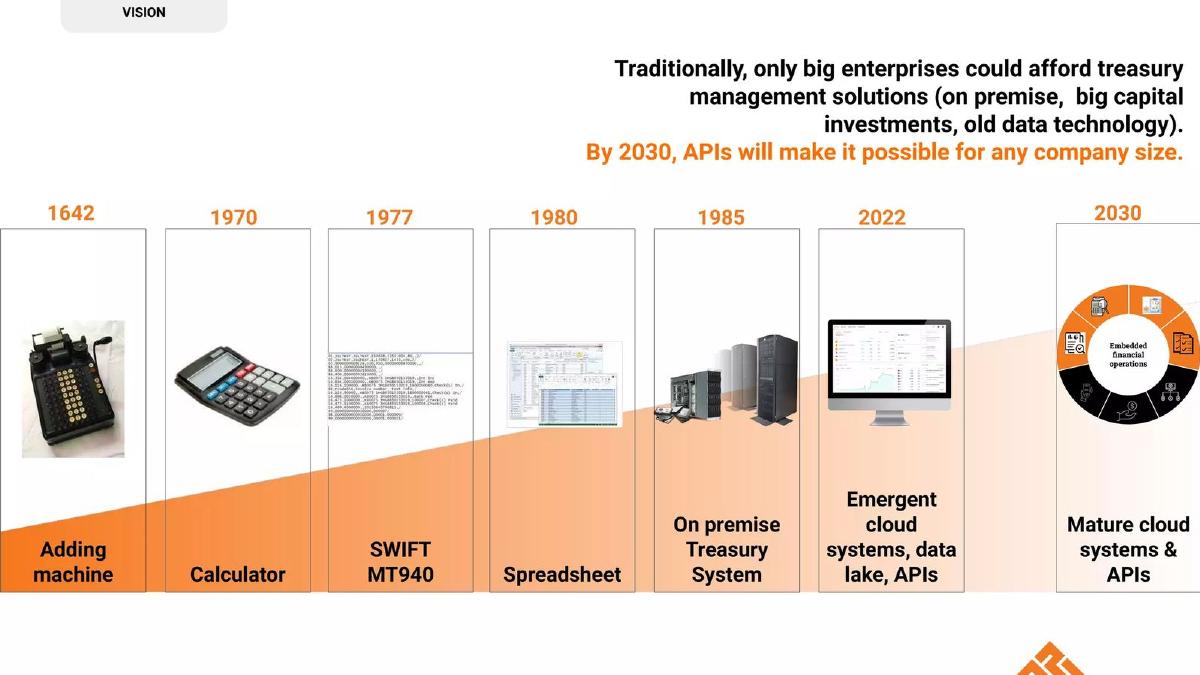
Slide 2 provides a historical timeline of financial technology, starting from the adding machine in 1642 to the calculator in 1970, SWIFT MT940 in 1977, and spreadsheets in 1980. It notes that traditionally, only large enterprises could afford treasury management solutions due to high capital investment and old data technology. The slide sets a future milestone: "By 2030, APIs will make it possible for any company size." This slide effectively frames the problem—cost and complexity—and the solution—cloud systems and APIs. It positions the current era (2022) as the time of "Emergent cloud systems, data lake, APIs," leading toward a mature ecosystem by 2030. This creates a sense of inevitability for the shift Finqware is facilitating.
Slide 3: New Category Setter - FinqTreasury
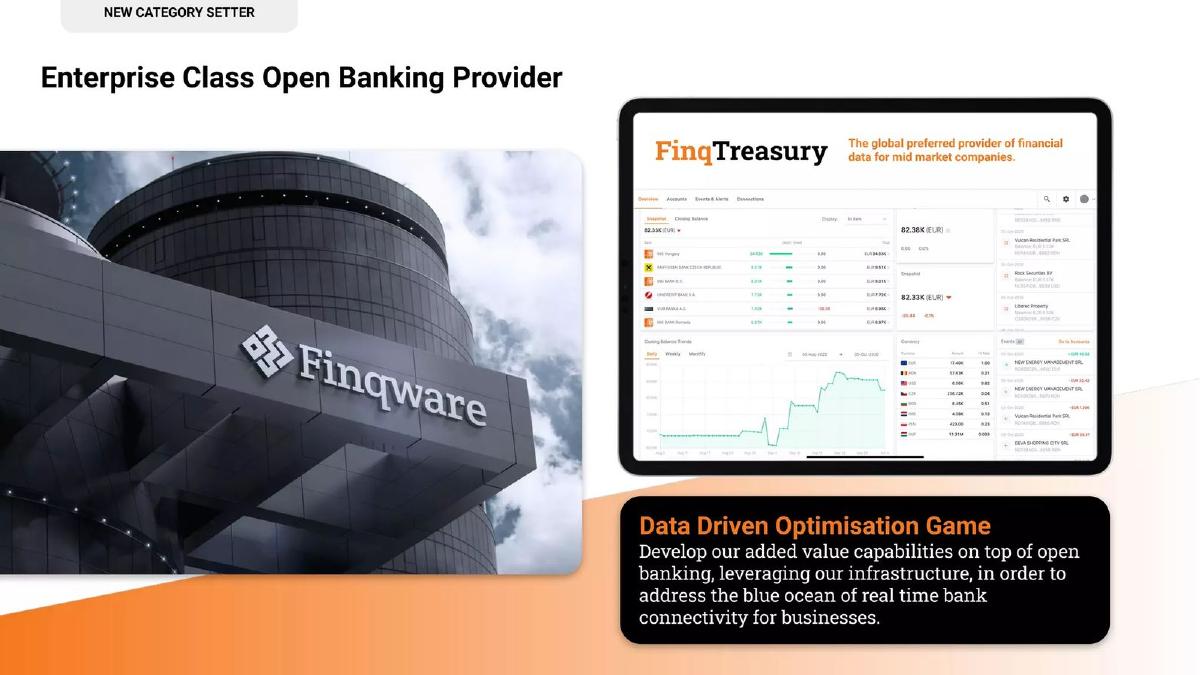
This slide introduces the flagship product, FinqTreasury. It is described as the "global preferred provider of financial data for mid market companies." The slide features a high-quality mockup of the platform on a tablet, showing a dashboard with bank balances (e.g., ING Hungary, Raiffeisen Bank Czech Republic) and closing balance trends. The text emphasizes a "Data Driven Optimisation Game," where Finqware builds added-value capabilities on top of open banking infrastructure. The goal is to address the "blue ocean" of real-time bank connectivity for businesses. This slide is crucial because it shows the product in action, proving that the "vision" from the previous slide is already a functional reality.
Slide 4: Competitive Positioning and TAM
Slide 4 is the most data-dense slide in the deck. It identifies direct competitors Trovata and Cobase . Finqware claims its "secret sauce" is a proprietary data aggregation layer called Finqware OneAPI . The market size data is broken down into two columns:
Mid & large enterprises: 67,192 companies, 2.4 Billion EUR TAM, 36,000 EUR estimated average ARR. · Financial services: 2,036 companies, 97 Million EUR TAM, 48,000 EUR estimated average ARR.
The slide includes a footnote stating that the core target consists of companies with more than 25 million EUR and up to 500 million EUR in yearly revenues. This specific segmentation helps investors understand exactly who the customer is and what the revenue potential per account looks like.
Slide 5: Regulatory Compliance and Backing
For a fintech company, trust is the primary currency. Slide 5 aggregates all of Finqware’s credentials. It states that Finqware SRL is a payment institution authorized and supervised by the National Bank of Romania and is passported across the EEA (European Economic Area). It lists existing investors GapMinder and Elevator Ventures (Raiffeisen Bank International). Additional trust signals include:
Member of The LHoFT (Luxembourg House of Financial Technology). · Seal of Excellence from the European Commission (Horizon 2020). · ISO 27001 (Information Security) and ISO 22301 (Business Continuity) certifications. · Supported by Microsoft for Startups .
This slide is exceptionally strong. It removes the "regulatory risk" objection that often plagues early-stage fintech pitches.
Slide 6: Conclusion and Demo
The final slide is a standard "Thank you" page but includes a call to action: a 12-minute video product demo. It provides a general contact email (info@finqware.com) and social media links. While it serves its purpose for a pitch battle, it lacks a specific call to action for investors (e.g., "We are raising $X million") or a summary of the team's expertise.
What Works Well in This Deck
Regulatory Clarity: Finqware does an excellent job of proving they are a legitimate, licensed entity. In the complex world of EU financial regulations, stating their National Bank of Romania authorization and EEA passporting upfront is a major win. Market Segmentation: Instead of claiming a trillion-dollar market, they use Eurostat statistics to define a realistic, reachable TAM of 2.4 billion EUR based on a specific revenue bracket (25M-500M EUR). Visual Product Proof: The dashboard mockup on Slide 3 is clean and professional, showing specific bank integrations that prove the product's cross-border utility.
What Is Missing
The Team Slide: In the provided 6 slides, there is no mention of the founders' backgrounds or the technical team's expertise. In early-stage fundraising, the "who" is often as important as the "what." Growth Metrics: While the deck lists the estimated ARR, it does not list current ARR, number of active customers, or month-over-month growth rates. The Ask: There is no slide detailing how much capital the company is looking to raise, what the valuation expectations are, or how the funds will be allocated (e.g., 50% engineering, 30% sales, etc.). Unit Economics: There is no mention of Customer Acquisition Cost (CAC) or Lifetime Value (LTV), which are critical for evaluating the scalability of a SaaS model.
What a Founder Should Copy
The Evolution Slide: Slide 2 is a masterclass in framing. By showing a timeline of 400 years, the founder makes the transition to APIs feel like an inevitable historical progression rather than just a new software trend. Secret Sauce Definition: Clearly naming their proprietary tech ("OneAPI") and positioning it against competitors who might use third-party aggregators is a strong way to claim a moat. Trust Stacking: Grouping ISO certifications, government seals of excellence, and reputable VC logos on a single slide (Slide 5) creates a powerful "wall of credibility" that can silence skeptics quickly.
Frequently asked questions
- What is Finqware's core product offering?
- Finqware offers FinqTreasury, a SaaS platform described as an enterprise-class open banking provider. It leverages a proprietary data aggregation layer (OneAPI) to provide real-time bank connectivity and financial data optimization for mid-market companies that previously could not afford traditional treasury management solutions.
- Who are Finqware's primary competitors according to the deck?
- The deck explicitly identifies Trovata and Cobase as direct competition. Finqware differentiates itself by relying on its own proprietary aggregator rather than third-party services, which they claim allows them to better address the 'blue ocean' of real-time bank connectivity for businesses.
- What is the regulatory status of the company?
- Finqware SRL is a licensed payment institution authorized and supervised by the National Bank of Romania. Crucially for European expansion, this license is passported across the entire European Economic Area (EEA), allowing them to operate legally in multiple countries.
- How does Finqware define its target market size?
- Finqware targets two segments: Mid & large enterprises (67,192 companies with a TAM of 2.4 billion EUR) and Financial services (2,036 companies with a TAM of 97 million EUR). These figures are based on Eurostat statistics, focusing on companies with revenues between 25 million and 500 million EUR.
- What institutional support does Finqware have?
- The company lists GapMinder and Elevator Ventures (the corporate venture capital arm of Raiffeisen Bank International) as existing investors. They also hold a 'Seal of Excellence' from the European Commission and are supported by the Microsoft for Startups program.