The Thinaire deck, labeled 'Diageo 062015', is less a traditional pitch and more a technical architecture overview for a proximity marketing and commerce platform. It focuses heavily on the 'how'—detailing APIs, SDKs, and complex data exchange ecosystems—while neglecting the 'who' and 'how much.' The presentation identifies a significant market opportunity in mCommerce, citing eMarketer projections of $149.79 billion by 2019 (Slide 8), and provides a concrete case study involving the Verizon NFL Mobile App (Slide 5). However, the absence of a team slide, financial projections, or a specific i…
Key takeaways
- The platform positions itself as a bridge between back-office systems and edge networks using APIs, PaaS, and SDKs (Slide 1).
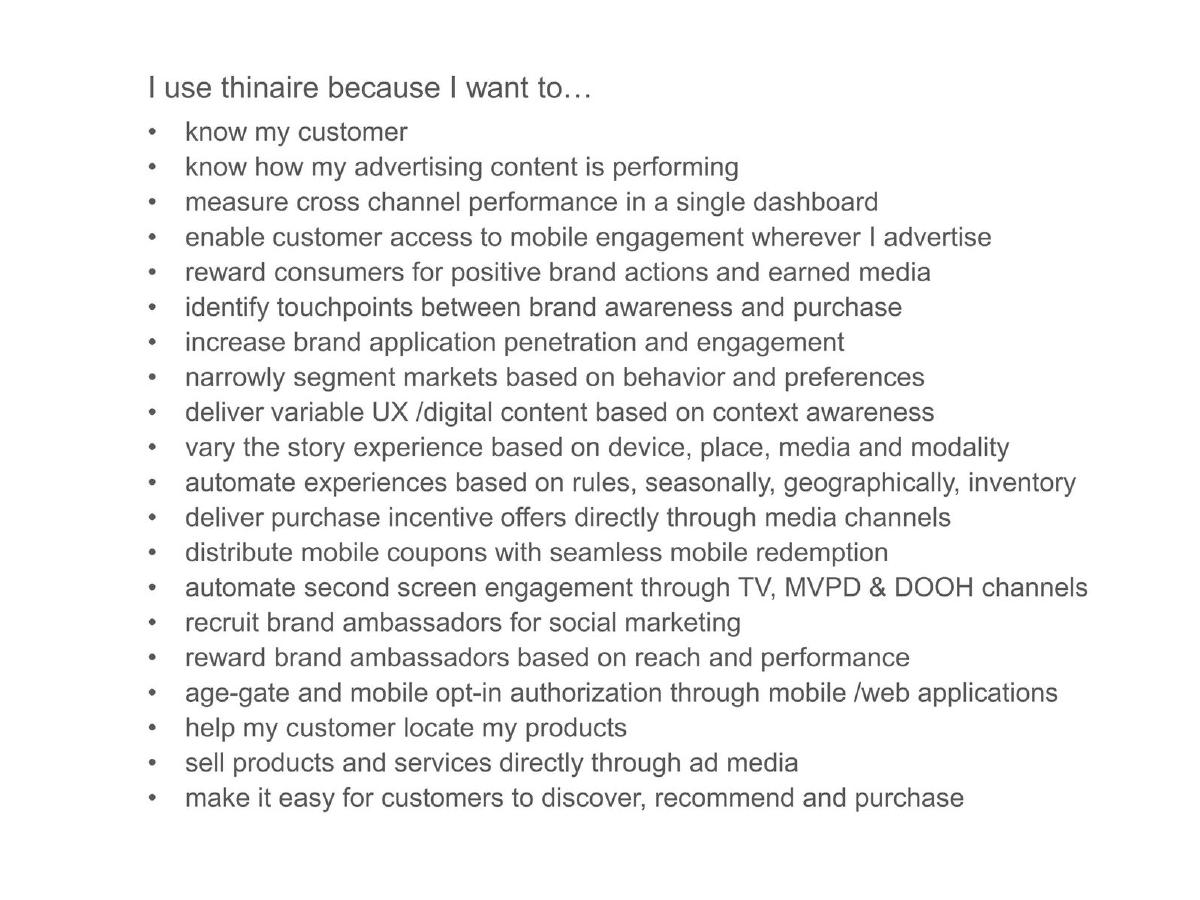
- A comprehensive list of 20 user motivations highlights a broad focus ranging from 'knowing the customer' to 'age-gating' (Slide 2).
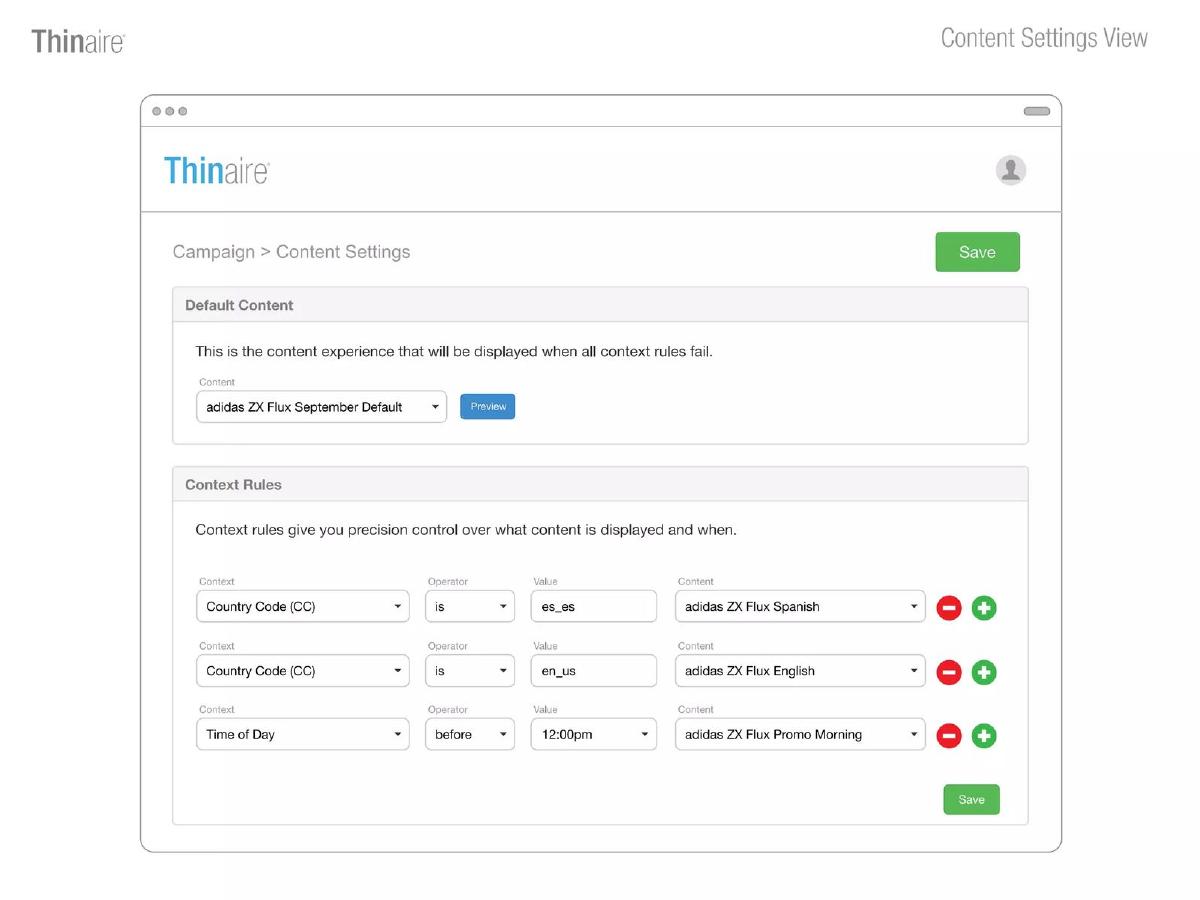
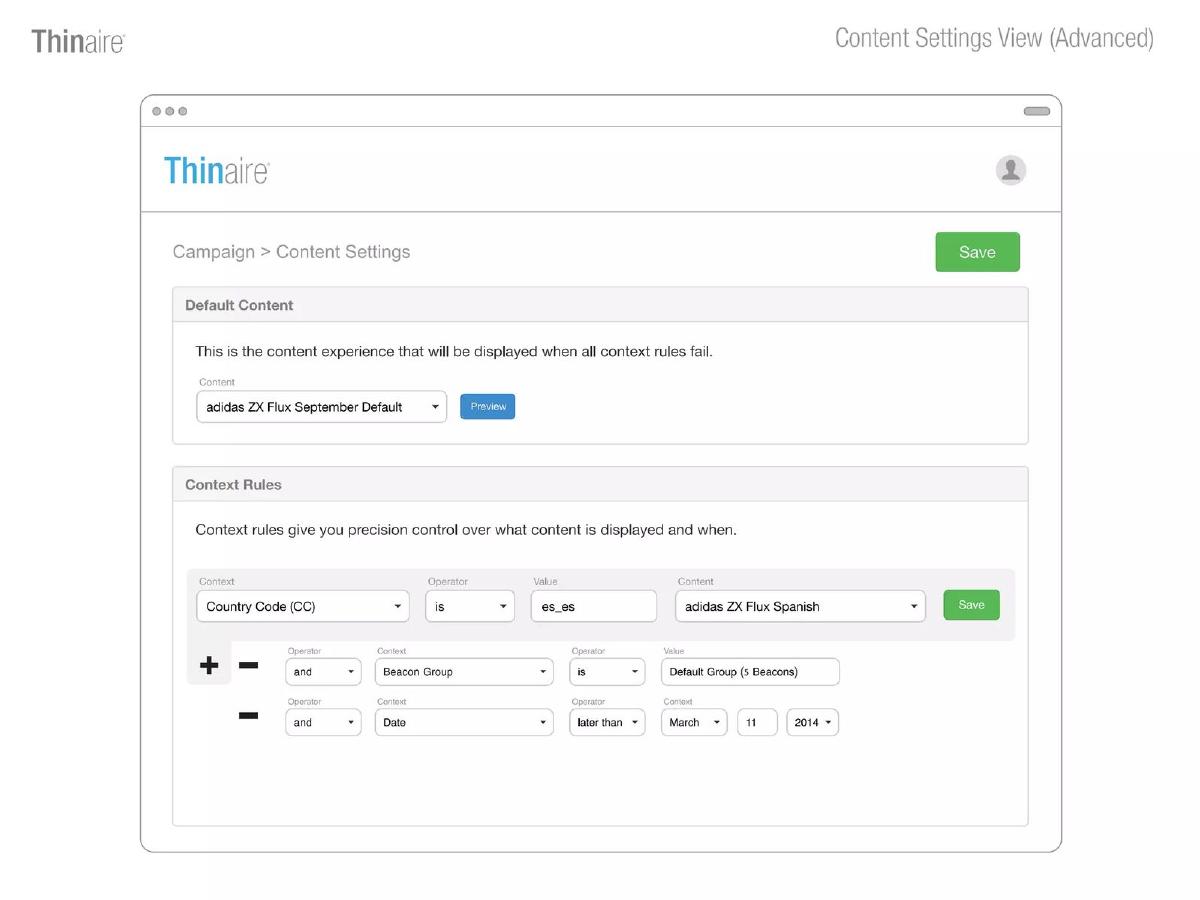
- The 'Content Settings View' mockup demonstrates a rules-based engine for triggering content by country, beacon group, and date (Slide 3).
- A detailed case study for the Verizon NFL Mobile App dated 09.26.14 illustrates the end-to-end flow from game viewing to in-store beacon recognition (Slide 5).
- Market data highlights that two-thirds of TV viewers engage in 'second screen' behavior, spending 316 minutes per day on digital media (Slide 6).
- The deck projects massive growth in US Retail mCommerce, rising from $47.71 billion in 2013 to $149.79 billion in 2019 (Slide 8).
- Social media shopping data identifies 'Consumer electronics and computers' as the top category at 55% (Slide 9).
- The deck completely omits a team slide, business model details, competitive analysis, and a financial ask.
Executive Summary: A Technical Blueprint for Proximity Commerce
The Thinaire deck, dated June 2015, represents a highly specialized look into the world of proximity marketing and mobile commerce automation. Rather than following the standard problem-solution-market-team narrative, this deck functions as a technical manifesto. It maps out a complex ecosystem where mobile devices, beacons, and retail back-offices converge. While the technical depth is impressive, the lack of business fundamentals suggests this was likely used for a specific corporate partnership discussion—potentially with Diageo, given the source listing—rather than a general venture capital roadshow.
Slide 1: The Product Architecture
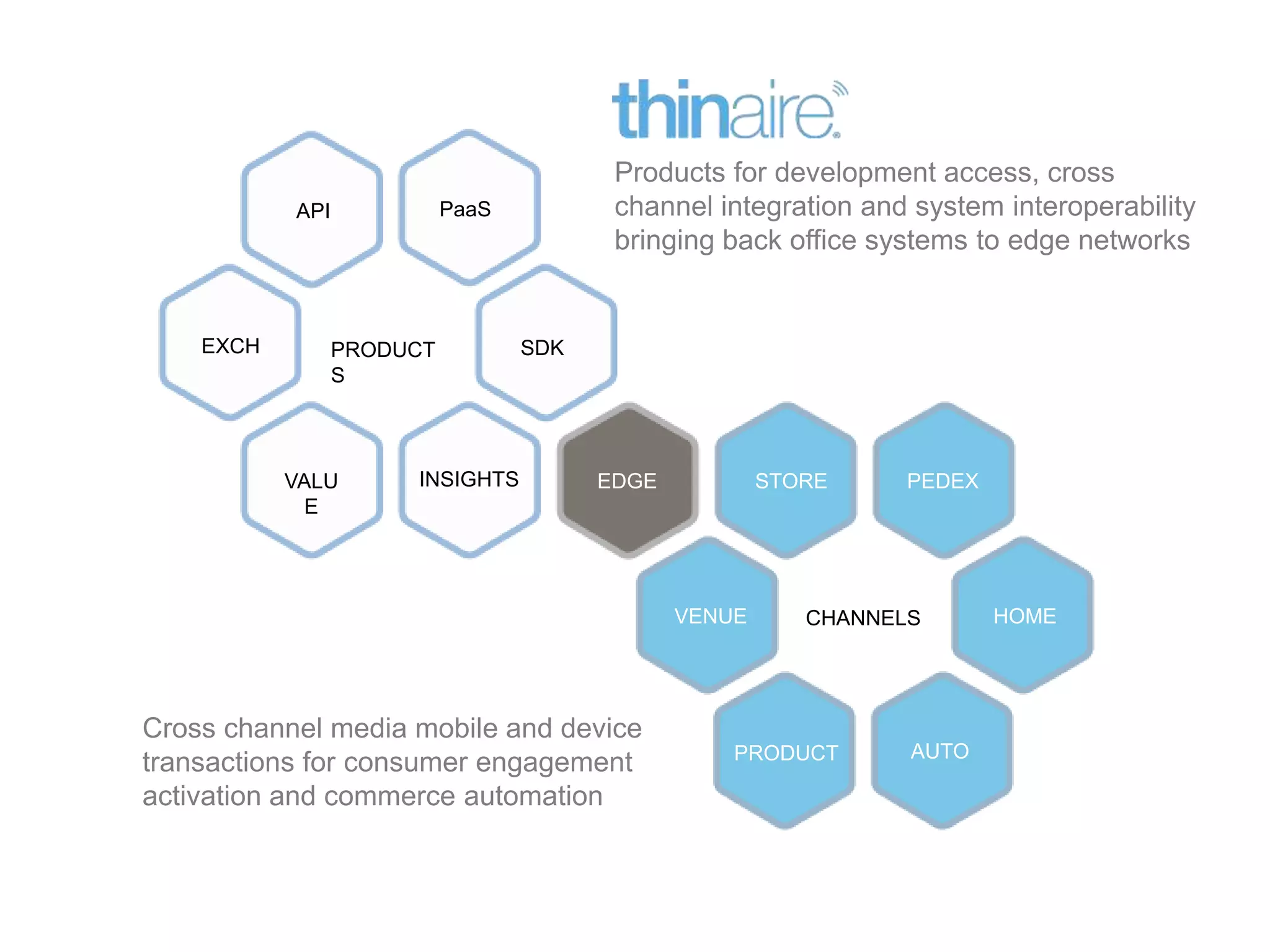
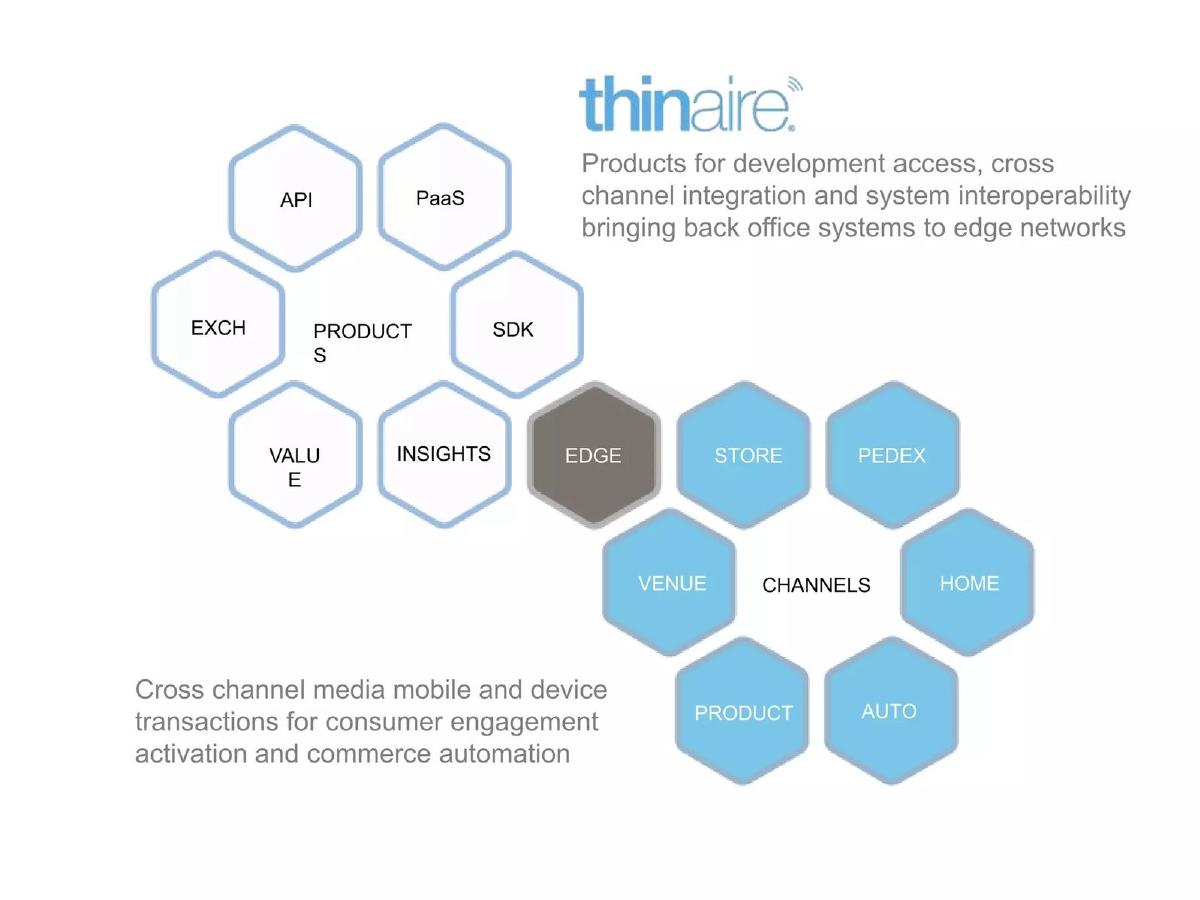
The opening slide introduces Thinaire not just as a service, but as a technical bridge. It uses a hexagonal diagram to categorize its offerings into two groups: Products (API, PaaS, SDK, Insights, Value, Exch) and Channels (Edge, Store, Pedex, Home, Auto, Product, Venue). The stated mission is 'bringing back office systems to edge networks.' This is a sophisticated way of saying they help large corporations connect their internal data to the physical locations where customers actually shop.
Slide 2: The 'Why' - User Motivations
Slide 2 lists 20 distinct reasons to use Thinaire. This is an unusually long list for a pitch deck, which usually focuses on three to five core value propositions. The points range from high-level goals like 'know my customer' to very specific technical features like 'age-gate and mobile opt-in authorization.' By including so many points, Thinaire attempts to position itself as a horizontal platform capable of solving almost any mobile engagement problem, though it risks diluting its primary message.
Slide 3: Interface and Logic Engine
This slide provides a mockup of the Content Settings View (Advanced) . It is a crucial slide because it proves the product exists beyond just a conceptual diagram. The interface shows a rules-based engine where content (e.g., 'adidas ZX Flux Spanish') is triggered by specific operators like Country Code, Beacon Group, and Date (specifically citing March 11, 2014). This demonstrates that the platform is built for granular, context-aware marketing campaigns.
Slide 4: The Second Screen Ecosystem
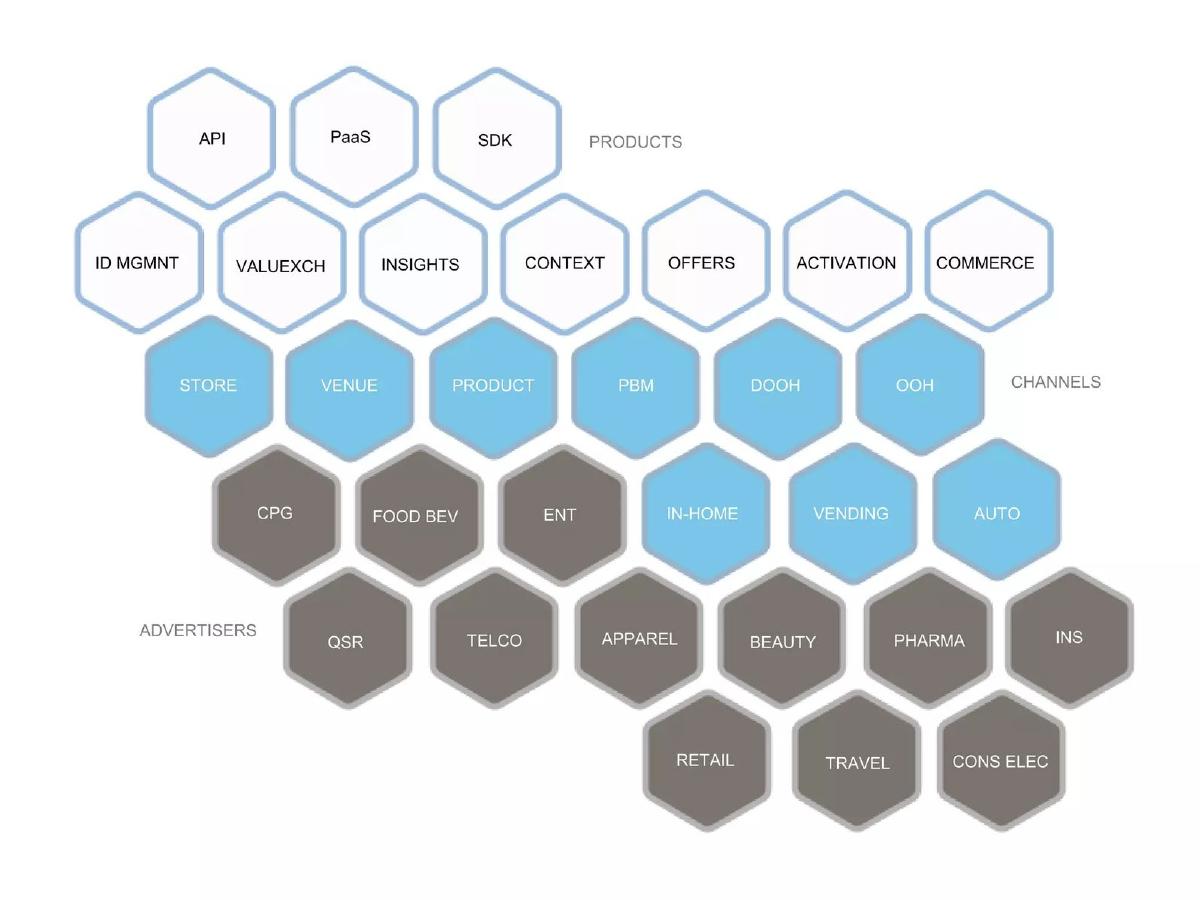
Slide 4 expands the hexagonal map to include the broader media landscape. It identifies players like MNOs (Mobile Network Operators), OEMs, Studios, and Smart TV providers. The phrase 'Digital video and the second screen experience' suggests that Thinaire views the mobile phone not just as a shopping tool, but as a companion to television and digital video consumption.
Slide 5: Case Study - Verizon NFL Mobile App
This is arguably the most important slide in the deck. It documents a 'Story Case' from September 26, 2014. It follows a user journey: watching a game on the NFL Mobile App, seeing a Fritos/Pepsi ad, opting into offers, and then receiving an 'In-Store Auto Alert' via beacon recognition at retailers like Kroger or Supervalu. This slide moves the deck from theoretical architecture to proven application, showing exactly how the 'Edge' and 'Store' channels interact in the real world.
Slide 6: The Shift to Digital Dominance
To justify the need for their platform, Thinaire cites 2014 data from Advertising Age. The slide notes that users spend 316 minutes per day on digital media compared to 271 minutes on TV. Perhaps most importantly for Thinaire's 'second screen' strategy, it states that 'Two-thirds of TV viewers talk text or surf' while watching. This behavior creates the window of opportunity for Thinaire to trigger mobile engagements during TV broadcasts.
Slide 7: The Commerce Data Organization
Slide 7 is the most visually complex in the deck, titled 'Commerce Data Organization | Factoring Ecosystem.' It attempts to map every data point involved in a transaction, from 'Geospatial' and 'Modality' to 'Affinity Tokens' and 'PCI EMV' (payment standards). While it demonstrates that the founders have a deep understanding of the complexity of commerce data, it is likely too dense for a standard pitch, serving more as a 'trust us, we've thought of everything' slide.
Slide 8: The $150 Billion Opportunity
Using eMarketer data from June 2015, Thinaire projects the growth of US Retail mCommerce. The chart shows a steady climb from $47.71 billion in 2013 to a projected $149.79 billion in 2019 . By placing a 'location pin' icon on the 2015 data point ($74.93 billion), the deck signals that the company is entering the market at the start of a massive upward inflection point.
Slide 9: Social Media Shopping Categories
The final data slide breaks down where social media shopping is actually happening. According to a 2013 PwC survey, 'Consumer electronics and computers' (55%) and 'Clothing and footwear' (54%) are the leading categories. This data helps Thinaire's potential partners (like Diageo or Adidas, mentioned in Slide 3) understand which product verticals are most ripe for their mobile engagement technology.
Slide 10: Closing Visual
The deck ends with a minimalist visual of clouds and a blue sky, featuring the Thinaire logo. There is no contact information, no 'thank you,' and no call to action. This reinforces the impression that this deck was part of a larger presentation or a supplemental document rather than a standalone pitch.
What Works Well in This Deck
Technical Credibility: The deck leaves no doubt that the team understands the plumbing of the internet of things (IoT) and mobile advertising. The logic engine shown on Slide 3 is a concrete example of functional software. · Market Timing: The use of eMarketer and Advertising Age data effectively paints a picture of a world moving rapidly toward mobile-first commerce. · Real-World Application: The NFL case study on Slide 5 is excellent. It translates abstract concepts like 'edge networks' into a story that a brand manager or investor can easily visualize.
What Is Missing
The Team: There is no mention of who is building this. In early-stage fundraising, the 'who' is often as important as the 'what.' The absence of founder bios is a major red flag for a standard pitch. · Business Model: How does Thinaire make money? Do they charge a SaaS fee, a per-transaction fee, or a fee per beacon? The deck is silent on unit economics. · Competition: The proximity marketing space was crowded in 2015 (e.g., Estimote, Gimbal). Thinaire does not explain why their 'PaaS' approach is superior to competitors. · The Ask: A pitch deck without an 'Ask' slide isn't a pitch; it's a brochure. We don't know if they are looking for $1 million or $10 million.
Founder Lessons
Avoid the 'Everything' Slide: Slide 7 is a cautionary tale. While you want to appear thorough, a slide that requires five minutes of explanation just to read the labels will lose your audience. Break complex ecosystems into three smaller, digestible slides.
Contextualize Your Data: Thinaire does a good job of this on Slide 8. By putting a pin on the current year's projection, they show exactly where they sit on the growth curve. Always show where your company fits into the macro trends you are citing.
Show, Don't Just Tell: The rules-based engine on Slide 3 is much more effective than the list of 20 bullet points on Slide 2. Whenever possible, replace a list of features with a screenshot of those features in action.
Include a Clear Path to Revenue: Even if your technology is a 'platform' or 'infrastructure,' you must explain the flow of dollars. Investors need to see that your technical brilliance translates into a scalable business model.
Frequently asked questions
- What is the primary product Thinaire is offering?
- Based on Slide 1, Thinaire offers a suite of products including APIs, PaaS, and SDKs designed for 'cross channel integration and system interoperability.' The goal is to connect back-office systems to edge networks, enabling mobile engagement, consumer activation, and commerce automation across various channels like stores, venues, and homes.
- Does the deck provide evidence of product-market fit?
- The deck includes a specific 'Story Case' on Slide 5 featuring the Verizon NFL Mobile App from September 2014. This case study shows a functional loop where a user watches a game, receives a sponsored ad (Fritos/Pepsi), opts into offers, and eventually redeems a loyalty card in-store via beacon recognition. This serves as a proof of concept for their technical stack.
- What market trends is Thinaire capitalizing on?
- Thinaire targets the 'second screen' engagement trend and the rapid growth of mobile commerce. Slide 6 notes that users spend 271 minutes on TV versus 316 minutes on digital daily. Slide 8 supports this with eMarketer data showing a projected 214% increase in US Retail mCommerce sales between 2013 and 2019.
- How does the platform handle content delivery?
- Slide 3 shows an 'Advanced Content Settings View' where administrators can set 'Context Rules.' These rules use logic (e.g., 'Country Code is es_es' AND 'Beacon Group is Default Group') to determine exactly what content is displayed to a user and when, allowing for highly localized and time-sensitive marketing.
- What are the most significant omissions in this deck?
- This deck is missing almost all standard 'investor' slides. There is no mention of the founding team or their expertise, no business model explaining how Thinaire makes money, no competitive landscape, and no slide detailing the amount of capital being raised or how it will be used.