Digital Donations Technologies pitches the 'GIV Ecosystem,' a suite of six distinct products ranging from ATM fundraising (PosGIV) to a dedicated cryptocurrency (CoinGIV). The deck highlights a significant market opportunity, noting that NPOs raised over US$457 Billion in 2016, with 74% coming from individual donors (Slide 3). The company positions itself as a 'turnkey fundraising solution with no upfront costs' (Slide 7), leveraging strategic alliances with ATM manufacturers and payment processors. While the deck showcases impressive nonprofit partners like the American Heart Association and…
Key takeaways
- The company identifies a market of 1.5 million U.S. nonprofits struggling with high fundraising costs (Slide 2).
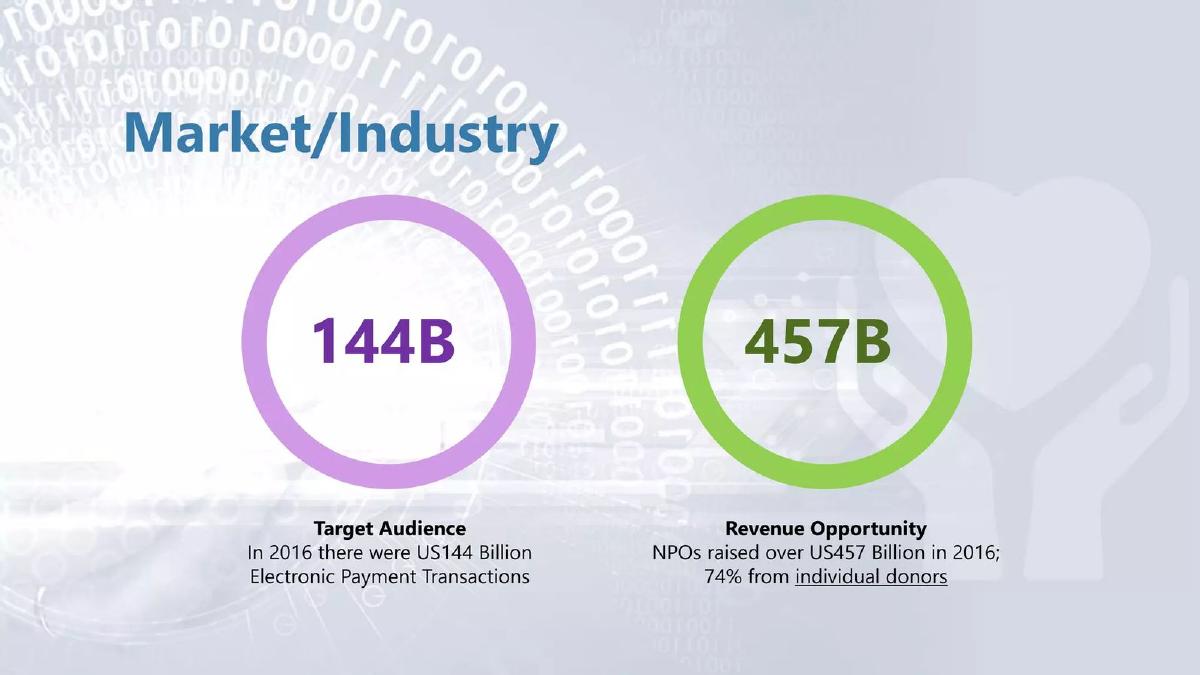
- The total revenue opportunity is cited as US$457 Billion based on 2016 NPO fundraising data (Slide 3).
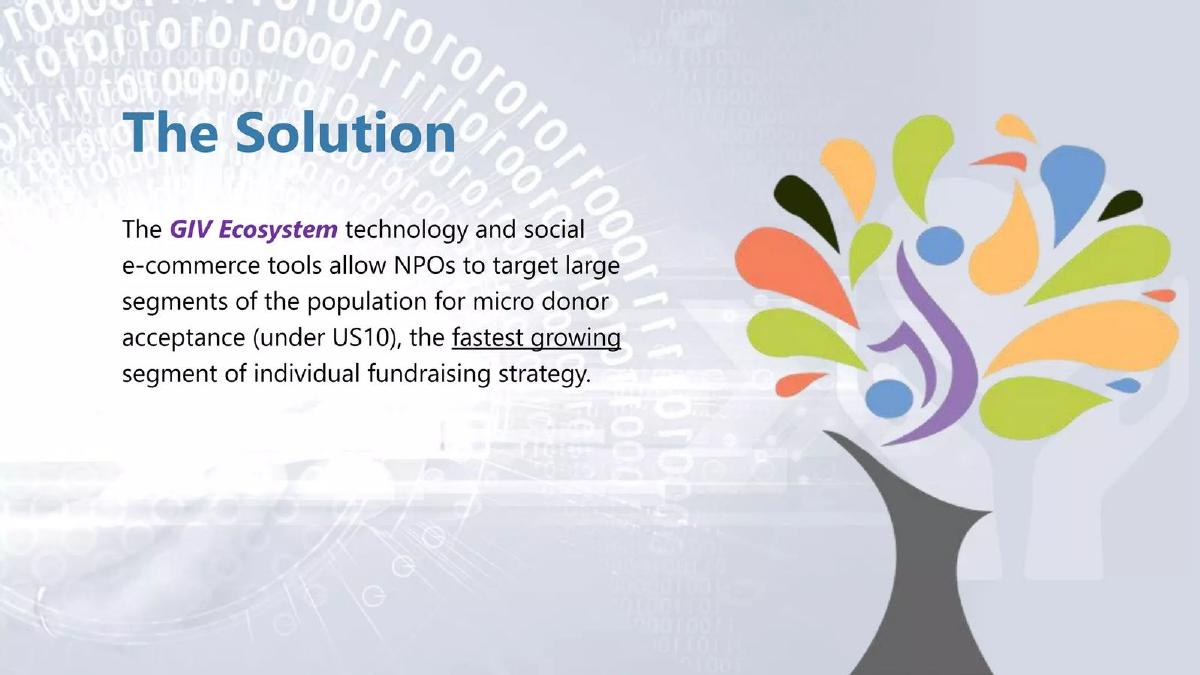
- The 'GIV Ecosystem' consists of six sub-brands: MyGIV, ReGIV, PartnerGIV, PayGIV, CoinGIV, and PosGIV (Slide 4).
- PosGIV focuses specifically on point-of-sale and ATM-based fundraising (Slide 4).
- PartnerGIV integrates donor rewards and loyalty programs across ATMs, mobile, and digital shopping carts (Slide 5).
- The company claims integration with 80% of the largest payment processors worldwide (Slide 7).
- A fiscally sponsored foundation, GIVFoundation, allows the company to raise funds for any qualified 501c3 (Slide 7).
- The deck lists major nonprofit partners including the American Cancer Society and The Humane Society (Slide 6).
Executive Summary: The GIV Ecosystem
Digital Donations Technologies presents a vision for a frictionless philanthropic landscape where giving is integrated into the fabric of daily commerce. Their deck focuses on the 'GIV Ecosystem,' a comprehensive suite of technologies designed to capture micro-donations at the point of sale, through ATMs, and via digital rewards programs. By targeting the 74% of nonprofit revenue that comes from individual donors, the company seeks to modernize a sector that they argue is currently hampered by high-cost, traditional fundraising methods.
Slide 1: Title and Vision
The opening slide introduces 'The GIV Ecosystem' with the tagline 'Connecting cause and commerce to make a difference.' The visual identity uses a heart-in-hands icon and a background of digital binary code, signaling a blend of social impact and technological infrastructure. This slide sets a broad tone, positioning the company not just as a tool, but as an 'ecosystem'—a term that implies multiple interconnected revenue streams and touchpoints.
Slide 2: The Problem
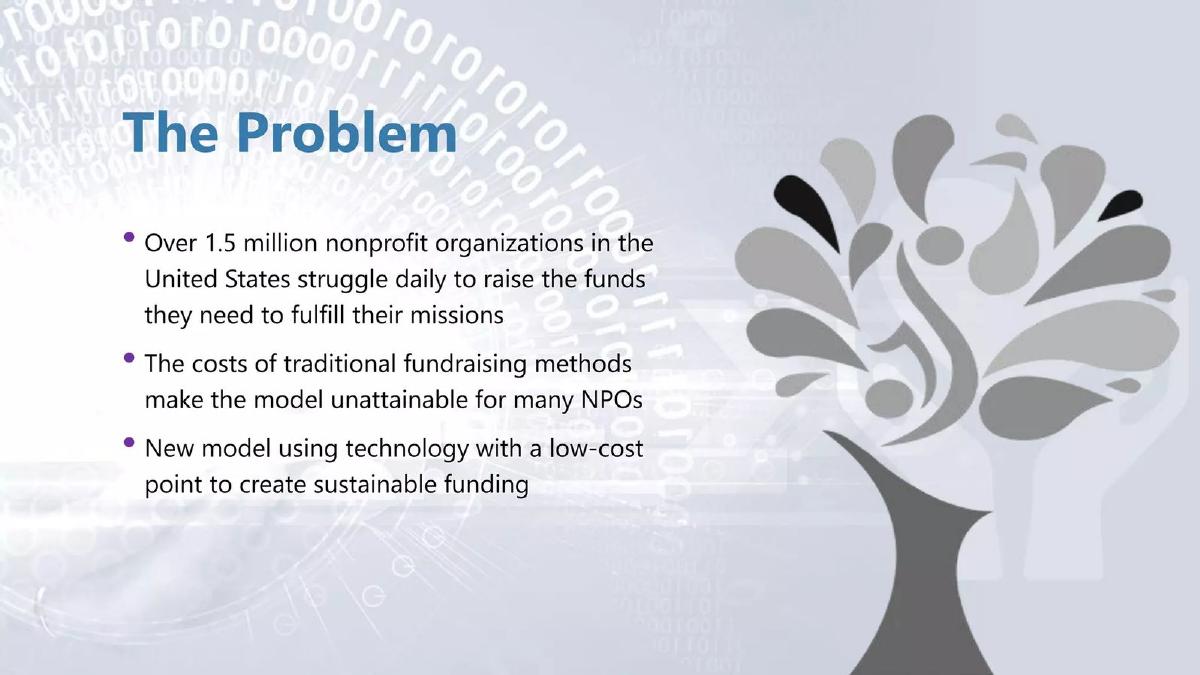
The problem statement is clear and quantitative. It identifies that over 1.5 million nonprofit organizations (NPOs) in the United States struggle daily to fulfill their missions due to funding gaps. The slide explicitly calls out the 'costs of traditional fundraising methods' as a barrier, making the current model unattainable for many smaller NPOs. The proposed solution is a 'new model using technology with a low-cost point to create sustainable funding.' This slide effectively establishes the pain point: fundraising is too expensive and inefficient for the average nonprofit.
Slide 3: Market/Industry Opportunity
Slide 3 provides the macro-economic justification for the business. It uses two large circles to represent the 'Target Audience' and the 'Revenue Opportunity.' Citing 2016 data, it notes US$144 Billion in electronic payment transactions and a total NPO fundraising market of US$457 Billion. The most important figure here is the 74% of funds coming from individual donors. This validates the company's focus on consumer-facing transaction points rather than corporate grants or large-scale foundations.
Slide 4: The Digital Donations Ecosystem
This slide is the architectural heart of the deck. It breaks down the 'GIV Ecosystem' into six distinct sub-brands:
MyGIV: Geotargeting rewards for donations. · ReGIV: Incomplete form data recovery (likely a tool to capture abandoned donation attempts). · PartnerGIV: Donor rewards from NPO business partners. · PayGIV: Automated donations and e-wallet integration. · CoinGIV: A cryptocurrency specifically for the nonprofit sector. · PosGIV: Point-of-sale and ATM fundraising.
While this shows a wide range of capabilities, it also introduces significant complexity. Managing six distinct product lines requires substantial resources and clear differentiation, which the deck attempts to address in subsequent slides.
Slide 5: PartnerGIV and Loyalty Programs
Slide 5 dives deeper into the 'PartnerGIV' component, explaining how rewards and loyalty programs increase fundraising opportunities. It lists several delivery mechanisms: ATM receipts, Point-of-Sale real-time promotions, mobile purchases, and digital shopping carts. The mention of 'CoinGIV' generating 'reward tokens' suggests an attempt to integrate blockchain-based incentives into the traditional retail experience. This slide emphasizes the 'commerce' side of the company's mission, showing how businesses can benefit from participating in the ecosystem through increased customer loyalty.
Slide 6: Nonprofit Partners
Social proof is provided on Slide 6, which features logos from major national organizations. The list includes the American Heart Association, American Cancer Society, National MS Society, Special Olympics, and The Humane Society. The presence of these household names suggests that Digital Donations Technologies has already cleared the significant hurdle of NPO procurement and trust. For an investor, this is perhaps the most compelling slide in the deck, as it demonstrates market traction and brand validation.
Slide 7: The Business Model
The final slide in the provided set explains 'Why it Works.' The key value proposition for NPOs is a 'turnkey fundraising solution with no upfront costs.' This lowers the barrier to entry for nonprofits. The slide also claims strategic alliances with ATM manufacturers and media/entertainment industries, and integration with '80% of the largest processors worldwide.' Finally, it mentions the 'GIVFoundation,' a fiscally sponsored entity under United Charitable, which allows the company to facilitate donations to any 501c3. This structure is vital for legal compliance and operational flexibility.
What Works in This Deck
Strong Social Proof: The inclusion of major nonprofit logos on Slide 6 is a powerful indicator of product-market fit. Large NPOs are notoriously risk-averse; their participation suggests the technology is secure and the value proposition is real.
Clear Market Segmentation: By highlighting that 74% of donations come from individuals (Slide 3), the deck justifies its focus on high-frequency, low-friction transaction points like ATMs and POS systems.
Comprehensive Ecosystem: The breakdown on Slide 4 shows a holistic approach to the problem. They aren't just an ATM plugin; they are attempting to own the entire donor journey, from abandoned forms (ReGIV) to long-term loyalty (PartnerGIV).
What Is Missing
The Team: There is no information regarding the founders or the executive team. In early-stage fundraising, the 'who' is often as important as the 'what.' Investors need to know if the team has the fintech or philanthropic experience to execute this complex multi-product strategy.
Financials and Projections: The deck provides market-wide data from 2016 but offers no company-specific financial metrics. There are no details on transaction volumes, take rates, current revenue, or projected growth. Without these, the 'Business Model' slide remains theoretical.
The Ask: The provided slides do not include a funding request. It is unclear how much capital the company is seeking, at what valuation, and specifically how they intend to use the funds to scale the various 'GIV' products.
Competitive Analysis: The deck assumes a vacuum. It does not mention other point-of-sale donation giants (like checkout charity programs at major retailers) or other crypto-philanthropy platforms. Explaining their 'moat' against these competitors is a necessary addition.
Founder's Playbook: What to Copy
The 'No Upfront Cost' Hook: If you are selling to nonprofits or budget-constrained SMEs, lead with a model that removes financial risk. Slide 7's emphasis on 'no upfront costs' is the most effective way to drive adoption in the NPO sector.
Visualizing the Ecosystem: Slide 4 uses a clear, color-coded list to explain a complex product suite. If your company has multiple modules or sub-brands, this 'hub and spoke' visual style helps investors understand how different products fit into a single vision without getting lost in the weeds.
Macro-to-Micro Data Flow: The transition from Slide 2 (the broad problem) to Slide 3 (the specific market data) is a classic and effective way to build a narrative. It defines the 'why' before diving into the 'how.'
Final Analysis
Digital Donations Technologies has built a compelling narrative around the 'GIV Ecosystem.' The deck successfully identifies a massive, inefficient market and presents a multi-pronged technological solution. The strength of their nonprofit partnerships provides a level of credibility that many startups lack. However, the deck's reliance on older data (2016) and the omission of team and financial specifics make it an incomplete pitch. To move from a 'vision' deck to an 'investment' deck, the company would need to provide a granular look at their unit economics and the specific milestones they intend to reach with new capital.
Frequently asked questions
- What is the core product of Digital Donations Technologies?
- The core product is the 'GIV Ecosystem,' a multi-channel platform that facilitates donations through everyday commercial transactions. It includes tools for ATM and point-of-sale fundraising (PosGIV), a cryptocurrency for the nonprofit sector (CoinGIV), and a rewards program (PartnerGIV) that incentivizes donations through business partner offers.
- How does the company address the 'Problem' slide?
- Slide 2 states that over 1.5 million U.S. nonprofits struggle to raise funds due to the high costs of traditional fundraising methods. Digital Donations Technologies proposes a 'new model using technology with a low-cost point' to create sustainable, recurring funding streams for these organizations.
- What market data does the deck provide?
- Slide 3 cites 2016 data, noting there were US$144 Billion in electronic payment transactions and that nonprofits raised over US$457 Billion that year. Crucially, it highlights that 74% of that funding came from individual donors, which is the primary target for their transaction-based tools.
- Who are the company's notable partners?
- Slide 6 displays logos for several high-profile nonprofit partners, including the American Heart Association, American Cancer Society, National Multiple Sclerosis Society, Special Olympics, United Charitable, and The Humane Society of the United States. These partnerships suggest significant early-stage validation.
- What is missing from the provided slides?
- The provided slides lack a dedicated team slide, detailed financial projections, a competitive landscape analysis, and a specific funding 'ask.' Without these, it is difficult to assess the company's valuation, the experience of the leadership, or the specific use of funds they are seeking from investors.