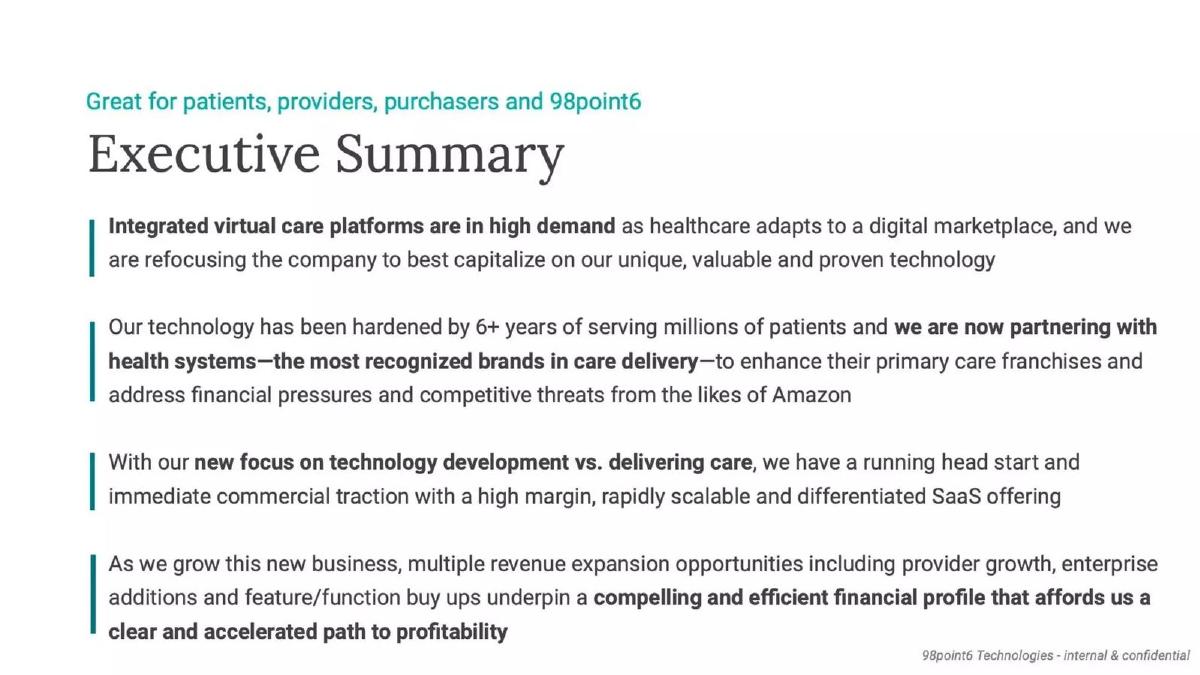
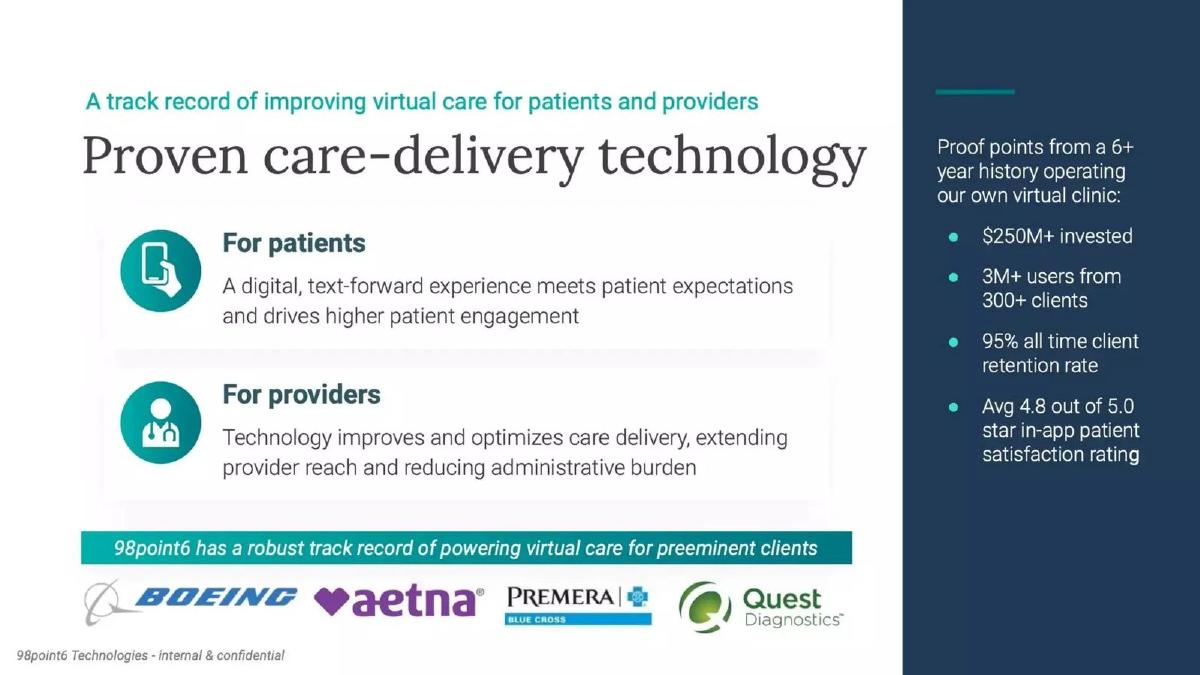
98point6’s $30.7M deck represents a classic 'Phoenix' pivot. Originally a full-stack virtual clinic, the company sold its care delivery arm to Transcarent in March 2023 to focus exclusively on licensing its underlying technology platform. The deck leans heavily on the credibility earned through eight years of clinical operations, citing the completion of 500,000 text-based visits as the R&D foundation for their current SDK product. By shifting from a service-heavy model to a high-margin software licensing model, 98point6 aims to solve provider burnout and excess capacity issues for regional h…
Key takeaways
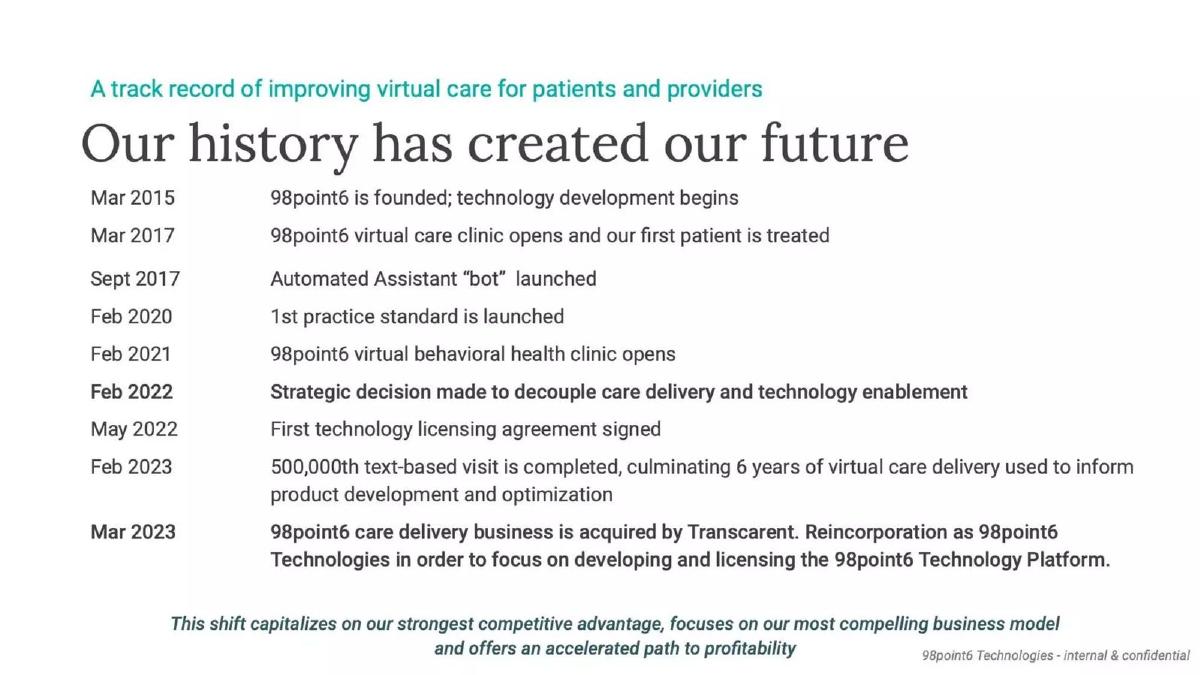
- The company underwent a major strategic pivot in March 2023, selling its care delivery business to Transcarent to focus on technology licensing (Slide 3).
- Product development is backed by a significant data moat, specifically 500,000 text-based visits completed by February 2023 (Slide 3).
- The new value proposition targets health systems by offering EMR enablement, flexible provider staffing, and revenue cycle reporting (Slide 6).
- The core product is now an SDK that allows health systems to offer digital-first care under their own trusted brand (Slide 7).
- The platform claims to address the ~20% daily excess provider capacity found at single-location health systems (Slide 8).
- Technology features include an ML/AI chatbot, connected diagnostic devices, and full visit transcripts for quality control (Slide 9).
- The deck positions virtual care as a 'necessity' driven by COVID-19 and skyrocketing demand for behavioral health (Slide 4).
- The business model shift is explicitly described as an 'accelerated path to profitability' (Slide 3).
The Strategic Pivot: From Clinic to Software Engine
The 98point6 deck is a masterclass in rebranding a company’s history to support a new direction. Most startups try to hide a pivot; 98point6 embraces it as the core of their value proposition. By selling their care delivery business, they transformed from a capital-intensive service provider into a scalable software-as-a-service (SaaS) entity. This teardown examines how they used their clinical legacy to sell a high-margin technology future.
Slide 1: Title and Positioning
The cover slide introduces '98point6 Technologies.' The addition of 'Technologies' to the brand name is a subtle but vital signal of their new identity. The subtitle, 'Digital healthcare for a competitive edge,' moves away from patient-facing language toward B2B enterprise language, signaling that their customer is now the health system, not the individual patient.
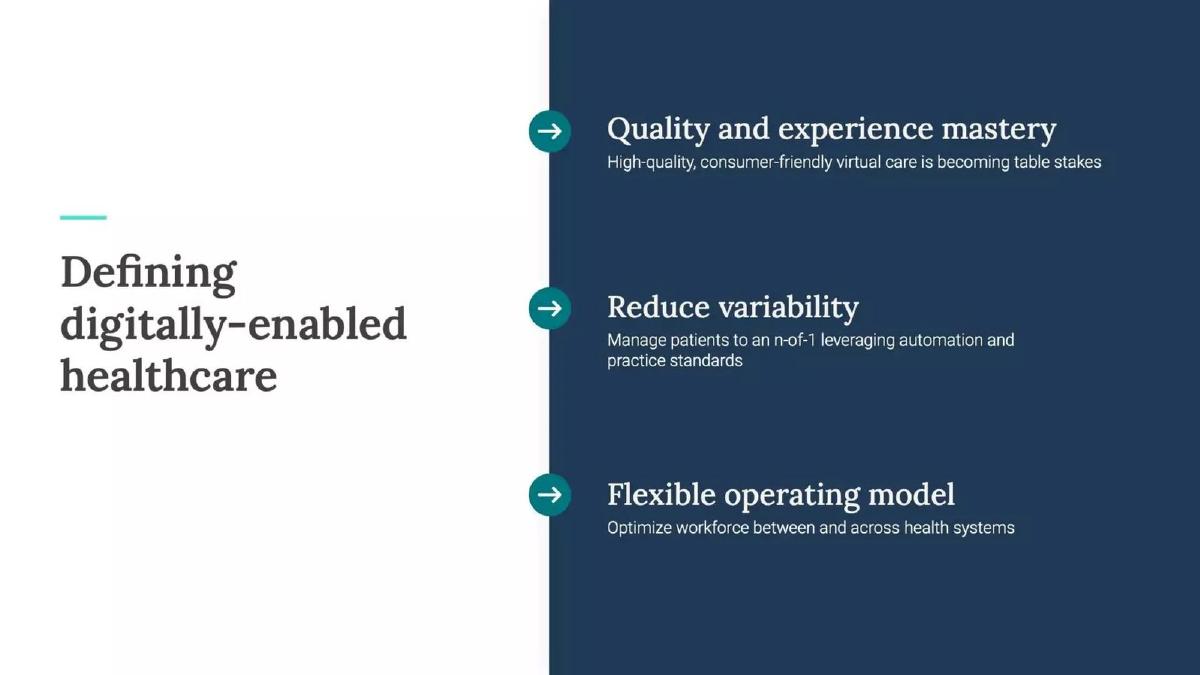
Slide 2: Defining Digitally-Enabled Healthcare
This slide sets the stage for the 'why.' It identifies three pillars: quality and experience mastery, reducing variability through automation, and a flexible operating model. By stating that virtual care is now 'table stakes,' they justify the need for health systems to adopt their technology to remain competitive. The mention of 'n-of-1' management leveraging automation hints at the sophisticated backend they’ve built.
Slide 3: The History and Pivot Timeline
This is arguably the most important slide in the deck. It provides a chronological justification for their current state. Key milestones include the 2015 founding, the 2017 launch of an automated assistant 'bot,' and the 2023 completion of 500,000 text-based visits. The slide concludes with the March 2023 acquisition of their care delivery business by Transcarent. They frame this not as an exit, but as a 'reincorporation' to focus on their strongest competitive advantage: the technology platform. The footer explicitly mentions an 'accelerated path to profitability,' a phrase designed to appeal to late-stage investors.
Slide 4: Market Context
Under the heading 'Meeting the moment,' the company lists the macro drivers for their business. They cite COVID-19 as the catalyst that made virtual care a necessity. They also highlight the 'skyrocketing' demand for behavioral health and the industry-wide shift toward home diagnostics. This slide serves to validate that the market for their software is expanding, even if they are no longer providing the care themselves.
Slide 5: Strategic Collaboration
This transition slide introduces the solution. It uses a high-quality image of a healthcare professional, maintaining the 'human' element of healthcare while the text focuses on how 'technology can support health systems.' It bridges the gap between the old 98point6 (the doctors) and the new 98point6 (the software).
Slide 6: The Evolving Value Proposition
This slide breaks down the product offering into four quadrants: Expertise, Access, Integration, and Extension. It lists specific technical capabilities such as EMR (Electronic Medical Record) enablement, scheduling, and value-based reporting. This is where the deck gets granular about what the 'Technology Platform' actually does for a hospital administrator.
Slide 7: Product Visualization (The SDK)
Slide 7 shows the product in action through a series of mobile app mockups. It emphasizes that their SDK (Software Development Kit) allows health systems to 'retain their trusted brand.' This is a critical selling point for hospitals that fear losing their patient relationship to a third-party platform. The mockups show a seamless journey from sign-in to a text-based visit with 'Dr. Sarah Smith,' demonstrating the 'digital-first' approach.
Slide 8: Regional Health System ROI
This slide speaks directly to the CFO of a health system. It lists four ways the platform generates ROI: generating specialty referrals, reducing provider burnout, optimizing physical footprint, and utilizing excess provider capacity. The specific figure of '~20% daily' excess capacity at single locations provides a tangible problem for their software to solve.
Slide 9: Actionable Insights and AI
The final content slide focuses on the data advantage. It highlights the ML/AI chatbot and the text-based modality. Because every interaction is text, the company claims to enable a 'new standard of quality' where peer reviews can analyze the entire conversation, not just the doctor's notes. This positioning turns their text-only limitation into a data-rich feature.
Slide 10: External Resource
The final slide is a generic placeholder for 'bestpitchdeck.com' and does not contain company-specific information.
What Works in This Deck
Credibility through Volume: Citing 500,000 completed visits (Slide 3) gives the software immediate 'battle-tested' status. It’s not a prototype; it’s a platform that has already handled half a million patients. · Clear B2B Transition: The deck successfully shifts the narrative from 'we treat patients' to 'we help you treat patients better.' The focus on 'retaining trusted brand' (Slide 7) addresses a major pain point for health systems. · Problem-Solution Alignment: Slide 8 identifies specific operational inefficiencies (like the 20% excess capacity) that their software is uniquely positioned to fix.
What Is Missing
Team Slide: The provided slides do not include a team overview. In a pivot of this magnitude, investors would want to know if the leadership team has the technical and enterprise sales expertise to transition from a clinical services company to a SaaS company. · Financials and Projections: There are no slides showing current ARR (Annual Recurring Revenue), licensing fees, or growth projections. While the text mentions a 'path to profitability,' the numbers are absent. · Competitive Landscape: The deck does not address other telehealth platform providers or white-label SDK competitors. · The Ask: There is no slide detailing how the $30.7M will be spent or what milestones the company intends to hit with this specific round of funding.
Lessons for Founders
Own Your Pivot: If your company changes direction, don't treat the past as a failure. 98point6 treats their eight years of clinical operations as a massive R&D phase that gave them a data advantage no pure software startup could replicate. · Focus on the Customer's ROI: Especially in healthcare, you must prove how you save money or increase efficiency. Slide 8 is a great example of translating technical features into business outcomes like 'reducing provider burnout' and 'optimizing physical footprint.' · White-Labeling is a Power Move: For B2B startups, showing that you can empower your customer's brand rather than competing with it (Slide 7) is a highly effective way to lower sales resistance.
Frequently asked questions
- What was the primary reason for 98point6's business model shift?
- According to Slide 3, the company made a strategic decision in February 2022 to decouple care delivery from technology enablement. By March 2023, they sold the care delivery side to Transcarent. This allowed them to focus on a licensing model which they claim offers a stronger competitive advantage and an accelerated path to profitability compared to managing a full-scale clinical workforce.
- How does 98point6 use AI and machine learning in its platform?
- Slide 9 specifies that the platform utilizes an ML/AI chatbot to assist in care. Because the modality is text-based, the system captures full visit transcripts. This data allows for automated quality control and peer reviews that go beyond traditional chart notes, as the technology is effectively 'in the room' for every patient-provider interaction.
- Who is the target customer for the 98point6 Technology Platform?
- The deck primarily targets regional health systems. Slide 8 outlines how these systems can generate ROI by using the platform to reduce provider burnout, optimize their physical footprint by shifting walk-in visits to digital channels, and utilize excess provider capacity across a linked network.
- What evidence of scale does the company provide?
- The company points to its eight-year history, starting in 2015. The most significant metric provided is on Slide 3, which notes the completion of their 500,000th text-based visit in February 2023. They frame this volume not just as a service milestone, but as the data foundation used to inform and optimize their current software product.
- Does the deck include financial asks or valuation details?
- Based on the 10 slides provided from the 19-slide deck, there is no explicit 'Ask' slide, nor are there specific valuation figures or detailed financial projections. The narrative focuses on the strategic shift and the technical capabilities of the SDK rather than the mechanics of the $30.7M fundraising round itself.