Difi (Delhi Institute of Functional Imaging) provides a comprehensive overview of its established position in the Indian nuclear medicine market. Founded in 2003, the company has grown from a single standalone center in New Delhi to a multi-city operation. The deck is notable for its transparency regarding historical financial performance, showing a revenue CAGR of 21% and a net revenue CAGR of 20% between 2009 and 2017. Unlike typical tech startups, Difi’s pitch is rooted in physical infrastructure, specialized medical expertise, and government empanelment. The company is seeking $5 million…
Key takeaways
- The company has a 15-year operational history, starting with its first center in South Ex, New Delhi, in January 2003 (Slide 3).
- Revenue grew from 39.5 million INR in 2009/10 to 175 million INR in 2016/17, representing a 21% CAGR (Slide 5).
- Difi identifies a critical shortage of qualified Nuclear MDs and equipment availability as primary market challenges (Slide 2).
- The competitive analysis shows Difi outperforming rivals in volume, recording 1,020 Gamma figures per month compared to the next highest at 300 (Slide 4).
- The team is led by CEO Rahul Sannan, who has over 30 years of industry experience and founded the Difi brand (Slide 6).
- The revenue model relies on a mix of cash patients from referring doctors and credit patients from government schemes like CGHS and ESI (Slide 8).
- The $5 million capital ask is split between $4 million for new center expansion and $1 million for sustaining capital and debt retirement (Slide 9).
- Expansion plans include a 'shop in shop' placement at a cancer hospital in Pune and a new PET-CT placement in Lucknow (Slide 9).
Executive Summary: A Mature Play in a Specialized Niche
The Difi (Delhi Institute of Functional Imaging) pitch deck is a departure from the high-growth, low-asset software decks typically seen in fundraising. It describes a capital-intensive, high-barrier-to-entry medical diagnostic business that has successfully navigated the Indian healthcare market for over a decade. The deck focuses heavily on historical performance, regulatory compliance, and physical expansion, presenting a case for an established brand looking to institutionalize its growth.
Slide 1: Title Slide
The deck opens with the full name: "DELHI INSTITUTE OF FUNCTIONAL IMAGING." The tagline, "Achieving better healthcare one Patient at a time," is standard for the medical industry. The design is minimalist, utilizing a dark background with white and yellow text. There is no mention of the specific funding round or the year of the presentation on this slide, though later slides provide context.
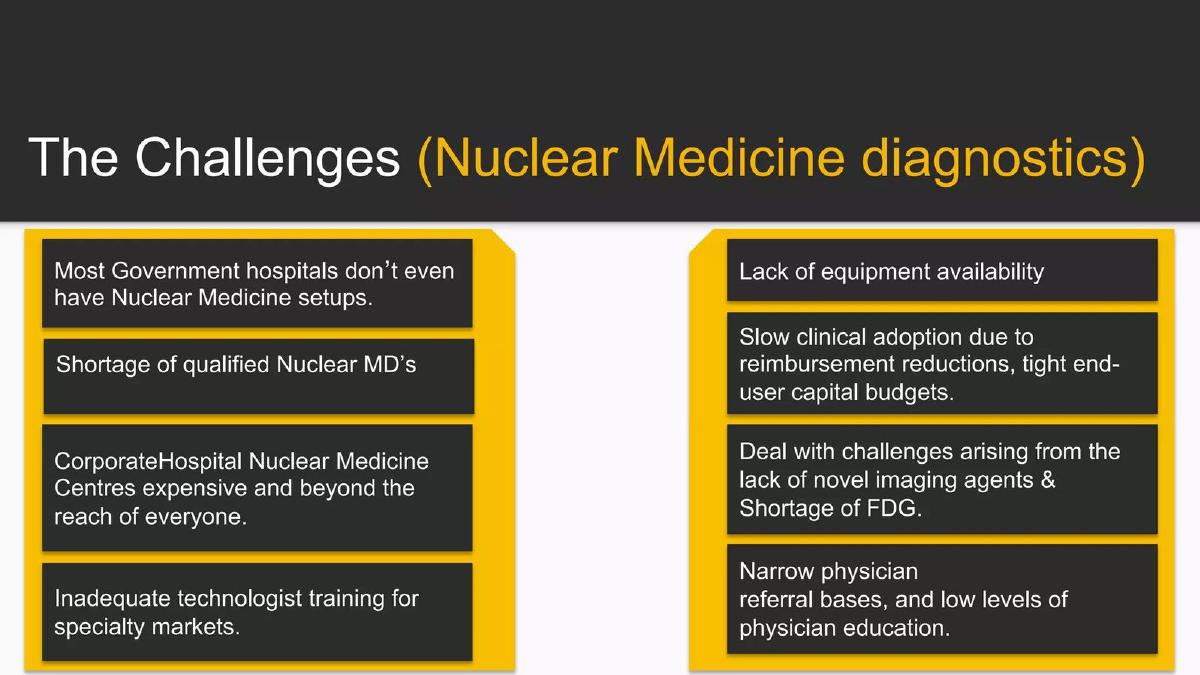
Slide 2: The Challenges (Nuclear Medicine diagnostics)
Difi outlines the macro-environmental hurdles in the Indian nuclear medicine sector. The slide is divided into two columns of bullet points. Key challenges identified include:
A lack of Nuclear Medicine setups in most government hospitals. · A shortage of qualified Nuclear MDs and inadequate technologist training. · High costs at corporate hospitals making services inaccessible to the general population. · Slow clinical adoption due to reimbursement reductions and tight capital budgets. · Shortages of essential imaging agents like FDG.
This slide effectively establishes the "Problem" by highlighting a supply-demand gap that Difi intends to fill.
Slide 3: Milestones
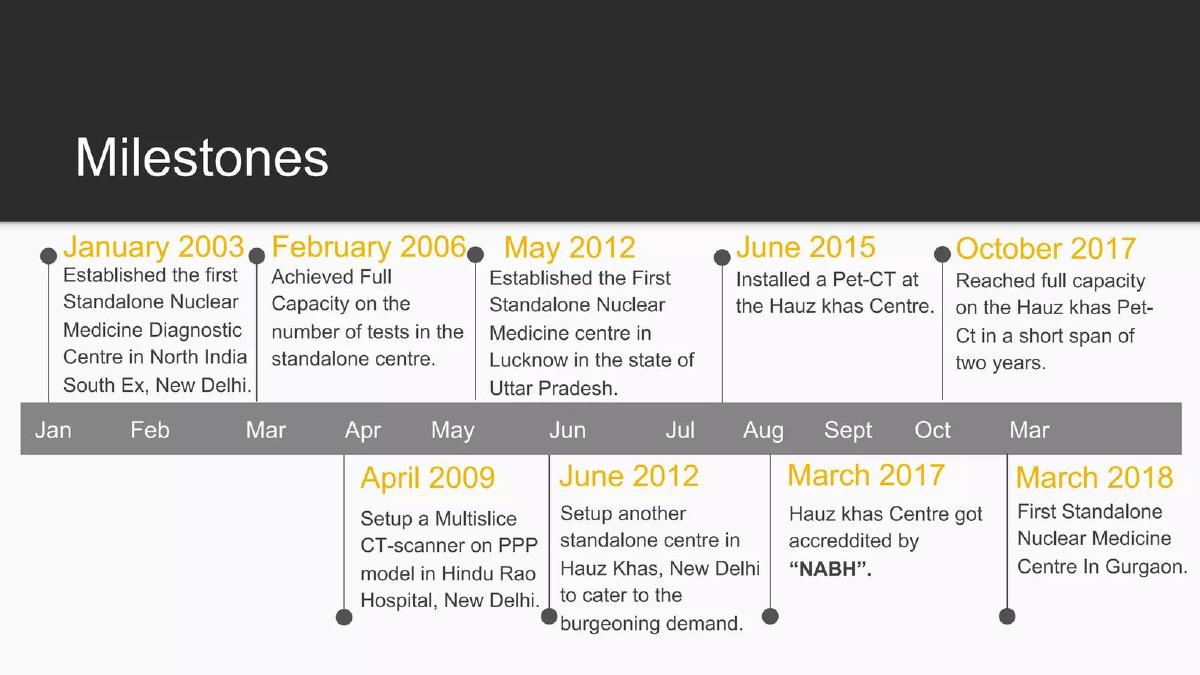
This timeline slide tracks the company’s evolution from 2003 to 2018. Notable milestones include:
January 2003: Establishment of the first standalone center in South Ex, New Delhi. · April 2009: Setup of a Multislice CT-scanner on a Public-Private Partnership (PPP) model at Hindu Rao Hospital. · May 2012: Expansion to Lucknow, Uttar Pradesh. · June 2015: Installation of a Pet-CT at the Hauz Khas center. · March 2017: NABH accreditation for the Hauz Khas center. · March 2018: Opening of the first standalone center in Gurgaon.
The 15-year history presented here serves as a powerful validation of the founders' ability to sustain and grow a complex medical business.
Slide 4: Competitive Analysis
Difi uses a detailed table to compare itself against four competitors: Anand, Ganesh, HOD, and Saral. The data points include modalities (Pet & Gamma), empanelments, monthly figures, and pricing. Difi (listed at the bottom) highlights its competitive edge in volume, claiming 1,020 Gamma figures per month, significantly higher than its rivals. It also lists a comprehensive array of accreditations (CGHS, ESI, ECHS, DGESH, NABH, DAK, RAILWAYS, DJB), which are critical for securing patient referrals in the Indian market. The slide includes a generic "Competitor Analysis" graphic on the left that adds little value and could have been replaced with more specific data.
Slide 5: Financial Snapshot
This is arguably the strongest slide in the deck. It shows a bar chart of Revenue and Net Revenue from the 2009/10 fiscal year through 2016/17. The figures are in Millions of INR:
2009/10: 39.5 Mil Revenue / 5.8 Mil Net Revenue. · 2016/17: 175 Mil Revenue / 29.4 Mil Net Revenue.
The slide explicitly states a Revenue CAGR of 21% and a Net Revenue CAGR of 20%. This level of financial transparency is rare in early-stage decks and demonstrates a business that is not just growing, but doing so profitably.
Slide 6: The Team
The leadership team is presented with photos and brief biographies. The team appears well-balanced:
Rahul Sannan (CEO): 30+ years of industry experience and the founder of the brand. · Dr. Niraj Naswa (Medical Director): Provides the necessary clinical credibility as an AIIMS alumnus with extensive publications. · Amit Naswa (President Operations): 18 years of experience in finance and marketing. · Harman Bedi (Project Manager): 14 years of experience, specifically noted for "reviving sick units."
The team possesses the requisite mix of clinical expertise and operational longevity required for this sector.
Slide 7: How Does a PET Center Work / History of Nuclear Medicine
This slide is a composite of two infographics. The left side illustrates the technical workflow of a PET center (cyclotron facility, radiochemical lab, quality control, etc.). The right side provides a timeline of the history of nuclear medicine starting from the 1890s. While educational, these graphics appear to be sourced from external websites (indicated by the watermarks and URLs at the bottom). For a sophisticated investor, this slide may feel like "filler" as it explains the industry rather than Difi’s specific innovation.
Slide 8: Revenue Model
Difi clarifies its income streams through a simple flowchart. Revenue is split between:
Cash Patients: Referred by specialists like cardiologists and oncologists. · Credit Patients: Referred via government and corporate empanelments (ESI, ECHS, CGHS, DAK).
The slide notes there is "No customer concentration risk," which is a vital point for investors concerned about the stability of cash flows in a service-based business.
Slide 9: Growth Capital Requirement and Usage
Total Growth Capital: $4 Million. · Sustaining Capital & Debt Retirement: $1 Million.
The $4 million is earmarked for specific geographic expansions: West Delhi, Gurgaon, a "Shop in Shop" placement in Pune, and a new PET-CT in Lucknow. The slide also mentions that equity shares will be offered and valuation will be based on the "Discounted method on future projections." The use of the term "Discounted method" likely refers to a Discounted Cash Flow (DCF) analysis, which is appropriate for a business with predictable historical earnings.
What Works in the Difi Deck
Proven Traction: The 15-year timeline and 8-year financial history provide a level of de-risking that most startups cannot match. Investors can see exactly how the business has scaled through different economic cycles.
Operational Specificity: The deck identifies specific locations for expansion (West Delhi, Pune, etc.) and specific equipment needs. This shows that the founders have a concrete plan for the capital rather than a vague "marketing and sales" budget.
Regulatory Moat: By listing their extensive empanelments and NABH accreditations, Difi highlights a significant barrier to entry. In the Indian healthcare sector, these certifications are essential for high-volume patient flow.
What is Missing from the Difi Deck
Unit Economics: While the deck shows aggregate net revenue, it does not break down the margins per scan or the payback period for a new PET-CT machine. For a capital-intensive business, understanding the ROI on a single piece of equipment is crucial.
Technology/Innovation Angle: The deck focuses entirely on existing medical technology. There is no mention of proprietary software, AI-driven diagnostics, or unique operational efficiencies that would give Difi a technological edge over larger hospital chains.
Exit Strategy: There is no mention of how investors will eventually realize a return. In a brick-and-mortar healthcare play, this usually involves an IPO or acquisition by a larger hospital network (like Apollo or Fortis), but the deck is silent on this point.
Founder's Guide: What to Copy
The Financial Snapshot (Slide 5): If your company has been operating for several years, a clear, year-over-year bar chart showing both top-line revenue and bottom-line profit is the most effective way to build trust. Difi’s inclusion of CAGR percentages makes the data easy to digest.
The Competitive Table (Slide 4): Instead of a generic 2x2 matrix, Difi uses a data-heavy table that compares actual volumes and specific accreditations. This is much more persuasive for industry-savvy investors who know which metrics actually matter.
Direct Use of Funds (Slide 9): Tying a funding ask to specific physical locations and equipment purchases makes the investment feel tangible. It moves the conversation from "betting on an idea" to "financing an expansion."
Frequently asked questions
- What is Difi's core business model?
- Difi operates specialized diagnostic centers focused on nuclear medicine, specifically PET and Gamma imaging. They generate revenue from two primary streams: direct cash payments from patients referred by specialists (cardiologists, oncologists, etc.) and credit-based payments from government and corporate empanelments such as CGHS, ESI, and the Railways. This dual approach mitigates customer concentration risk.
- How does Difi compare to its competitors in the Delhi region?
- According to the competitive analysis on slide 4, Difi maintains a significant volume advantage. It reports 1,020 Gamma figures per month, which is more than triple its closest competitor, Saral (300). While its PET prices (23,607 INR) are slightly higher than competitors like HOD (10,000 INR), its high volume and extensive list of accreditations suggest a premium market position.
- What are the specific financial growth metrics provided?
- The deck provides an eight-year financial snapshot from 2009 to 2017. Revenue increased from 39.5 million INR to 175 million INR. Net revenue (profitability) also saw consistent growth, rising from 5.8 million INR to 29.4 million INR in the same period. The company maintains a 20% CAGR on net revenue, demonstrating scalable profitability.
- What is the primary use of the requested $5 million investment?
- The majority of the funds ($4 million) are earmarked for geographic expansion and infrastructure. This includes setting up new centers in West Delhi and Gurgaon, a 'shop in shop' model in Pune, and upgrading equipment in Lucknow. The remaining $1 million is intended for sustaining capital and retiring existing debt to clean up the balance sheet.
- Who are the key members of the leadership team?
- The team is led by Founder/CEO Rahul Sannan (30+ years experience) and Medical Director Dr. Niraj Naswa, an AIIMS alumnus with over 30 international publications. Operations are handled by Amit Naswa (18 years experience), and project management is led by Harman Bedi, who specializes in business transformation and reviving underperforming units.