The 1994 Diablo pitch deck by Condor, Inc. is a masterclass in conceptual clarity and market positioning for the mid-90s gaming landscape. Spanning eight pages, the document outlines a vision for a 'hack and slash' RPG designed to fill a niche left by overly complex multimedia titles. Interestingly, the original design was turn-based, utilizing a 'Dynamic Random Level Generation' (DRLG) system to ensure replayability. The deck places heavy emphasis on a recurring revenue model through $4.95 expansion disks, drawing direct parallels to the success of Magic: The Gathering. While it lacks modern…
Key takeaways
- The game was originally proposed as a turn-based system where players move space-to-space using a mouse (Slide 2).
- A proprietary 'Dynamic Random Level Generation' (DRLG) system was the core technical moat for replayability (Slide 2).
- The deck explicitly targets a 'neglected niche' by moving away from 'multimedia extravaganzas' toward pure gameplay (Slide 2).
- Marketing strategy relied on $4.95 expansion disks to provide 'continuous revenues with minimal investment' (Slide 6).
- The deck uses Magic: The Gathering as a primary market comparable for its collectible expansion model (Slide 6).
- Development was planned for a strict 12-month timeline with a team of 11 people, including three pixel artists (Slide 7).
- The proposal includes a 'permadeath' mechanic where a character is 'erased completely from the hard-drive' upon death (Slide 5).
- The technical target was Super VGA mode at 640x480 pixels with eight directions of movement (Slide 7).
The 1994 Diablo Pitch: A Blueprint for a Genre
In 1994, Condor, Inc. (which would later become Blizzard North) drafted a proposal for a game that would eventually redefine the action role-playing genre. This eight-page document is less of a modern 'pitch deck' and more of a formal design specification and business proposal. It reflects a time when the gaming industry was transitioning from niche hobbyist markets to mainstream commercial powerhouses. The deck is notable for its focus on 'replayability' and 'expandability,' terms that remain central to gaming today.
Slide 1: Title and Concept
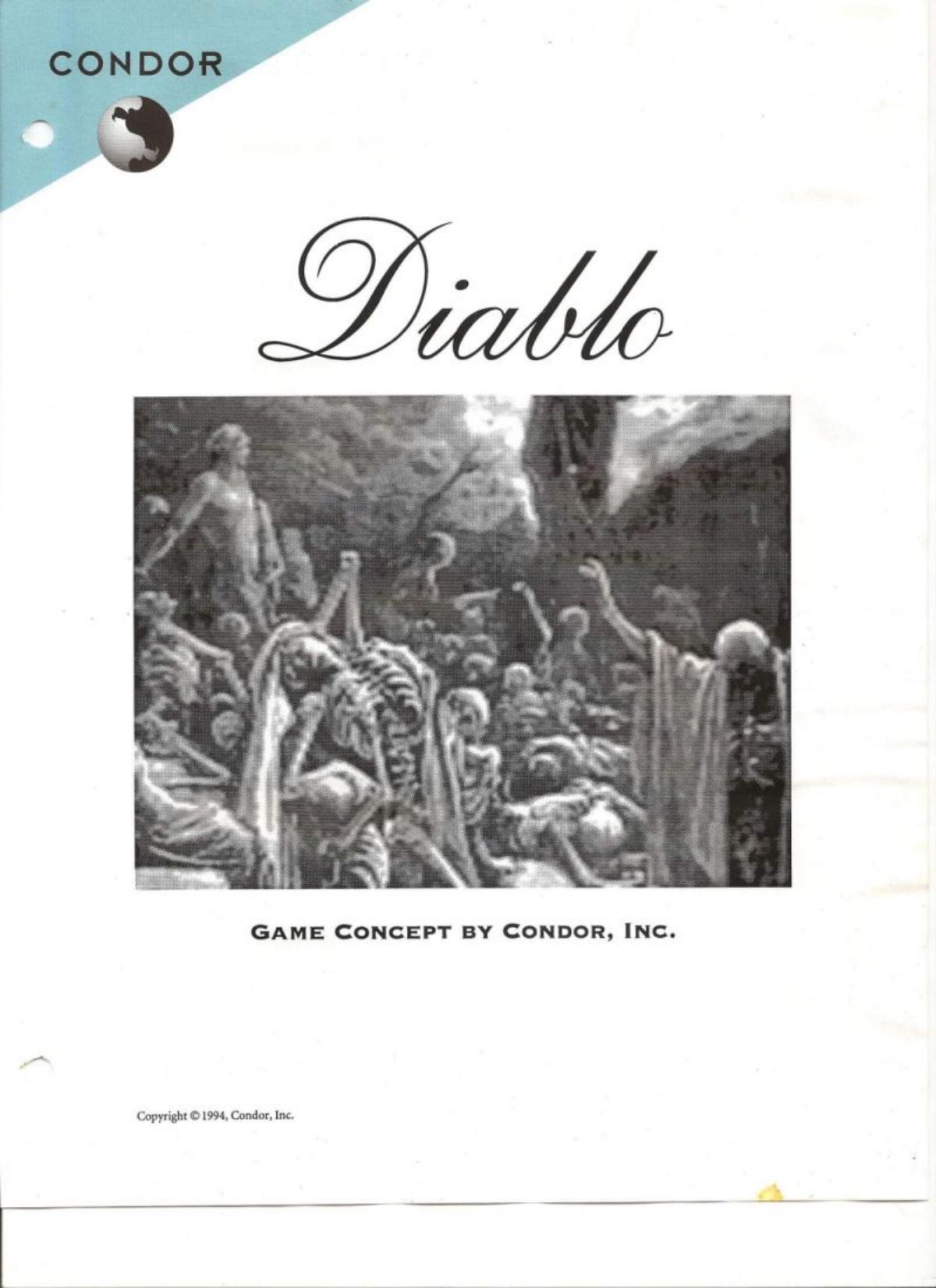
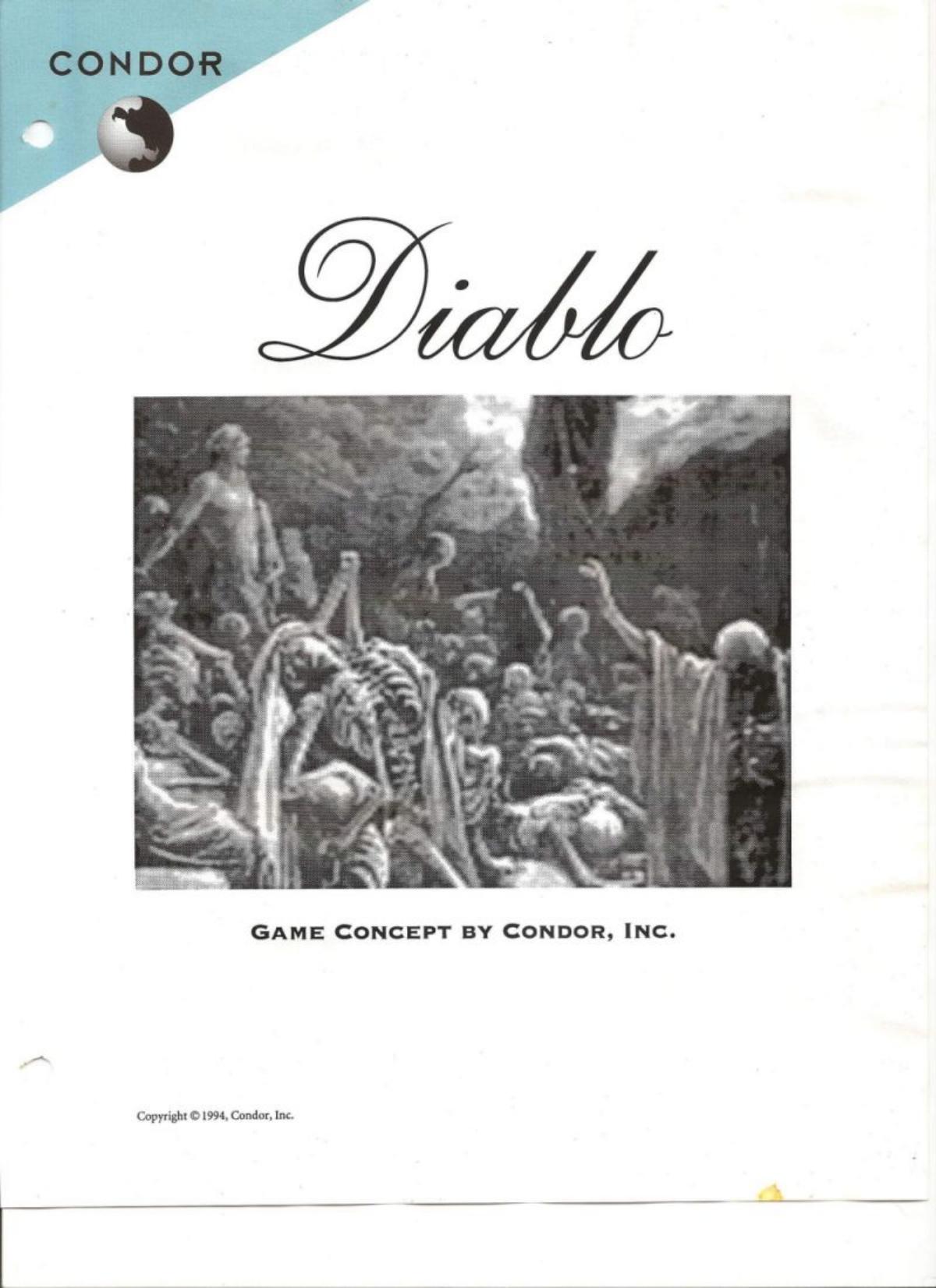
The cover slide is minimalist, featuring the 'Diablo' title in a script font and a black-and-white illustration of skeletons and demons. It identifies the project as a 'Game Concept by Condor, Inc.' and carries a 1994 copyright. The branding is stark, leaning into the 'dark quest for justice' mentioned in the following pages. There is no tagline or mission statement on the cover, relying instead on the visual tone to set the stage.
Slide 2: The Core Thesis and Game Design
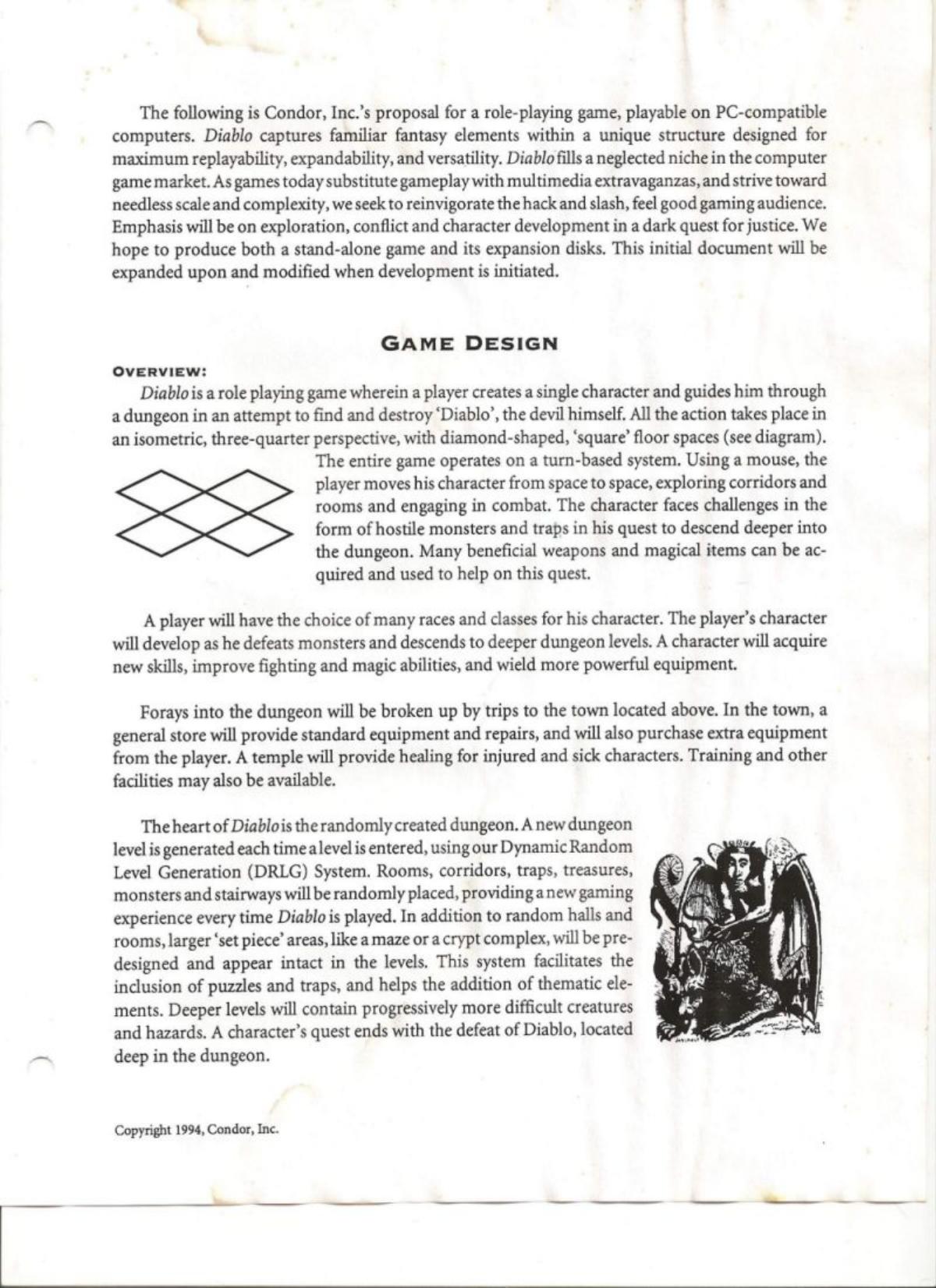
Slide 2 serves as the executive summary. It identifies a 'neglected niche' in the market, arguing that contemporary games were focusing too much on 'multimedia extravaganzas' and 'needless scale' at the expense of gameplay. Condor’s solution was to reinvigorate the 'hack and slash' genre.
Perspective: An isometric, three-quarter perspective using 'diamond-shaped, square floor spaces.' · Movement: A turn-based system where players move space-to-space using a mouse. · The DRLG System: The 'Dynamic Random Level Generation' system is introduced as the 'heart of Diablo,' promising a new experience every time the game is played.
The slide also mentions the inclusion of a town for healing and repairs, establishing the 'dungeon-to-town' gameplay loop that remains a staple of the series.
Slide 3: Expandability and Multi-player
This slide focuses on the longevity of the product. It emphasizes that the DRLG engine allows for new magic items, creatures, and scenarios to be added post-purchase. Crucially, it introduces the concept of multi-player gaming via 'modem or network.' It even proposes a 'special arena dungeon' for PvP (player vs. player) combat, showing that competitive play was a day-one consideration for the developers.
Slide 4: Plot, Setting, and Gameplay Walkthrough
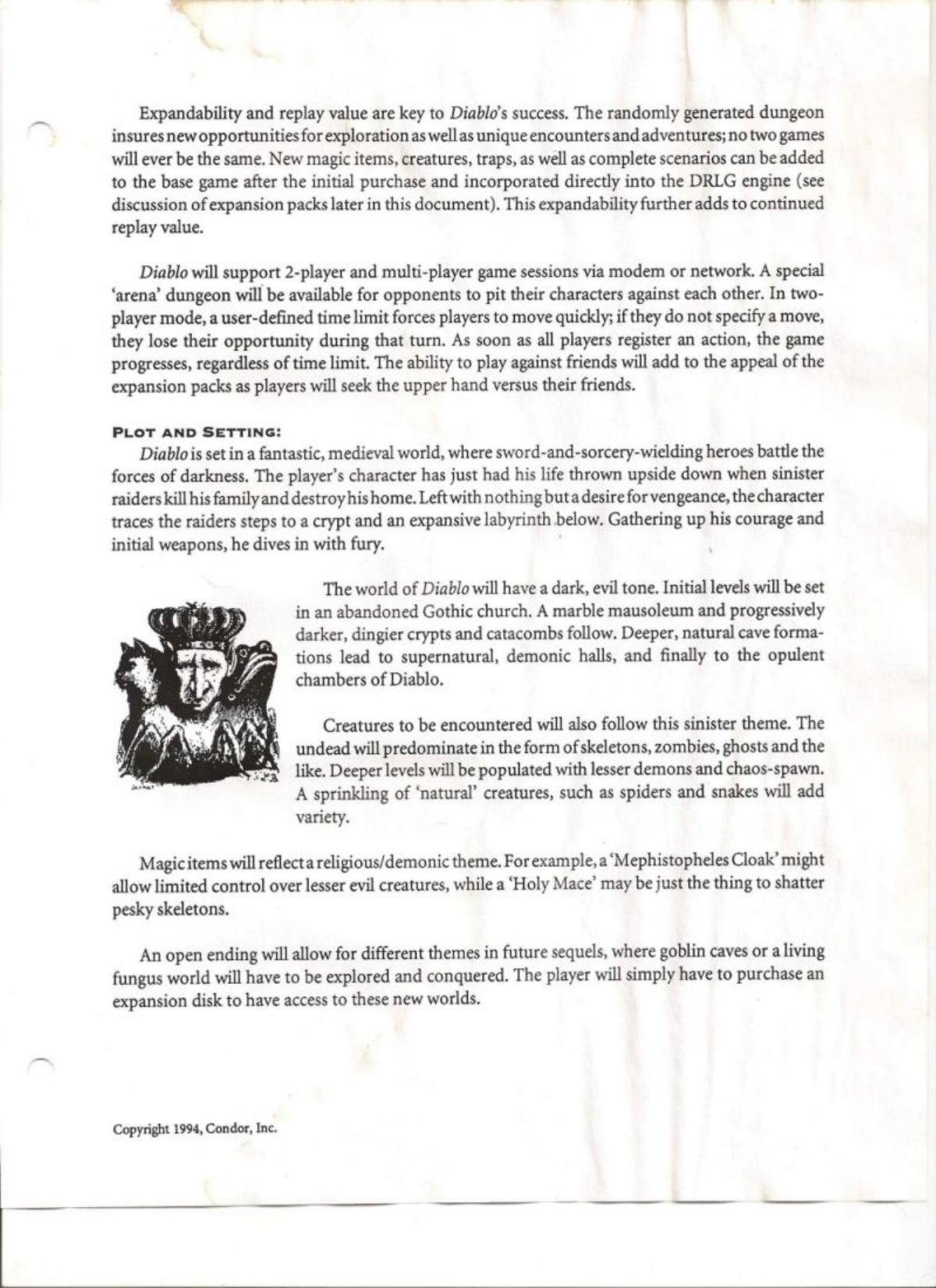
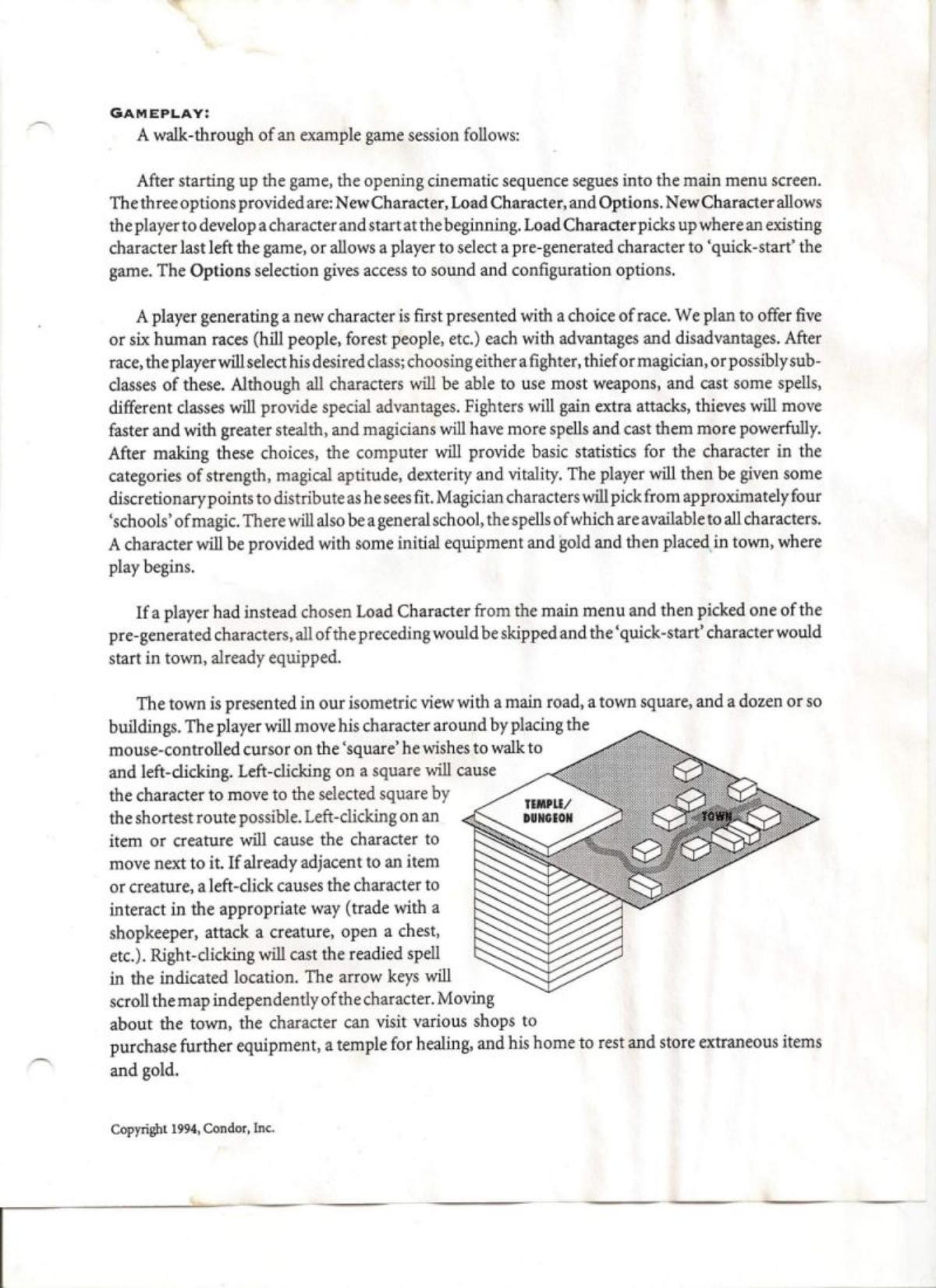
Slide 4 and Slide 5 transition into a narrative and mechanical walkthrough. The setting is described as a 'fantastic, medieval world' with a 'dark, evil tone.' The deck lists specific environments: an abandoned Gothic church, marble mausoleums, catacombs, and natural caves. It also lists enemy types like skeletons, zombies, and ghosts.
The gameplay walkthrough details the user interface, mentioning 'New Character,' 'Load Character,' and 'Options.' It describes a class system (fighter, thief, or magician) and a race system (hill people, forest people, etc.), the latter of which was largely simplified in the final release. The walkthrough explains how left-clicking moves the character or attacks, while right-clicking casts spells.
Slide 5: The Turn-Based Mechanic and Permadeath
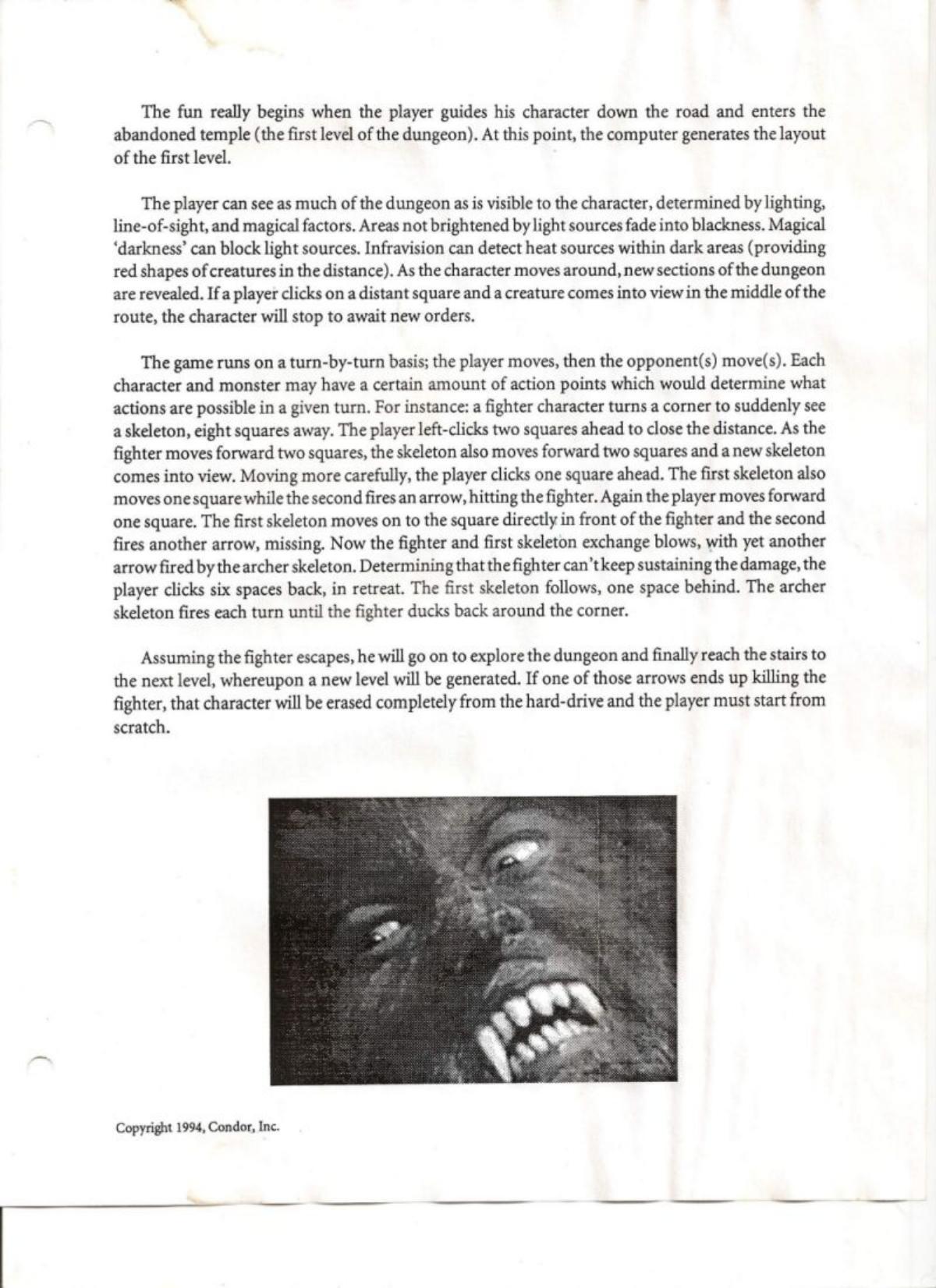
Slide 5 provides a granular example of combat. It describes a turn-by-turn exchange between a fighter and an archer skeleton, utilizing 'action points' to determine possible moves. This is the most significant departure from the final product, which famously switched to real-time action. The slide also contains the brutal 'permadeath' clause: 'that character will be erased completely from the hard-drive and the player must start from scratch.'
Slide 6: The Marketing Strategy
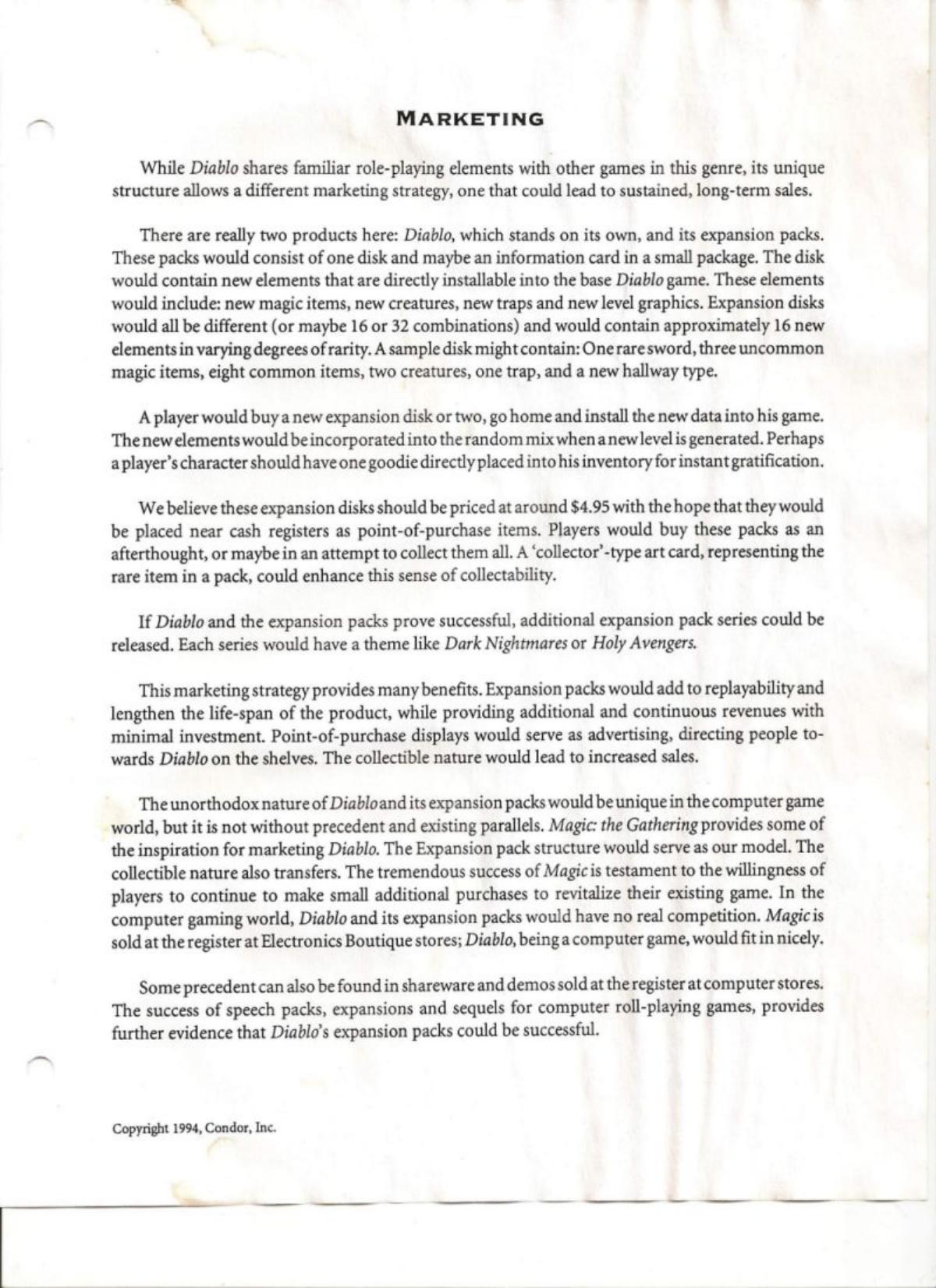
This is perhaps the most business-centric slide in the deck. Condor proposes a two-product strategy: the base game and expansion packs. These packs were envisioned as $4.95 disks sold near cash registers as 'point-of-purchase' items. The deck cites Magic: The Gathering as a successful precedent for this 'collectible' nature. The goal was to provide 'continuous revenues with minimal investment,' a precursor to the modern DLC and microtransaction models.
Slide 7: Development and Team Composition
Slide 7 outlines the production requirements. Condor planned for a one-year development cycle. The team was specified as:
1 Designer · 1 Chief Programmer and 2 Junior Programmers · 2 Art Directors/Artists · 1 Illustrator/Sculptor · 3 Pixel Artist/Illustrators · 1 Music/Sound Effects person
The slide also notes technical targets: Super VGA mode (640x480 pixels) and monsters requiring 'at least 50 frames of animations.'
Slide 8: The Development Schedule
The final slide is a Gantt chart showing a 12-month timeline. Design was slated for the first two months, with programming and art running concurrently from Month 3 through Month 12. A significant four-month block at the end of the schedule was dedicated to 'Testing/Balance,' highlighting the importance the team placed on gameplay feel over mere technical completion.
What Works in This Deck
1. Clear Market Positioning: The deck identifies a specific gap in the market (the lack of pure hack-and-slash gameplay in an era of 'multimedia' bloat) and positions Diablo as the solution. This 'anti-trend' approach is often effective when the dominant market trend is failing to satisfy core users.
2. Technical Specificity: By naming the 'Dynamic Random Level Generation' (DRLG) system, the founders gave a generic feature (random levels) a proprietary-sounding name, making it feel like a unique piece of intellectual property.
3. The Business Model: The comparison to Magic: The Gathering was a stroke of genius for 1994. It took a successful model from a different industry (tabletop gaming) and applied it to software, providing a clear path to high-margin recurring revenue.
What is Missing
1. Financial Projections: There are no estimates of unit sales, development costs in dollars, or projected ROI. While it mentions a $4.95 price point for expansions, it doesn't model how many expansions a typical user might buy.
2. Competitive Analysis: While it mentions 'multimedia extravaganzas' generally, it does not name specific competing titles or studios. A modern deck would require a 'Competitor Matrix' showing how Diablo compared to other RPGs of the era like Ultima or Wizardry.
3. The 'Ask': The deck ends with a schedule but no formal request for funding. It doesn't state how much capital is needed to sustain the 11-person team for 12 months, nor does it offer equity or distribution terms.
Founder's Lessons
Focus on Replayability: If you are building a product that requires high user retention, you must explain the engine that drives that retention. For Diablo, it was the DRLG. For a modern SaaS company, it might be a data flywheel or a network effect. Don't just say your product is 'sticky'; show the mechanics that make it so.
Use Cross-Industry Comparables: Condor’s use of Magic: The Gathering to explain their expansion pack strategy is a perfect example of using a known success story to validate an unproven model. If your business model is 'The [Successful Company] of [Your Industry],' it helps investors visualize the upside instantly.
Prioritize the 'Feel': The inclusion of a detailed combat walkthrough (Slide 5) and a four-month balancing phase in the schedule (Slide 8) shows that the founders understood their product's success depended on the 'feel' of the gameplay. In any product-led pitch, demonstrating a deep obsession with the end-user experience is vital.
Final Thought: The Diablo deck is a reminder that great products often start with a simple, well-articulated rejection of current market trends. By focusing on 'fun' and 'replayability' over 'multimedia' flash, Condor, Inc. laid the groundwork for a multi-billion dollar franchise.
Frequently asked questions
- What was the original business model for Diablo?
- The original model focused on a stand-alone game supplemented by frequent, low-cost expansion disks priced at approximately $4.95. Condor, Inc. envisioned these as point-of-purchase items similar to collectible card games, containing new items, monsters, and level types to extend the product's lifespan and generate recurring revenue.
- How did the original gameplay differ from the final 1997 release?
- The most significant difference was the turn-based mechanic. Slide 2 and Slide 5 describe a system where the player moves and then the opponents move, governed by action points. The final game famously shifted to real-time action during development after pressure from Blizzard.
- What technical innovations did the deck highlight?
- The primary innovation was the Dynamic Random Level Generation (DRLG) system. This allowed for rooms, corridors, traps, and treasures to be randomly placed each time a player entered a level, ensuring that 'no two games will ever be the same' (Slide 3).
- How did the team plan to handle character death?
- The deck proposed a high-stakes 'permadeath' system. Slide 5 states that if a character is killed, that character would be 'erased completely from the hard-drive,' forcing the player to start from scratch, a mechanic that eventually became the 'Hardcore' mode in the final series.
- What was the proposed development timeline and team size?
- Condor, Inc. planned for a 12-month development cycle (Slide 8). The team was to consist of 11 people: one designer, three programmers, two art directors, one illustrator/sculptor, three pixel artists, and one sound person (Slide 7).