The dhc pitch deck, published in 2018, outlines a regional healthcare play focused on the substance abuse epidemic in the Appalachian coalfield regions. The company identifies a specific market gap: a lack of clinicians and a competitor landscape dominated by a single comprehensive care organization (KRCC). By focusing exclusively on addiction and accepting insurance—a rarity in the local private market—dhc projects a path to $494,400 in annual sales by its third year. While the deck provides clear hiring milestones and localized competitive advantages, it lacks a specific dollar amount for t…
Key takeaways
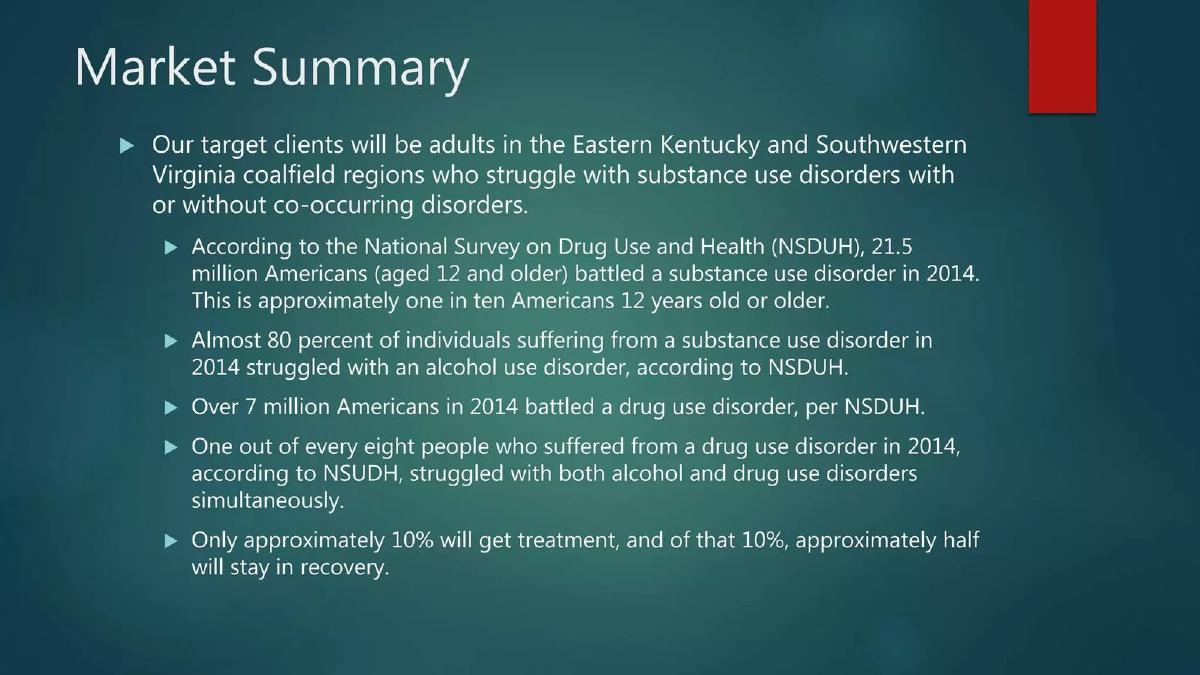
- The business targets a specific geographic niche: the coalfield regions of Eastern Kentucky and Southwestern Virginia (Slide 4).
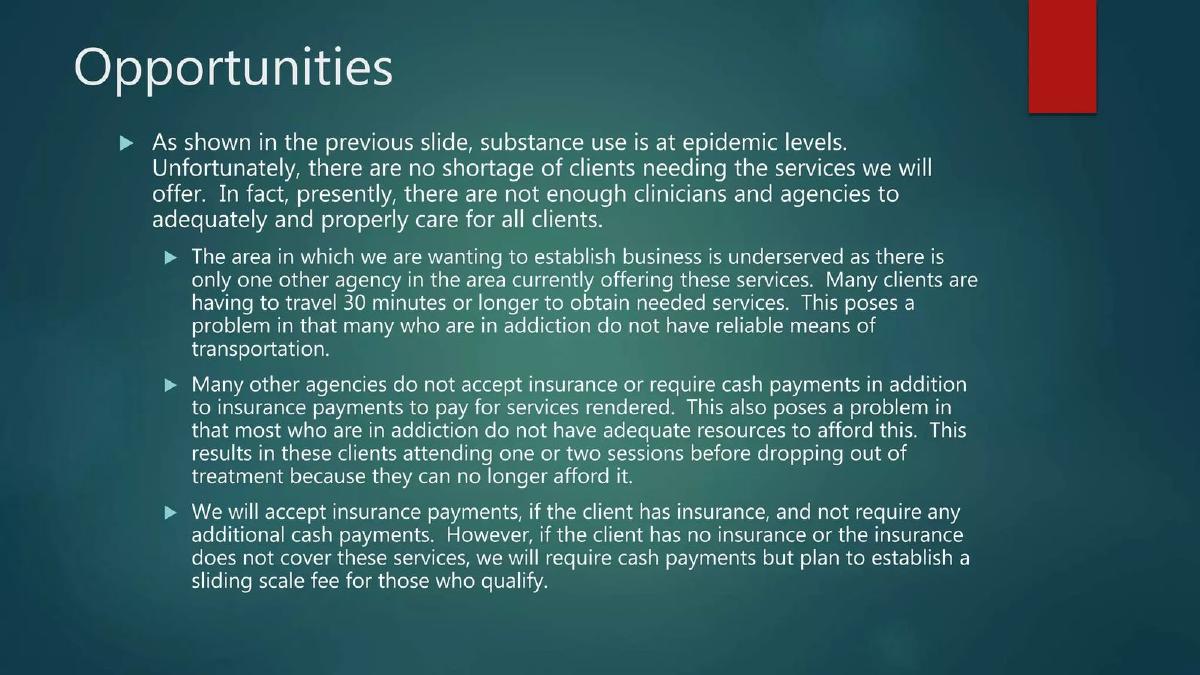
- A core competitive advantage is the acceptance of insurance and a sliding scale fee, addressing the financial barriers that cause local patients to drop out of treatment (Slide 5).
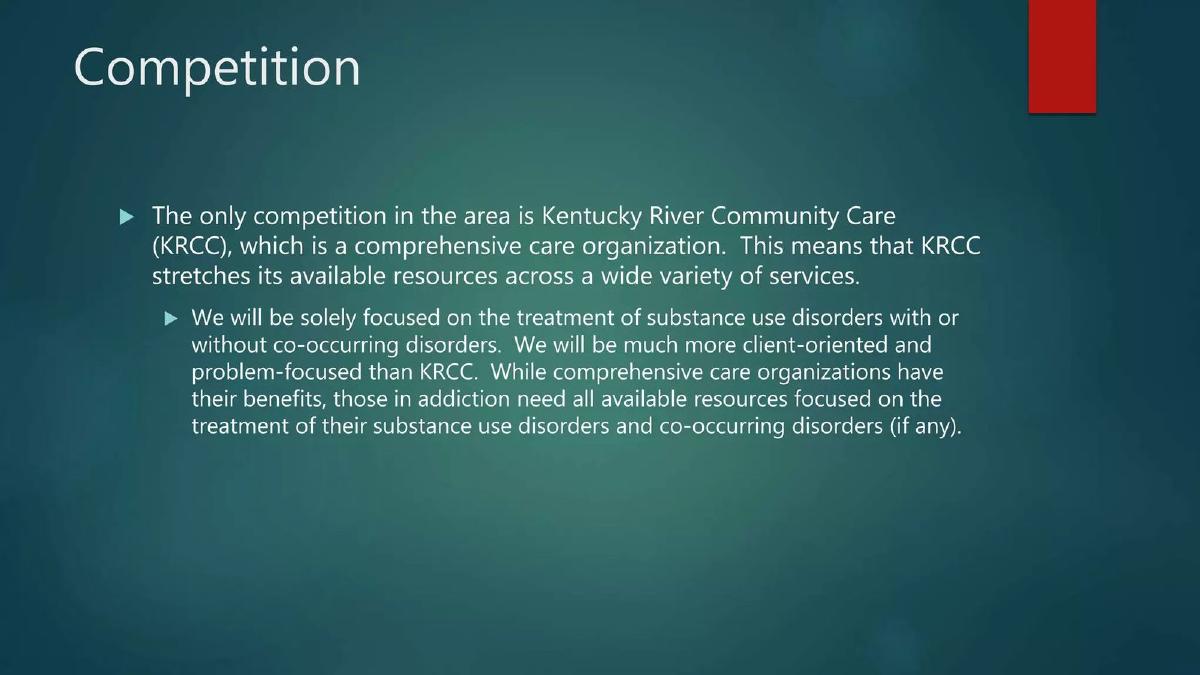
- The company identifies Kentucky River Community Care (KRCC) as its only local competitor, arguing that KRCC's broad focus dilutes its effectiveness in addiction recovery (Slide 6).
- Growth is tied directly to headcount, with plans to hire one full-time clinician in year one and another in year two to double capacity (Slide 7).
- Financial projections estimate a jump from $11,000 in net profit for late 2018 to $276,179 by 2021 (Slide 10).
- The team includes a Program Director with counseling experience dating back to the 1980s and a Lead Clinician with a background in law enforcement and EMS (Slide 8).
- The deck concludes with a binary 'Key Issue': the business requires financial support to become operational or it will likely fail (Slide 12).
- There is a notable absence of a specific 'Ask' amount or a breakdown of how startup capital will be deployed (Slide 12).
Executive Summary and Business Concept
Slides 1-3: The Mission of Recovery
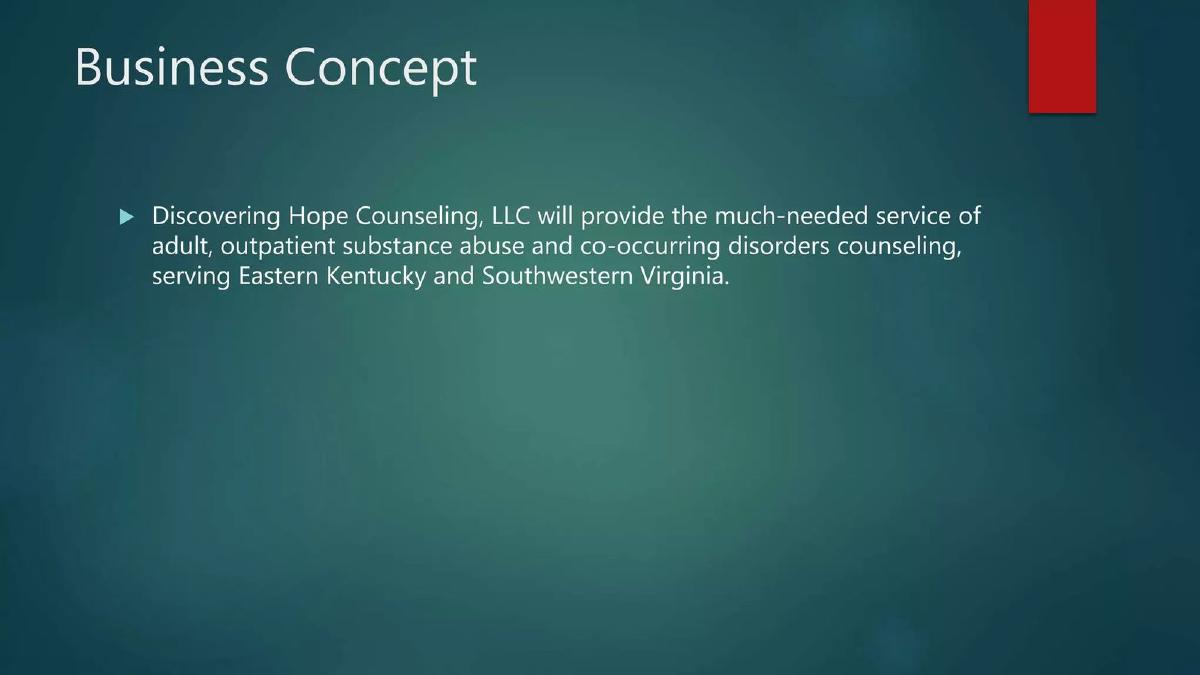
The deck opens with a straightforward title slide for Discovering Hope Counseling, LLC , followed immediately by the Business Concept on Slide 2. The concept is localized and specific: providing adult, outpatient substance abuse and co-occurring disorders counseling to Eastern Kentucky and Southwestern Virginia. This geographic focus is a recurring theme throughout the presentation, suggesting the business is designed as a regional service provider rather than a scalable technology platform.
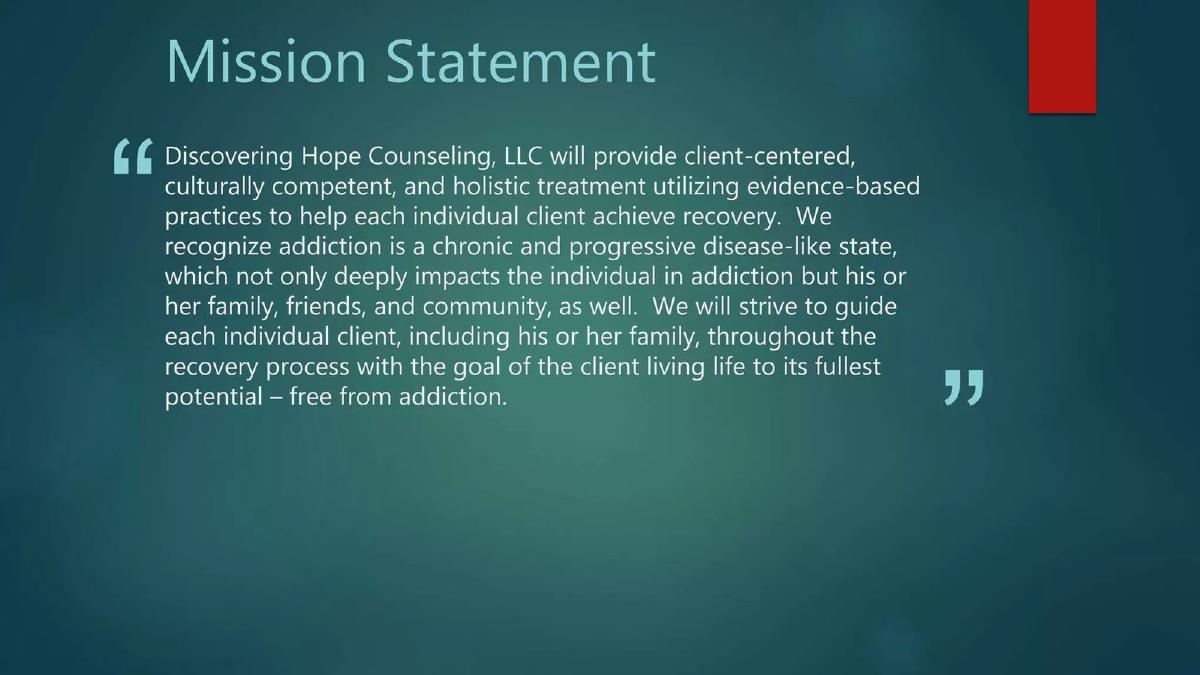
Slide 3 presents the Mission Statement . It emphasizes a "client-centered, culturally competent, and holistic treatment" approach using evidence-based practices. The mission frames addiction as a "chronic and progressive disease-like state" that impacts not just the individual, but their family and community. The language here is standard for the healthcare and counseling industry, signaling to investors or partners that the founders adhere to modern clinical perspectives on recovery.
Market Analysis and Opportunity
Slides 4-5: The Addiction Epidemic and Local Barriers
Slide 4, Market Summary , uses data from the 2014 National Survey on Drug Use and Health (NSDUH) to establish the scale of the problem. It notes that 21.5 million Americans battled substance use disorders in 2014, with only approximately 10% receiving treatment. While these are national figures, the slide anchors the target market to the "coalfield regions" of Kentucky and Virginia. By citing that only half of those who get treatment stay in recovery, the deck highlights a clear need for better long-term support systems.
Slide 5, Opportunities , transitions from national statistics to local pain points. The founders identify three critical gaps in the current market: underserved geography (clients traveling 30+ minutes), transportation barriers for those in addiction, and financial barriers . A key differentiator mentioned here is that dhc will accept insurance and offer a sliding scale fee for those without it. The slide explicitly states that other local agencies often require cash payments in addition to insurance, leading to high dropout rates when clients run out of funds.
Slide 6: Competitive Landscape
The Competition slide identifies a single primary competitor: Kentucky River Community Care (KRCC). The critique of KRCC is that it is a "comprehensive care organization," meaning its resources are spread thin across many different types of services. dhc positions itself as a specialist firm that will be "solely focused" on substance use disorders. This is a classic niche strategy: competing against a large generalist by offering deeper expertise and a more focused client experience.
Operational Strategy and Team
Slides 7-9: Scaling Through Headcount
Slide 7, Goals and Objectives , outlines a clear growth path based on clinical capacity. The plan involves hiring one additional full-time clinician within the first year and another in the second year. The slide also mentions the objective of obtaining accreditation from bodies like the Commission on Accreditation of Rehabilitation Facilities (CARF) or The Joint Commission within one year of licensing. This shows an understanding of the regulatory and quality-control milestones required in healthcare.
The Team (Slide 8) and Team Organization Chart (Slide 9) provide the human context. The leadership includes Andrew Rose, who combines clinical psychology education with law enforcement and EMS experience, and Vikki Bonyata, a PhD-level clinician with experience dating back to the 1980s. Lynsey Rose serves as CEO/COO, bringing experience in insurance and addiction services. The organization chart shows a lean structure that scales by adding "Clinicians" under the Lead Clinician and Program Director, supported by office and billing staff.
Financials and Risk Assessment
Slides 10-12: Projections and the Funding Gap
Slide 10, Financial Plan , provides a four-year outlook. The projections are predicated on clinicians maintaining full caseloads. The growth is substantial: Projected Sales rise from $187,200 in the first full year (2019) to $494,400 by the third year (2021). Projected Net Profit follows a similar trajectory, growing from $43,807 to $276,179. These figures suggest a high-margin service model once the initial overhead is covered and clinicians are fully utilized.
Slide 11, Risks and Rewards , is perhaps the most optimistic part of the deck. The founders claim the "only significant risk" is maintaining a full caseload. They dismiss this risk by pointing back to the shortage of clinicians in the area and their plan for targeted marketing. This section lacks a discussion of regulatory changes, insurance reimbursement rate fluctuations, or the difficulty of recruiting qualified clinicians in rural areas.
The deck concludes with Key Issues on Slide 12. The "Near term" issue is a binary need for financial support to become operational. The "Long term" section states, "There are no identifiable, long-term issues to address." For a professional investor, this lack of long-term risk identification might be a red flag, as it suggests a potential oversight of the complexities involved in scaling a healthcare business.
What Works and What is Missing
What Works
Clear Geographic Niche: The deck does an excellent job of explaining why Eastern Kentucky and Southwestern Virginia are specific areas of need. · Headcount-Driven Growth: The link between hiring clinicians and increasing revenue is logical and easy to follow. · Competitive Differentiation: Identifying the specific weaknesses of the local incumbent (KRCC) gives the business a clear reason to exist.
What is Missing
The Specific Ask: While Slide 12 mentions the need for "financial support," it never specifies how much money is being raised or what the terms are. · Use of Funds: There is no breakdown of how the initial capital will be spent (e.g., facility lease, licensing fees, initial marketing, or working capital). · Recruitment Strategy: In rural healthcare, finding and retaining qualified PhD or licensed clinicians is often a major hurdle. The deck assumes these hires will be made easily. · Unit Economics: While total sales are projected, the deck does not show the revenue per patient session or the cost of acquisition per patient.
Founder Takeaways
Founders building service-based businesses should look at how dhc uses local market gaps to justify their entry. By focusing on the specific pain point of "cash payments" and "travel time," dhc makes a compelling case for a new entrant in a market with only one major player. However, founders should avoid the pitfall of Slide 12; claiming there are "no identifiable long-term issues" rarely rings true to investors. A more robust deck would acknowledge risks like staffing shortages or regulatory shifts and explain how the company plans to mitigate them. Finally, always include a specific dollar amount for your funding request to ensure the pitch leads to a concrete call to action.
Frequently asked questions
- What is the primary problem dhc is trying to solve?
- According to Slide 5, the primary problem is a lack of accessible addiction treatment in underserved regions. The founders note that existing agencies often do not accept insurance, requiring cash payments that clients cannot afford. Additionally, the lack of local providers forces clients to travel 30 minutes or more, which is a significant barrier for those without reliable transportation.
- How does dhc plan to differentiate itself from the incumbent, KRCC?
- Slide 6 explains that while Kentucky River Community Care is a comprehensive care organization, its resources are stretched across many services. dhc intends to focus solely on substance use and co-occurring disorders. The founders argue this specialization allows them to be more 'client-oriented and problem-focused' than a generalist agency.
- What are the projected financials for the first three years?
- Slide 10 projects sales of $64,200 for the end of 2018, $187,200 for 2019, $340,800 for 2020, and $494,400 for 2021. Net profits (before taxes) are expected to scale from $11,000 in the initial four-month period to $276,179 by the third full year of operation.
- Who are the key members of the leadership team?
- The team consists of Andrew Rose (Executive Director and Lead Clinician), Vikki Bonyata (Program Director/Clinical Services Supervisor), and Lynsey Rose (CEO/COO). Vikki Bonyata is highlighted for having provided counseling services since the 1980s and holding a PhD, while Andrew Rose brings experience from law enforcement and emergency medical services (Slide 8).
- What is the biggest risk identified by the founders?
- Slide 11 states that the only significant risk is the intake and maintenance of a full client caseload. The founders mitigate this by claiming there is no shortage of clients in the area and that they will use targeted marketing to attract referrals. Notably, Slide 12 claims there are 'no identifiable, long-term issues to address' beyond initial funding.