Desert Haven Women & Children’s Foundation presents a highly structured, compliance-focused pitch deck for a non-profit housing initiative in Nevada. The organization targets two specific sites—Roach and Winchester—to provide 32 total units of transitional and affordable housing. The financial model is heavily dependent on government grants, with 86.5% of Year 1 revenue ($1,435,500) projected to come from five HUD programs. The deck excels at demonstrating regulatory knowledge, citing specific CFR parts and HUD compliance requirements, which is critical for this sector. However, the plan lack…
Key takeaways
- The foundation targets two distinct Nevada locations: Roach (12 transitional units) and Winchester (20 affordable units), as shown on slide 3.
- Revenue is highly concentrated in federal grants, with HUD programs like CDBG, HOME, and HTF accounting for the majority of the $1,435,500 Year 1 budget (slide 7).
- The organization positions itself as a first-mover in Roach, NV, claiming to be the only housing non-profit in that rural market (slide 4).
- A detailed staffing plan for Year 1 outlines 15.0 FTEs with a total cost of $845,000, including two Licensed Clinical Social Workers (slide 6).
- The financial model projects a net surplus growing from $636,500 in Year 1 to $689,000 by Year 4 (slide 8).
- Break-even is achieved at 22 units, representing a 68.75% occupancy rate, which provides a $421K safety margin in Year 1 (slide 9).
- The strategy leverages a rural Opportunity Zone designation (OBBBA) starting in January 2027 to attract private equity and reduce capital costs by 20-35% (slide 10).
- There is no team slide included in the 10-slide sample, omitting the names and backgrounds of the Executive Director and Board.
Executive Summary: A Compliance-Driven Housing Model
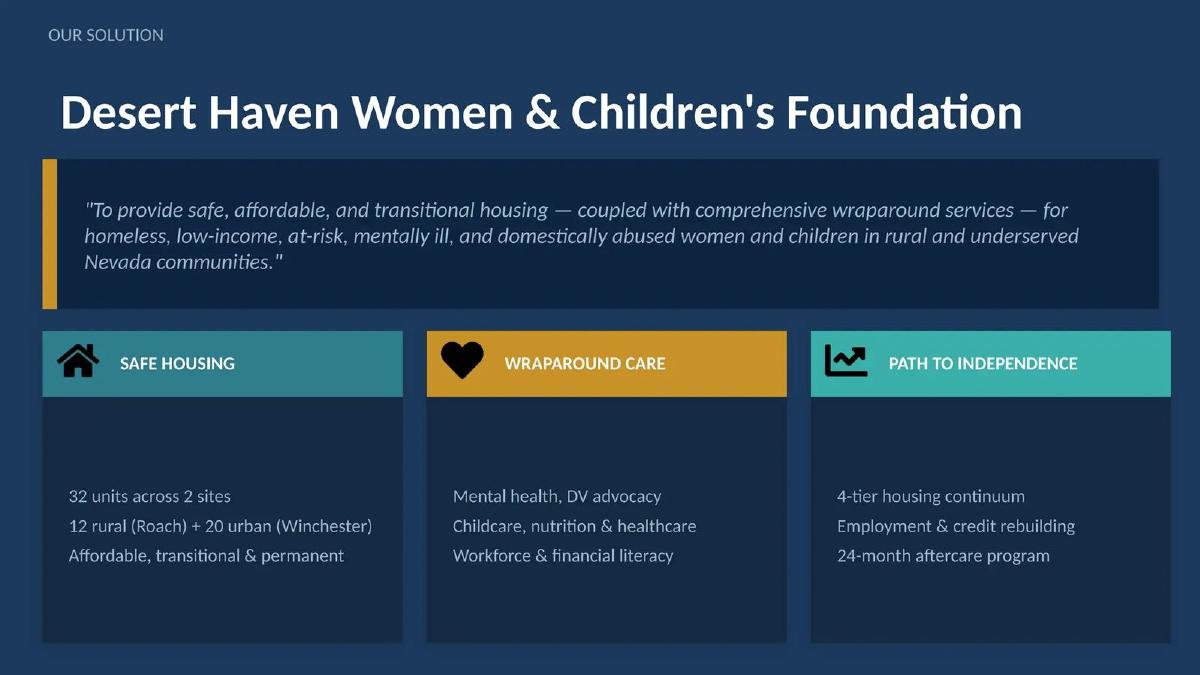
Desert Haven Women & Children’s Foundation presents a pitch deck that reads more like a government grant application than a traditional venture capital deck. This is appropriate given their target audience: HUD reviewers and social impact investors. The deck focuses heavily on regulatory compliance, geographic necessity, and a diversified (though government-heavy) revenue stream. The primary value proposition is the creation of 32 housing units in underserved areas of Clark County, Nevada, specifically targeting the rural gap in Roach and the high-poverty needs of Winchester.
Slide 1: Title and Scope
The cover slide establishes the organization as a provider of affordable and transitional housing for at-risk women and children. It explicitly mentions two locations: Roach, Nevada, and Winchester, Nevada. Notably, the slide states it is 'For HUD Review' and references the 'HUD CPD Consolidated Plan FY 2026–2031.' It lists several federal funding acronyms—CDBG, HOME, HTF, ESG, and HOPWA—signaling immediately that this is a project built on the backbone of federal housing policy.
Slide 2: Target Population
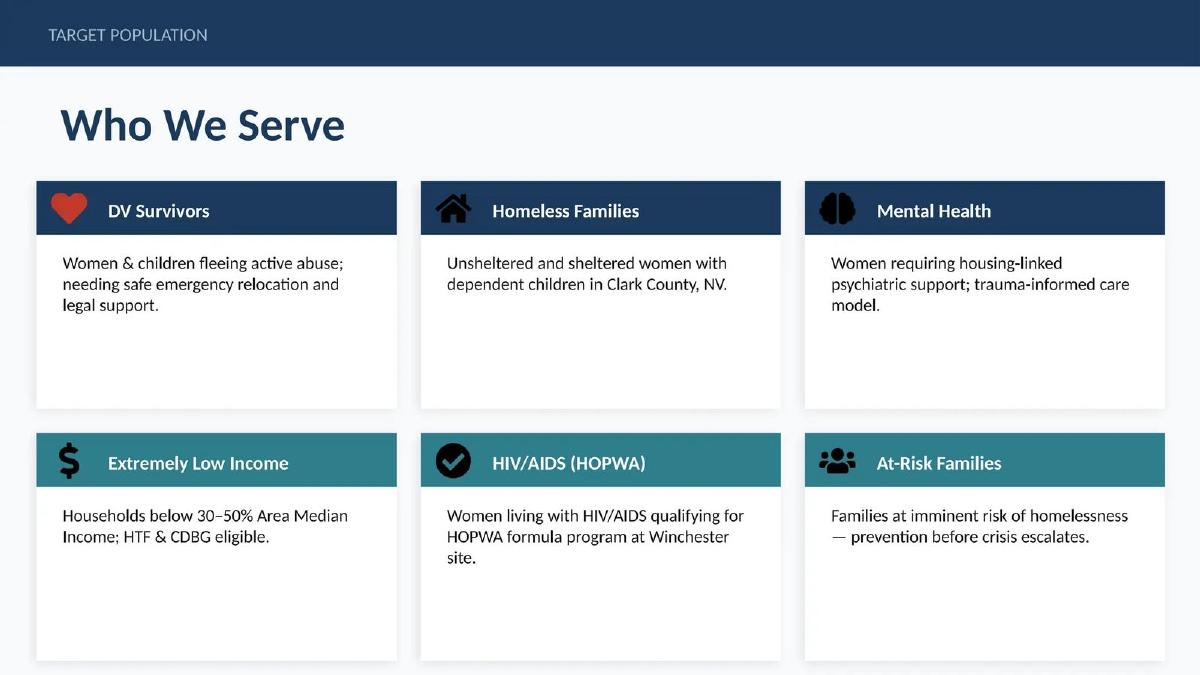
The 'Who We Serve' slide breaks the target demographic into six categories. It emphasizes trauma-informed care for DV survivors and mental health support. It also specifies the economic threshold: households below 30-50% of the Area Median Income (AMI). This specificity is crucial for qualifying for the HTF (Housing Trust Fund) and CDBG (Community Development Block Grant) eligibility mentioned on the slide.
Slide 3: Service Locations
This slide provides a side-by-side comparison of the two strategic sites. The Roach site is described as 'Rural' and the 'First dedicated housing service in the area,' located 45 miles from the nearest DV shelter. It will house 12 transitional units. The Winchester site is 'Unincorporated,' near the Las Vegas job market, and will house 20 affordable units, including a wing for HIV/AIDS patients. The total unit count is 32.
Slide 4: Competitive Advantage
Under the heading 'Why Desert Haven Wins,' the foundation lists six advantages. The most significant are the 'First-mover advantage' in the rural Roach market and 'Regulatory Expertise.' The slide cites compliance with '24 CFR Parts 91, 92, 93, 570, 574, 576,' which demonstrates a deep understanding of the bureaucratic requirements for federal housing funds. It also introduces the 'Asset-Building Model,' claiming $2.4M+ in owned real estate by Year 2 with zero debt.
Slide 5: Wraparound Services
Housing is rarely successful for at-risk populations without support. This slide details the 'Comprehensive Support Services,' including mental health (2 LCSWs), DV intervention, childcare (ages 0-5), nutrition (food pantry), workforce development, and transportation. The inclusion of '2 org vehicles' for medical and court appointments addresses a common barrier to stability for rural or low-income residents.
Slide 6: Staffing Plan
The Year 1 Staffing Plan is highly detailed, listing 15.0 Full-Time Equivalents (FTE). The total cost is projected at $845,000. The breakdown includes an Executive Director ($82,000 salary), a Program Director ($68,000), and three Housing Case Managers ($46,000 each). A footnote clarifies that the Year 1 income statement reflects a partial 6-month operation cost of $318K, while the $845K figure represents the full annualized cost.
Slide 7: Revenue Mix
This slide is the core of the financial argument. The Year 1 Revenue Mix is $1,435,500. A pie chart shows that 86.5% of this comes from five HUD programs. The largest contributors are HOME ($420,000 or 29.3%) and HTF ($380,000 or 26.5%). Private foundations and donations account for only 7.5% and 3% respectively. This highlights a significant reliance on government funding, which is both a strength (stability) and a risk (political/budgetary changes).
Slide 8: Financial Projections
The deck projects steady growth over four years. Revenue is expected to rise from $1,435,500 in Year 1 to $1,864,000 in Year 4. Expenses also rise, but at a slower rate, leading to an 'Annual Net Surplus' that grows from $636,500 to $689,000. The surplus is intended to build the foundation's equity and sustainability, rather than being distributed as profit.
Slide 9: Break-Even Analysis
The foundation claims to achieve break-even in Year 1. The 'Break-Even Occupancy Rate' is 68.75%, or 22 out of 32 units. With an annual revenue need of $1,014K to break even, the projected revenue provides a 'Safety Margin' of $421K (29.4% above break-even). The chart visualizes the intersection of revenue and costs, emphasizing that the grant-subsidized model reduces occupancy risk compared to market-rate operators.
Slide 10: Long-Term Sustainability
The final slide in the sample outlines the strategy for the future. Key pillars include 'Real Property Equity' (owning the assets debt-free), 'Opportunity Zone Leverage' (attracting private equity via the OBBBA designation in 2027), and an 'Endowment Campaign' targeting a $500K launch in Year 3. It also mentions 'Earned Revenue Growth,' where program fees are projected to triple as residents achieve employment and pay on a sliding scale.
What Works in This Deck
Regulatory Fluency: The deck uses the language of its primary funders. By citing specific HUD programs and CFR parts, the founders demonstrate they are not amateurs; they understand the complex reporting and compliance landscape of federal housing.
Geographic Specificity: The choice of Roach, NV, is well-defended. Identifying a 45-mile gap in service for DV survivors creates a compelling 'why now' and 'why here' narrative that appeals to both grantors and impact investors.
Granular Staffing: Many non-profit decks gloss over operational costs. By providing a line-item staffing budget with salaries and benefits, Desert Haven provides a realistic view of what it takes to run a high-touch service model.
What Is Missing
The Team: The most glaring omission in this 10-slide sample is a Team slide. In the non-profit world, the reputation and experience of the Executive Director and the Board of Directors are paramount. Without knowing who is leading the organization, it is difficult to assess the execution risk.
Capital Stack for Acquisition: The deck claims the organization will own $2.4M in real estate with 'zero debt' by Year 2. However, it does not explain how the land or buildings are acquired. Are they donated by the county? Is there a separate capital campaign not shown here? HUD grants typically fund operations or specific development costs, but the 'zero debt' claim suggests a massive upfront equity injection that isn't fully explained in the revenue mix.
Community Partnerships: While Three Square Food Bank is mentioned, the deck would benefit from listing formal MOUs (Memorandums of Understanding) with local law enforcement, hospitals, or the Clark County government to prove local buy-in.
Founder Takeaways
Speak the Language of Your Funder: If you are chasing government money, your deck should look like this one. Use the acronyms, cite the regulations, and align your goals with the 'Consolidated Plan' of the agency you are pitching. Quantify the 'Safety Margin': Slide 9's break-even analysis is an excellent way to show financial resilience. Showing that you only need 68% occupancy to survive gives donors confidence that their money won't be wasted if the program takes time to scale. Diversify Early: Even though they are 86% grant-funded, the inclusion of an endowment plan and sliding-scale fees (Slide 10) shows a forward-thinking approach to sustainability that moves beyond the next grant cycle.
Frequently asked questions
- How does Desert Haven plan to fund its operations?
- According to slide 7, the foundation relies on a 'Multi-Grant Revenue Model.' For Year 1, 86.5% of the $1,435,500 total revenue comes from five HUD programs: HOME (29.3%), HTF (26.5%), CDBG (19.5%), ESG (6.6%), and HOPWA (4.7%). The remaining funds come from state grants, private foundations, and donations. Slide 10 also mentions a future $500K endowment campaign and sliding-scale program fees to diversify income.
- What specific populations does this foundation serve?
- Slide 2 identifies six target groups: domestic violence survivors, homeless families in Clark County, women requiring psychiatric support, households below 30-50% Area Median Income, women living with HIV/AIDS (via the HOPWA program), and families at imminent risk of homelessness. The Winchester site specifically includes a wing designated for the Housing Opportunities for Persons With AIDS (HOPWA) program (slide 3).
- What is the geographic focus of the project?
- The project is centered in Clark County, Nevada. Slide 3 details two sites: Roach, a rural area where they will provide 12 transitional units, and Winchester, an unincorporated area near the Las Vegas job market where they will provide 20 affordable housing units. The Roach site is noted as being approximately 45 miles from the nearest domestic violence shelter.
- What wraparound services are provided beyond housing?
- Slide 5 outlines a 'Comprehensive Support Services' model. This includes mental health and trauma therapy provided by two Licensed Clinical Social Workers, DV advocacy and legal support, on-site childcare for ages 0-5, a weekly food pantry through a Three Square Food Bank partnership, workforce development, and transportation via two organizational vehicles for medical and court appointments.
- Is the financial model sustainable without constant fundraising?
- The deck argues for sustainability through 'Real Property Equity.' Slide 10 claims the foundation will own $2.4M+ in real estate with zero mortgage debt by Year 5. Additionally, slide 8 shows that annual revenue is projected to consistently exceed expenses, leading to a net surplus. However, the model remains heavily reliant on the successful renewal of competitive federal grants to maintain this surplus.