diabetesProject presents a hardware-centric solution for the diabetic community, utilizing a physical hub to collect data from partner products like glucose meters and food scales. The core value proposition, as described on slide 2, is the compilation of this data for sale to insurance companies and researchers. The business model relies on insurers providing financial rewards to patients for healthy behavior changes, creating a feedback loop illustrated on slide 3. While the deck identifies a clear path through the Virginia market first (slide 6), it lacks a team slide, specific unit econom…
Key takeaways
- The product is a physical home hub designed to aggregate data from third-party devices like blood glucose meters and food scales (Slide 2).
- The business model relies on a four-way data and value exchange between the patient, the hub, the company, and insurance providers like Anthem (Slide 3).
- Initial market entry is hyper-localized, targeting diabetics in Virginia before expanding to other states (Slide 6).
- The company identifies insurance companies as the primary 'Organizational Market' that will buy hubs to distribute to their members (Slide 6).
- Short-term financials project a starting capital of $70,000.00 with a monthly burn of -$10,000.00, leading to zero capital by month 7 (Slide 8).
- Long-term projections show a massive capital influx of approximately $50,000,000.00 in Quarter 3, though the deck does not specify if this is a series A round or a large contract (Slide 9).
- The deck explicitly acknowledges that the product is a 'discontinuous innovation' which may be hard for the market to foster (Slide 5).
- There is no mention of the founding team, their medical expertise, or technical background in the provided slides.
diabetesProject Deck Analysis
The diabetesProject pitch deck describes an integrated hardware and data service platform designed to sit at the intersection of diabetic patients and health insurance providers. The core of the offering is a physical hub that serves as a data aggregator for various medical and lifestyle devices. By centralizing this data, the company aims to provide insurers with the insights necessary to incentivize healthier behaviors through financial rewards, theoretically lowering long-term costs for the healthcare system.
Slide 1: Title and Branding
The opening slide features the company logo, which incorporates the acronym 'HSC' (Health, Security, Community) set against a shield and a green medical cross encircled by a blue ring. The tagline 'Health. Security. Community.' establishes the three pillars of the brand. The blue circle is later identified as a symbol for the diabetic community.
Slide 2: Product Overview
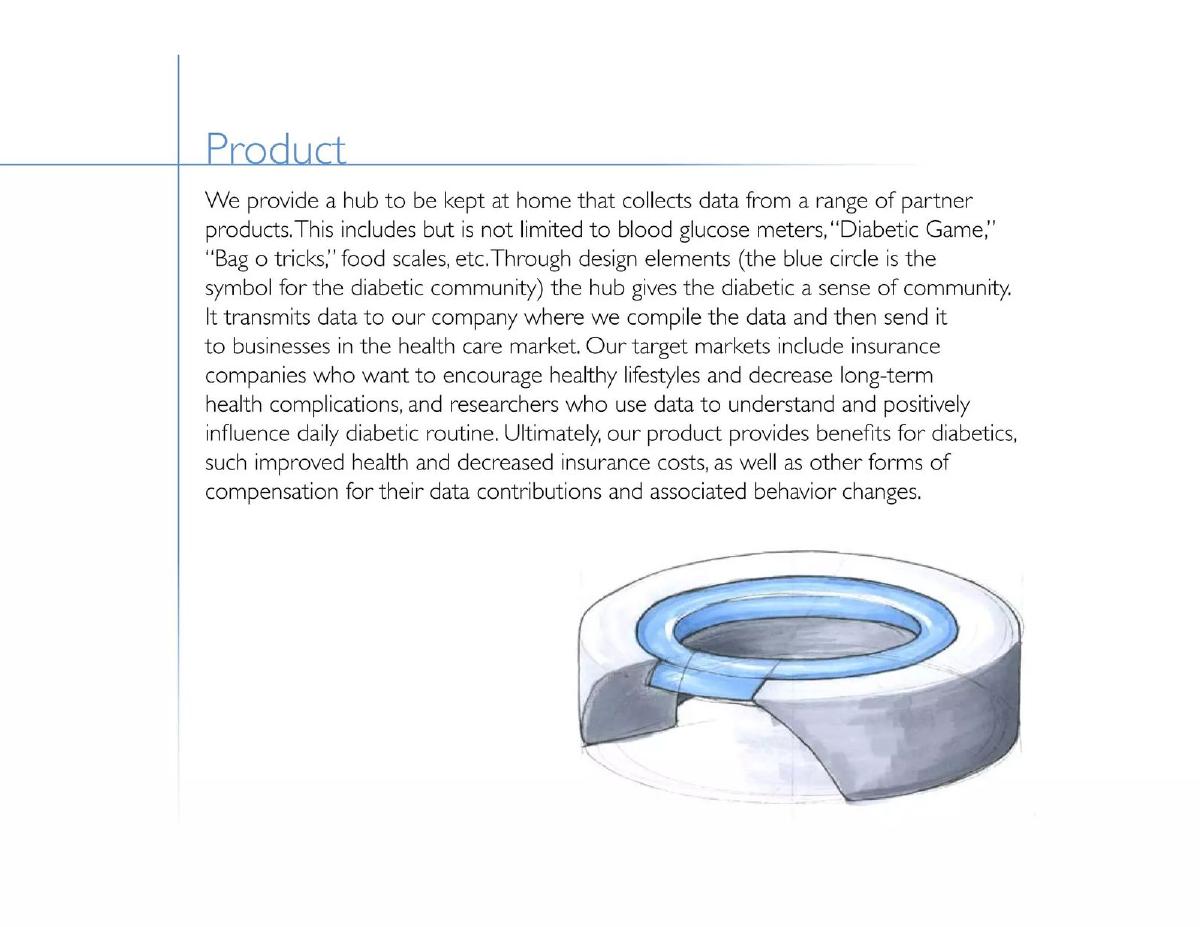
Slide 2 defines the product as a 'hub to be kept at home.' The text specifies that this hub collects data from partner products, including blood glucose meters and food scales. It also mentions 'Diabetic Game' and 'Bag o tricks,' which appear to be proprietary software or accessory components. The slide explicitly states the business goal: to compile data and send it to businesses in the healthcare market, specifically insurance companies and researchers. The stated benefit for the patient is 'improved health and decreased insurance costs.'
Slide 3: The Business Ecosystem
This slide uses a flow diagram to explain the value chain. Data flows from a glucose meter to the home hub, then to the HSC company, and finally to an insurance provider (represented by the Anthem logo). In return, the insurance provider sends 'rewards' and '$' back to the family. This visualizes a B2B2C model where the insurer is the primary payer, and the patient is the data provider and beneficiary of incentives.
Slide 4: Market Segmentation
Titled 'Possible Markets,' this slide lists potential stakeholders. While it lists 'Diabetics' and 'Insurance Companies' as the primary targets, it also identifies physicians, researchers, dieticians, and charitable foundations as secondary markets. The text notes that the initial effort will focus on U.S. diabetics and their insurers before branching out to healthcare facilities.
Slide 5: Strategic Challenges
This slide addresses the 'Keys to Success' and 'Critical Issues.' The founders admit that the service is 'intangible' and requires significant marketing communication to explain. Most notably, they categorize their product as a 'relatively discontinuous innovation,' which is a marketing term for a product that requires consumers to significantly change their behavior. They also cite medical data confidentiality laws as a major macroenvironmental factor.
Slide 6: Target Demographics and Rollout
Slide 6 provides more granular detail on the target market. The 'Consumer Market' is defined as Type 1 and Type 2 diabetics who are 'frustrated with the process of obtaining coverage.' The rollout strategy is geographic: starting in Virginia before expanding. The 'Organizational Market' consists of insurance companies who will 'buy the hubs to distribute to diabetics.' This clarifies that the patient is not expected to purchase the hardware out-of-pocket.
Slide 7: Insurance Sales Strategy
This slide focuses on the B2B sales approach. It notes that since there is 'usually only one insurance company/state,' the company will use sales representatives to target these specific entities. They also plan to use trade shows to demonstrate the 'ease of our service' to the broader insurance market, suggesting a goal of creating a competitive market where insurers use this tool to attract and manage diabetic members.
Slide 8: Short Term Financials
The short-term financial table shows a 7-month runway. The company starts with $70,000.00 in capital (after an initial $80,000.00 revenue event in Month 0, which is not explained). With a consistent monthly expense of -$10,000.00 and zero revenue for the following seven months, the capital is depleted to $0.00 by Month 7. This suggests a pilot phase or a development period with no recurring income.
Slide 9: Long Term Financials
The final slide in this set shows a quarterly projection up to Quarter 16. A massive spike in 'Projected Capital' occurs in Quarter 3, jumping from near zero to $50,000,000.00. This likely represents a planned venture capital raise or a massive upfront contract. Following this spike, capital decreases as expenses rise, but quarterly revenues (blue line) eventually climb to $20,000,000.00, with quarterly profits (yellow line) reaching approximately $10,000,000.00 by the end of the period.
What diabetesProject Does Well
The deck is very clear about the data flow. By using a visual diagram on slide 3, the founders eliminate confusion about how a physical hub translates into a financial business model. They also show a pragmatic understanding of the insurance landscape, recognizing that insurance is often a state-by-state sale and identifying the specific 'Organizational Market' as the actual purchaser of the hardware. The geographic focus on Virginia for the pilot suggests a disciplined approach to go-to-market rather than trying to boil the ocean on day one.
What is Missing from the Deck
The most glaring omission in these nine slides is a Team Slide . In healthcare and IoT, the credentials of the founders—specifically in medical data compliance (HIPAA) and hardware engineering—are critical. There is also no Competition Slide ; the deck operates as if no other remote patient monitoring (RPM) solutions exist. Furthermore, there is no Unit Economics breakdown. While we see total expenses, we don't know the Bill of Materials (BOM) for the hub or the expected Life Time Value (LTV) of the data sold to insurers. Finally, there is no Ask Slide . The financial projections show a need for capital, but the deck does not state how much they are raising or what the milestones for that funding will be.
Founder Takeaways: What to Copy
Visualizing the Ecosystem: If your business involves multiple stakeholders (patient, insurer, researcher), use a flow diagram like Slide 3 to show how value and data move between them. · Phased Rollout: Don't just say 'The U.S. Market.' Specifying a single state (Virginia) for a pilot makes your execution plan feel more grounded and achievable. · Acknowledging Innovation Type: Identifying the product as a 'discontinuous innovation' shows a high level of self-awareness regarding the difficulty of changing consumer behavior.
Founder Takeaways: What to Avoid
Unexplained Financial Spikes: If your chart shows a $50 million jump in capital (Slide 9), you must explain if that is a fundraise, a grant, or a contract. Leaving it unexplained looks like a typo or a fantasy. · Vague Product Names: Terms like 'Diabetic Game' and 'Bag o tricks' (Slide 2) are too informal for a medical pitch and should be replaced with descriptive functional names. · Ignoring the 'Who': Never send a deck without a team slide. Investors invest in people first, especially when the product involves complex medical hardware.
Frequently asked questions
- What is the primary function of the diabetesProject hub?
- According to slide 2, the hub acts as a central data collector for a range of partner products. It specifically mentions blood glucose meters, food scales, and proprietary concepts like 'Diabetic Game' and 'Bag o tricks.' The hub then transmits this compiled data to the company, which processes it for sale to insurance companies and researchers.
- How does the company plan to generate revenue?
- The revenue model is two-pronged. First, insurance companies are expected to buy the physical hubs to distribute to their diabetic members (Slide 6). Second, the company sells the compiled data to these insurers and researchers. Slide 3 illustrates that insurers then provide financial rewards to the users based on the data received.
- What are the biggest risks identified by the founders?
- Slide 5 lists several 'Critical Issues' and 'Macroenvironmental Factors.' The founders note that because the service is intangible, it is difficult to communicate the benefits. They also highlight the legal and regulatory hurdles regarding the confidentiality of medical data and the difficulty of fostering adoption for a 'discontinuous innovation.'
- What is the geographic strategy for the rollout?
- The company plans a phased rollout starting in Virginia. Slide 6 states they will target diabetics in Virginia first before moving to other states. This localized approach is mirrored in their sales strategy for insurance companies, noting there is usually only one major insurance company per state to target (Slide 7).
- What do the financial projections indicate about the company's scale?
- The financials suggest a small-scale pilot followed by a massive jump. Slide 8 shows a modest $70,000 starting capital. However, slide 9 shows quarterly revenues eventually reaching $20,000,000.00 and quarterly profits stabilizing around $10,000,000.00 by Quarter 10, indicating an expectation of rapid, high-margin scaling.