Value Proposition Slide: 6 Real Pitch Deck Examples
What a value proposition slide should say: who gets what outcome, and why they should believe it.
Value Proposition Slide: Outcomes for a Named Customer, Not Features
Some decks give the value proposition its own slide, separate from the solution. The six real slides below show three things that decide whether it works: whether it names who benefits, whether it states outcomes rather than features, and whether anything on the slide makes the claim believable.
TL;DR
A value proposition slide should say who the customer is, what outcome they get, and give one reason to believe it. Brandslip and 4.screen split the slide by side of their market, so each group sees its own benefit. The Plate writes three outcomes for food creators, such as a reliable monthly income. Elite Events is the only example that adds proof: 1,000+ attendees per event and named sponsors. HSC for Diabetics states the buyer and the outcome in one sentence but gives no evidence. MySwimPro lists features (training plans, videos, watch compatibility) and leaves the investor to work out the benefit. Name the customer, write the outcome in their words, and add one fact that supports it.
Value proposition slides from real pitch decks
Each example shows the exact stored slide above its analysis and links to the full teardown. Claims are as shown on the slides; we have not verified them. Stage and year are given only where the slide or deck states them.
Elite Events solution slide — slide 3
Event company running after-parties at conferences. Stage and year are not stated on the slide.
Elite Events deck, slide 3. Exact stored slide matched to this analysis.
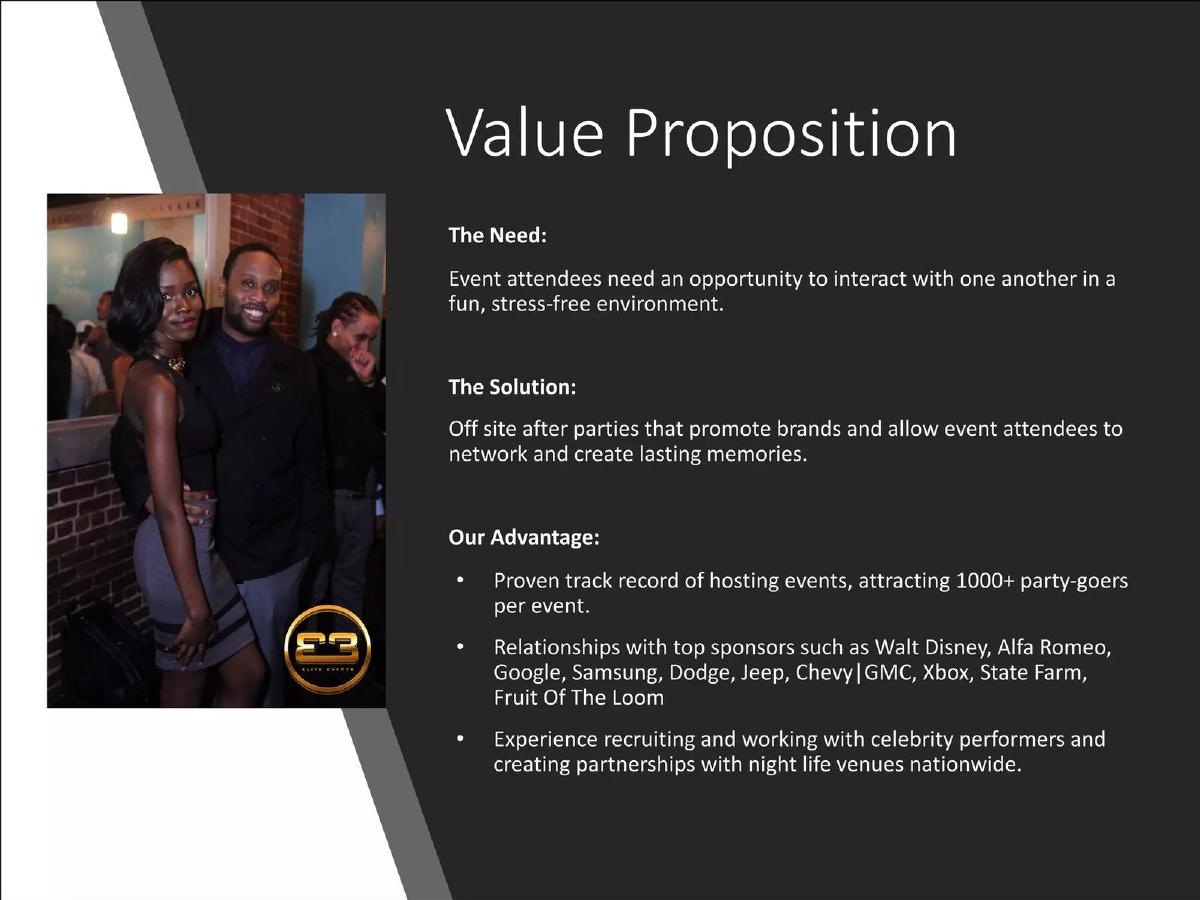
Our analysis: It is the only slide here with evidence: an attendance figure and named sponsors back up the claim.
Evidence and limitation: The value to sponsors, who likely pay, is only implied ("promote brands"). Say what a sponsor gets, such as reach or leads.
What a founder can adapt: Follow need, offer, proof. Put your best number and best-known customer or partner under the claim.
Supporting analysis
What the deck claims: "Value Proposition" in three parts. The Need: "Event attendees need an opportunity to interact with one another in a fun, stress-free environment." The Solution: "Off site after parties that promote brands and allow event attendees to network and create lasting memories." Our Advantage: "Proven track record of hosting events, attracting 1000+ party-goers per event", sponsors including Walt Disney, Alfa Romeo, Google, Samsung and Xbox, and experience with celebrity performers and venues.
Presentation choice: It is the only slide here with evidence: an attendance figure and named sponsors back up the claim.
When it does not fit: The value to sponsors, who likely pay, is only implied ("promote brands"). Say what a sponsor gets, such as reach or leads.
Marketplace connecting brands with social media influencers. Stage and year are not stated on the slide.
Brandslip deck, slide 5. Exact stored slide matched to this analysis.
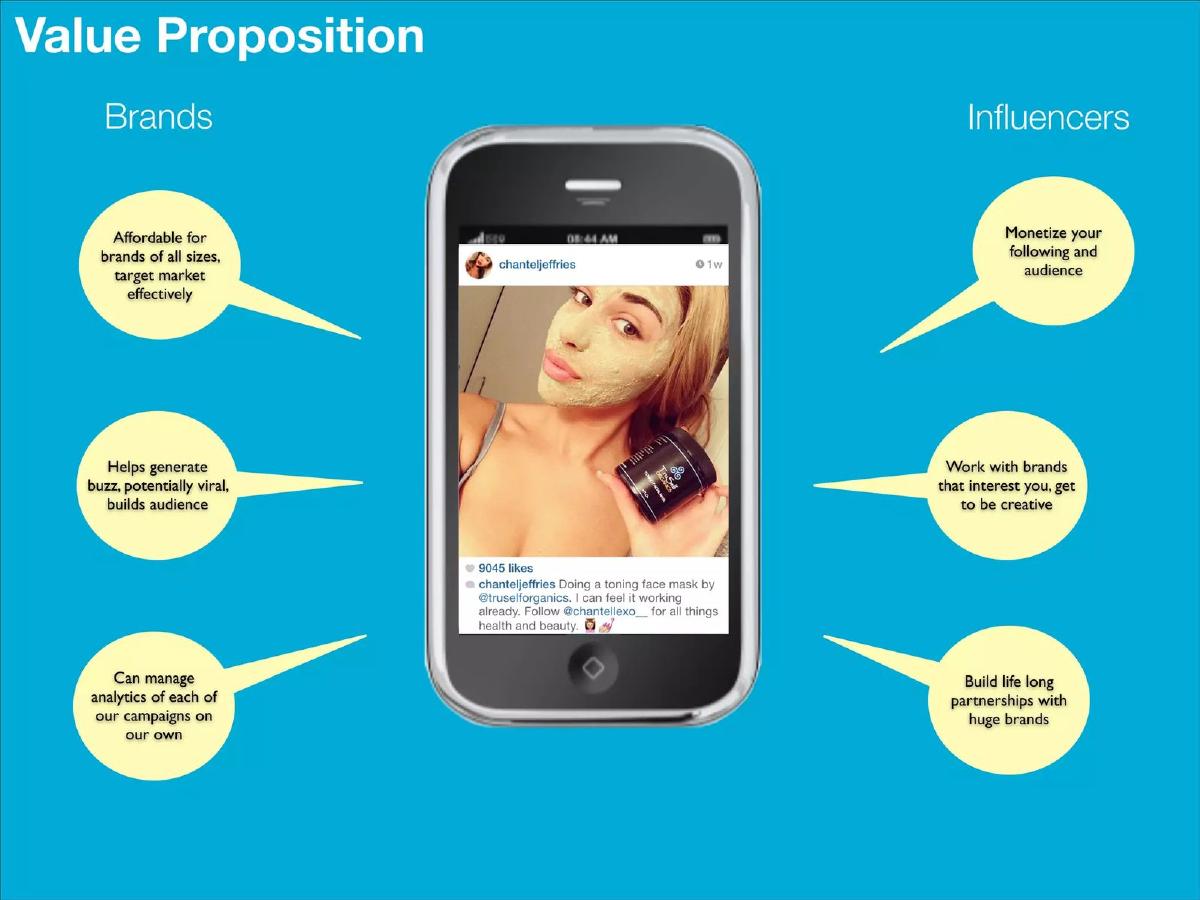
Our analysis: Each side of the marketplace gets its own three benefits, and the phone shows what a campaign looks like.
Evidence and limitation: "Potentially viral" and "affordable" have no number behind them. Add a price point or a campaign result.
What a founder can adapt: For a two-sided product, give each side its own column and write the benefits from their point of view.
Supporting analysis
What the deck claims: "Value Proposition" with Brands on the left and Influencers on the right, around a phone showing a sponsored Instagram post. Brands: "Affordable for brands of all sizes, target market effectively", "Helps generate buzz, potentially viral, builds audience", "Can manage analytics of each of our campaigns on our own". Influencers: "Monetize your following and audience", "Work with brands that interest you, get to be creative", "Build life long partnerships with huge brands".
Presentation choice: Each side of the marketplace gets its own three benefits, and the phone shows what a campaign looks like.
When it does not fit: "Potentially viral" and "affordable" have no number behind them. Add a price point or a campaign result.
In-car platform for businesses to reach drivers through the car's screen. Stage and year are not stated on the slide.
4.screen deck, slide 3. Exact stored slide matched to this analysis.
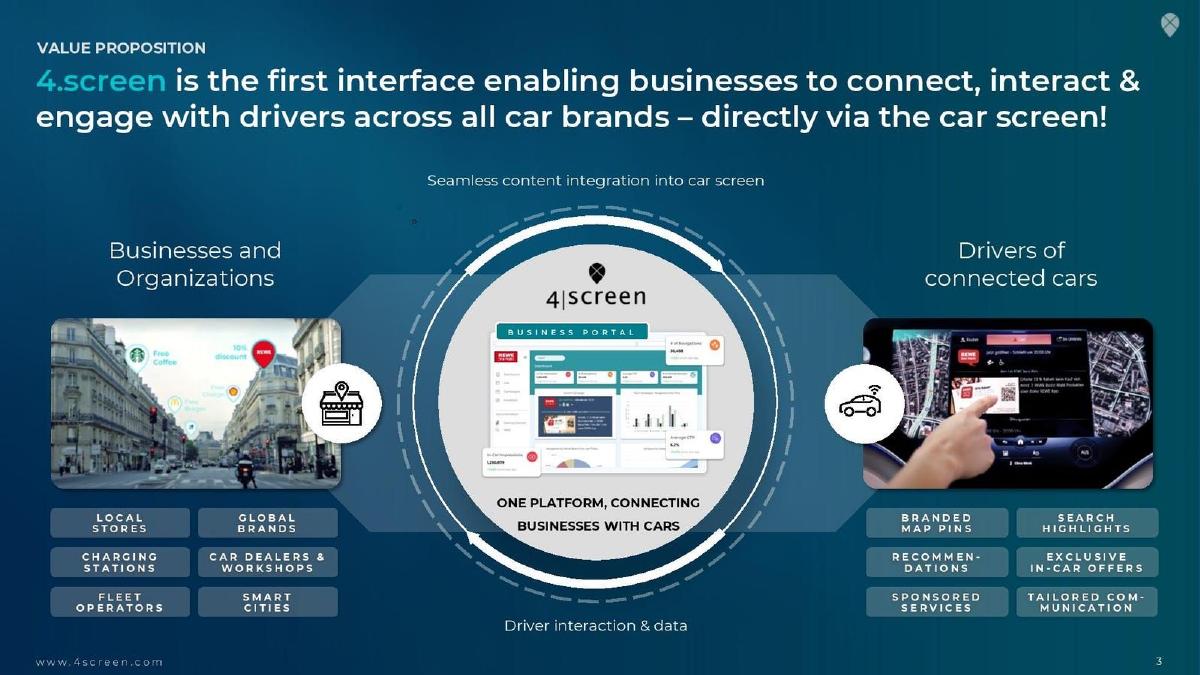
Our analysis: One headline sentence says who it connects and how, and the diagram names the customer types on each side.
Evidence and limitation: "First" and "across all car brands" are big claims with no support on the slide. Name the carmakers you are live with.
What a founder can adapt: Write a one-sentence headline, then list the specific customer types you serve.
Supporting analysis
What the deck claims: "4.screen is the first interface enabling businesses to connect, interact & engage with drivers across all car brands – directly via the car screen!" A diagram links "Businesses and Organizations" (local stores, global brands, charging stations, car dealers and workshops, fleet operators, smart cities) to "Drivers of connected cars" (branded map pins, search highlights, recommendations, exclusive in-car offers, sponsored services, tailored communication).
Presentation choice: One headline sentence says who it connects and how, and the diagram names the customer types on each side.
When it does not fit: "First" and "across all car brands" are big claims with no support on the slide. Name the carmakers you are live with.
Subscription platform for food creators. Stage and year are not stated on the slide.
The Plate deck, slide 4. Exact stored slide matched to this analysis.
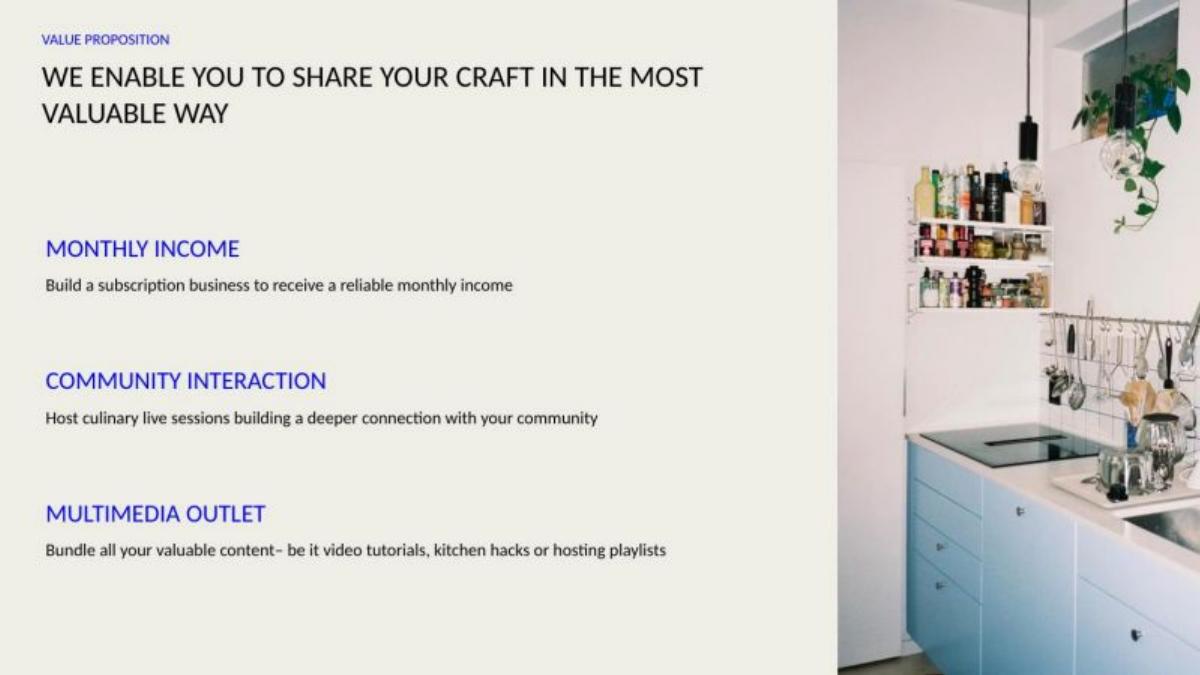
Our analysis: Each benefit is written as an outcome for the creator, and income comes first.
Evidence and limitation: Nothing shows that creators earn or want this. Add a creator count, earnings or a quote.
What a founder can adapt: Lead with the outcome your customer cares about most, usually money or time.
Supporting analysis
What the deck claims: "We enable you to share your craft in the most valuable way." Monthly Income: "Build a subscription business to receive a reliable monthly income." Community Interaction: "Host culinary live sessions building a deeper connection with your community." Multimedia Outlet: "Bundle all your valuable content – be it video tutorials, kitchen hacks or hosting playlists."
Presentation choice: Each benefit is written as an outcome for the creator, and income comes first.
When it does not fit: Nothing shows that creators earn or want this. Add a creator count, earnings or a quote.
Diabetes health incentive and data business. Stage and year are not stated on the slide.
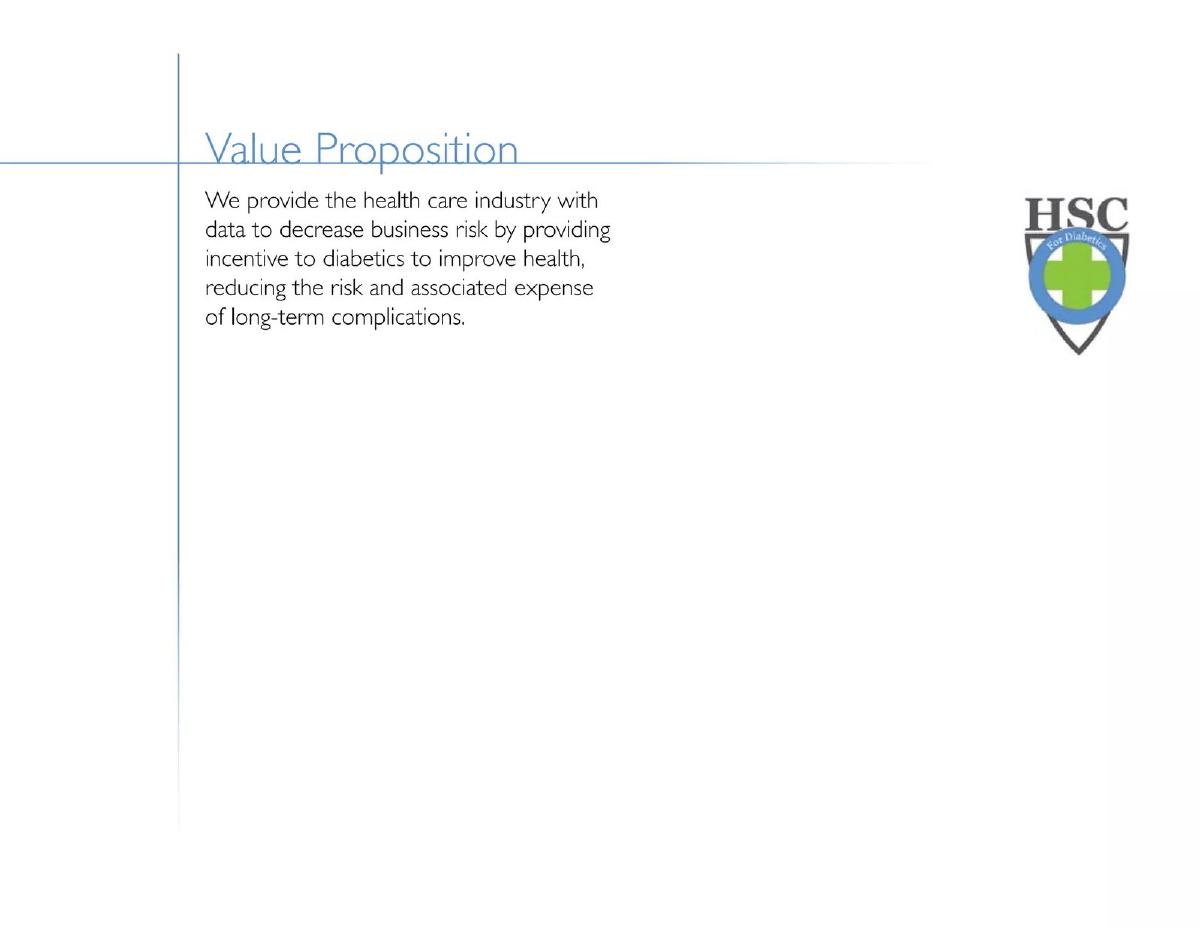
HSC for Diabetics deck, slide 2. Exact stored slide matched to this analysis.
Our analysis: One sentence names the buyer (the health care industry), what it gets (data that lowers risk) and how (incentives for patients).
Evidence and limitation: "The health care industry" is too broad; name insurers, employers or providers. There is no cost figure or evidence.
What a founder can adapt: Use this as a test: can you state buyer, outcome and mechanism in one sentence?
Supporting analysis
What the deck claims: "We provide the health care industry with data to decrease business risk by providing incentive to diabetics to improve health, reducing the risk and associated expense of long-term complications."
Presentation choice: One sentence names the buyer (the health care industry), what it gets (data that lowers risk) and how (incentives for patients).
When it does not fit: "The health care industry" is too broad; name insurers, employers or providers. There is no cost figure or evidence.
Swim training app. Stage and year are not stated on the slide.
MySwimPro deck, slide 5. Exact stored slide matched to this analysis.
Our analysis: The lists show how much the product does, which suits a product slide.
Evidence and limitation: Every line is a feature. The swimmer's benefit is left for the investor to infer, and "largest community" has no number or source.
What a founder can adapt: Treat this as a slide to improve on. Turn features into outcomes: "swim faster with a plan that adapts to you".
Supporting analysis
What the deck claims: "Value Proposition" with two photos and two lists: "12 Personalized Swim Training Plans", "100s of instructional technique videos", "New workout content added daily", "Dynamic training algorithm for personalization"; "Apple Watch, Garmin, Android Wear, Fitbit compatibility", "Heart Rate, Stroke Count, Lap Splits, SWOLF", "Personal workout journal", "Largest digital community of swimmers in the world".
Presentation choice: The lists show how much the product does, which suits a product slide.
When it does not fit: Every line is a feature. The swimmer's benefit is left for the investor to infer, and "largest community" has no number or source.
The strongest value proposition slides name the customer, state an outcome and add proof.
Example
Customer named
Outcomes or features
Proof on the slide
Elite Events
Attendees (sponsors implied)
Outcomes
Yes: 1,000+ per event, named sponsors
Brandslip
Both sides
Outcomes
No
4.screen
Both sides, by type
Mixed
No
The Plate
Food creators
Outcomes
No
HSC for Diabetics
Broadly (health care industry)
Outcome
No
MySwimPro
Implied (swimmers)
Features
No
Key Takeaways
Name who benefits. Two-sided products need a benefit for each side, as Brandslip and 4.screen show.
Write outcomes, not features. The Plate says "reliable monthly income"; MySwimPro lists training plans and videos.
Add one reason to believe. Elite Events is the only example here with numbers and named partners.
One clear sentence can work, as HSC shows, if the next slides back it up.
Claims like "first" or "largest" need a source or they read as filler.
Build your value proposition slide
Answer three questions, then write one headline sentence.
Customer. Who exactly benefits? If you serve two sides, answer for each.
Outcome. What do they get, in their words: money earned, time saved, risk reduced?
Proof. What single fact makes it believable: a customer, a number, a result?
Claims. Which words (first, largest, affordable) need a source or should go?
Copyable framework: [Product] helps [specific customer] [outcome] by [mechanism]. Proof: [number or named customer].
Illustrative example 1 — written by us
Before: 12 personalized training plans. 100s of technique videos. Apple Watch compatibility.
After: Swimmers get a training plan that adapts to them and tracks every lap from their watch. [N] swimmers train with us each week.
What improved: Our illustrative rewrite, not any company's text; the placeholder must be filled with a real figure. It names the customer, states the outcome and leaves room for proof.
Value proposition versus solution
The solution slide explains what you built and how it removes the problem. A value proposition slide states what the customer gets from it. Many decks merge the two; this guide covers decks that give the value proposition its own slide. For the combined version, see the solution slide guide.
The examples are ordered from the most complete (customer, outcome and proof) to the weakest (a feature list).
Common mistakes
Feature lists. Say what the customer gets, not what the product has.
No named customer. "Businesses" or "the industry" is too broad.
One side only. Marketplaces need a benefit for each side.
Unsupported superlatives. "First" and "largest" need a source.
Diagnostic checklist
The slide names who benefits, for each side if there are two.
Each benefit is an outcome, not a feature.
At least one fact supports the claim.
Superlatives have a source or are removed.
The headline could stand alone as a one-sentence summary.
Frequently asked questions
How we chose these examples
Corpus: published pitch deck teardowns on StartupFundraising.com. Founder-uploaded private decks are excluded.
Selection (2026-09-28): we grouped the opening words of extracted slide text for slides 2–25 and found 36 slides in about 32 decks that begin "Value Proposition". We kept slides with a stored image not used in another guide, dropped duplicate decks (three copies of Hard Asset Management), and chose six that show different approaches.
Overlap check: the solution slide guide covers the combined problem-to-product slide; the product slide guide covers features and screenshots; the why us guide covers the team's advantage. None of these six slides appears in another guide.
Review: all six stored slide images were inspected on 2026-09-28 and matched to company, deck and slide number (editorial model review). No person has yet completed an editorial review of this page.
Claims are as shown on the slides; we have not verified them. We make no claim that any slide caused a fundraising outcome.