BrandSlip positioned itself as a self-service marketplace connecting brands with mid-level influencers, specifically targeting platforms like Vine and Instagram which were surging in 2014. The deck emphasizes a 'free-flowing' model to differentiate from high-touch agencies and competitors like Niche.co. With a revenue model anchored on a 15% transaction commission and plans for future subscription tiers, the company sought $750k to scale. However, the deck relies heavily on projected milestones rather than historical performance, setting a goal of $100k in revenue by June 2014. While the prod…
Key takeaways
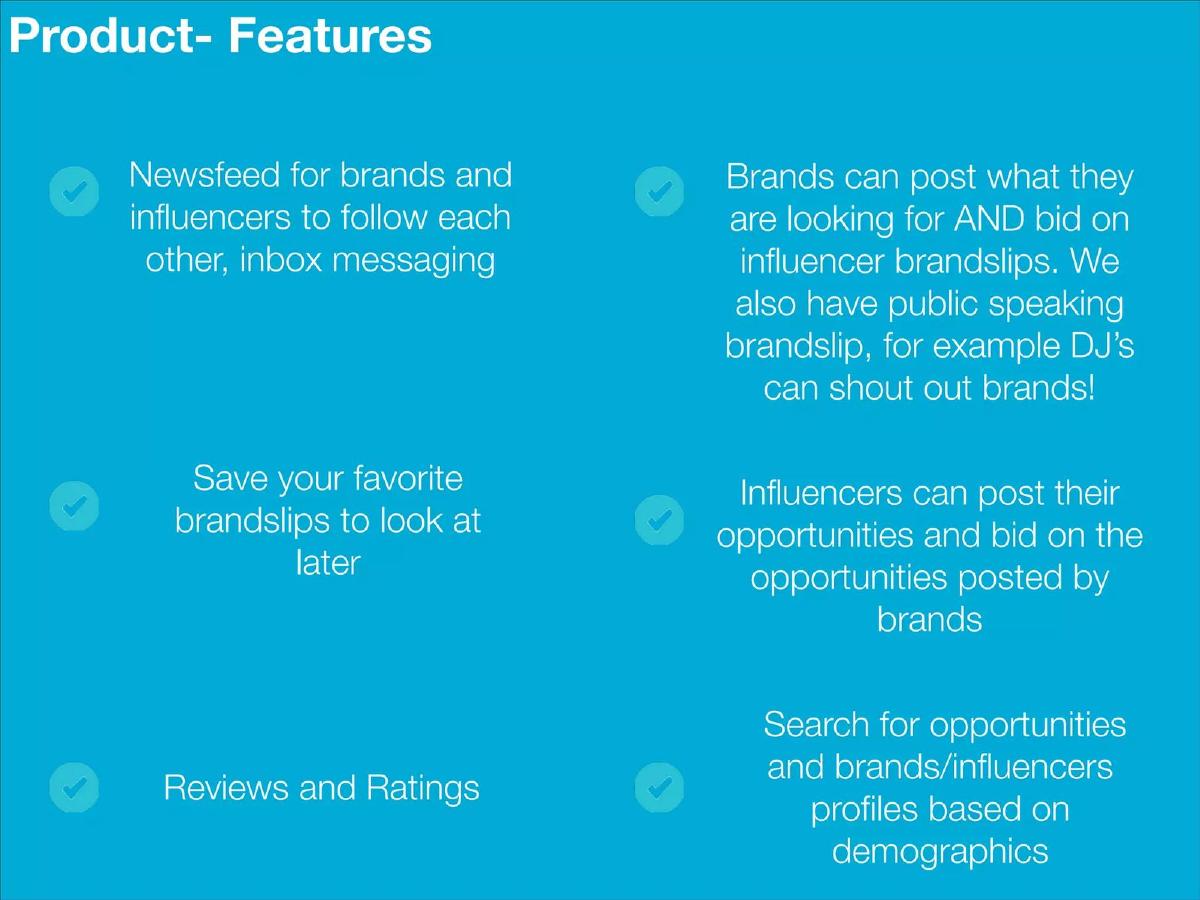
- The platform targets mid-level influencers on Vine, Instagram, and YouTube, including public speaking figures (Slide 2).
- BrandSlip differentiates itself from Niche.co by being a self-service marketplace rather than a managed service agency (Slide 4).
- The revenue model is based on a 15% commission per transaction, with plans for monthly fees in the 'Growth' and 'Maturity' phases (Slide 5).
- The deck lists a specific funding ask of $750k to be raised by June 2014 (Slide 6).
- Early traction claims include 75 influencers and 50 brands signed up prior to a March/April 2014 launch (Slide 6).
- Financial projections assume an average transaction value of $200 and a limit of 3 collaborations per influencer per week (Slide 6).
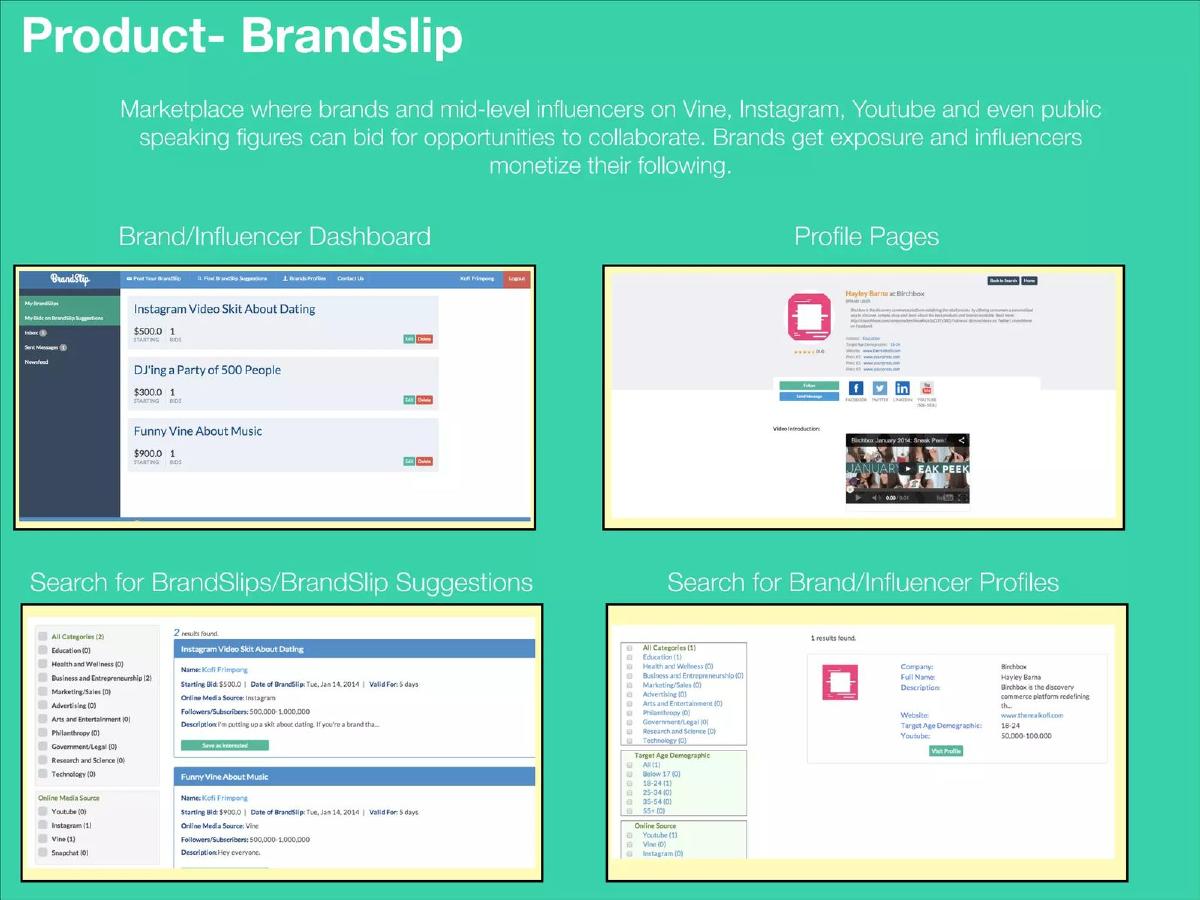
- The product interface includes features for bidding on opportunities, such as a '$900.0 starting bid' for a Vine skit (Slide 2).
- The deck omits a dedicated team slide, leaving the founders' backgrounds and execution capabilities unverified (Slide 1-6).
BrandSlip Pitch Deck Analysis
BrandSlip emerged during the peak of the short-form video era, specifically targeting the burgeoning 'influencer' economy on platforms like Vine and Instagram. This teardown examines their 11-slide deck (6 slides provided) which focuses on a marketplace model designed to democratize brand deals for mid-level creators. The deck is a product of its time, highlighting platforms that no longer exist in their original form, yet the marketplace mechanics remain relevant to modern creator-tech startups.
Slide 1: Title and Contact
The cover slide establishes the brand identity with a friendly, script-based logo and a clear sub-headline: "The Marketplace for Influencers and Brands to Collaborate." It features a lifestyle background image of young adults, signaling the target demographic. A notable inclusion is the direct contact email for 'kofi@brandslip.com' and a navigation bar at the bottom that mimics a website UI (Home, How it works, Our Team, etc.), suggesting the deck may have been adapted from web assets. While functional, it lacks a high-level 'hook' or a statement of current traction.
Slide 2: Product - BrandSlip
This slide serves as the functional heart of the deck. It defines the platform as a marketplace for "mid-level influencers on Vine, Instagram, Youtube and even public speaking figures." The inclusion of public speaking is a unique pivot from standard social media marketplaces. The slide provides four UI screenshots: Brand/Influencer Dashboard: Shows active listings like "Instagram Video Skit About Dating" with a starting bid of $500.0. Profile Pages: Displays a profile for "Hayley Barna at Birchbox," including social links and a video introduction. Search for BrandSlips: Shows a filtering system by category (Education, Health, etc.) and media source. Search for Profiles: Demonstrates how brands can find influencers based on target age demographics and follower counts (e.g., 50,000-100,000).
Slide 3: Value Proposition
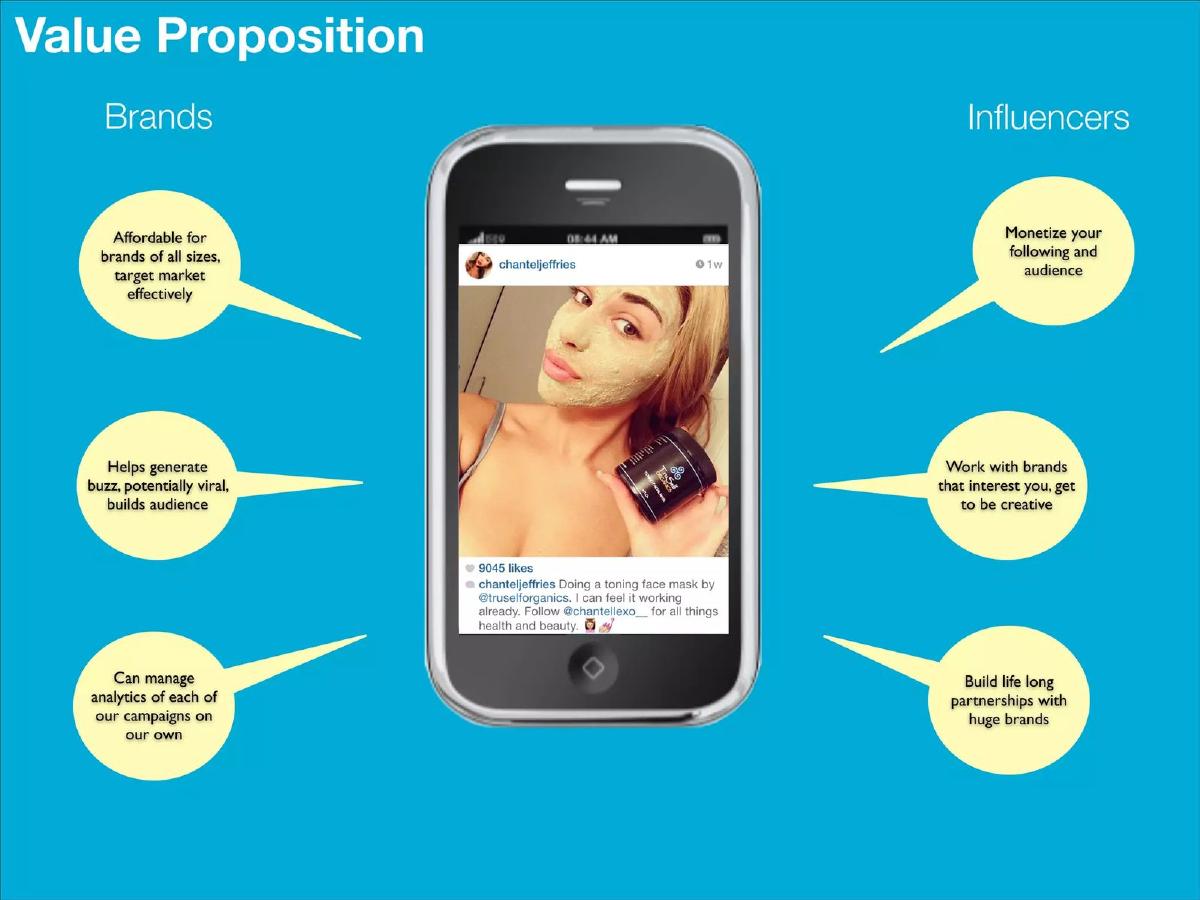
Using a visual of an early-generation iPhone, this slide splits the value prop between two stakeholders. For Brands , the platform offers affordability for all sizes, buzz generation, and self-managed analytics. For Influencers , it promises monetization, creative freedom by choosing brands they like, and the potential for long-term partnerships. The central image shows a real-world example of an influencer (Chantel Jeffries) promoting a face mask, which helps ground the abstract marketplace concept in a tangible output.
Slide 4: Competitors
BrandSlip takes a direct approach to competition, naming Niche.co and Sponsify. They cite Niche.co's $550k raise in 11/2013 and Sponsify's $175k raise in 11/2012. The differentiation is clearly articulated: BrandSlip is a "free flowing marketplace" whereas competitors are described as being "heavily involved in the creative process" or acting as agencies. BrandSlip positions itself as a "one off marketplace" that is more affordable and platform-agnostic, specifically mentioning its utility for musicians and startups.
Slide 5: Revenue Model
Private Beta: A flat 15% commission on each transaction. · Growth: The 15% commission remains, but a monthly fee is added for "limited access to exclusive brands." · Maturity: The monthly fee grants "unlimited access," and a new stream is added where "Speakers pay for promoted posts."
This shows a clear path from transactional revenue to recurring SaaS-style revenue, though it lacks specific pricing for the monthly fees.
Slide 6: Timeline and The Ask
The final slide in this set combines the roadmap with the fundraising goal. The company states it is "Looking to raise $750k by June 2014." The timeline is aggressive, starting with a March/April 2014 launch with 75 influencers and 50 brands already signed up. By June 2014, they aimed for over 500 transactions and $100k in revenue. The slide also includes a box of "Assumptions," which is a rare but helpful addition for analysts. They assume an average transaction of $200 and that influencers will do no more than 3 collaborations per week. This transparency allows investors to stress-test the $100k revenue goal.
What BrandSlip Does Well
The deck excels at defining its niche. By targeting "mid-level" influencers, BrandSlip avoids the crowded top-tier talent market managed by traditional agencies. The competitive analysis is also strong; rather than just listing names, they provide context on funding and specific operational differences (agency vs. marketplace). The inclusion of an "Assumptions" section on the timeline slide is a sophisticated touch that demonstrates the founders have modeled their growth based on specific user behaviors rather than just pulling numbers out of thin air.
What is Missing from the Deck
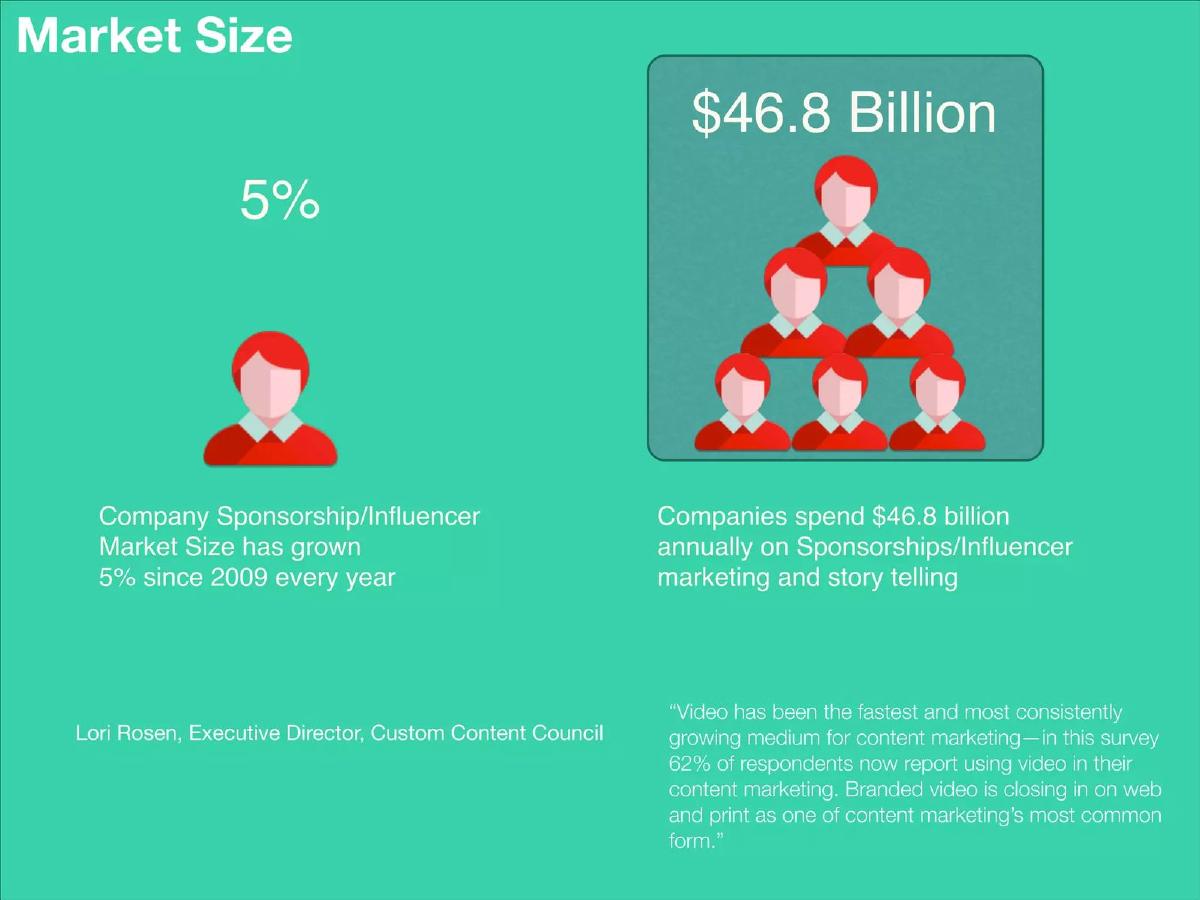
The most glaring omission is a Team Slide . In early-stage fundraising, the 'who' is often as important as the 'what.' Without bios or past successes, an investor cannot judge execution risk. Additionally, there is no Market Size (TAM) slide. While they mention being "affordable for brands of all sizes," they don't quantify the total addressable market for influencer marketing in 2014. Finally, the Use of Funds is missing. Asking for $750k without explaining if that money goes toward engineering, sales, or influencer acquisition is a significant red flag for professional investors.
Lessons for Founders
Founders can learn from BrandSlip's use of UI Mockups to explain a marketplace. Instead of describing how a bid works, they show a screenshot with a "Starting Bid: $500.0" button. This makes the product feel real and ready for market. However, founders should avoid the mistake of omitting the team and the specific use of funds. If you are asking for nearly a million dollars, you must show who is spending it and exactly what it is buying (e.g., "$300k for 3 full-stack engineers, $200k for brand sales outreach"). Lastly, the "Assumptions" box is a great tool for building credibility—it shows you understand the levers of your own business.
Frequently asked questions
- What is the core problem BrandSlip aims to solve?
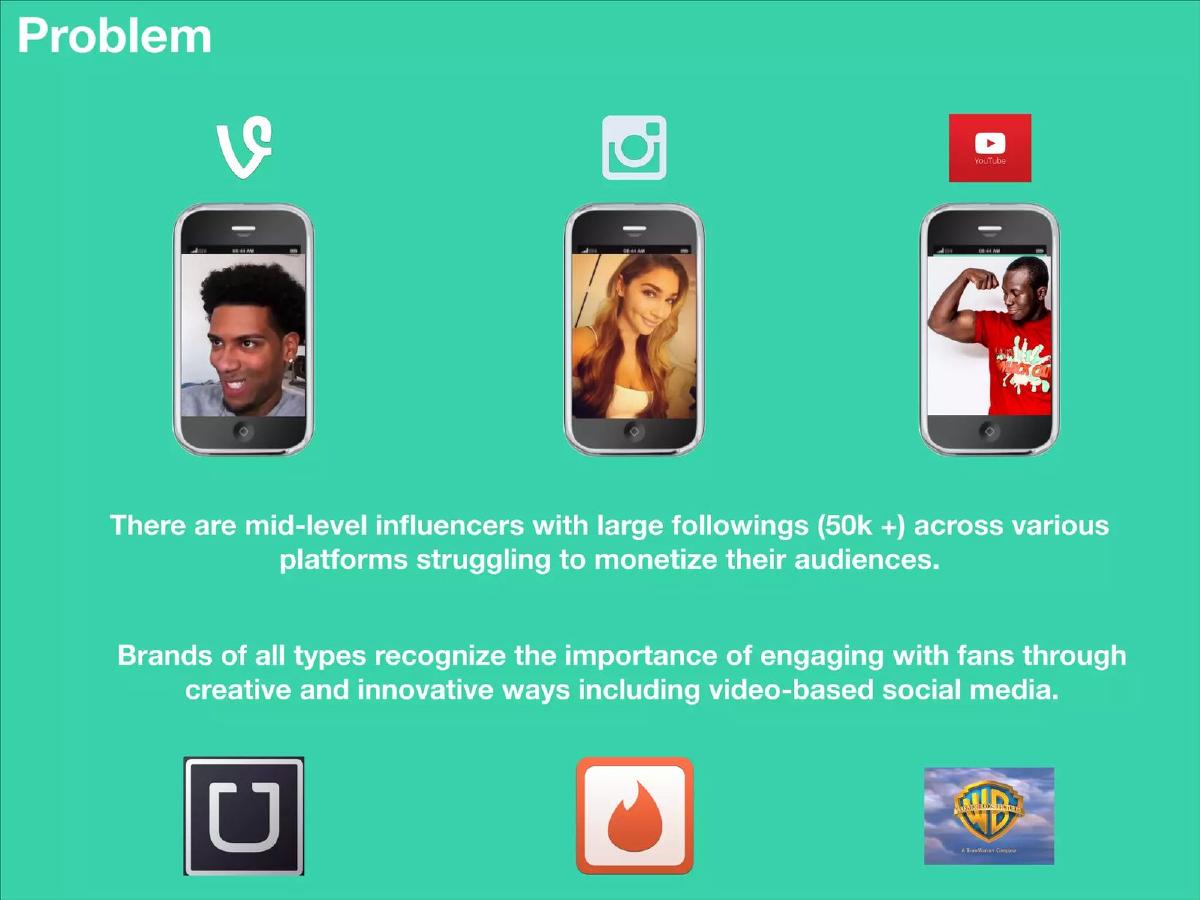
- BrandSlip addresses the friction between brands and mid-level influencers. According to Slide 2, it provides a marketplace where these parties can bid for collaboration opportunities. Brands get exposure while influencers monetize their following. Slide 4 further clarifies that they aim to replace the 'heavily involved' creative process of agencies with a 'free-flowing' marketplace that is affordable for brands of all sizes, including startups and musicians.
- How does BrandSlip plan to generate revenue?
- The revenue strategy is phased into three stages as shown on Slide 5. In the 'Private Beta' phase, they charge a flat 15% commission on each transaction. During the 'Growth' phase, they add a monthly fee for limited access to exclusive brands. In the 'Maturity' phase, this evolves into a monthly fee for unlimited access and a new revenue stream where speakers pay for promoted posts.
- Who are the primary competitors identified in the deck?
- Slide 4 identifies Niche.co and Sponsify as primary competitors. Niche.co is described as a managed service that raised $550k in 2013, while Sponsify is noted for raising $175k in 2012 with a focus on YouTube. BrandSlip differentiates itself by supporting more platforms (Vine, Instagram, YouTube, and public speaking) and operating as a one-off marketplace rather than a campaign-running agency.
- What are the key metrics and assumptions for their 2014 projections?
- On Slide 6, the company outlines several assumptions: an average 'brandslip' (transaction) value of $200 and a cap of 3 collaborations per influencer per week. They projected reaching over 500 transactions and $100k in revenue by June 2014. They also anticipated having over 30 public speakers on the platform by the summer of 2014.
- What is missing from this pitch deck that investors usually require?
- The most notable omission is a Team slide; while the cover slide provides a contact email, there is no information regarding the founders' expertise. Additionally, there is no slide for Market Size (TAM/SAM/SOM), no detailed breakdown of how the $750k ask will be spent (Use of Funds), and no mention of unit economics like Customer Acquisition Cost (CAC) or Lifetime Value (LTV).