Brand Boards uses an 8-slide deck to pitch a digital marketplace for live event advertising, specifically targeting the 15-35% of unsold inventory at sports venues. The deck is a textbook example of a 'team-first' pitch, highlighting a CEO with a 700X return for angel investors and a Chairman who managed $200 million in annual sports spend at Anheuser-Busch. Despite its brevity, the deck establishes a clear $9 billion market opportunity and demonstrates product readiness through a functional advertiser portal screenshot. While it lacks detailed unit economics or a competitive landscape, the c…
Key takeaways
- The founding team features deep domain expertise, including a Chairman who managed $200 million in annual spend for Anheuser-Busch (Slide 3).
- CEO Kenny Hawk highlights a track record of three companies built, including one sold to Qualcomm and another providing a 700X return to angel investors (Slide 3).
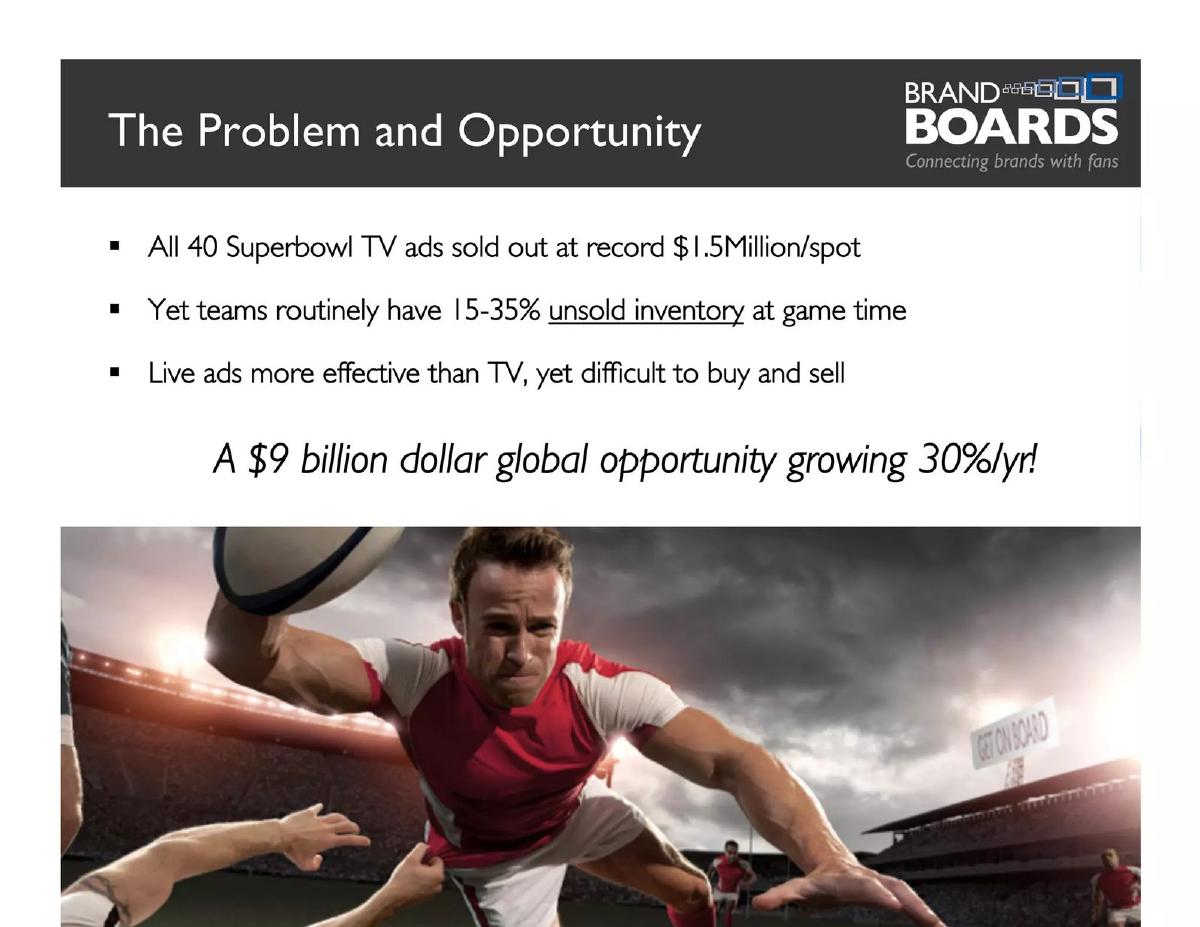
- The problem is defined by the inefficiency of live event ads, noting that teams routinely have 15-35% unsold inventory at game time (Slide 4).
- The company identifies a $9 billion global market opportunity growing at 30% per year (Slide 4).
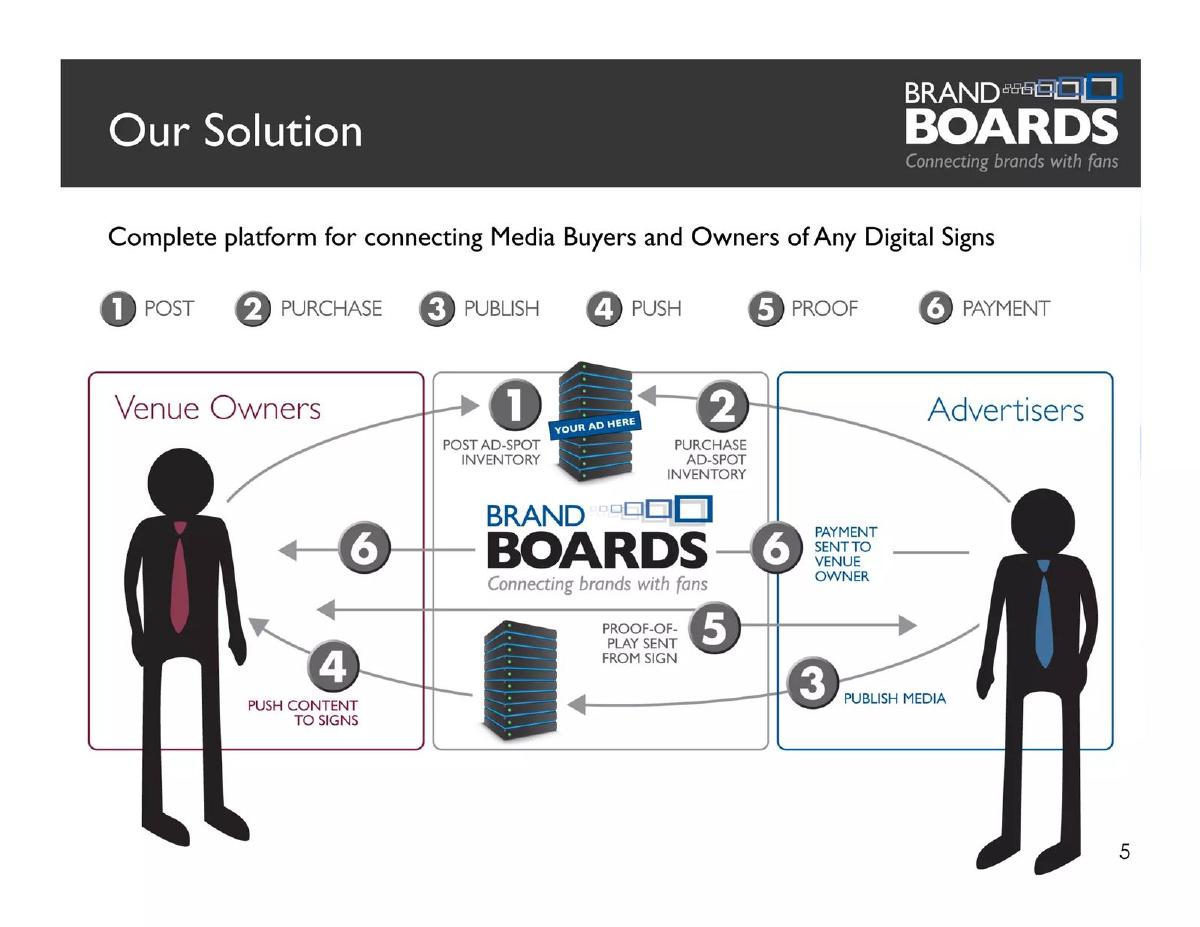
- The solution is a six-step automated platform connecting media buyers and venue owners, covering everything from posting inventory to proof-of-play (Slide 5).
- Traction is evidenced by $1 million in signed advertising commitments and ongoing contract phases with major sports brands like the Dallas Cowboys and NASCAR (Slide 7).
- The deck concludes with a specific investment ask of $750,000 (Slide 8).
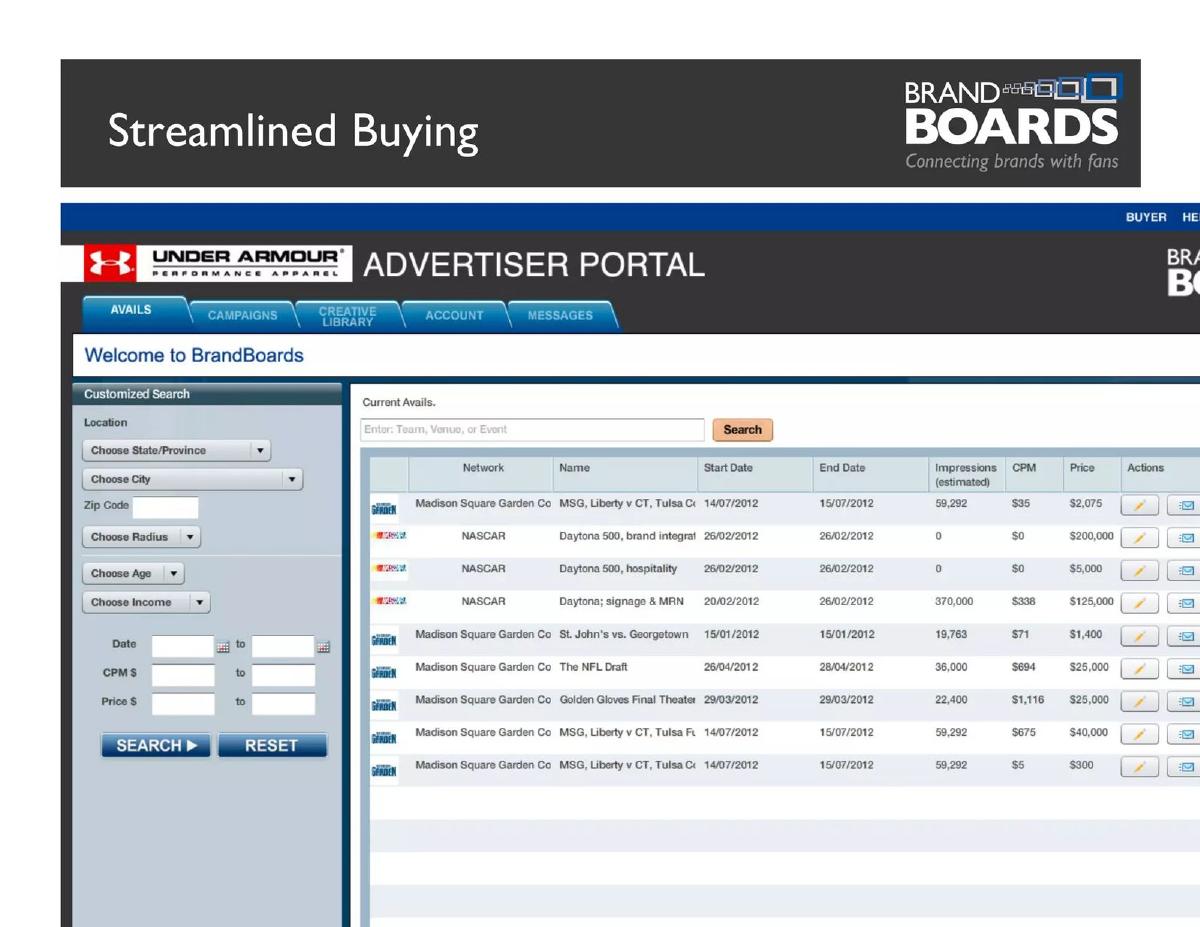
- The product is shown via a functional UI mockup featuring real-world venue data from Madison Square Garden and NASCAR (Slide 6).
Executive Summary: The Power of Pedigree
The Brand Boards pitch deck is a concise, 8-slide presentation designed for a demo day environment. It focuses on a clear, massive inefficiency in the sports and entertainment world: the high percentage of unsold digital signage inventory. The deck's primary strength lies in its team; the founders possess the exact industry connections and exit history required to build a marketplace in the high-stakes world of professional sports advertising. With $1 million in commitments already secured, the $750,000 ask appears conservative and highly de-risked.
Slide 1: Title Slide
The deck opens with the Brand Boards logo and the tagline "Connecting brands with fans." It identifies Kenny Hawk as the Co-Founder. The design is minimalist, using a dark gray background and a blue-and-white color scheme that is maintained throughout the presentation. There are no distracting elements, keeping the focus entirely on the brand name.
Slide 2: Mission
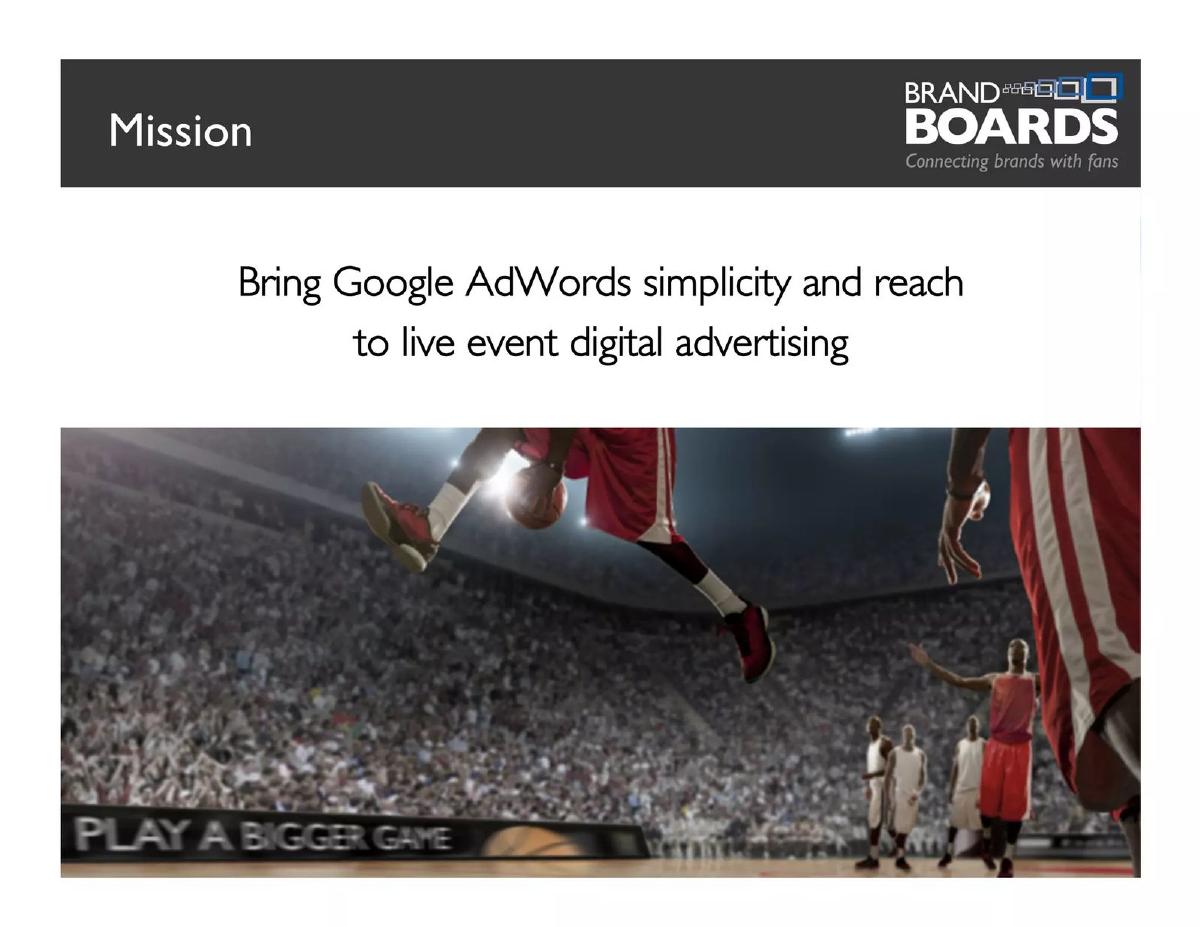
Slide 2 defines the company's North Star: "Bring Google AdWords simplicity and reach to live event digital advertising." This is a powerful analogy. By referencing AdWords, the company immediately communicates that they are building a self-service, scalable marketplace for an industry that has traditionally relied on manual, relationship-based sales. The background image of a basketball player emphasizes the sports focus.
Slide 3: Experienced Team
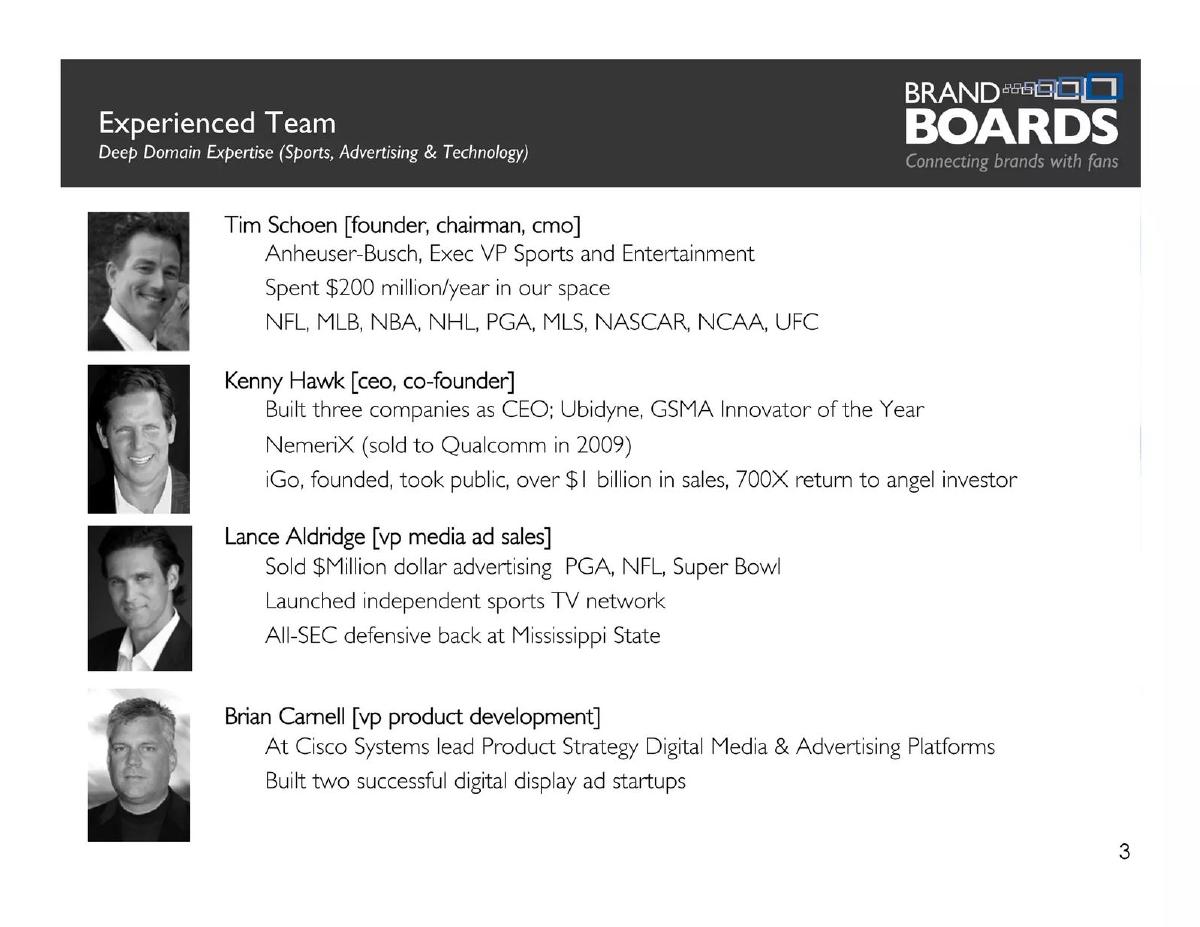
This is arguably the most important slide in the deck. It lists four key members with "Deep Domain Expertise": Tim Schoen (Founder, Chairman, CMO) , who managed a $200 million annual budget at Anheuser-Busch across all major leagues (NFL, MLB, NBA, etc.); Kenny Hawk (CEO, Co-Founder) , who has built three companies, sold one to Qualcomm, and delivered a 700X return to a previous angel investor; Lance Aldridge (VP Media Ad Sales) , who sold million-dollar ads for the Super Bowl; and Brian Carnell (VP Product Development) , a former lead at Cisco Systems. The pedigree here is elite, signaling to investors that this team has the 'rolodex' to close deals with major venues.
Slide 4: The Problem and Opportunity
Slide 4 quantifies the market pain. It notes that while Super Bowl ads sell for $1.5 million per spot, teams routinely have "15-35% unsold inventory at game time." This highlights a massive waste of potential revenue for venue owners. The slide identifies a "$9 billion dollar global opportunity growing 30%/yr," framing the solution as a way to capture this 'lost' revenue through more effective, easier-to-buy live ads.
Slide 5: Our Solution
The solution is presented as a "Complete platform for connecting Media Buyers and Owners of Any Digital Signs." The slide uses a flow diagram to illustrate a six-step process: 1. Post, 2. Purchase, 3. Publish, 4. Push, 5. Proof, and 6. Payment. By visualizing the interaction between Venue Owners and Advertisers, the deck demonstrates that Brand Boards handles the entire transaction lifecycle, including the technical delivery of the ad ("Push") and the verification of the ad's appearance ("Proof-of-play").
Slide 6: Streamlined Buying
This slide provides a screenshot of the "Advertiser Portal," using Under Armour as a placeholder client. The UI shows a search function for location, age, and income, alongside a list of "Current Avails." The data in the table is specific, citing Madison Square Garden and NASCAR events with specific dates, impression estimates (e.g., 59,292), CPMs (ranging from $5 to $1,116), and total prices. This slide proves that the software is not just a concept but a functional tool capable of handling complex pricing and inventory data.
Slide 7: Accelerating Traction
Traction is shown through two key metrics: "Signed first $1 Million in advertising commitments" and being in the "Contract phase" with a list of prestigious teams and leagues. The slide displays logos for the Houston Texans, Dallas Cowboys, St. Louis Cardinals, Golden State Warriors, Oakland A's, Cleveland Cavaliers, New York Knicks, Kansas City Royals, Dallas Mavericks, New York Mets, NASCAR, and Orlando Magic. This visual 'logo soup' serves as a powerful validation of the team's ability to navigate the complex procurement processes of professional sports organizations.
Slide 8: Investment Opportunity
The final slide is the ask: "Raising $750K." It includes the CEO's email address. While the slide is simple, the small size of the raise relative to the $1 million in commitments and the high-profile team suggests this may be a bridge round or a final seed allocation intended to reach a specific milestone before a larger Series A.
What Brand Boards Does Well
The deck excels at establishing Founder-Market Fit . In a marketplace startup, the biggest risk is the 'chicken and egg' problem—getting both buyers and sellers onto the platform. By showing a team that has spent hundreds of millions in this specific sector and listing $1M in commitments from major sports teams, Brand Boards effectively argues that they have already solved the hardest part of the business. The use of the AdWords analogy is also a brilliant way to explain a complex B2B marketplace in a single sentence.
What is Missing from the Deck
Despite its strengths, the deck leaves several questions unanswered. There is no Competitive Landscape slide; it is unclear if they are competing against traditional agencies, other digital signage startups, or the internal sales teams of the venues themselves. There is also a lack of Unit Economics . While we see prices and CPMs on Slide 6, we don't know the Brand Boards 'take rate' or the cost to acquire a new venue. Finally, the Use of Funds is omitted; investors are told how much is being raised, but not whether that money will go toward engineering, sales, or geographic expansion.
Founder Takeaways: Lessons to Copy
Lead with your strengths: If your team has exits and managed massive budgets, put that on Slide 3. Don't bury your best assets at the end of the deck. · Use 'The Gap' to define the problem: Brand Boards didn't just say "ads are hard." They pointed to the 15-35% of inventory that is currently earning zero dollars. That is a specific, painful gap that any business owner wants to close. · Show, don't just tell: The screenshot on Slide 6 is far more effective than a bulleted list of features. It shows the platform is real and handles real-world data like CPMs and impressions. · Leverage social proof: The logos on Slide 7 do the heavy lifting. Even if the contracts aren't fully executed, being in the "contract phase" with the Dallas Cowboys carries significant weight with investors.
Frequently asked questions
- What is the core value proposition of Brand Boards?
- Brand Boards aims to bring 'Google AdWords simplicity' to the live event digital advertising space. According to Slide 2 and Slide 4, they target the 15-35% of advertising inventory that goes unsold at sports games. By creating a digital marketplace, they allow venue owners to post inventory and advertisers to purchase and push content to signs in a streamlined, six-step process.
- How strong is the founding team according to the deck?
- The team is exceptionally strong for an early-stage startup. Slide 3 lists Tim Schoen, former Exec VP at Anheuser-Busch who managed $200M in annual spend, and CEO Kenny Hawk, who has three CEO roles under his belt, including an exit to Qualcomm and a 700X return for previous angel investors. This 'deep domain expertise' is the primary driver of the deck's credibility.
- What evidence of market traction does the company provide?
- On Slide 7, the company claims to have signed its first $1 million in advertising commitments. They also list 12 major sports logos, including the Houston Texans, Golden State Warriors, and NASCAR, stating they are in the 'contract phase' with these organizations. This suggests significant early interest from both sides of the marketplace.
- What are the specific financial details of the investment opportunity?
- Slide 8 explicitly states the company is raising $750,000. The deck does not disclose the valuation, the type of security (SAFE vs. Equity), or the specific use of funds. However, the $1 million in commitments mentioned on Slide 7 suggests the raise is intended to scale operations to fulfill existing demand.
- Does the deck address competition or unit economics?
- No. The 8-slide deck omits a competitive landscape slide and does not provide unit economics, such as take rates or customer acquisition costs. It relies instead on the 'Problem and Opportunity' slide (Slide 4) to establish the $9 billion market size and the 'Streamlined Buying' slide (Slide 6) to show the product's ease of use.