OwnLocal’s deck is a textbook example of how to pitch a 'boring' but massive market—local advertising—by focusing on sheer scale and efficiency. Founded in 2010, the company targeted the digital transformation of local newspapers and media outlets. The deck excels at demonstrating a clear 'before and after' for their customers, moving from manual offline ads to automated digital campaigns. By the time they reached this stage, they were already reporting 65,000 active SMBs and a remarkably low 3-month payback period on customer acquisition costs. While the deck lacks a formal team slide in thi…
Key takeaways
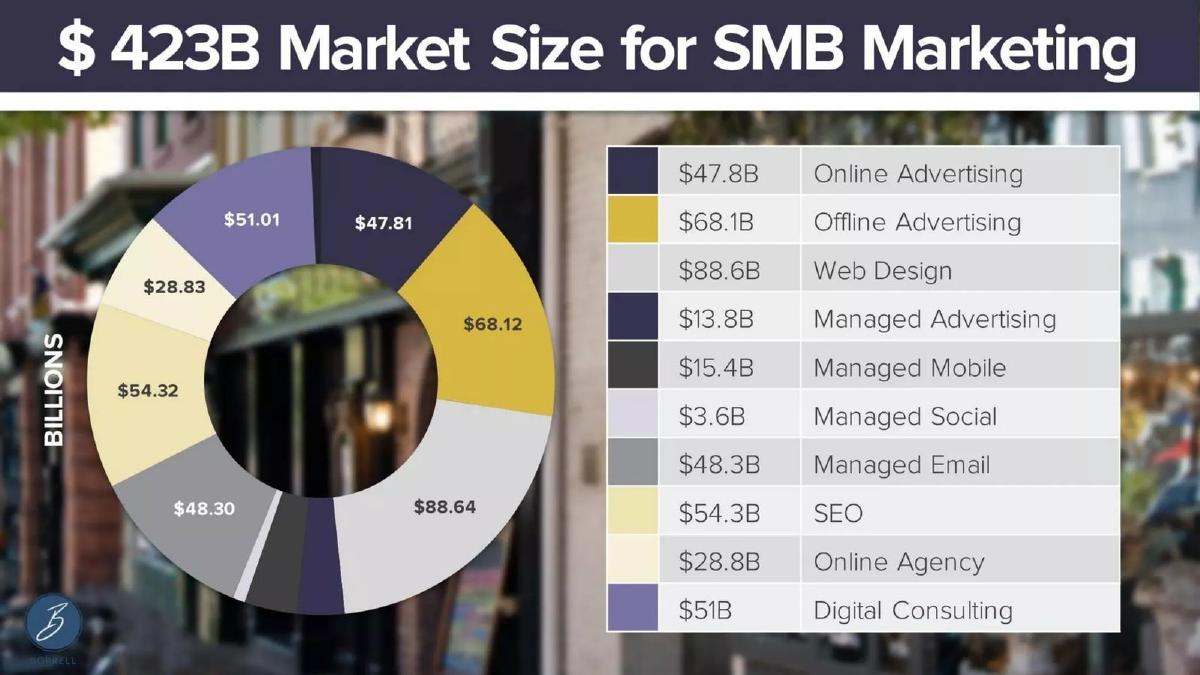
- The deck identifies a massive $423B market size for SMB marketing, broken down into specific segments like SEO and Web Design on Slide 3.
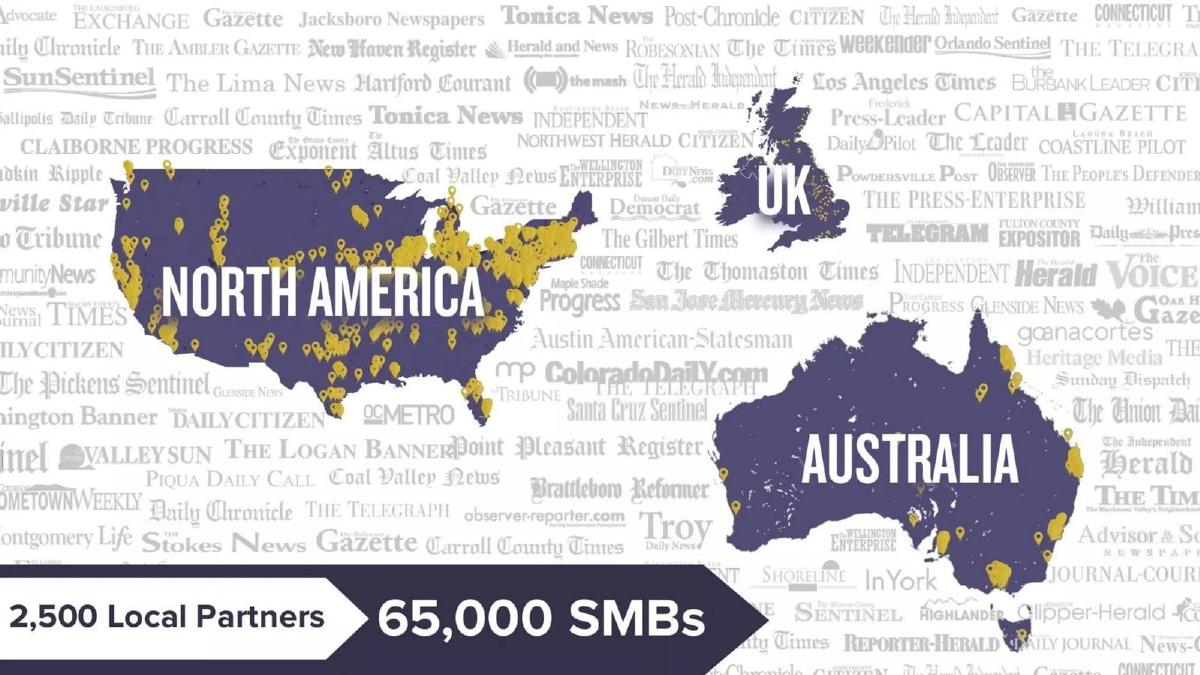
- Traction is front-loaded, showing 2,500 local partners and 65,000 SMBs across North America, the UK, and Australia on Slide 2.
- The problem is framed through the lens of the SMB owner, citing high spend requirements and confusing self-service options on Slides 5 and 6.
- Automation is the core value proposition, specifically targeting sales, campaign creation, fulfillment, and upsells as shown on Slides 9 and 10.
- Revenue growth shows a consistent upward trend, moving from $412k in 2012 to a projected $7.5m-$12m range for 2016 on Slide 12.
- Unit economics are exceptionally transparent, citing a $30.72 CAC and a $10.60 MRR per SMB on Slide 13.
- The deck uses a 'build-up' animation style (Slides 4-6 and 8-10) to walk investors through the complexity of the problem and the simplicity of the solution.
- There is a notable absence of a competitor slide or a detailed technology/AI explanation in this version of the deck.
Introduction: The Bridge Between Print and Pixels
OwnLocal’s pitch deck is a masterclass in focusing on what matters to Seed and Series A investors: scale, unit economics, and a clear path to revenue. Founded in 2010 and based in Austin, Texas, OwnLocal entered a market that many VCs were wary of—local media. By positioning themselves as an automation layer rather than a media company, they successfully raised $3,400,000. This teardown looks at the 14 key slides that tell the story of a company turning a dying industry into a digital goldmine.
The Hook: Global Scale and Market Context
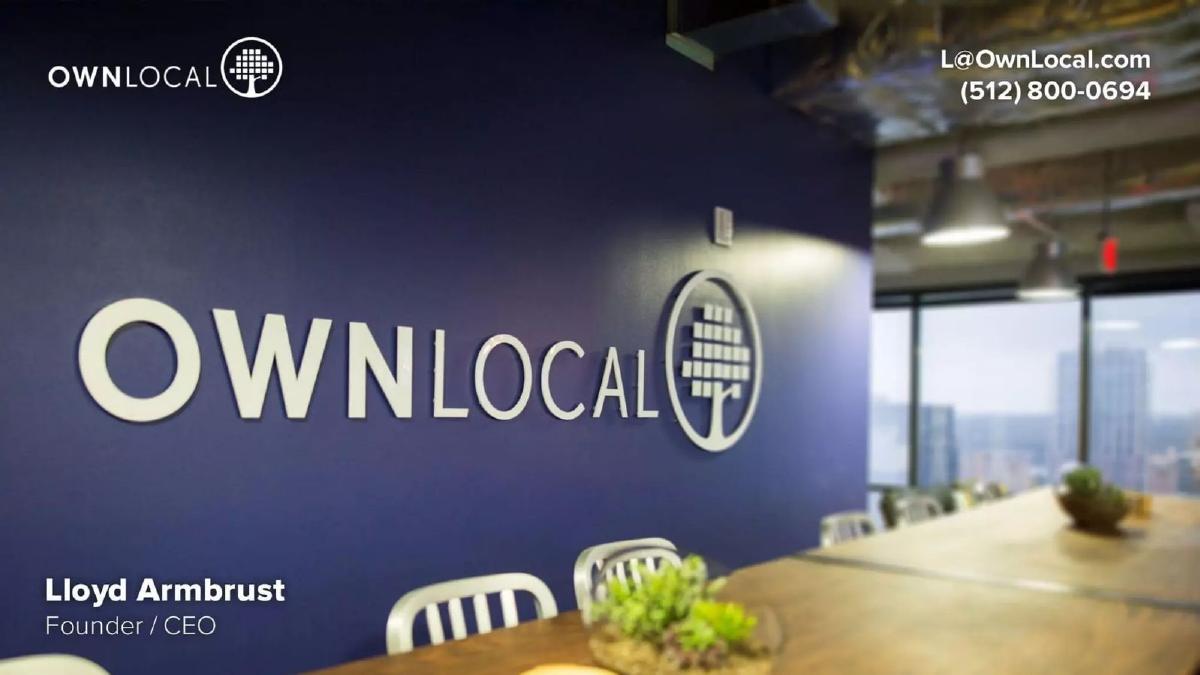
Slide 1: Title Slide The deck opens with a clean, professional photo of the OwnLocal office. It features the name of the founder and CEO, Lloyd Armbrust, along with direct contact information. This establishes immediate accessibility and a sense of established physical presence.
Slide 2: Traction Map OwnLocal doesn't wait to show off. Slide 2 features a map of North America, the UK, and Australia covered in yellow pins. The slide highlights two massive numbers: 2,500 Local Partners and 65,000 SMBs. By leading with these figures, the company immediately answers the 'is anyone using this?' question. The background is a collage of newspaper mastheads, subtly reinforcing their target industry.
Slide 3: Market Size The deck cites a $423B Market Size for SMB Marketing. Rather than just throwing out a large number, they provide a detailed breakdown using a donut chart. Key segments include Web Design ($88.6B), Offline Advertising ($68.1B), and SEO ($54.3B). This slide proves that even a small percentage of this market represents a multi-billion dollar opportunity.
Defining the Friction: Why SMB Marketing Fails
Slides 4, 5, and 6: The Problem Build-up These slides use a progressive reveal to explain why 'Small Business Marketing is Hard.' Slide 4 introduces the concept with a photo of a small business owner. Slide 5 adds two pain points: 'Requires a huge dollar spend' and 'Self-service is confusing.' Slide 6 completes the picture by adding 'Little trust via phone sales' and 'ROI is hard to understand.' This sequence builds empathy for the customer while highlighting the inefficiencies that OwnLocal intends to solve.
The Solution: Automation as the Great Equalizer
Slide 7: The Input/Output Model This slide is a visual representation of their technology. On the left, 'Input' is defined as Newspaper Ads, TV Ads, and Radio Ads. The 'Output' is shown on a laptop screen as a digital campaign. This clearly communicates their value proposition: taking legacy media data and automatically generating digital presence.
Slides 8, 9, and 10: The Product in Action Similar to the problem slides, these three use a build-up to show the software's capabilities. Slide 8 shows a clean laptop interface. Slide 9 adds arrows pointing to 'Automate Campaign Creation' and 'Automate Sales.' Slide 10 adds 'Automate Fulfillment' and 'Automate Upsells.' By the end of the sequence, the investor understands that OwnLocal is a full-stack automation engine for the entire sales and marketing lifecycle of an SMB.
The Financial Engine: Growth and Unit Economics
Slide 11: SMB Customer Growth This bar chart shows a dramatic acceleration. Starting in January 2013, the growth is steady but modest. However, the projection for 2016 (indicated by grey bars) shows a massive spike, aiming for 120,999 SMBs by Q4 2016. This slide is designed to show that the company has figured out its distribution and is ready to pour gasoline on the fire.
Slide 12: Revenue Growth The revenue story is equally compelling. The slide shows actual revenue growing from $412k in 2012 to $4.8m in 2015. The 2016 estimate (2016E) shows a range between $7.5m and roughly $12.5m. This 10x growth over four years is exactly what venture capitalists look for in a seed-to-growth stage transition.
Slide 13: SMB Customer Metrics This is perhaps the most important slide in the deck. It breaks down the unit economics with brutal honesty:
65k active SMBs · 2.48% monthly churn · $30.72 CAC (Customer Acquisition Cost) · $10.60 MRR (Monthly Recurring Revenue) per SMB · 3.0 months to payback CAC
A 3-month payback period is elite for an SMB-focused SaaS company. It suggests that even with a low MRR per customer, the acquisition is so efficient (likely due to their 2,500 local partners) that the model is highly profitable.
Slide 14: Closing Logo The deck ends with the OwnLocal logo over a stylized map, reinforcing the 'local' focus of the brand.
What Works in the OwnLocal Deck
The standout feature of this deck is its transparency regarding unit economics . Most founders hide their churn or CAC behind vague 'blended' metrics. OwnLocal puts them front and center on Slide 13. By showing a $30 CAC against a $10 MRR, they prove they have a 'money printer'—for every $30 they spend, they get a customer that pays for itself in 90 days and then generates pure margin for the rest of their lifecycle.
The progressive reveal strategy (Slides 4-6 and 8-10) is also highly effective. It prevents the slides from becoming cluttered and allows the presenter to control the narrative pace, ensuring the investor absorbs each pain point and solution feature before moving to the next.
What is Missing
Despite the strong financials, there are significant gaps in this 14-slide subset. There is no Team slide. In a seed round, the 'who' is often as important as the 'what.' Investors want to know why this specific team is qualified to navigate the complex world of local media partnerships.
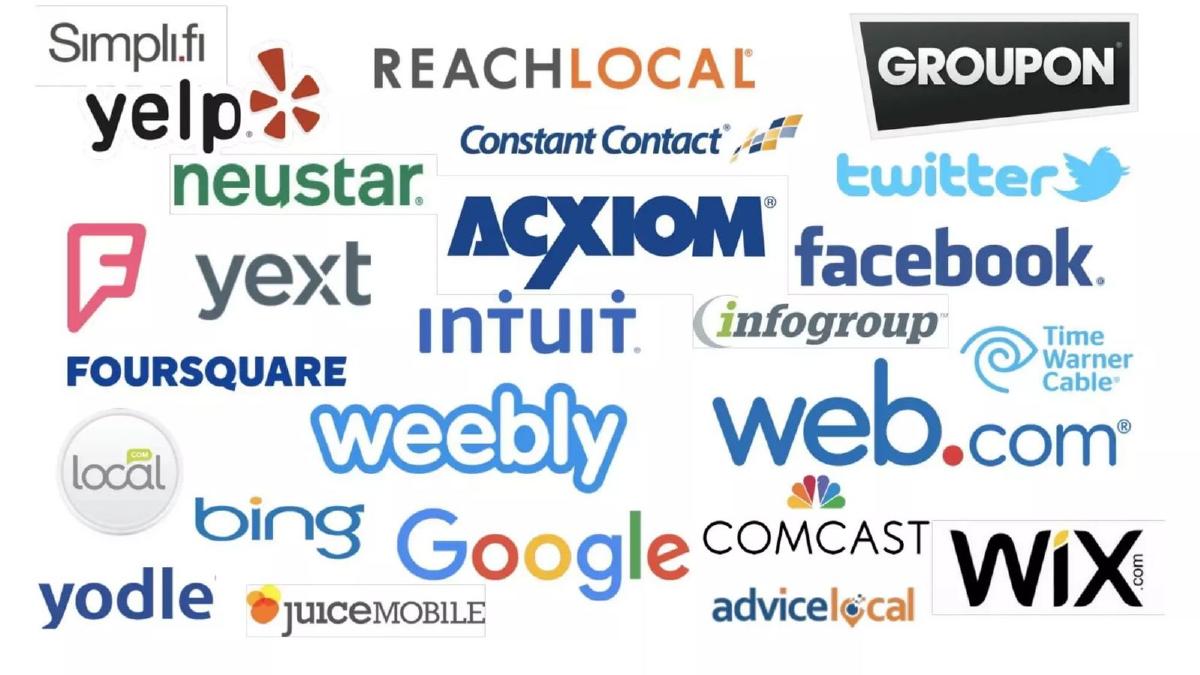
The 'Ask' is missing. We know from the catalogue that they raised $3.4M, but the deck doesn't state how much they were looking for or how they planned to allocate those funds (e.g., 50% engineering, 30% sales, 20% ops). Finally, there is no competitive landscape . Local marketing is a crowded space with players like Yext, ReachLocal, and Gannett’s internal teams. Failing to address how OwnLocal wins against these incumbents is a missed opportunity to de-risk the investment.
What a Founder Should Copy
Founders should emulate the Traction-First approach seen on Slide 2. If you have impressive numbers, do not bury them at the end of the deck. Use them to buy the investor's attention for the more technical slides that follow.
Additionally, the Market Segmentation on Slide 3 is a great way to handle a 'Large TAM' slide. Instead of just saying 'Marketing is a $400B industry,' breaking it down into specific buckets like 'Web Design' and 'SEO' shows that you actually understand the flow of capital in your industry. It makes the massive number feel grounded in reality rather than a speculative guess.
Conclusion
OwnLocal’s deck succeeded because it turned a 'low-rent' market (small local ads) into a high-efficiency technology play. By focusing on automation and rapid payback periods, they moved the conversation away from the declining newspaper industry and toward the scalable future of automated digital marketing. For any founder pitching a high-volume, low-ARPU (Average Revenue Per User) business, Slide 13 of this deck should be the blueprint for their financial storytelling.
Frequently asked questions
- What is OwnLocal's primary business model based on the deck?
- OwnLocal operates as a B2B2B platform. They partner with local media companies (2,500 partners as per Slide 2) who already have relationships with small businesses. OwnLocal then provides the automation layer to convert those businesses' offline data (Newspaper, TV, Radio) into digital marketing campaigns, charging a monthly recurring revenue (MRR) per SMB.
- How does the company justify its market opportunity?
- On Slide 3, they cite a total market size of $423 billion. They break this down into specific sub-sectors to show where the money is currently flowing, such as $88.6B in Web Design and $68.1B in Offline Advertising. This suggests their platform can capture spend from both traditional and emerging digital budgets.
- What are the key unit economics for OwnLocal?
- According to Slide 13, the company has a Customer Acquisition Cost (CAC) of $30.72 and generates $10.60 in MRR per SMB. This leads to a 3.0-month payback period. With a monthly churn rate of 2.48%, the lifetime value of a customer significantly outweighs the cost to acquire them through their partner network.
- How does the deck demonstrate product-market fit?
- The deck uses a 'hockey stick' growth chart on Slide 11, showing SMB customer growth from near zero in early 2013 to a projected 120,999 SMBs by Q4 2016. This rapid scaling, combined with the revenue growth shown on Slide 12, serves as quantitative proof that their automation solution is being adopted by the market.
- What is missing from this pitch deck?
- This 14-slide selection is missing a dedicated Team slide, a Competitor analysis slide, and a specific 'Ask' slide detailing how the $3.4M will be spent. It also lacks a deep dive into the 'AI' mentioned in their catalogue description, focusing instead on the business outcomes of automation rather than the technical architecture.