OX Security’s 15-slide Series A deck is a highly technical, product-centric presentation that successfully secured $34M in 2022. The narrative transitions quickly from macro-level threats—citing that 62% of organizations faced supply chain attacks in 2021—to granular product functionality. By focusing on 'end-to-end traceability' and automated vulnerability blocking, the deck positions OX as a necessary evolution of the DevSecOps pipeline rather than just another scanning tool. While the deck lacks traditional business metrics like ARR or a team slide in this public version, its strength lies…
Key takeaways
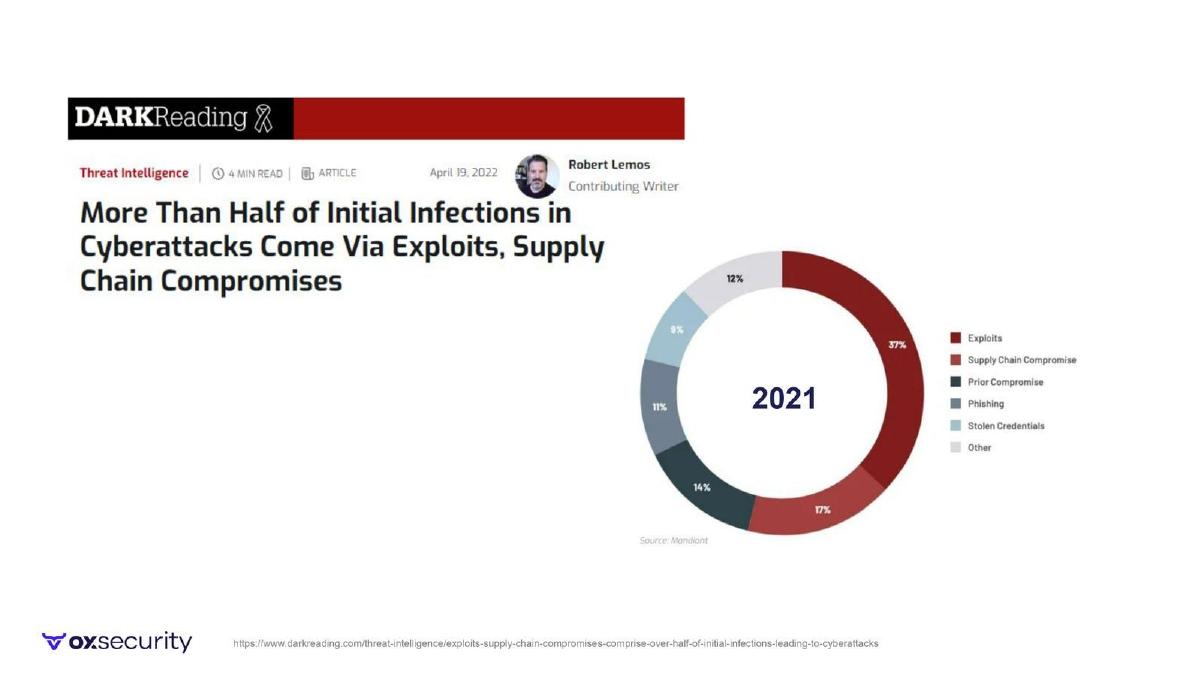
- The deck leverages third-party validation early, citing a DarkReading report that over half of initial infections come via exploits and supply chain compromises (Slide 2).
- OX Security defines the problem through high-profile failures, mapping attacks like SolarWinds, Log4j, and Equifax across the software lifecycle (Slide 4).
- The 'Discover' phase emphasizes visibility across 350 repos and 434 cloud assets, showcasing the platform's ability to handle scale (Slide 5).
- Automation is presented as a policy-driven engine that can 'block vulnerabilities' from being merged, moving beyond simple detection (Slide 6).
- The concept of a 'PBOM' (Pipeline Bill of Materials) is introduced to ensure every artifact in production originates from a secure, signed pipeline (Slide 7).
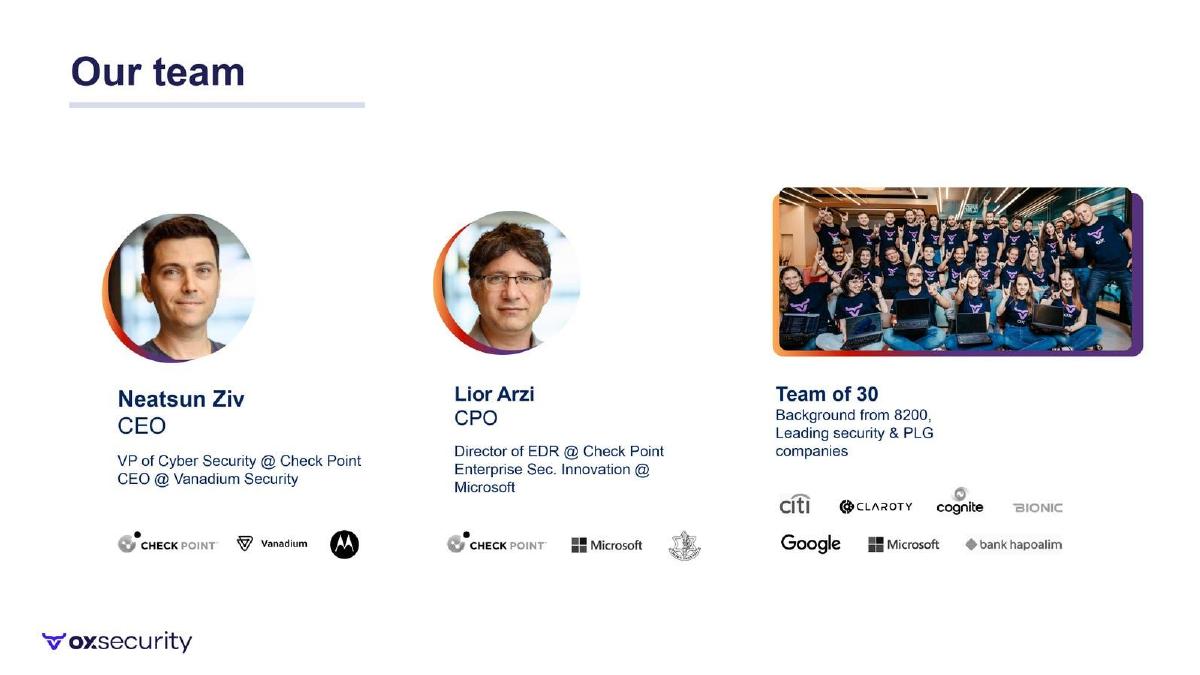
- The deck omits standard fundraising slides such as the Team, Financials, and the specific 'Ask,' focusing entirely on the technical value proposition.
- Reported facts indicate the company raised $34M in a Series A round in 2022, headquartered in the Middle East.
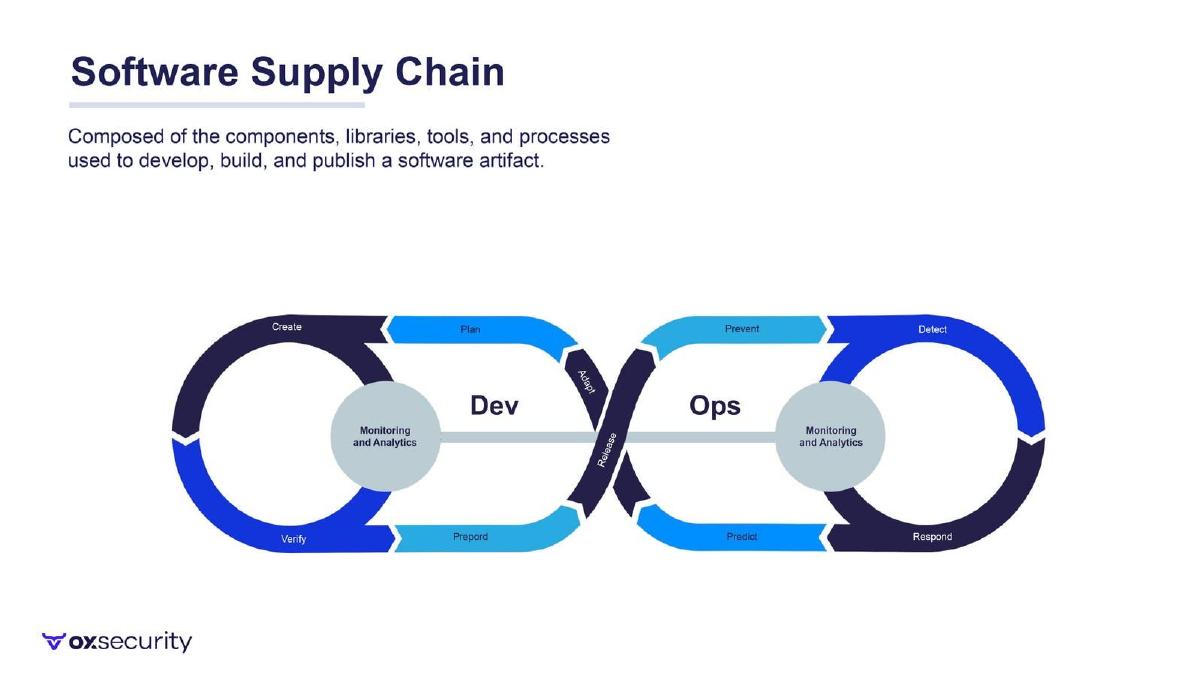
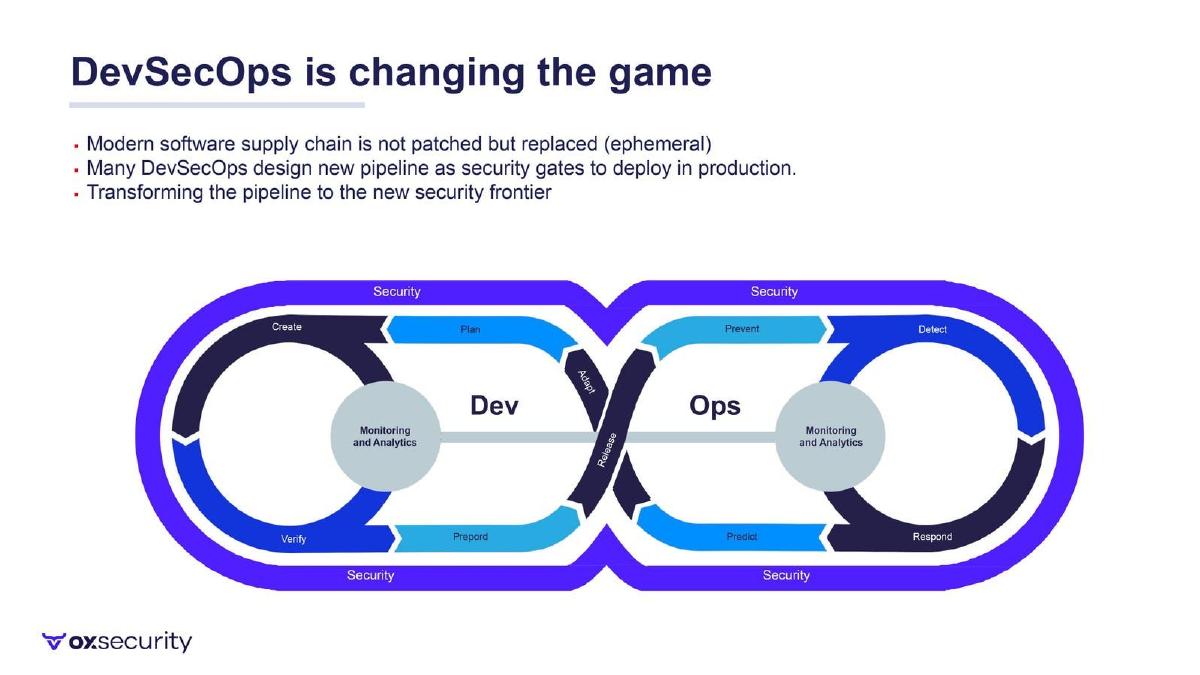
- Visual storytelling is used to explain the 'ephemeral' nature of modern software supply chains, where code is replaced rather than patched (Slide 3).
The Technical Pivot: How OX Security Framed a $34M Series A
OX Security’s pitch deck is a focused, technical document that prioritizes product architecture and problem-mapping over traditional business metrics. In a 2022 cybersecurity market that was increasingly wary of 'point solutions,' OX used these 15 slides to argue for a platform-level approach to the software supply chain. According to publisher-reported facts, this deck supported a $34M Series A round, a significant sum that reflects the urgency of the problem space they addressed.
Slide 1: The Identity
The title slide is minimalist, featuring the OX Security logo and the tagline: Stop Attacks Across Your Software Supply Chain . Dated September 2022, it sets a professional tone. The branding uses a bull icon, which reappears throughout the deck as a mascot, humanizing a deeply technical product. The simplicity here suggests a company that is confident in its name recognition within the cybersecurity community or is presenting to an audience already familiar with the space.
Slide 2: Establishing the Threat Landscape
OX immediately moves to third-party validation. They feature a headline from DarkReading: More Than Half of Initial Infections in Cyberattacks Come Via Exploits, Supply Chain Compromises . The slide includes a donut chart attributed to Mandiant for the year 2021, showing that 'Exploits' (37%) and 'Supply Chain Compromise' (17%) are the leading vectors. By citing Mandiant and DarkReading, OX grounds their pitch in industry-standard data, removing the 'founder bias' from the problem statement.
Slide 3: The Shift to DevSecOps
This slide explains the 'Why Now.' It argues that DevSecOps is changing the game . The key points are that the modern software supply chain is 'ephemeral'—meaning code is replaced rather than patched—and that the pipeline itself is the 'new security frontier.' A large infinity-loop diagram visualizes the Dev and Ops cycles, with 'Security' wrapping around the entire process. This slide is crucial because it moves the conversation from 'fixing bugs' to 'securing the factory' that builds the software.
Slide 4: Mapping the Failure Points
Slide 4 is perhaps the most effective in the deck. It states that despite most organizations having implemented AppSec tools , 62% still faced supply chain attacks in 2021. The slide visualizes a timeline from 'Plan' to 'Monitor,' placing famous logos at their point of failure: Codecov, Peloton, Log4j, SolarWinds, BitGo, and Equifax . This creates a sense of 'inevitability'—if these giants failed with traditional tools, the investor realizes a new category of security is required.
Slide 5: The 'Discover' Phase
Here, OX transitions into the product. The 'Discover' slide promises full visibility and end-to-end traceability . The graphic shows a linear flow from Source Control to Security Logs. It lists specific integrations and metrics, such as 350 Repos, 10 CI/CD Pipelines, 20 Artifacts, and 434 Cloud Assets . This slide proves the platform can handle the complexity of a modern enterprise environment, showing logos like GitLab, Checkmarx, and AWS.
Slide 6: The 'Automate' Phase
OX moves from visibility to action. The 'Automate' slide explains how the platform can automatically block vulnerabilities . It shows a policy engine interface where users can set rules (e.g., if a secret is found in code, 'Block-Pipeline'). Below the table is a logic flow diagram showing how a Webhook triggers an 'If/Then' sequence that ends in a Jira ticket, a Slack message, or a GitLab block. This demonstrates that OX isn't just a dashboard; it’s an active participant in the development workflow.
Slide 7: The 'Secure' Phase and Integrity
The final product slide focuses on Integrity of cloud assets . It introduces the concept of a PBOM (Pipeline Bill of Materials) . The goal is to ensure every artifact in production originates from a secure, signed pipeline. The slide shows a dashboard with 'Risk Scores' and 'Business Priority' for various apps (e.g., 'app/scanner' with a score of 383). This is the 'bottom line' for a CISO: a single view to see if what is running in the cloud is actually what they intended to build.
Slide 8-15: The Missing Narrative
The provided text for slides 8 through 15 simply repeats 'OX Security.' In a standard pitch deck, these slides would typically cover the Business Model, Go-To-Market Strategy, Competition, Team, and The Ask . The fact that these are omitted in the public version suggests either a highly confidential strategy or a deck that relied heavily on a verbal presentation. However, based on the first seven slides, the technical foundation is clearly the 'hero' of the pitch.
What OX Security Does Well
The deck excels at contextualizing the problem . By mapping specific, well-known breaches to a timeline of the software development lifecycle, OX makes a complex technical problem feel tangible. They avoid the trap of 'fear-mongering' by using reputable data from Mandiant and DarkReading, which builds immediate credibility with sophisticated investors.
Furthermore, the Product-Led approach is strong. Instead of abstract promises, the deck shows actual UI components and logic flows. Seeing the 'Policy' table on Slide 6 allows an investor to visualize exactly how a customer would use the product. This reduces the 'black box' risk often associated with cybersecurity startups.
What is Missing from the Deck
The most glaring omission is the Team Slide . In a Series A, the pedigree of the founders (especially in a region like the Middle East, known for elite cyber talent) is often 50% of the investment decision. Without seeing the expertise behind the 'PBOM' concept, the technical claims carry less weight.
Additionally, there is no Traction or Financials slide . While the 'Discover' slide mentions 350 repos, it isn't clear if these are from a single pilot customer or an aggregate across a large user base. Investors typically want to see ARR growth, churn rates, or at least a pipeline of enterprise logos to justify a $34M valuation. The Competitive Landscape is also ignored; the deck assumes OX is the only solution to this problem, which is rarely the case in the crowded DevSecOps market.
Lessons for Founders
Use the 'Timeline of Failure': If you are solving a problem that existing tools failed to fix, map those failures visually. Slide 4 is a perfect example of how to show a gap in the market by using real-world examples. · Define a New Standard: OX didn't just say they scan code; they introduced the 'PBOM.' Creating your own terminology (if it makes sense) helps position your company as a category leader rather than a feature. · Show, Don't Just Tell: The inclusion of the logic flow on Slide 6 is powerful. It shows that the product is 'plumbed' into the developer's existing tools (Slack, Jira, GitLab), which addresses the common concern of 'tool fatigue.' · Lead with Data: Start with macro-trends from respected third parties. It sets a professional baseline and ensures the investor agrees with your premise before you ever show the product.
Frequently asked questions
- What is the core value proposition of OX Security according to the deck?
- The core value proposition is providing 'full visibility and end-to-end traceability' across the entire software pipeline—from code and CI/CD to artifact registries and production. As shown on Slide 5 and 6, the platform aims to automate the blocking of critical vulnerabilities and ensure the integrity of cloud assets by verifying their origin through a secure pipeline.
- How does OX Security differentiate itself from traditional AppSec tools?
- On Slide 4, the deck notes that while most organizations have AppSec tools, 62% still faced supply chain attacks in 2021. OX differentiates by covering the 'new security frontier' of the pipeline itself, treating the supply chain as ephemeral and focusing on integrity and automated gates rather than just static scanning.
- What specific cyberattacks does the deck use to justify its existence?
- Slide 4 explicitly maps several major breaches to different stages of the software lifecycle: Codecov (Plan), Peloton (Code), Log4j (Build), SolarWinds (Release), BitGo (Deploy), and Equifax (Operate/Monitor). This demonstrates that vulnerabilities exist at every step, requiring a holistic solution.
- Does the deck include financial projections or a team overview?
- No. The 15-slide deck provided focuses exclusively on the problem, market context, and product functionality. It omits traditional slides like the founding team's pedigree, current revenue/ARR, market size (TAM), and the specific breakdown of how the $34M Series A funds will be spent.
- What technical concepts are central to the OX Security platform?
- The deck highlights 'PBOM' (Pipeline Bill of Materials) on Slide 7, which ensures artifacts in production are signed and secure. It also emphasizes 'Infrastructure as Code' (IaC) security, 'SCA' (Software Composition Analysis), and 'SBOM' (Software Bill of Materials) integration as part of its end-to-end discovery process.