Oxygen's 16-slide pitch deck is a data-heavy narrative that focuses on two primary pillars: brand-led differentiation and deep technical moats. By positioning themselves as the 'Mac of Financial Services,' Oxygen moved away from the commodity 'white label' fintech model, emphasizing their proprietary tech stack and direct Visa integrations. The deck is particularly strong in its presentation of cohort data, showing that users not only stay but increase their deposit volumes and transaction frequencies over time. While the deck lacks a traditional 'Ask' slide and specific founder bios, it comp…
Key takeaways
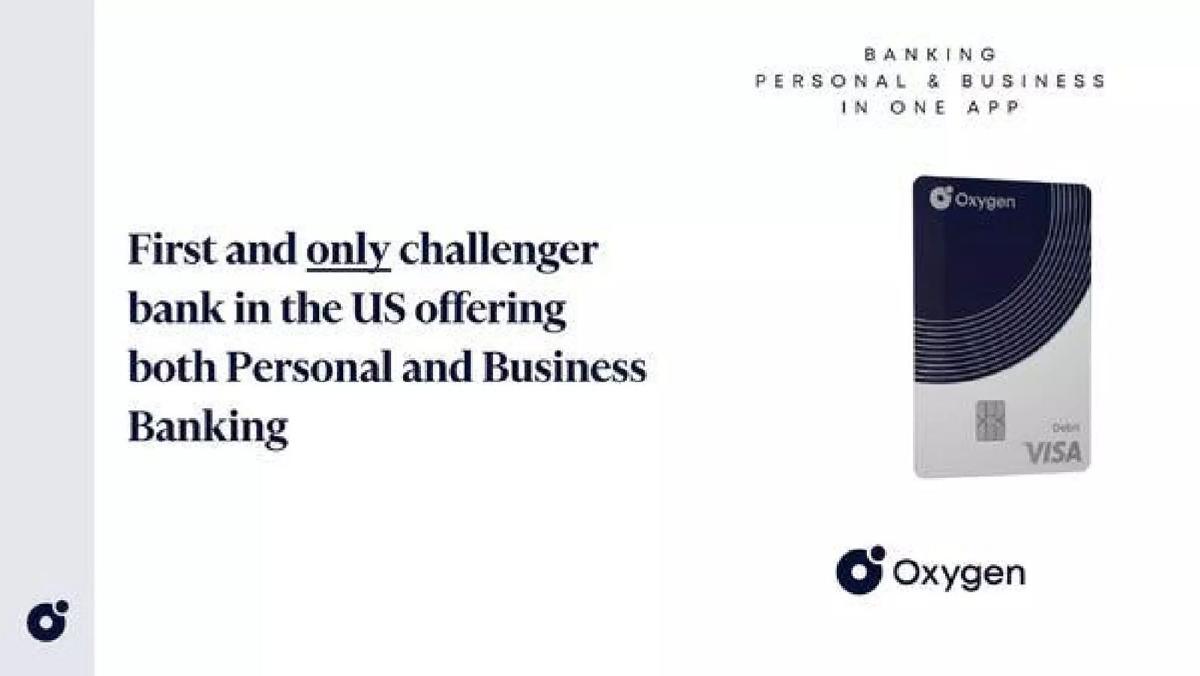
- Oxygen claims to be the first and only US challenger bank offering both personal and business banking in one app on slide 2.
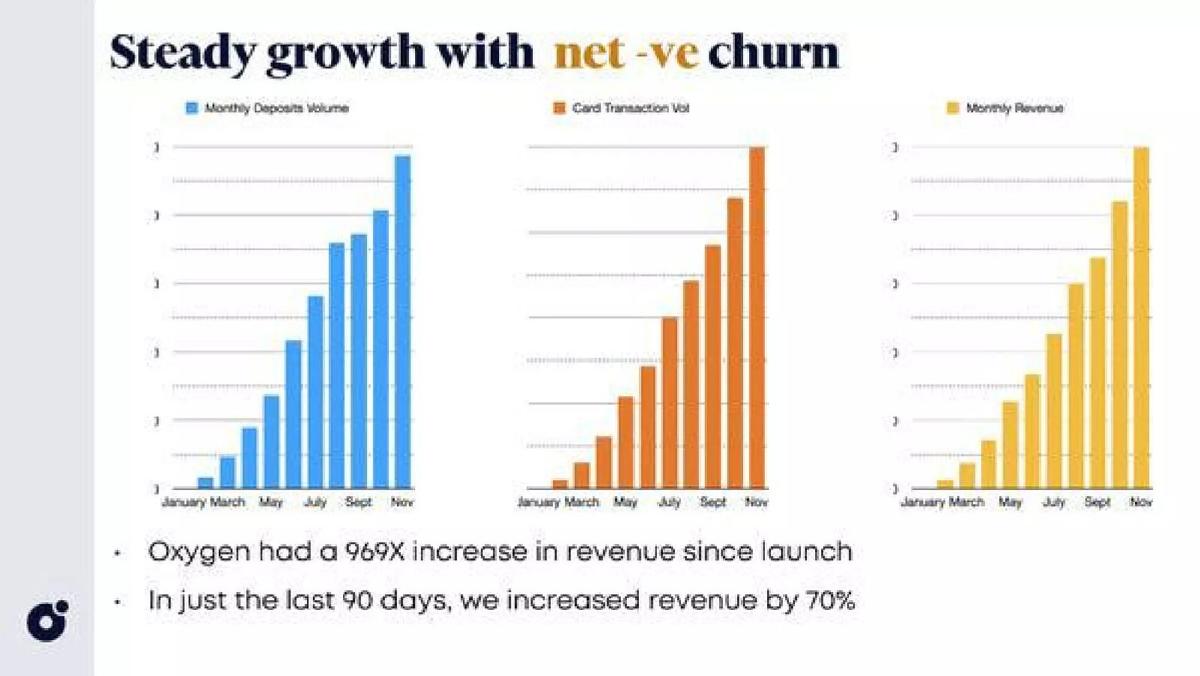
- The company reported a 969X increase in revenue since launch and a 70% revenue increase in the 90 days prior to the deck on slide 3.
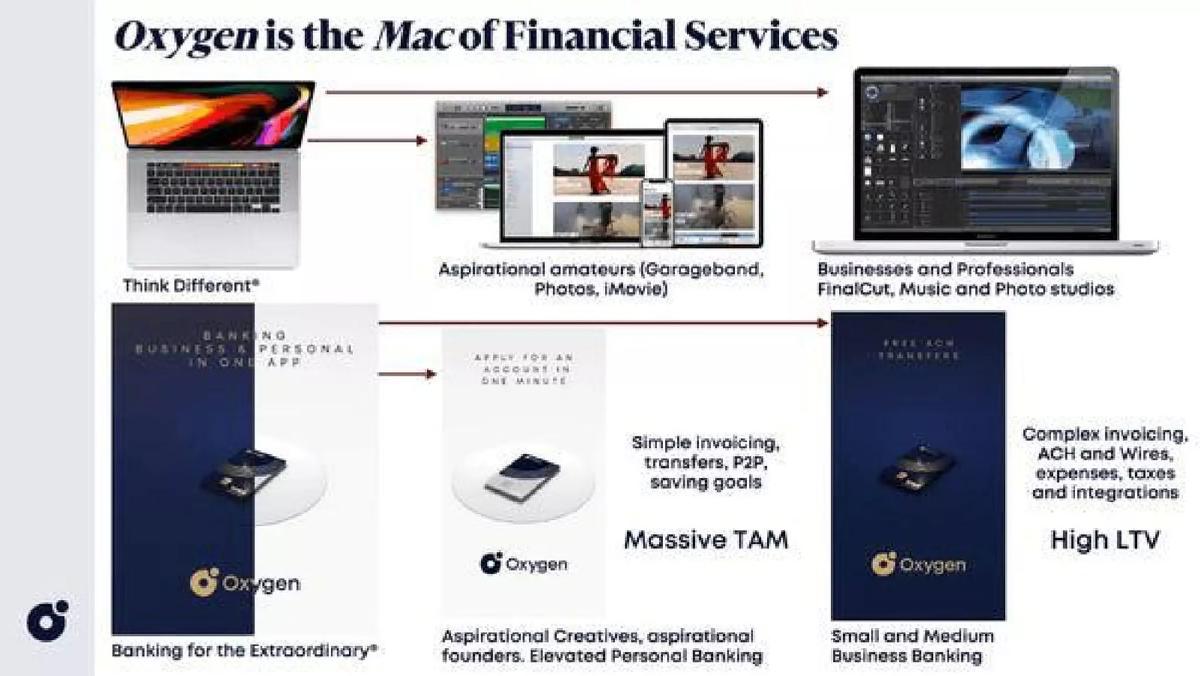
- Oxygen uses a direct analogy to Apple, calling itself the 'Mac of Financial Services' to explain its tiered user journey from amateurs to professionals on slide 4.
- The deck emphasizes technical independence, noting proprietary CIP and direct partnerships with 78 partners to avoid revenue sharing on slide 7.
- Cohort analysis on slide 9 shows that active users deposit larger amounts within 30 to 60 days of joining.
- Slide 10 explicitly links account expansion of active users to negative net churn, a key metric for fintech sustainability.
- The company demonstrated 12 months of consistent growth at a rate of 25% plus month-over-month on slide 13.
- The deck highlights backing from Y Combinator, Runa Capital, and individual advisors from Deutsche Bank and LVMH on slide 15.
Introduction: The Unified Banking Play
Oxygen entered the fintech space in 2018 with a specific mission: to bridge the gap between personal and business banking for the gig economy and digital entrepreneurs. This 16-slide pitch deck was instrumental in securing $25,000,000 in funding. It stands out not for its aesthetic beauty—which is minimalist and functional—but for its aggressive focus on cohort data and structural margin advantages. In a market where most neobanks were fighting for the same consumer checking accounts, Oxygen’s deck argues for a vertical approach that follows the user from their first freelance gig to a full-scale SMB.
Slides 1-2: The Hook and the Differentiator
The deck opens with the tagline Banking for the Extraordinary on slide 1, accompanied by high-energy lifestyle photography. This immediately signals that Oxygen is a brand-led company, not just a utility. However, slide 2 gets straight to the competitive moat: First and only challenger bank in the US offering both Personal and Business Banking . By highlighting 'only' with an underline, the founders are telling investors that they have found a blue ocean in a crowded red market. The visual of the sleek, minimalist Visa card reinforces the premium brand positioning.
Slides 3-5: Traction and the Apple Analogy
Slide 3 is a heavy-hitter for growth metrics. It shows three bar charts for Monthly Deposits Volume, Card Transaction Vol, and Monthly Revenue. While the Y-axis lacks specific dollar amounts, the trend lines are steep. The slide claims a 969X increase in revenue since launch and a 70% increase in the last 90 days . This is classic early-stage momentum signaling.
Slide 4 is perhaps the most important strategic slide in the deck. It uses the Mac of Financial Services analogy. It maps Oxygen's product tiers to Apple's software: personal banking is the 'iMovie' (Massive TAM), and business banking is the 'FinalCut' (High LTV). This explains their unit economics: they acquire users cheaply at the personal level and expand them into high-value business customers who need complex invoicing, ACH, wires, and tax integrations. Slide 5 follows this up with a 'mood board' of social proof, showing influencers and users with the card, reinforcing the 'high activation and retention' claim through brand affinity.
Slides 6-7: The Technical Moat
After the brand fluff, slide 7 dives into the 'how.' Oxygen makes a point to distance itself from White Label FinTech (which is shown with a red 'no' symbol). They list proprietary assets: a custom CIP, AI-powered support, and Oxygen Mission Control (OMC) , their bespoke back-office system. The key takeaway here is the Fundamental Margin Advantage . By having direct Visa and processor integrations and 78 partner/vendor relationships, they claim to keep all the revenue rather than sharing it with a banking-as-a-service provider. This is a crucial point for Series A/B investors who are wary of thin margins in fintech.
Slides 8-11: The Power of Cohorts
This section is the data-driven core of the deck. Slide 8 shows that ARPU (Average Revenue Per User) is increasing because deposits and transactions per user are growing. Slide 9 and 10 use cohort lines to show that as users stay on the platform for 30, 60, or 90 days, their activity doesn't just plateau—it accelerates. Slide 10 explicitly states that Account expansion of active users results in negative net churn . For a bank, this is the 'holy grail' metric. It means the existing customer base is growing in value faster than new customers are leaving. Slide 11 is a transition slide titled 'Scaling,' featuring more lifestyle imagery to reset the pace before the final financial push.
Slides 12-16: The Close and the Team
Slide 13 provides the long-term growth view: 12 months consistently growing @ 25%+ MoM . The chart shows a clear inflection point where growth begins to compound. Slide 14 serves as a recap, summarizing the massive market size of Gen Z/Millennial entrepreneurs and their 'proven highly scalable acquisition.'
Slide 15 introduces the World class investors and advisors . Rather than focusing on the founders' day-to-day bios (which are notably absent from this slide), they highlight heavyweights like Frank Strauss (Deutsche Bank) and Pauline Brown (LVMH), alongside logos for Y Combinator and Runa Capital. This suggests a team that is well-connected in both the financial and luxury/brand worlds. The deck concludes on slide 16 with a simple 'Thank you' and the recurring brand imagery.
What Works in the Oxygen Deck
Strategic Analogy: The 'Mac of Financial Services' comparison is brilliant. It simplifies a complex multi-product strategy into a mental model that every investor understands: acquire the amateur, serve the professional. · Negative Net Churn: By focusing on cohort expansion (slides 9-10), Oxygen proves that their product is 'sticky.' In fintech, where customer acquisition costs (CAC) are notoriously high, proving that users increase their deposits over time is the best way to justify a high valuation. · Infrastructure Independence: Highlighting that they are not a 'white label' player (slide 7) addresses a major investor concern regarding long-term profitability and platform risk. · Consistent Growth Narrative: The 25% MoM growth figure on slide 13 provides a clear benchmark for the company's execution capabilities.
What is Missing from the Oxygen Deck
The Ask: There is no slide detailing how much money they are raising, the valuation they are seeking, or specifically how the $25M will be spent (e.g., % to marketing, % to engineering). · Founder Bios: While the advisors are impressive, the actual founders' backgrounds and their specific 'why' are not detailed in these slides. Investors usually want to see the operational team's pedigree, not just their advisors. · Competitive Landscape: The deck claims to be the 'only' one doing personal and business banking, but it doesn't acknowledge other neobanks (like Chime or Revolut) or how they plan to defend their territory as those giants inevitably expand their features. · Unit Economics Specifics: While they mention 'great economics,' they don't provide specific CAC (Customer Acquisition Cost) or LTV (Lifetime Value) dollar amounts, which are standard for a Series A/B fintech deck.
What a Founder Should Copy
The Cohort Visuals: The way Oxygen visualizes user behavior over time (slides 9 and 10) is a gold standard for showing product-market fit. Don't just show total users; show that your old users are doing more today than they were yesterday. · The 'Anti-Category' Positioning: Oxygen's explicit rejection of 'white label fintech' is a powerful way to position against competitors. If you have built proprietary tech in a world of resellers, make it a headline. · The Unified User Journey: If your product serves two different needs (like personal and business), use a slide like slide 4 to show how one feeds the other. It turns a 'distracted' product roadmap into a 'synergistic' one. · Recap Slide: Slide 14 is an excellent summary. It ensures that if an investor only remembers three things, they are the three things you chose: Market Size, PMF, and Efficiency.
Frequently asked questions
- What is Oxygen's core value proposition according to the deck?
- Oxygen positions itself as a unified financial platform for the 'extraordinary,' specifically targeting digital natives and entrepreneurs. Its primary differentiator, stated on slide 2, is being the only US challenger bank to offer both personal and business banking within a single application. This allows them to capture users as 'aspirational creatives' and transition them into high-LTV business accounts as their professional lives scale.
- How does Oxygen justify its valuation and growth potential?
- The deck relies heavily on traction and efficiency metrics. On slide 3, they cite a 969X revenue increase since launch and 70% growth in the last 90 days. Furthermore, slide 13 shows a consistent 25% month-over-month growth rate over a 12-month period. By showing that users increase their deposits and transactions over time (slides 9 and 10), they demonstrate a 'negative net churn' profile that is highly attractive to investors.
- What is the 'Mac of Financial Services' analogy?
- On slide 4, Oxygen compares its product tiers to Apple's ecosystem. They equate their personal banking to 'Garageband' or 'iMovie' for aspirational amateurs, while their business banking is compared to 'FinalCut' for professionals. This analogy helps investors understand their customer acquisition strategy: start with a massive TAM of individuals and upsell them to complex, high-margin business services like invoicing and tax integrations.
- What technical advantages does Oxygen claim over other fintechs?
- Oxygen emphasizes that they are not a 'white label' fintech. Slide 7 details their proprietary Customer Identification Program (CIP), AI-powered support, and a bespoke back-office system called 'Oxygen Mission Control' (OMC). By having direct Visa and processor integrations and 78 partner relationships, they claim a 'fundamental margin advantage' because they do not have to share revenue with middle-ware providers.
- Who are the key investors and advisors mentioned in the deck?
- Slide 15 lists several high-profile backers, including Y Combinator, Runa Capital, and 1984 VC. Notable advisors include Frank Strauss (former CEO of Private & Commercial Bank at Deutsche Bank), Pauline Brown (former Chairman of LVMH America), and Andre Bliznyuk (GP at Runa Capital). This mix of traditional banking expertise and venture capital pedigree adds significant credibility to the startup.