Oxwash’s 9-slide deck is a lean, data-driven presentation that successfully bridged the gap between a traditional service industry and high-tech sustainability. By positioning themselves as 'Clinically Clean, Space Age Laundry,' the founders moved beyond the 'laundry app' trope to highlight proprietary technology like ozone sterilization and microfibre filtration. The deck is particularly strong in its operational transparency, sharing specific metrics like a 99.8% successful collection rate and 78.2% rider utilization. While it lacks a formal 'Ask' slide or detailed competitor matrix, the co…
Key takeaways
- The deck identifies a specific 'Washing Gap' in the £2.5B UK market, targeting SMEs that are too large for consumer solutions but too small for enterprise contracts (Slide 3).
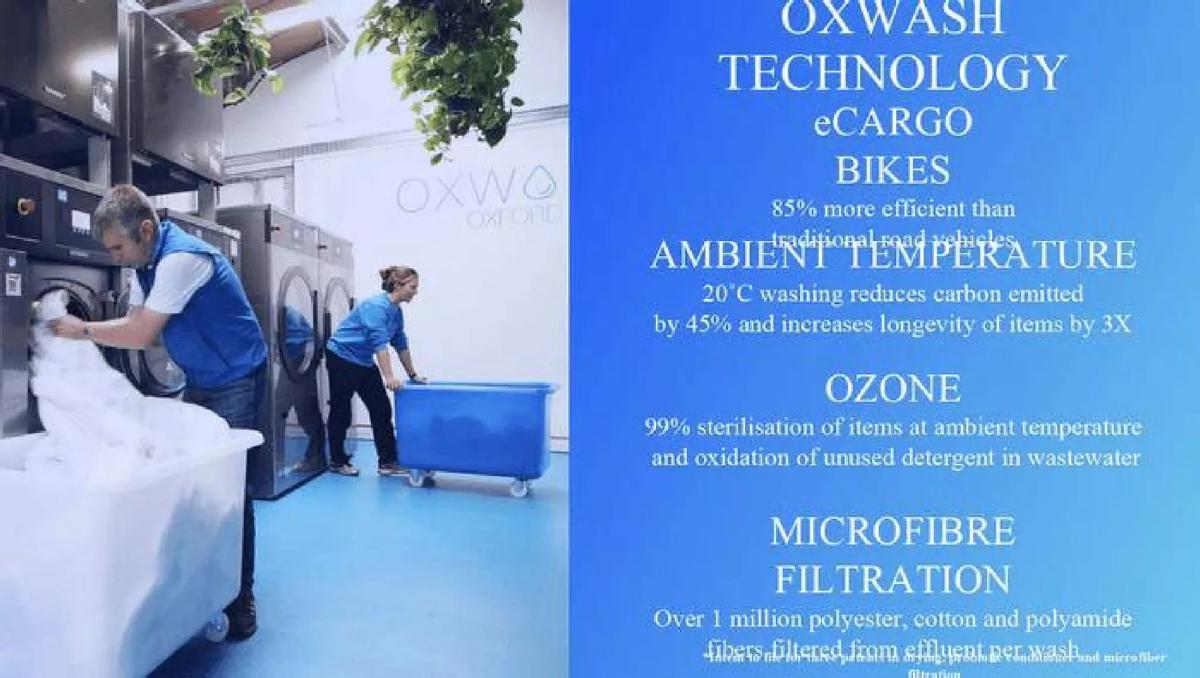
- Sustainability is treated as a technical advantage rather than just marketing, citing 20°C washing that reduces carbon by 45% and increases item longevity by 3X (Slide 5).
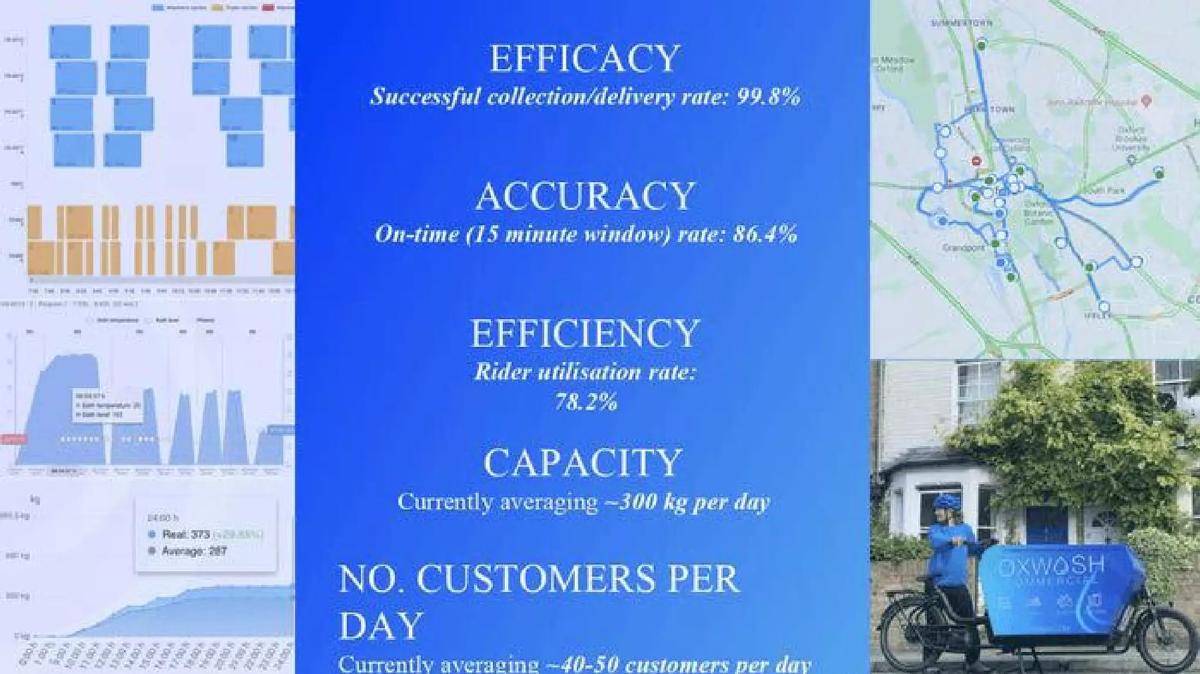
- Operational efficiency is proven through granular data, including an 86.4% on-time rate within a 15-minute window (Slide 6).
- The company utilizes e-cargo bikes which they claim are 85% more efficient than traditional road vehicles (Slide 5).
- Revenue projections show a steep trajectory from near-zero in 2018 to a forecasted £12M by 2025 (Slide 7).
- The leadership team features a high-signal mix of academic and operational expertise, led by an ex-NASA scientist CEO (Slide 8).
- The deck omits a specific breakdown of how the $15.8M Series A funds would be allocated.
- Social proof is established through a 'Key Customers' list featuring global brands like Deliveroo, Marriott, and Virgin (Slide 7).
Executive Summary: The 9-Slide Efficiency Play
Oxwash’s Series A deck is a study in brevity. At just nine slides, it manages to cover the essential bases of a venture-scale business: problem, market gap, proprietary technology, operational proof, and team pedigree. The company, founded in 2018 by an ex-NASA scientist, positions itself not as a laundry service, but as a sustainable technology platform for 'space-age' cleaning. With a total raise of $15.8 million, this deck successfully convinced investors that the unglamorous world of laundry was ripe for a high-tech, ESG-aligned overhaul.
Slide 1: Title and Visual Identity
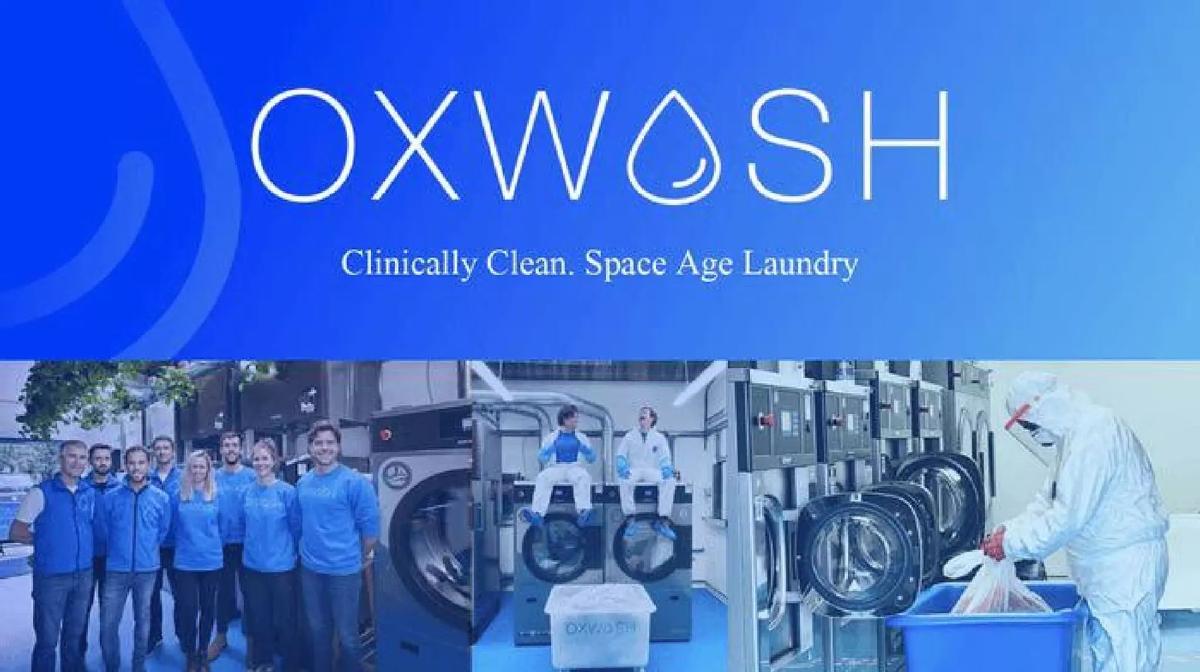
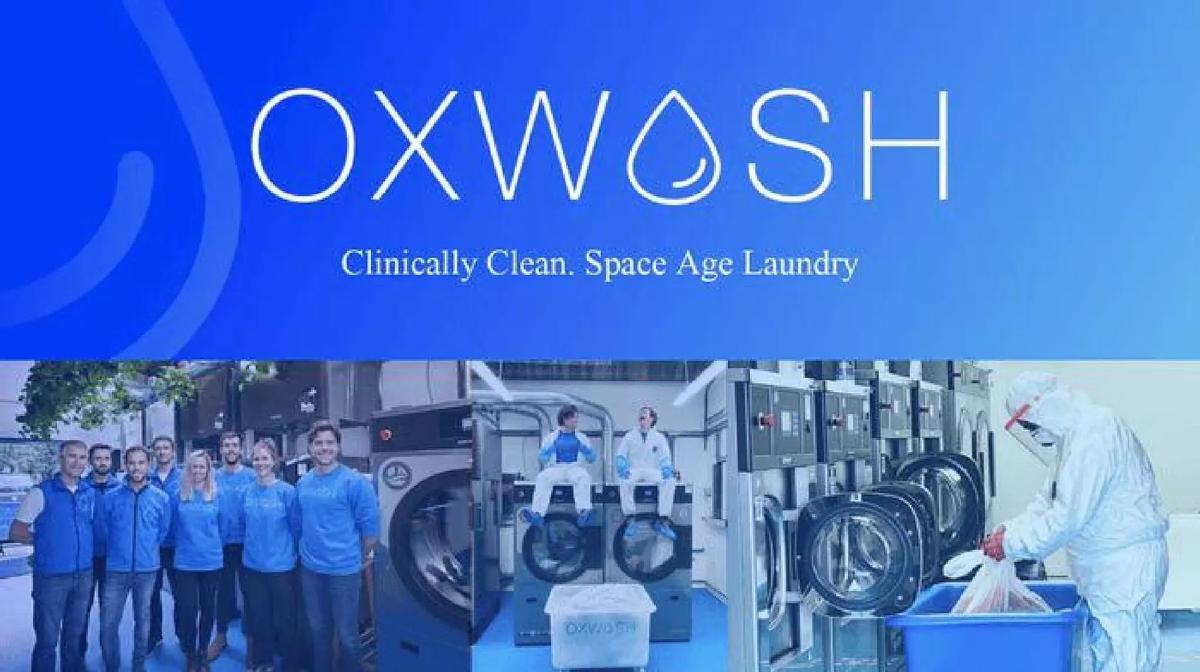
The deck opens with a clean, blue-gradient title slide featuring the tagline: "Clinically Clean. Space Age Laundry." The bottom half of the slide uses a collage of three photos: the team in uniform, founders sitting on industrial washers, and a worker in a full hazmat-style suit. This immediately establishes the brand's focus on professionalization and hygiene, distancing it from the 'mom-and-pop' laundromat aesthetic.
Slide 2: The Problem - Laundry's Dirty Secrets
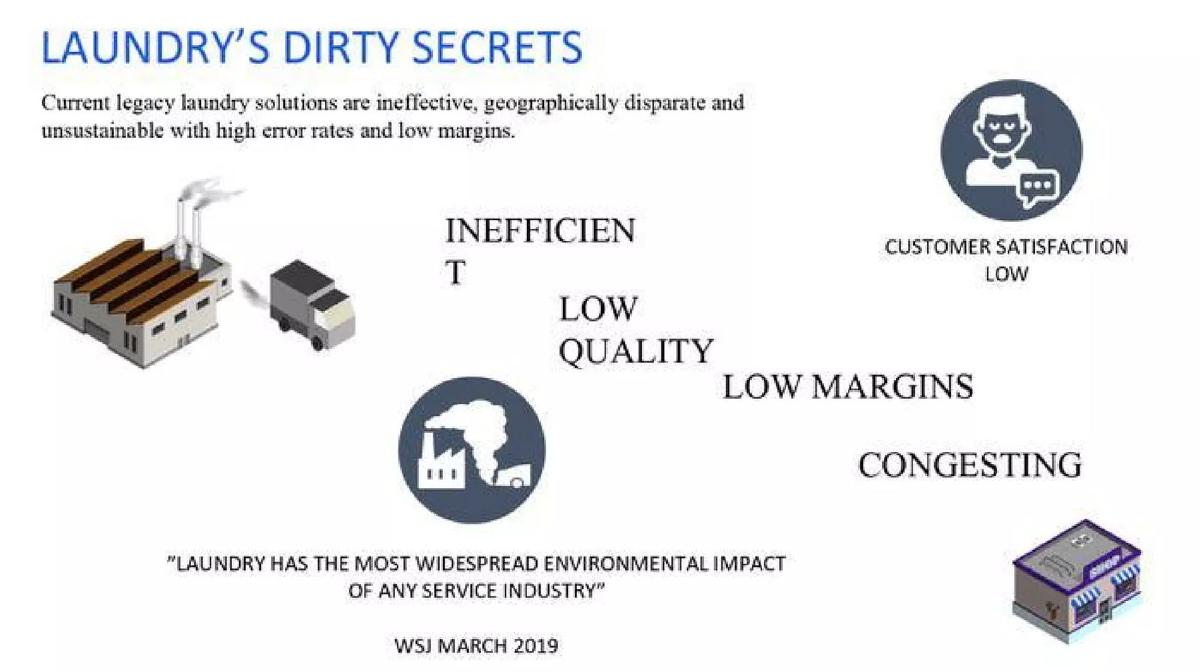
Slide 2 identifies the pain points of the 'legacy' laundry industry. It lists five key issues: Inefficient, Low Quality, Low Margins, Congesting, and Low Customer Satisfaction. The slide includes a quote attributed to the WSJ in March 2019: "Laundry has the most widespread environmental impact of any service industry." This framing is crucial; it transforms a logistics problem into an environmental mandate, appealing to the growing pool of ESG-focused capital.
Slide 3: The Washing Gap
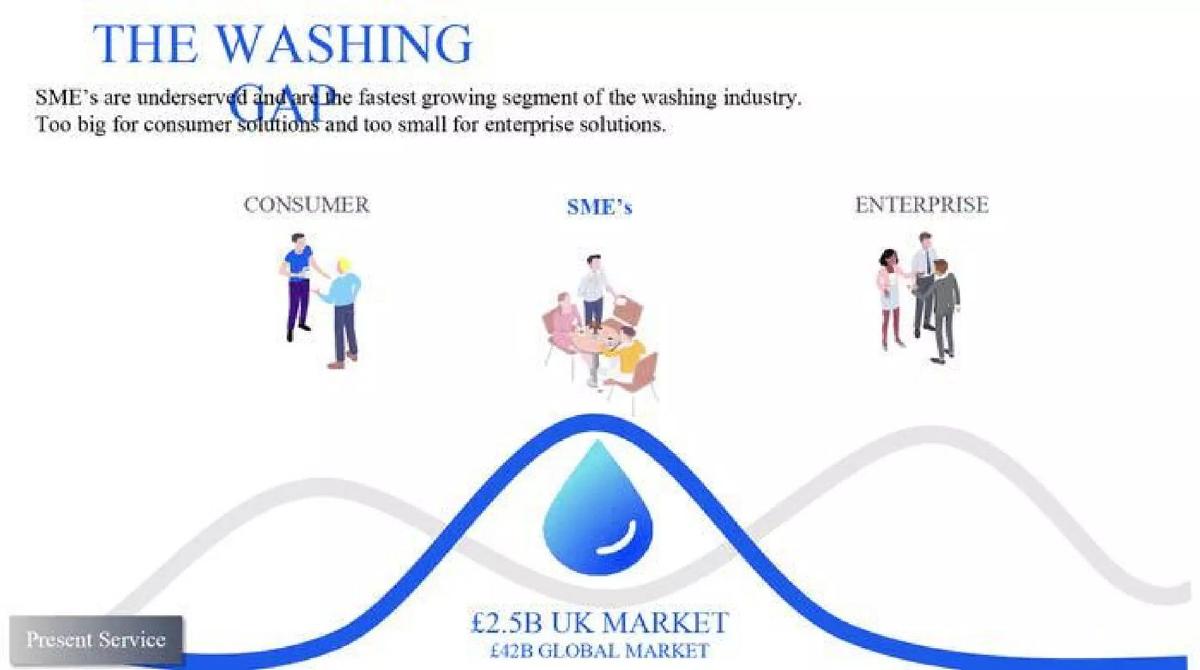
This slide defines the target market. Oxwash identifies a 'gap' between Consumer and Enterprise solutions. They claim SMEs are the fastest-growing segment but are currently underserved because they are "too big for consumer solutions and too small for enterprise solutions." The slide quantifies the opportunity with two figures: a £2.5B UK Market and a £42B Global Market. The visual uses a bell-curve graphic to show Oxwash sitting directly in the underserved middle.
Slide 4: The Oxwash Model
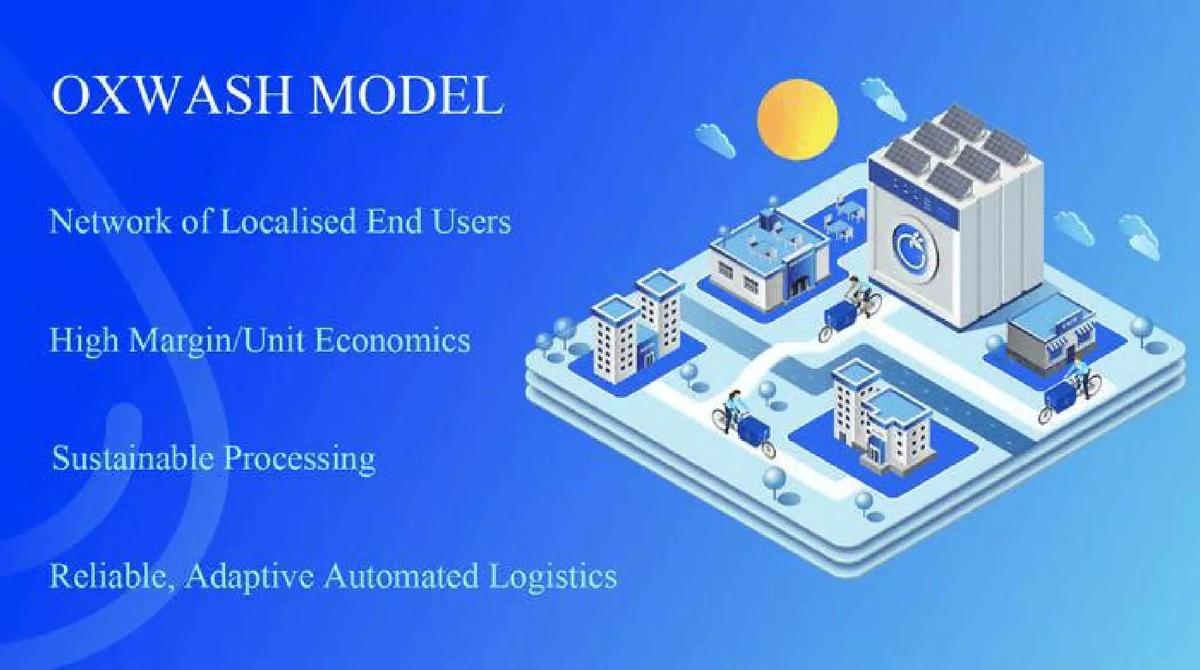
Slide 4 introduces the solution through an isometric illustration of a city. The model is built on four pillars: Network of Localised End Users, High Margin/Unit Economics, Sustainable Processing, and Reliable, Adaptive Automated Logistics. The illustration shows solar panels on the roof of the washing facility and e-cargo bikes moving between buildings, visually reinforcing the 'zero-emission' logistics footprint mentioned in the company's description.
Slide 5: Proprietary Technology
This is the 'moat' slide. Oxwash breaks down its technological advantages into four categories:
eCargo Bikes: 85% more efficient than traditional road vehicles. · Ambient Temperature: 20°C washing reduces carbon by 45% and increases item longevity by 3X. · Ozone: 99% sterilization and oxidation of unused detergent. · Microfibre Filtration: Over 1 million fibers filtered per wash.
By highlighting these specific technical achievements, Oxwash moves the conversation away from 'we pick up clothes' to 'we have engineered a superior cleaning process.'
Slide 6: Operational Efficacy and Metrics
Slide 6 provides the 'proof of life' for the business model. It is dense with data points that suggest a highly optimized operation:
Successful collection/delivery rate: 99.8% · On-time (15 minute window) rate: 86.4% · Rider utilisation rate: 78.2% · Capacity: ~300 kg per day · Customers: ~40-50 per day
The inclusion of a map with delivery routes and screenshots of a backend dashboard suggests that the company has built the software infrastructure necessary to scale these metrics.
Slide 7: Financial Trajectory and Social Proof
The financial slide shows a bar chart of Total Revenue and Total EBITDA from 2018 to 2025. The chart indicates the company expected to hit EBITDA positivity in 2023, with revenue scaling to £12,000,000 by 2025. To the right, a 'Key Customers' section provides massive social proof, listing Deliveroo, University of Oxford, Marriott, and the Virgin London Marathon. Winning these high-volume contracts early is a strong signal of product-market fit for their SME/Enterprise hybrid strategy.
Slide 8: Leadership and Advisors
The team slide is exceptionally strong. CEO Kyle C. Grant is highlighted as an ex-NASA scientist and Oxford PhD. COO Thomas de Wilton brings engineering and modular assembly experience. Chairman Aron Ping D’Souza adds financial weight as a private equity manager. The 'Key Advisors & Investors' column includes Benjamin Legg (ex-Google COO), Srin Madipalli (Airbnb Head of Product), and Daniel Channer (ex-MD of Finders Keepers). This team composition covers all bases: science, operations, tech-scaling, and finance.
Slide 9: Contact and Closing
The final slide is a simple contact page featuring a photo of two team members high-fiving in the laundry facility. It provides direct email addresses for the CEO and COO. While it lacks a final 'vision' statement, the high-energy photo serves to end the deck on a positive, human note.
What Works in the Oxwash Deck
Specific Operational Data: Most early-stage decks are vague about their operations. Oxwash’s decision to share their 15-minute window accuracy (86.4%) and rider utilization (78.2%) on Slide 6 demonstrates a level of control and transparency that builds investor trust. It proves they aren't just 'disrupting' laundry; they are mastering the logistics of it.
The 'NASA Scientist' Hook: Leveraging the CEO's background as an ex-NASA scientist (Slide 8) is a brilliant framing device. It makes the 'Space Age Laundry' tagline feel like a legitimate technical claim rather than just a marketing gimmick. It suggests that the cleaning processes (Ozone, Microfiltration) are grounded in rigorous science.
Clear Market Segmentation: By defining 'The Washing Gap' on Slide 3, Oxwash avoids the trap of trying to be everything to everyone. They explicitly state they are targeting the underserved SME market, which gives investors a clear understanding of their go-to-market strategy and why they aren't just competing with every local dry cleaner.
What is Missing from the Oxwash Deck
The Ask: The most glaring omission is a slide detailing the funding round. There is no mention of how much capital is being sought, the valuation, or how the funds will be allocated (e.g., geographic expansion, R&D, marketing). While this may have been in a separate document or a later version of the deck, its absence here leaves a hole in the narrative.
Competitor Analysis: The deck mentions 'legacy solutions' generally on Slide 2, but it never names specific competitors or provides a feature-comparison matrix. Investors would likely want to know how Oxwash stacks up against other tech-enabled laundry startups (like Laundryheap) or large-scale industrial providers.
Unit Economics Detail: While Slide 4 mentions 'High Margin/Unit Economics,' the deck doesn't actually show the numbers. A slide detailing the CAC (Customer Acquisition Cost), LTV (Lifetime Value), and the contribution margin per kg of laundry would have strengthened the financial argument significantly.
What a Founder Should Copy
The 'Problem as an Industry Secret' Framing: Slide 2 is titled 'Laundry's Dirty Secrets.' This is a compelling way to frame a problem. It suggests the founder has 'insider' knowledge of why the current system is broken, which makes their solution feel more necessary and inevitable.
Technical Substantiation of ESG: Many startups claim to be 'green' without proof. Oxwash (Slide 5) provides specific numbers: 20°C washing, 45% carbon reduction, and 1 million fibers filtered. If you are pitching a sustainable business, copy this approach of using hard technical data to back up your environmental claims.
Visualizing the 'Gap': The bell curve on Slide 3 is a perfect way to visualize a market opportunity. It’s a simple, instantly recognizable graphic that explains why a new player can exist alongside established giants. If your startup targets a specific niche that others overlook, use a similar visual to show exactly where you sit in the ecosystem.
Final Verdict: The Oxwash deck is a lean, high-signal presentation that relies on technical credibility and operational excellence. By focusing on the 'how' (proprietary tech) and the 'who' (NASA-level leadership), they successfully turned a commodity service into a venture-backable technology play.
Frequently asked questions
- What is the primary market opportunity Oxwash identified?
- Oxwash identified what they call 'The Washing Gap' on Slide 3. They argue that Small and Medium Enterprises (SMEs) are the fastest-growing segment of the laundry industry but are currently underserved. These businesses are too large to use consumer-grade laundry services effectively but are not large enough to command the attention or pricing of massive industrial enterprise solutions. They value this UK market at £2.5 billion.
- How does Oxwash differentiate its technology from standard laundromats?
- On Slide 5, the company details four technical pillars: e-cargo bikes for 85% better efficiency, ambient temperature washing (20°C) to triple garment life, ozone sterilization for 99% disinfection, and microfibre filtration to remove over 1 million fibers per wash. This positions them as a technology-led infrastructure company rather than a simple service provider.
- What operational metrics did Oxwash share to prove their model works?
- Slide 6 is dedicated to 'Efficacy' and 'Accuracy.' They report a 99.8% successful collection/delivery rate, an 86.4% on-time rate within a strict 15-minute window, and a 78.2% rider utilization rate. At the time of the deck, they were averaging approximately 300 kg of laundry and 40-50 customers per day.
- Who are the key people behind Oxwash?
- The leadership team (Slide 8) is led by Dr. Kyle C. Grant, an ex-NASA scientist and Oxford PhD. He is joined by COO Thomas de Wilton, an Oxford Engineer with experience in modular assembly. The board is chaired by Aron Ping D’Souza, a private equity manager. Their advisor list includes former executives from Google, Airbnb, and Coca-Cola, providing significant institutional credibility.
- Is there a clear financial exit or 'Ask' in this deck?
- No. The 9-slide version of this deck lacks a formal 'Ask' slide detailing the amount being raised or the specific use of proceeds. It also does not explicitly discuss exit strategies. However, Slide 7 provides a 'Financial Trajectory' showing a path to EBITDA positivity by 2023 and £12M in revenue by 2025, which serves as the primary financial hook for investors.