Ownwell’s 11-slide Seed deck is a lean, problem-oriented presentation that successfully secured $5.75M in funding. The core of the pitch rests on a specific, high-pain problem: the $40 billion that property owners overpay in taxes annually. By positioning itself as a technology-enabled service that charges only upon success (a 25% contingency fee), Ownwell removes the friction of upfront costs. The deck uses social proof effectively, including Google Reviews and major media clips from The New York Times and Bloomberg to validate the systemic nature of unfair tax assessments. While the deck la…
Key takeaways
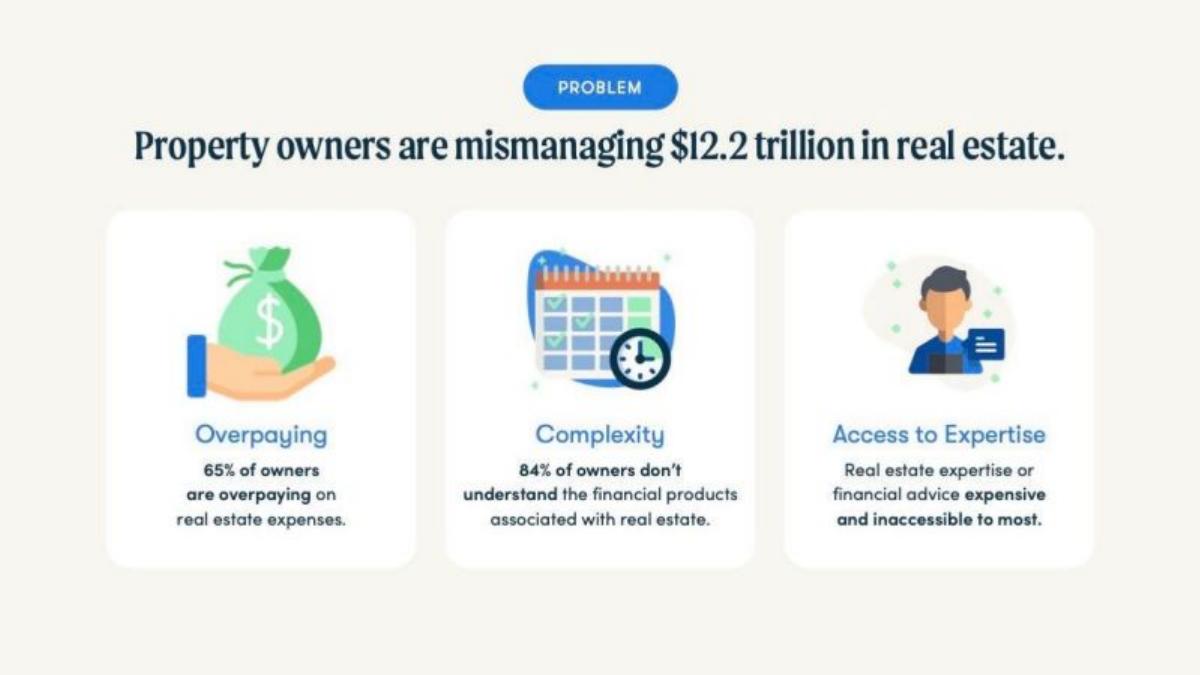
- The problem is quantified at a massive scale, noting that property owners mismanage $12.2 trillion in real estate assets (Slide 2).
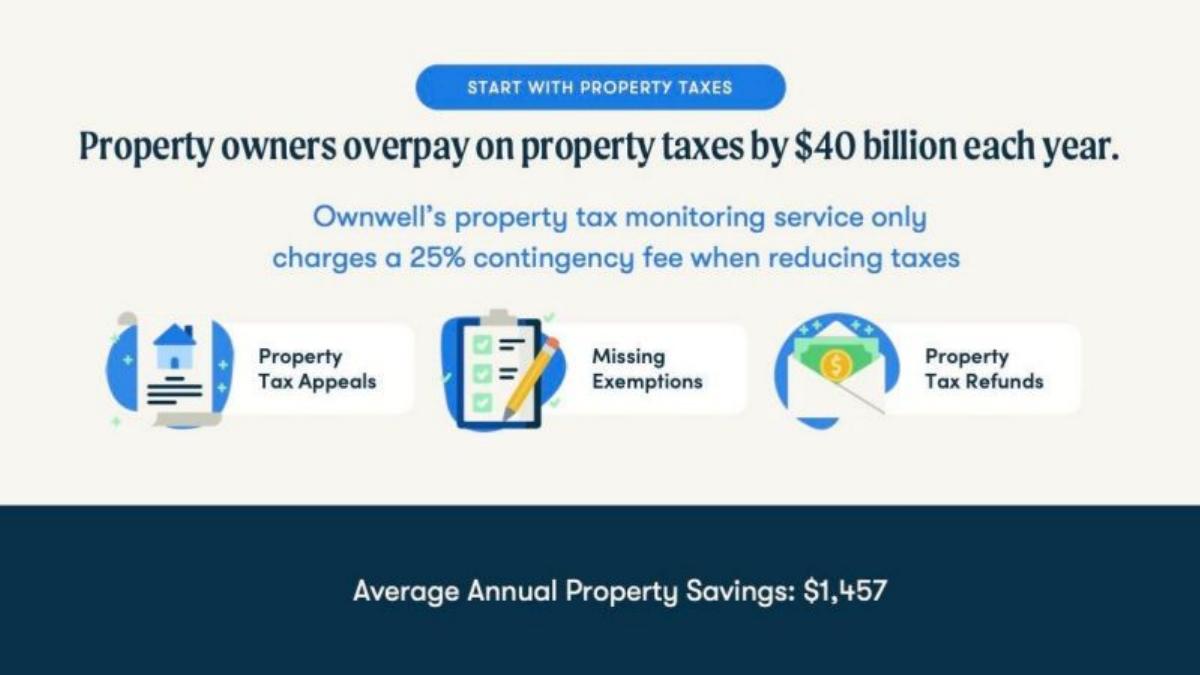
- Ownwell identifies a specific $40 billion annual overpayment in property taxes as its initial entry point (Slide 4).
- The business model is a 25% contingency fee, meaning customers only pay after they save money (Slide 4).
- The deck claims an average annual property savings of $1,457 for its users (Slide 4).
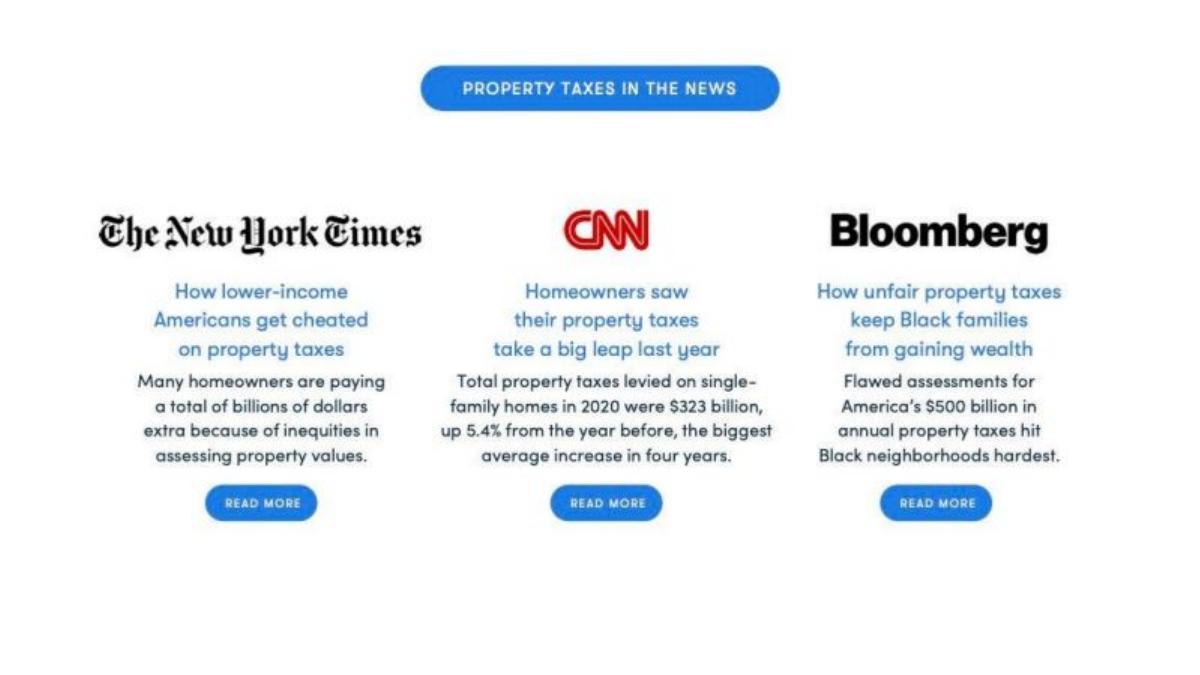
- External validation is provided through media coverage highlighting tax inequities in Black and lower-income neighborhoods (Slide 5).
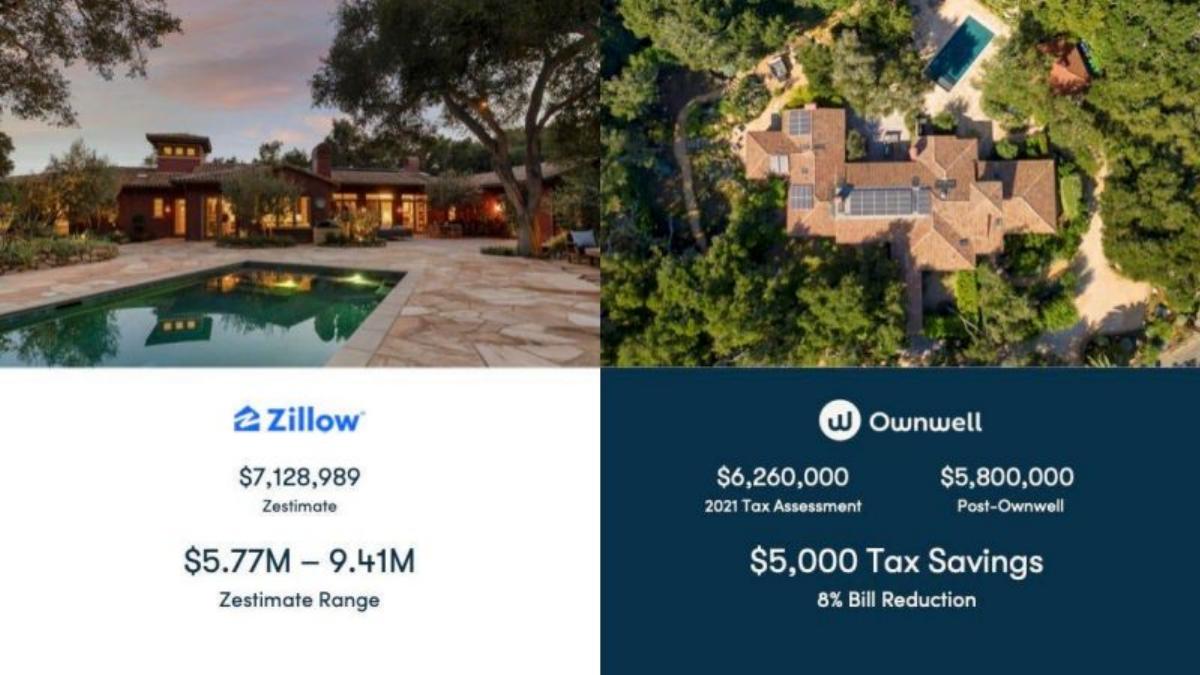
- A direct comparison with Zillow's 'Zestimate' illustrates how tax assessments can differ significantly from market value (Slide 6).
- The 'Why Now' slide points to the virtualization of the property tax appeal process as a key scalability driver (Slide 7).
- The team slide highlights deep institutional experience from companies like Compass, Uber, and NVIDIA (Slide 9).
The Narrative: Simplifying the Largest Asset
Ownwell’s pitch deck is a study in focused problem-solving. Rather than trying to solve all of real estate at once, the company focuses on a single, high-friction pain point: property taxes. The deck uses a clean, modern aesthetic to communicate that it is a technology-first solution to a traditionally bureaucratic and paper-heavy problem. By framing the mission as 'Democratizing access to real estate expertise,' Ownwell positions itself as a consumer advocate against inefficient government systems.
Slide 1: Title Slide
The deck opens with the tagline 'Democratizing access to real estate expertise.' The visual is a simple isometric illustration of houses under a magnifying glass. It establishes the brand as professional, approachable, and focused on the residential property sector.
Slide 2: The $12.2 Trillion Problem
Slide 2 sets the stage by claiming property owners are mismanaging $12.2 trillion in real estate. It breaks the problem into three pillars: Overpaying (65% of owners overpay on expenses), Complexity (84% don't understand associated financial products), and Access to Expertise (professional advice is expensive and inaccessible). This slide successfully establishes the 'why' by showing that the current state of property ownership is financially inefficient for the majority of people.
Slide 3: The Solution
The solution slide introduces the Ownwell platform with the headline 'Manage your largest asset like an investor.' It lists three key value propositions: a fast online solution for tracking expenses, automated processes to reach customers that traditional providers can't afford to service, and personalized targeting using machine learning. The inclusion of a laptop mockup showing the website interface provides a tangible sense of the product.
Slide 4: The Entry Point - Property Taxes
This is the most critical slide in the deck. It narrows the broad 'mismanagement' problem down to a specific, actionable wedge: property taxes. It states that owners overpay by $40 billion each year. Crucially, it introduces the business model: a 25% contingency fee . It also lists the three service areas: Property Tax Appeals, Missing Exemptions, and Property Tax Refunds. The footer of the slide highlights the 'Average Annual Property Savings: $1,457,' which provides a clear ROI for the customer.
Slide 5: Social and Political Context
Slide 5 uses 'Property Taxes in the News' to provide external validation. By quoting The New York Times, CNN, and Bloomberg, Ownwell shows that this isn't just a niche financial issue, but a systemic problem affecting wealth inequality and lower-income families. This adds a layer of social mission to the investment thesis, suggesting that Ownwell is solving a problem with significant public interest and media tailwinds.
Slide 6: The Zillow Comparison
This slide provides a clever comparison between a 'Zestimate' and an Ownwell assessment. It shows a property valued at over $7 million by Zillow, while Ownwell’s intervention reduced the tax assessment from $6.26M to $5.8M. This results in $5,000 in tax savings (an 8% bill reduction). This visual comparison helps investors understand exactly how Ownwell’s data differs from standard market valuation tools and where the specific 'tax' value is created.
Slide 7: Why Now?
The 'Why Now' slide identifies three catalysts: cash-strapped owners seeking savings, market volatility leading to overassessments, and the virtualization of the appeal process. The mention that the process has 'gone virtual' is a strong indicator of scalability, as it implies Ownwell can handle more appeals with less manual overhead than traditional local tax consultants.
Slide 8: Customer Proof
Slide 8 is dedicated to Google Reviews. It features five-star ratings and detailed testimonials from customers who saved money. One review mentions a $1,600 saving, while another mentions a reduction of more than 10%. This slide serves to prove that the product works and that customers are willing to advocate for it, which is essential for a consumer-facing PropTech startup.
Slide 9: The Team
The team slide features three co-founders: Colton Pace (CEO), Joseph Noor (CTO), and Frank DiZenzo (CRO). The slide is dense with high-tier logos, including Compass, Uber, NVIDIA, and KPMG, signaling that the founders have experience at scale. Additionally, the slide lists an impressive advisory board with a combined 161 years of experience across consumer tech, tax assessment, real estate law, and investing. This level of 'gray hair' on the advisory board likely gave Seed investors confidence in the founders' ability to navigate complex regulatory environments.
Slide 10 & 11: Conclusion
The deck ends with a simple 'Thank you' and a final slide promoting the source library. Notably, there is no 'Ask' slide in this version of the deck, which is common in decks shared publicly after a round closes, though it is an omission that a founder currently pitching should avoid.
What Works in This Deck
The Contingency Model: Highlighting the 25% contingency fee is a brilliant move. It immediately answers the 'how do you get customers?' question by showing there is no financial risk to the user. · Quantified Value: Stating the $1,457 average saving gives investors a clear metric to model the potential revenue per user. · The Wedge Strategy: By starting with property taxes (a $40B problem) but hinting at a broader $12.2T asset management play, the deck balances a realistic go-to-market strategy with a massive 'VC-scale' vision. · Third-Party Validation: Using major news outlets to highlight the 'unfairness' of property taxes turns a dry financial topic into a compelling narrative about equity and justice.
What Is Missing
Financial Projections: There is no mention of current revenue, growth rates, or future projections. While this is a Seed deck, some indication of traction (e.g., number of properties under management) would have strengthened the case. · The Ask: The deck does not specify how much money is being raised or how it will be spent. While we know from the catalogue that they raised $5.75M, the slides themselves are silent on the terms. · Competitive Landscape: The deck compares itself to Zillow (which is a different product), but it doesn't address traditional local tax attorneys or other emerging PropTech competitors in the tax space. · Unit Economics: While the average saving is mentioned, the cost to acquire a customer (CAC) and the lifetime value (LTV) are not discussed.
What a Founder Should Copy
The 'Why Now' Slide: Ownwell’s focus on the 'virtualization' of government processes is a perfect example of identifying a regulatory or technological shift that makes a new business model possible. · The ROI Footer: Placing the 'Average Annual Property Savings' at the bottom of the solution slide ensures that the most important number stays top-of-mind for the investor. · Pedigree Alignment: The team slide doesn't just list names; it groups advisors by their specific domain expertise (e.g., '34yrs Tax Assessment'), which shows the founders have intentionally filled their knowledge gaps.
Frequently asked questions
- How does Ownwell make money?
- According to slide 4, Ownwell operates on a contingency-based revenue model. They charge a 25% fee only when they successfully reduce a customer's property taxes. This aligns the company's incentives with the homeowner's savings, making the service virtually risk-free for the user.
- What is the average saving for an Ownwell customer?
- Slide 4 states that the average annual property savings for their customers is $1,457. This figure serves as a powerful anchor for the value proposition, especially when compared to the zero upfront cost of the service.
- Who are the key investors in Ownwell?
- Slide 9 lists Wonder Ventures, Founder Collective, and Long Journey Ventures as investors. The company also highlights a combined 161 years of experience across its advisory board in fields like consumer tech, tax assessment, and real estate law.
- What is the 'Why Now' factor for this business?
- Slide 7 identifies three factors: cash-strapped property owners looking for savings, real estate market volatility leading to overassessments, and the 'New Normal' where the property tax appeal process has moved online, making the service more scalable.
- What is missing from the Ownwell pitch deck?
- The deck is notably missing a detailed 'Ask' slide (specifying the exact amount being raised and the terms), a financial projection slide, and a competitive landscape matrix. It relies heavily on the strength of the problem and the team's background to carry the narrative.