OxySure Systems' October 2015 presentation serves as a progress report for a publicly traded medical technology firm (OTCQB: OXYS). The deck focuses on the company's proprietary technology that generates medical-grade oxygen from dry powders, positioning it as a safer, cheaper alternative to compressed cylinders. While the company demonstrated strong revenue growth—climbing from $269,697 in FY2012 to over $2.4 million in FY2014—the financials also reveal deepening net losses, reaching over $1.2 million in 2Q 2015 alone. The deck effectively communicates a global regulatory footprint, includin…
Key takeaways
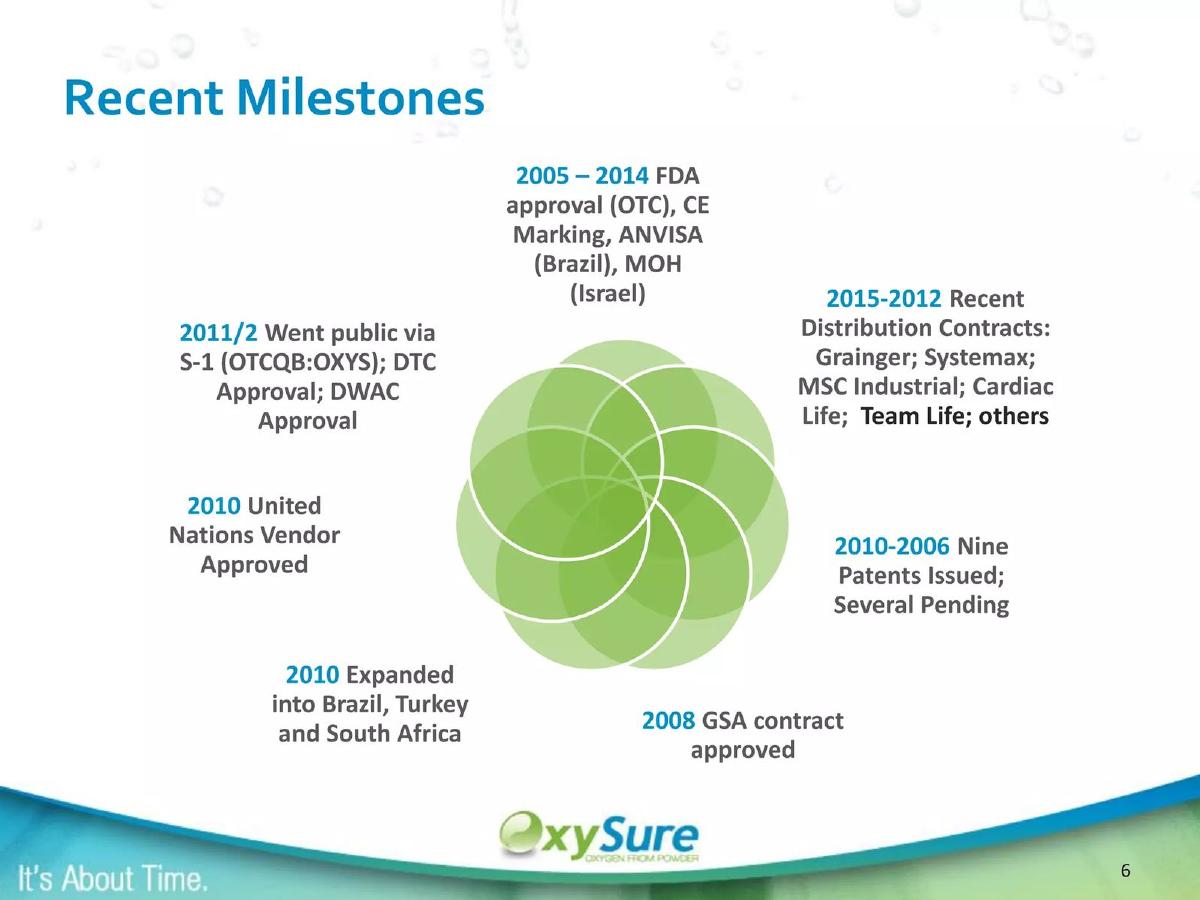
- The company achieved FDA (OTC) approval and CE Marking between 2005 and 2014, establishing a regulatory foundation for global sales (Slide 6).
- Revenue grew significantly year-over-year, increasing from $1,800,327 in FY2013 to $2,437,402 in FY2014 (Slide 21).
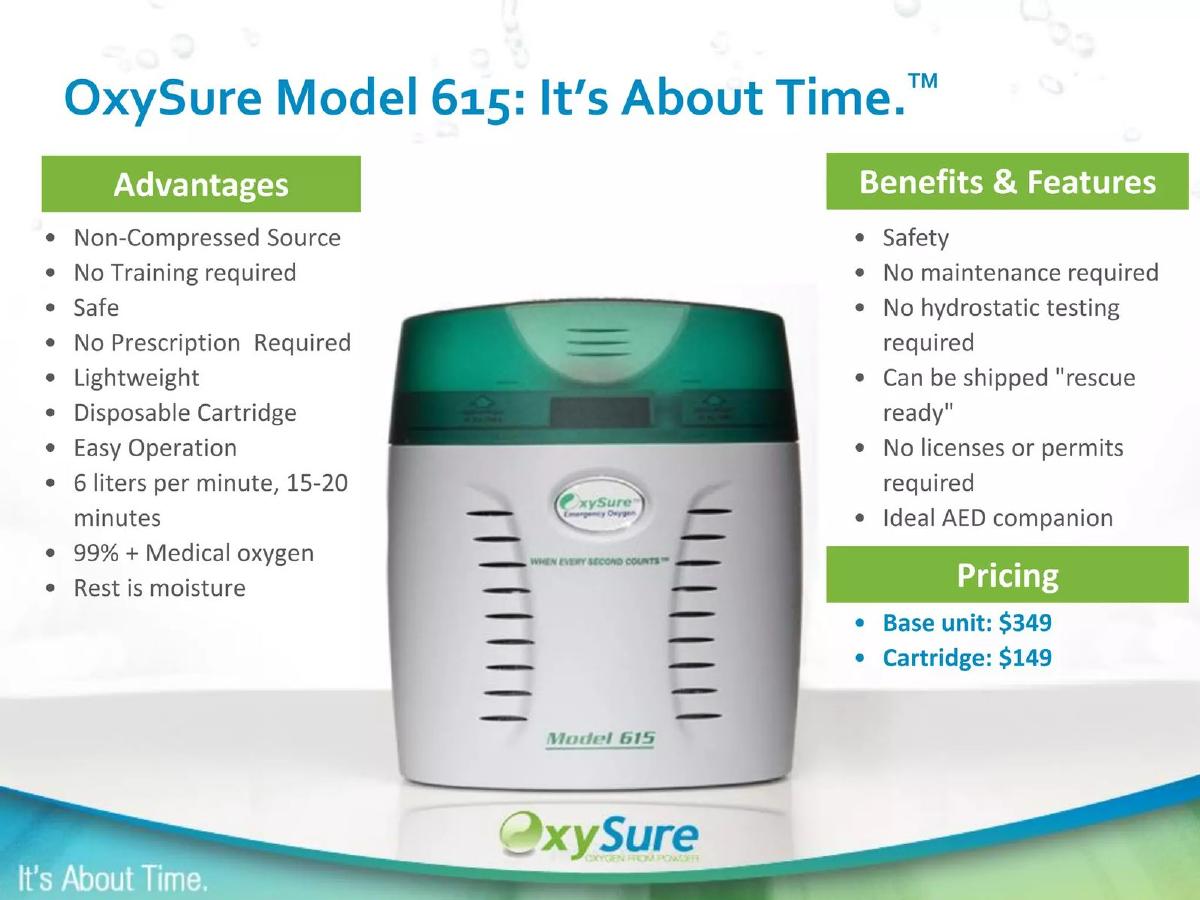
- OxySure positions its Model 615 at a $349 price point, significantly lower than the $369 - $899 range of existing emergency oxygen solutions (Slide 11).
- The company faces substantial net losses, reporting a $1,259,314 loss in 2Q 2015 despite record quarterly revenues of $1,045,693 (Slide 26).
- Financing is the primary driver of liquidity, with $3,923,853 produced from financing activities compared to a net change in cash of $2,228,848 (Slide 31).
- The growth strategy relies on a 'companion' market approach, targeting the 3 million+ unit AED market for placement (Slide 41).
- International expansion is tiered, with active markets in Brazil, Turkey, and South Africa, and pending status in several other regions (Slide 16).
- Intellectual property is a core asset, with nine patents issued between 2006 and 2010 and several more pending (Slide 6).
OxySure Systems, Inc. Corporate Presentation Analysis
The October 2015 corporate presentation for OxySure Systems, Inc. (OTCQB: OXYS) provides a comprehensive look at a medical technology company transitioning from a development stage to a commercial scaling phase. The deck is structured to validate the technology through regulatory milestones and demonstrate market demand through accelerating revenue figures.
Slide 1: Title Slide
The title slide introduces the company as OxySure Systems, Inc., using the ticker symbol OXYS. The tagline "Oxygen from Powder" immediately defines the unique selling proposition. The date, October 2015, sets the context for the financial data that follows. The visual theme of water splashes and bubbles reinforces the "clean" and "safe" nature of the chemical process used to generate oxygen.
Slide 6: Recent Milestones
This slide serves as a credibility builder. It outlines a decade of progress, starting with nine patents issued between 2006 and 2010 . Crucially, it lists regulatory successes: FDA approval (OTC), CE Marking, ANVISA (Brazil), and MOH (Israel) achieved between 2005 and 2014. The slide also notes the company went public via an S-1 in 2011/2012 and has secured distribution contracts with major industrial suppliers like Grainger, Systemax, and MSC Industrial .
Slide 11: Problems w/ Existing Emergency Oxygen
OxySure uses this slide to frame the market opportunity by highlighting the flaws of incumbents. Compressed cylinders are labeled as explosion hazards, heavy, and expensive . Chemical generators are described as highly toxic and producing high heat . The slide concludes with a price comparison: while existing solutions cost between $369 and $899 , the OxySure Model 615 is priced at $349 . This positioning suggests OxySure is both a safer and more economical choice.
Slide 16: Where Are We Today Outside US?
This slide uses a pyramid graphic to illustrate the company's global reach. The base of the pyramid includes Brazil, Turkey, and South Africa , followed by Australia, New Zealand, and the UK . The higher tiers include Netherlands, Belgium, Luxembourg, Hong Kong, Macau, and Chile . The top of the pyramid indicates "Others pending," suggesting an active pipeline of international regulatory filings and market entries.
Slide 21: Revenue Trends by Quarter
The company displays strong top-line growth here. Quarterly revenues increased from $103,327 in 3Q12 to $1,045,693 in 2Q15 . The annual revenue summary shows a jump from $269,697 in FY2012 to $2,437,402 in FY2014 . While the growth percentages are high (e.g., 568% in FY2013), the slide also shows a dip in growth to 35% in FY2014, indicating some volatility in the scaling process.
Slide 26: 2Q 2015 Financial Results
This slide provides a more sobering look at the company's profitability. Despite reaching record quarterly revenues of $1,045,693 , the company reported a net loss of $1,259,314 for the quarter. This is a significant increase in loss compared to 2Q 2014, where the loss was only $233,528 . The net loss per share improved slightly from $(.05) in 1Q 2015 to $(.04) in 2Q 2015, but the overall trend shows that expenses are outpacing revenue growth.
Slide 31: Statement of Cash Flows
The cash flow statement reveals how the company is funded. Net cash produced by financing activities was $3,923,853 , primarily driven by $2,650,001 from preferred stock and $1,461,000 from convertible notes payable . This financing allowed the company to end the period with $2,875,941 in cash , despite the operating losses. It highlights the company's dependence on capital markets to sustain operations.
Slide 36: Other Financial Items
This slide lists balance sheet strengths that might not be immediately apparent from the P&L. It notes $2 million in capital equipment off balance sheet and deferred income tax assets of $5.6 million . These items are likely intended to signal to investors that there is underlying value and future tax shields that could benefit the company once it reaches profitability.
Slide 41: Growth Strategy Next 3-5 Years
OxySure outlines a three-pronged growth strategy. First, they aim to grow "Placement Markets" by targeting the 3 million+ unit AED companion market . Second, they plan to grow "At Risk Markets" by pursuing insurance reimbursement (Medicare, private) for 100 million+ US customers. Finally, they identify new vertical mass markets including Military, Mining, Aviation, Sports, and Skin Care . The inclusion of "Strategic Alliances" at the bottom suggests they are open to partnerships to execute this broad expansion.
Slide 46: Contact Information
The final slide provides the company's headquarters address in Frisco, Texas , and contact details for their investor relations firms, Redchip Companies, Inc. and Renmark Financial Communications, Inc. . This confirms the company's focus on maintaining active communication with the public markets.
What OxySure Systems Does Well
OxySure excels at validating a complex medical technology for a general audience. By focusing on the "Oxygen from Powder" tagline, they simplify a chemical engineering feat into a digestible consumer benefit. The deck is also very transparent regarding regulatory status; listing specific agencies like ANVISA and MOH provides a level of detail that builds significant trust with institutional investors. Furthermore, the comparison slide (Slide 11) is a masterclass in positioning, clearly identifying the pain points of the status quo and offering a direct solution.
What is Missing from the Deck
Despite the 46-slide length, the 10 slides provided omit several critical pieces of information. There is no team slide in this selection, leaving investors unaware of the leadership's background in medical devices or public company management. There is also a lack of unit economics ; while we see total revenue and total loss, we don't see the gross margin per unit sold, which is vital for understanding if the company can ever reach break-even. Finally, the deck lacks a competitive landscape beyond generic categories; it does not name specific companies or brands they are competing against in the AED companion or aviation markets.
Lessons for Founders
Founders can learn two distinct lessons from this deck. First, regulatory milestones are the lifeblood of med-tech . OxySure correctly puts these front and center to prove that their technology isn't just a concept, but a legally saleable product. Second, transparency in financials is mandatory for public or late-stage companies . Even though the company is losing money, presenting the full statement of cash flows (Slide 31) shows professional maturity. However, founders should be wary of the "everything for everyone" growth strategy seen on Slide 41. Targeting military, mining, skin care, and aviation simultaneously can signal a lack of focus to some investors, who might prefer a deep dive into one high-value vertical before expanding.
Frequently asked questions
- What is the core technology behind OxySure?
- OxySure utilizes a proprietary 'oxygen from powder' technology. According to the presentation, this allows for the generation of medical-grade oxygen without the risks associated with compressed cylinders, such as explosion hazards or high maintenance costs. The deck positions this as a safer, more portable solution for emergency situations where immediate oxygen is required before professional medical help arrives.
- How does OxySure's pricing compare to competitors?
- On slide 11, OxySure explicitly compares its Model 615 pricing to existing emergency oxygen solutions. While traditional systems range from $369 to $899, the OxySure Model 615 is priced at $349. This cost advantage is presented alongside the elimination of maintenance costs typically associated with refilling and testing compressed oxygen tanks.
- What is the current financial health of the company based on the deck?
- The financial health is a mix of high growth and high burn. Slide 21 shows revenue growth of 568% in FY2013, but slide 26 reveals that net losses are accelerating. In 2Q 2015, the company lost $1.25 million on $1.04 million in revenue. The statement of cash flows (Slide 31) shows the company is sustained by financing, specifically issuing preferred stock and convertible notes.
- What are the primary target markets for future growth?
- OxySure identifies three growth pillars on slide 41: Placement Markets (targeting the AED companion market), At-Risk Markets (pursuing insurance reimbursement for 100 million+ US customers), and New Verticals. These new verticals include specialized industries such as Military, Mining, Aviation, Sports/Recreation, Skin Care, Wound Care, and Automotive.
- Does the company have international regulatory approval?
- Yes. Slide 6 lists several international milestones, including CE Marking for Europe, ANVISA for Brazil, and MOH for Israel. Slide 16 further details their international footprint, showing they are active in Australia, New Zealand, the UK, and several other countries, with additional registrations pending.