Alta’s 17-slide Seed deck focuses on the transition from a fragmented, human-heavy sales process to an autonomous 'AI Revenue Workforce.' The narrative centers on efficiency, claiming that their AI agents can replace a dozen disparate tools—including Cognism, ZoomInfo, and Outreach—while automating manual tasks like prospecting and data enrichment. By personifying their technology through agents like 'Katie,' Alta makes complex AI workflows tangible for investors. The deck highlights significant performance improvements, including a 4X increase in qualified meetings and 20 hours saved per wee…
Key takeaways
- The deck positions Alta as the '#1 Data-Driven AI Revenue Workforce,' aiming to automate the entire sales cycle from acquisition to expansion (Slide 1, 3).
- Alta uses a 'Strategy to execution loop' to show how their AI handles market research, ICP research, and implementation (Slide 4).
- A powerful 'Before vs. After' visual suggests Alta can replace 12+ industry-standard tools like ZoomInfo, Apollo.io, and Outreach (Slide 5).
- The startup personifies its technology with 'Katie,' an AI SDR agent that identifies prospects and sends personalized messages 24/7 (Slide 6).
- Product functionality is demonstrated through automated email personalization that references specific company growth data (Slide 7).
- Efficiency metrics claim a 4X increase in qualified meetings and a 15% increase in win rates (Slide 8).
- The deck argues that AI agents allow human teams to focus exclusively on 'Selling & Strategy' by handling all prospecting and follow-ups (Slide 8).
- Publisher reports indicate the company raised $7M in a 2024 Seed round to support its Middle East-based operations.
The Vision: An Autonomous Revenue Workforce
Alta enters the crowded AI sales category with a distinct narrative: consolidation. Rather than being another tool in the stack, Alta positions itself as the stack. The deck, used to raise a $7M Seed round in 2024, focuses on the transition from human-managed software to autonomous AI agents that handle the 'drudgery' of sales operations. By focusing on the Middle East region and targeting global revenue teams, Alta aims to redefine the SDR and RevOps roles through automation.
Slide 1: The Hook
The title slide introduces Alta as "The #1 Data-Driven AI Revenue Workforce." The sub-headline, "Leverage AI and Data to drive revenue growth," is standard, but the visual language is important. The use of stylized, 3D character avatars (which reappear throughout the deck) signals a personified approach to AI. This isn't just software; it is a digital teammate.
Slide 2: The Efficiency Gap
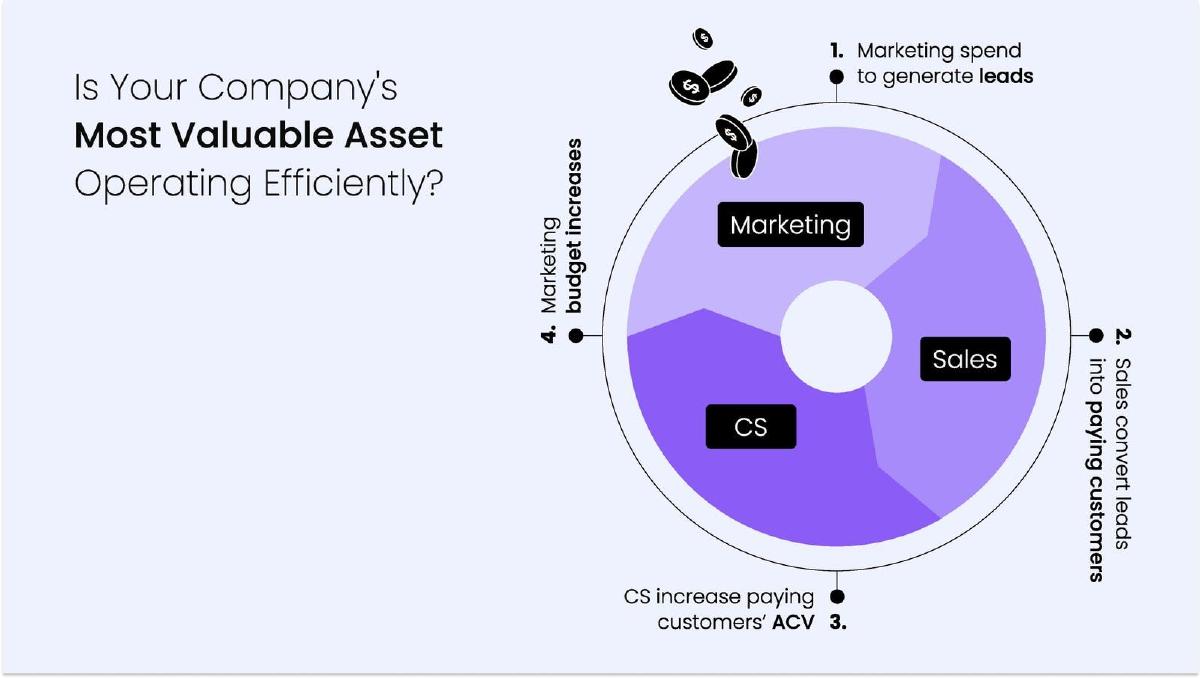
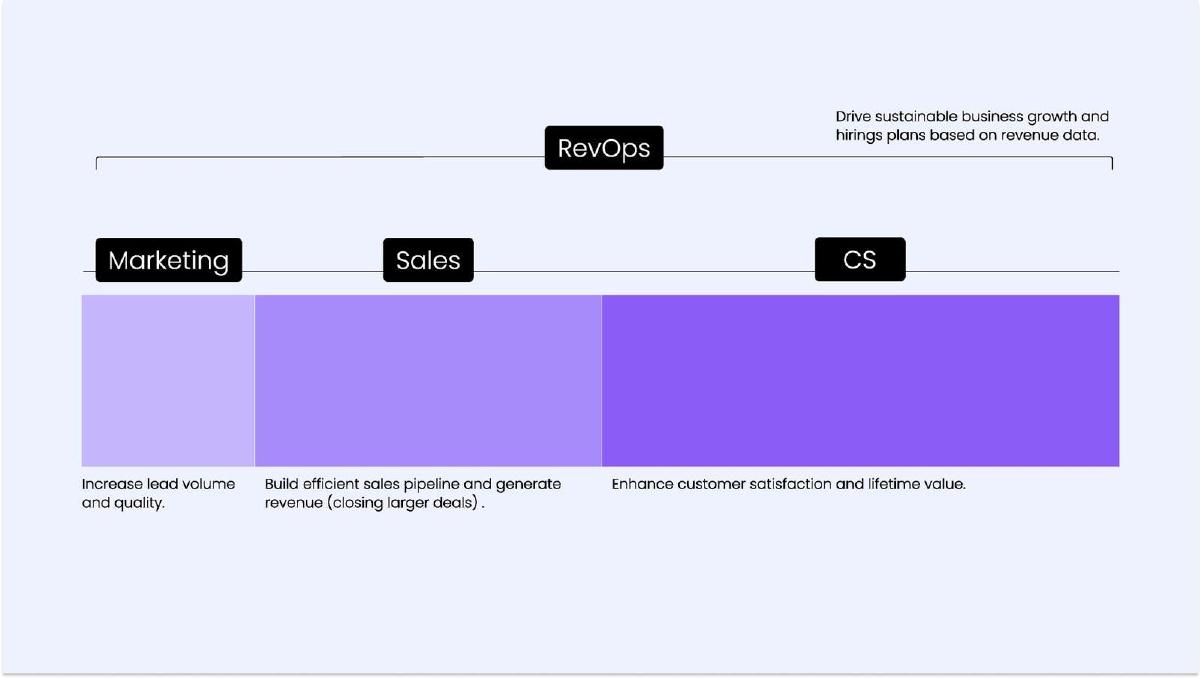
Slide 2 poses a rhetorical question: "Is Your Company's Most Valuable Asset Operating Efficiently?" It uses a circular diagram to show the feedback loop between Marketing, Sales, and Customer Success (CS). The cycle describes marketing spend generating leads, sales converting them, and CS increasing ACV to fuel larger marketing budgets. This sets the stage for where the 'leaks' in the bucket occur—typically at the hand-off points between these departments.
Slide 3: The Full-Funnel Scope
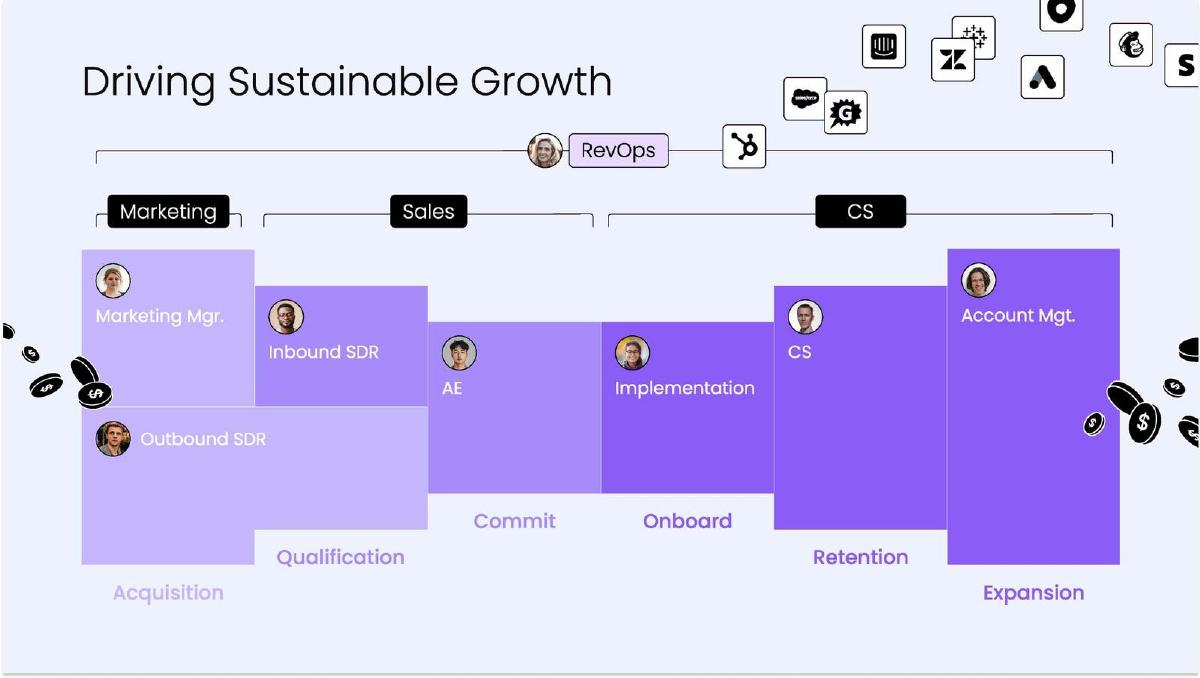
Slide 3, titled "Driving Sustainable Growth," maps out the entire revenue architecture. It visualizes the journey from Acquisition and Qualification (Marketing/Sales) to Onboarding, Retention, and Expansion (CS). A RevOps layer sits above the entire process. By showing human faces attached to these roles and then surrounding them with logos of various SaaS tools, Alta highlights the complexity of the modern revenue stack.
Slide 4: The Strategy to Execution Loop
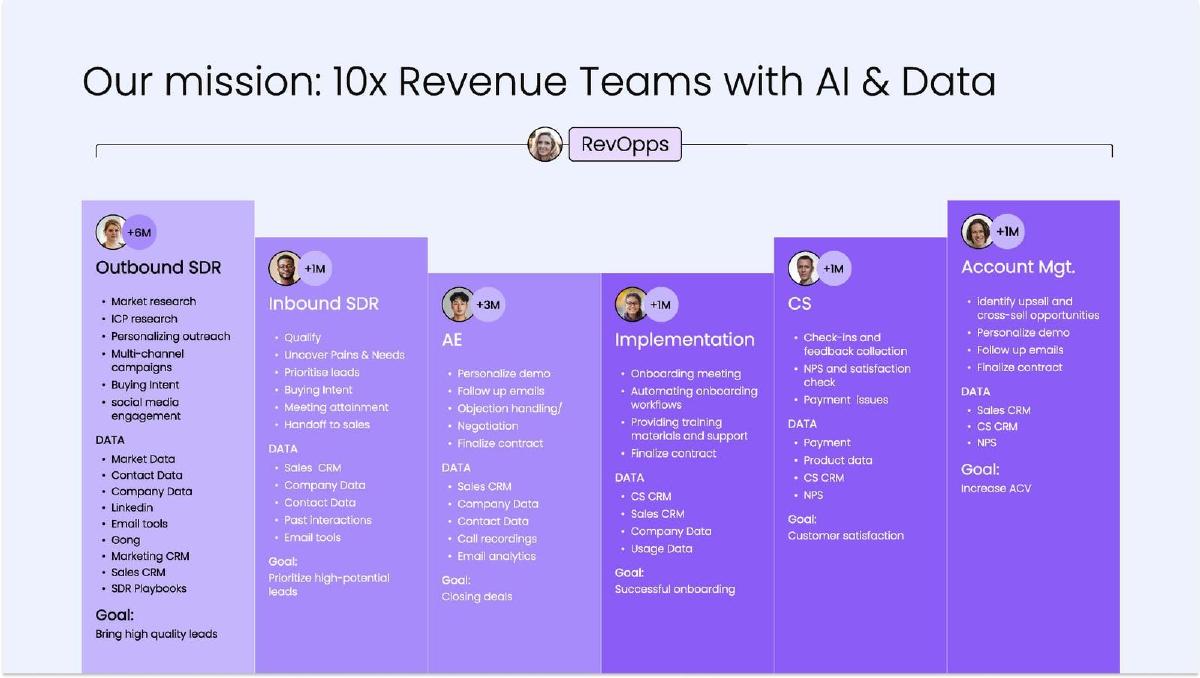
This slide breaks down the internal logic of the AI. It divides the process into three phases: Build Strategy, Implementation, and Measure & Learn. The 'Strategize' box is particularly dense, listing market research, ICP (Ideal Customer Profile) research, and bottleneck identification. It also lists the data sources the AI consumes, including contact data, email tools, and sales playbooks. The goal is clearly stated: "Identifying bottlenecks and highlight insights."
Slide 5: The Consolidation Play (Before vs. After)
This is arguably the most important slide in the deck. The "Before" column shows a grid of human silhouettes next to a long list of logos: Cognism, ZoomInfo, Clearbit, Lemwarm, Instantly, Apollo.io, Clay, Braze, Dripify, Outreach, Tableau, and Looker. The "After" column shows a single human manager overseeing three AI agents. The message is unmistakable: Alta intends to replace the fragmented, expensive 'Franken-stack' with a unified AI team. This is a bold claim, as it suggests Alta can perform the functions of data providers, sequencing tools, and BI platforms simultaneously.
Slide 6: Meet Katie, the AI SDR
To make the technology tangible, Slide 6 introduces "Katie," the first AI agent. She is described as an AI SDR that identifies prospects and sends personalized messages via email and LinkedIn. The slide shows a mock-up of "Meetings booked" with high-level prospects (e.g., VP Sales at Dive, CRO at Nike). This personification helps investors visualize the product not as a dashboard, but as a worker.
Slide 7: Product Mechanics
Slide 7 answers the "How does it work?" question. It shows a personalized email draft that references specific data points, such as a prospect's sales team growing by 13%. This demonstrates that the AI isn't just sending templates; it is performing real-time research. The "Always Improve" section shows a feedback loop where the AI identifies "Possible causes" for conversion drops (like seasonal factors) and suggests "Recommended actions."
Slide 8: The Bottom Line
The final content slide focuses on outcomes. It uses a horizontal bar chart to show the "Before" state (where humans spend time on prospecting, data enrichment, outreach, and follow-ups) versus the "After Alta" state. In the new model, the AI handles all the manual work, leaving humans with only "Selling & Strategy." The metrics are highlighted at the bottom: 4X increase in qualified meetings, 15% increase in win rate, and 20 hours saved per week.
Slide 9: The Closing
The deck concludes with a simple "Questions" slide, maintaining the character-driven visual theme. While the provided images end here, the narrative arc from problem (inefficiency) to solution (AI agents) to proof (4X meetings) is complete.
What Alta's Deck Does Well
The deck excels at visual storytelling . By using 3D avatars, they move away from the sterile, technical look of many AI startups and toward a "workforce" concept that feels approachable. The Before vs. After comparison on Slide 5 is a masterclass in establishing a high-value proposition; it tells the investor that Alta isn't a $50/month plugin, but a platform that could potentially capture the budget of twelve other vendors.
Furthermore, the granularity of the 'Strategize' phase on Slide 4 gives the product credibility. It lists specific data points (ICP research, conversion analytics, sales playbooks) that revenue leaders care about, proving the founders understand the nuances of the sales process beyond just 'sending more emails.'
What is Missing from the Alta Deck
Despite the strong narrative, several critical components are missing from the provided slides:
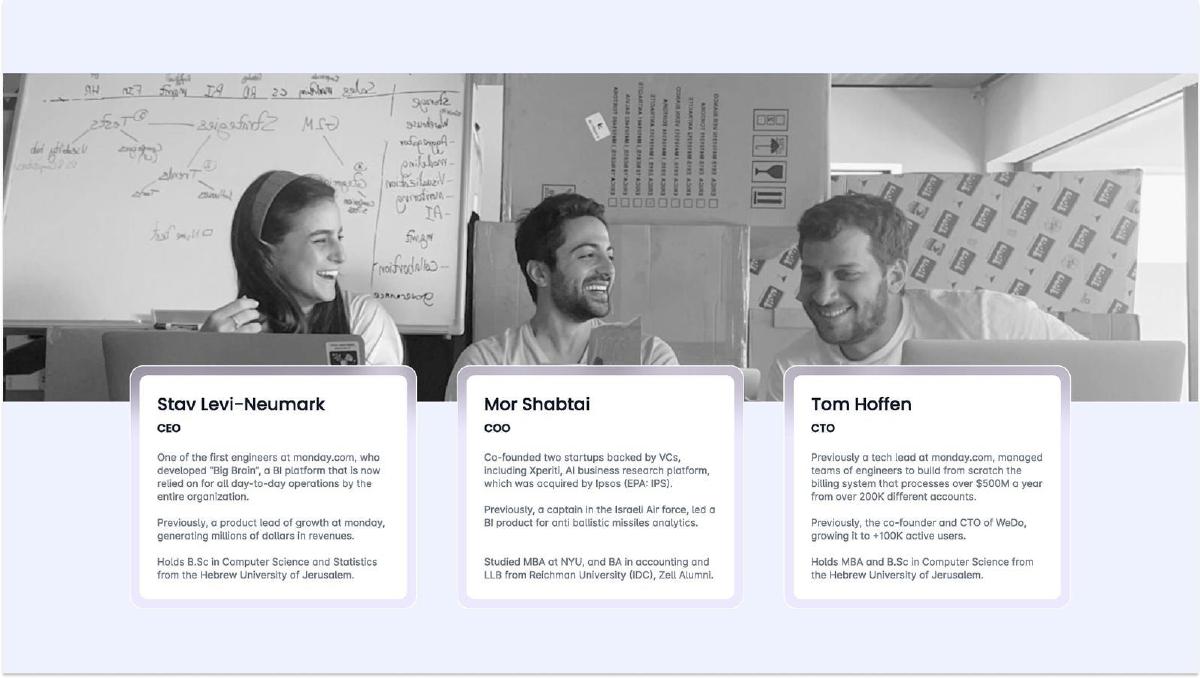
Team Slide: There is no information regarding the founders' backgrounds. In a Seed round, the 'why us' is often as important as the 'what.' · Market Size (TAM): While the deck implies a large market by listing competitors, it doesn't quantify the total addressable market for AI-driven revenue workforces. · Unit Economics & Traction: The deck mentions a 4X increase in meetings, but it doesn't state if these are results from a single pilot, a beta group, or a broad customer base. There is no mention of current ARR or growth rates. · The Ask: The slides do not specify how much capital is being raised or how it will be deployed (e.g., hiring more engineers vs. expanding sales). · Technical Moat: The deck explains what the AI does, but not how it does it better than a human using the existing stack. There is no mention of proprietary models or data advantages.
Founder Takeaways: How to Copy Alta's Success
Founders building in crowded spaces should take note of Alta's consolidation narrative . If you are entering a market with established incumbents, don't pitch yourself as a better version of one tool; pitch yourself as the replacement for the entire category. The 'Before vs. After' slide is the most effective way to communicate this.
Additionally, personifying the AI can be a powerful psychological tool. By naming the agent 'Katie' and giving her a face, Alta makes the concept of 'autonomous agents' feel less threatening and more like a productivity boost. This is particularly effective when pitching to non-technical investors who need to understand the business impact rather than the underlying LLM architecture.
Finally, focus on time-back metrics . Slide 8's claim of "20H / week saved" is a visceral metric that any manager can translate into a dollar amount. When pitching automation, always tie the technical capability back to the human hours it recovers for higher-value work.
Frequently asked questions
- What specific tools does Alta claim to replace?
- On Slide 5, Alta explicitly lists Cognism, ZoomInfo, Clearbit, Lemwarm, Instantly, Apollo.io, Clay, Braze, Dripify, Outreach, Tableau, and Looker as tools that are consolidated into their AI revenue team.
- How does Alta define its 'AI Revenue Workforce'?
- According to Slide 3, the workforce spans Marketing, Sales, and Customer Success (CS). It covers the entire customer journey: Acquisition, Qualification, Commit, Onboard, Retention, and Expansion.
- What are the primary performance metrics cited in the deck?
- Slide 8 highlights three key outcomes: a 4X increase in qualified meetings, a 15% increase in win rates, and 20 hours saved per week on manual tasks.
- Who is 'Katie' in the context of this pitch?
- Katie is introduced on Slide 6 as Alta’s first AI SDR agent. She is designed to identify top prospects and send personalized messages via email and LinkedIn to boost engagement.
- Does the deck explain how the AI improves over time?
- Yes, Slide 7 features an 'Always Improve' section showing an insights panel that identifies possible causes for performance shifts (like seasonal factors) and recommends specific actions, such as targeting new industries.