Almost Friday’s 2022 Seed deck is a masterclass in brevity, consisting of only four slides that focus almost exclusively on reach and cultural resonance. The company, which began as the Instagram account @friday.beers, used this presentation to secure $6M from venture capital investors. Rather than relying on traditional business plan structures, the deck highlights a massive audience of 3.1 million followers and a diversified ecosystem spanning events, apparel, podcasts, and music. By positioning themselves as the 'modern day Lampoon,' the founders successfully argued that their brand was no…
Key takeaways
- The deck reports a total reach of 3.1 million+ followers across all media platforms as of 2022 (Slide 2).
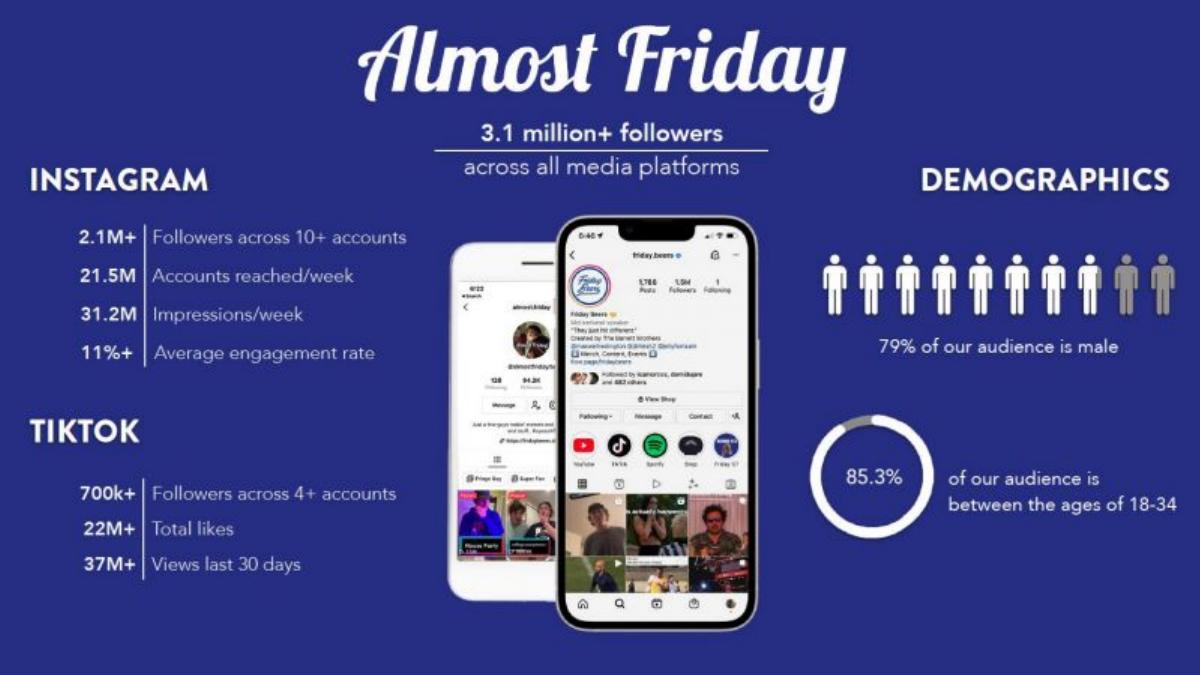
- Instagram is the primary driver of growth, boasting 21.5 million accounts reached per week and 31.2 million weekly impressions (Slide 2).
- The company maintains an exceptionally high average engagement rate of 11%+ on Instagram (Slide 2).
- The audience is highly concentrated in a specific demographic: 79% male and 85.3% between the ages of 18-34 (Slide 2).
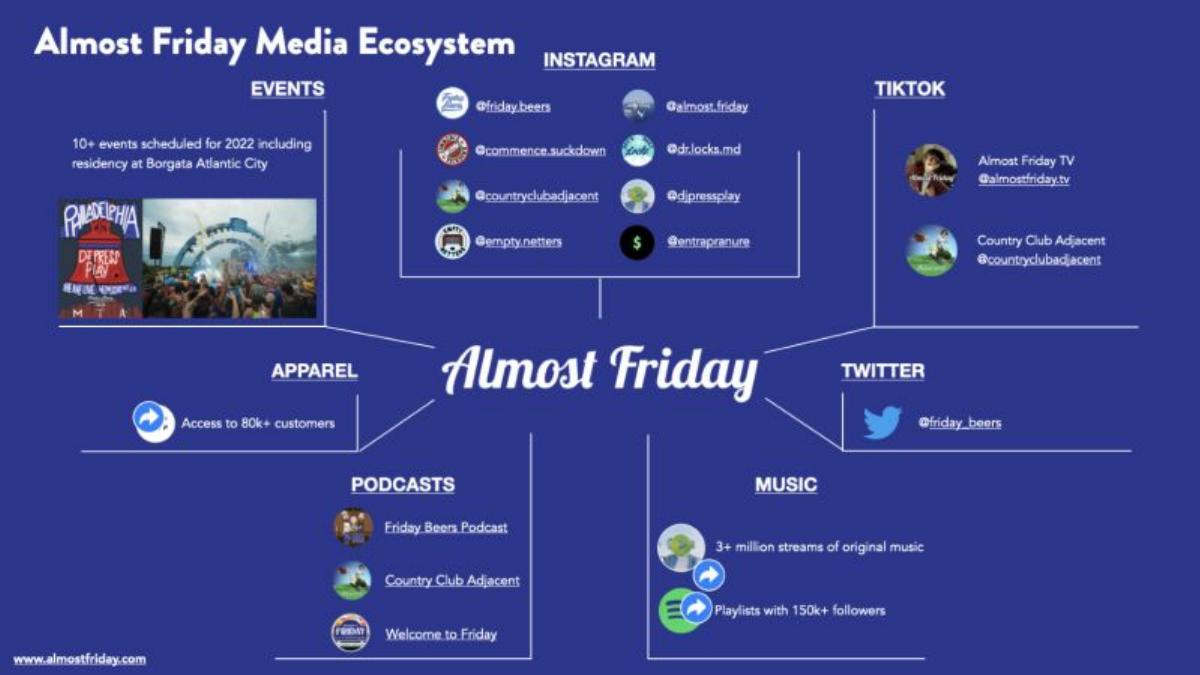
- The 'Media Ecosystem' includes diversified revenue and engagement streams such as 10+ scheduled events, 80k+ apparel customers, and 3+ million music streams (Slide 1).
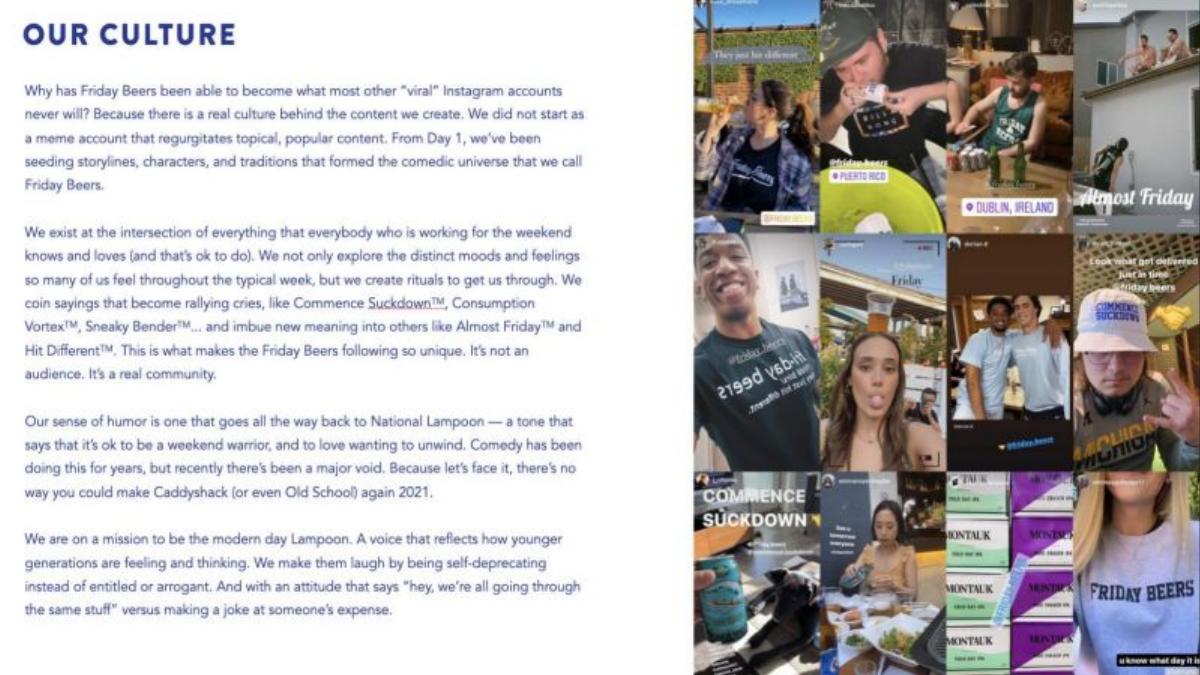
- Almost Friday positions itself as a 'modern day Lampoon,' focusing on self-deprecating humor rather than topical meme reposting (Slide 3).
- The deck omits standard financial projections, team biographies, unit economics, and a specific use-of-funds breakdown.
- TikTok growth is significant, with 37 million+ views in the 30 days preceding the deck's creation (Slide 2).
The Power of Traction: A 4-Slide Seed Deck
Almost Friday, the media entity born from the viral Instagram account @friday.beers, raised $6 million in 2022 using a remarkably brief presentation. In an era where pitch decks often stretch to 20 slides of complex market analysis and financial projections, Almost Friday leaned entirely on its ecosystem and engagement metrics. This teardown examines how a company can bypass traditional deck structures by proving they own a specific cultural moment.
Slide 1: Almost Friday Media Ecosystem
The opening slide serves as a visual map of the company’s brand extensions. Rather than starting with a problem statement, Almost Friday immediately presents its solution: a multi-channel media powerhouse. The slide is anchored by the 'Almost Friday' logo in the center, with spokes leading to various business verticals.
Events: 10+ events scheduled for 2022, including a residency at Borgata Atlantic City. · Apparel: Access to 80k+ customers, indicating a strong D2C foundation. · Music: 3+ million streams of original music and playlists with 150k+ followers. · Podcasts: Three distinct shows: Friday Beers Podcast, Country Club Adjacent, and Welcome to Friday. · Social Footprint: A list of 10 Instagram handles (including @friday.beers, @dr.locks.md, and @entrapanure) and two TikTok accounts (@almostfriday.tv and @countryclubadjacent).
This slide is designed to show 'surface area.' It tells the investor that the company is not a one-trick pony reliant on a single Instagram algorithm. By showing presence in music, podcasts, and physical events, they demonstrate a brand that can live anywhere their audience spends time.
Slide 2: Audience and Demographics
Slide 2 is the 'proof of work' slide. It moves from the conceptual ecosystem to the hard numbers that justify a $6M investment. The headline figure is 3.1 million+ followers across all media platforms. The slide breaks down these metrics by platform, providing the kind of granular detail that social media investors require.
2.1M+ followers across 10+ accounts. · 21.5M accounts reached per week. · 31.2M impressions per week. · 11%+ average engagement rate.
700k+ followers across 4+ accounts. · 22M+ total likes. · 37M+ views in the last 30 days.
The right side of the slide addresses the 'who.' With 79% of the audience being male and 85.3% between the ages of 18-34 , Almost Friday defines its niche perfectly. For a VC, this demographic data is the most important part of the slide; it proves the company has captured the attention of a demographic that is notoriously difficult to reach through traditional advertising.
Slide 3: Our Culture
The third slide shifts from quantitative to qualitative. It addresses the 'moat'—the reason why this brand won't simply be replaced by the next viral account. The text explicitly states that they did not start as a meme account that 'regurgitates topical, popular content.' Instead, they claim to have seeded 'storylines, characters, and traditions.'
The slide lists specific 'rallying cries' that the brand has trademarked or popularized, such as Commence Suckdown™ , Consumption Vortex™ , Sneaky Bender™ , and Hit Different™ . This is a sophisticated way of saying they own the language of their community. By comparing themselves to National Lampoon and referencing films like Caddyshack and Old School , they position themselves as the modern heirs to a specific type of American comedy. The mission statement at the bottom—to be a voice that reflects how younger generations are feeling by being 'self-deprecating instead of entitled'—provides the philosophical backbone for the entire enterprise.
Slide 4: Supplemental Information
The final slide in the provided set is a promotional slide for the platform where the deck was hosted (bestpitchdeck.com) and does not contain Almost Friday specific content. However, the absence of a traditional 'The Ask' or 'The Team' slide in the primary three-slide narrative is notable. It suggests that the founders were either pitching to investors who were already intimately familiar with the team, or that the traction was so undeniable that the 'business' details were handled in a separate document or data room.
What Almost Friday Got Right
1. Metric Density: Slide 2 is a powerhouse. An 11% engagement rate on Instagram is significantly higher than the industry average (usually 1-3%). By leading with these numbers, they make the investment seem like a bet on a sure thing rather than a speculative gamble on a new idea.
2. Brand Identity: They successfully articulated the difference between 'content' and 'culture.' Most social media startups fail because they are seen as fleeting. By using terms like 'media ecosystem' and 'modern day Lampoon,' Almost Friday framed themselves as an IP house, which carries a much higher valuation multiple than a simple social media account.
3. Diversification: Showing 80k apparel customers and 3M music streams proves that the audience is willing to open their wallets. This de-risks the business model by showing that they aren't just selling ads; they are selling a lifestyle.
What is Missing from the Deck
1. The Team: While the editorial context mentions the Barrett brothers, the deck itself does not highlight the founders' backgrounds. In a Seed round, the 'Why You?' is usually as important as the 'What?'
2. Financials and Unit Economics: There is no mention of revenue, burn rate, or profitability. While 80k apparel customers is a great top-line number, investors would typically want to see the margins on that merchandise and the cost of customer acquisition (CAC).
3. The Ask: The deck never specifies how much money is being raised or what the milestones for the next 18 months are. This information was likely communicated verbally or in a follow-up memo, but its absence makes the deck feel more like a media kit than a formal investment pitch.
Founder's Playbook: What to Copy
Focus on the 'Universe,' not the 'Post': If you are building a community-led business, follow Almost Friday’s lead by showing how your brand manifests across different mediums. Don't just show a screenshot of a post; show how that post turned into a trademarked phrase, a piece of clothing, and a live event.
Own Your Demographics: Don't just say you have a 'large audience.' Show exactly who they are. Almost Friday’s use of simple icons to show a 79% male split is effective because it tells an investor exactly which advertisers will want to partner with this brand.
Brevity is Strength: If your numbers are good enough, you don't need 20 slides. Almost Friday’s deck is a reminder that a high-growth company with clear traction can get to the 'Yes' by simply showing the scale of their reach and the depth of their community engagement.
Frequently asked questions
- How did Almost Friday raise $6M with only four slides?
- The raise was likely driven by the sheer scale of their existing traction rather than a complex narrative. With 31.2 million weekly impressions and an 11% engagement rate, the founders proved they had captured a difficult-to-reach demographic (18-34 males). In the creator economy, these top-of-funnel metrics often serve as a proxy for business viability, allowing the deck to focus on the 'ecosystem' rather than traditional financial modeling.
- What is the core business model presented in the deck?
- The deck presents a B2B2C media ecosystem model. Slide 1 illustrates that Almost Friday is not just a social account but a brand that monetizes through apparel (80k+ customers), live events (10+ scheduled for 2022), podcasts, and original music (3M+ streams). This diversification suggests a strategy to move beyond platform-dependent advertising revenue into direct-to-consumer sales and intellectual property licensing.
- Why does the deck emphasize 'Culture' over 'Content'?
- Slide 3 explicitly differentiates Almost Friday from 'meme accounts that regurgitate topical content.' By claiming to seed storylines, characters, and traditions, the founders argue they are building a durable 'universe' or IP. This is a critical distinction for investors who view meme accounts as low-moat businesses; Almost Friday is pitching itself as a character-driven media house similar to National Lampoon.
- Who is the target audience for Almost Friday according to the data?
- The data on Slide 2 shows a very narrow and valuable target: 79% male and 85.3% aged 18-34. This 'weekend warrior' demographic is highly sought after by advertisers in the beverage, gaming, and apparel sectors. The deck uses these demographics to justify their expansion into specific verticals like 'Country Club Adjacent' (golf) and 'Empty Netters' (hockey).
- What major components are missing from this pitch deck?
- This is a 'traction-first' deck and lacks almost all traditional startup components. There is no team slide (though the listing mentions the Barrett brothers), no competitive analysis, no financial history or burn rate, and no specific 'Ask' slide detailing how the $6M would be spent. It functions more as a brand look-book and proof-of-reach document than a comprehensive business plan.