Alluva's pitch deck is notable for its extreme brevity and high-impact visuals, successfully raising $10.2 million in 2018. The deck avoids technical jargon, instead focusing on the massive financial losses occurring in both crypto and traditional markets due to 'noise.' With only 10 slides, the presentation leans heavily on two key metrics: 46% month-over-month growth and a $1.2 million ARR. While it lacks a detailed product breakdown or business model, it compensates with strong social proof through a 'Customers That Trust Alluva' slide featuring major financial media outlets like Bloomberg…
Key takeaways
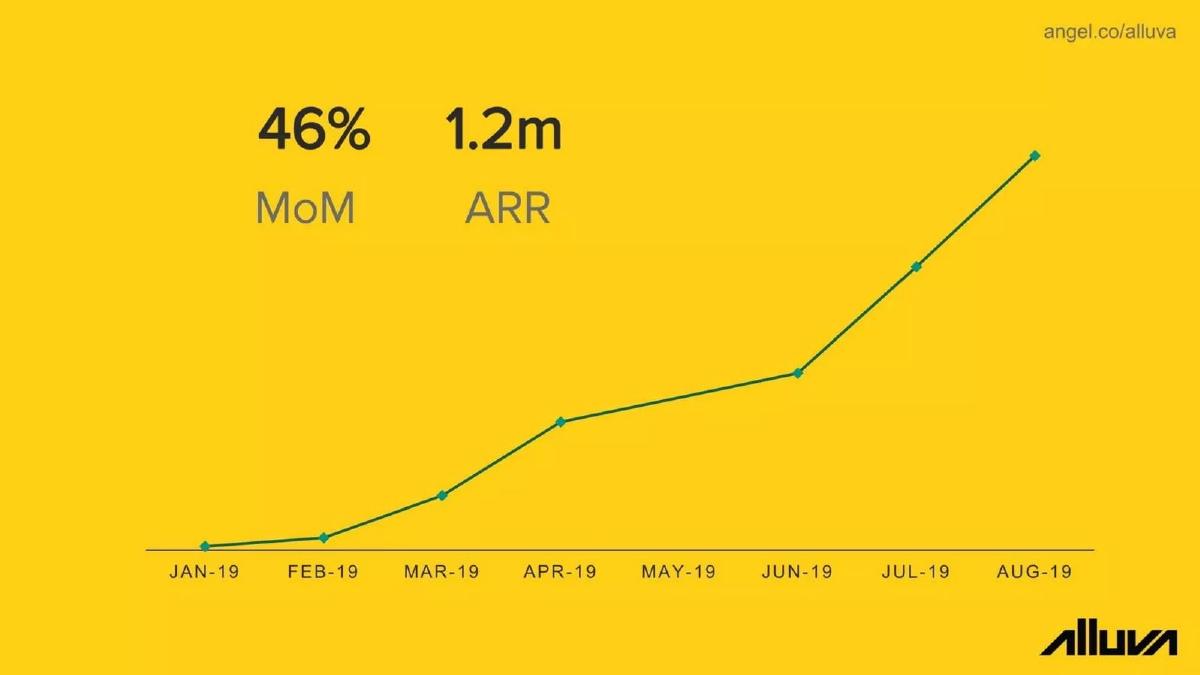
- The deck highlights a 46% Month-over-Month (MoM) growth rate and $1.2M ARR on both the second and final slides (Slide 2, Slide 10).
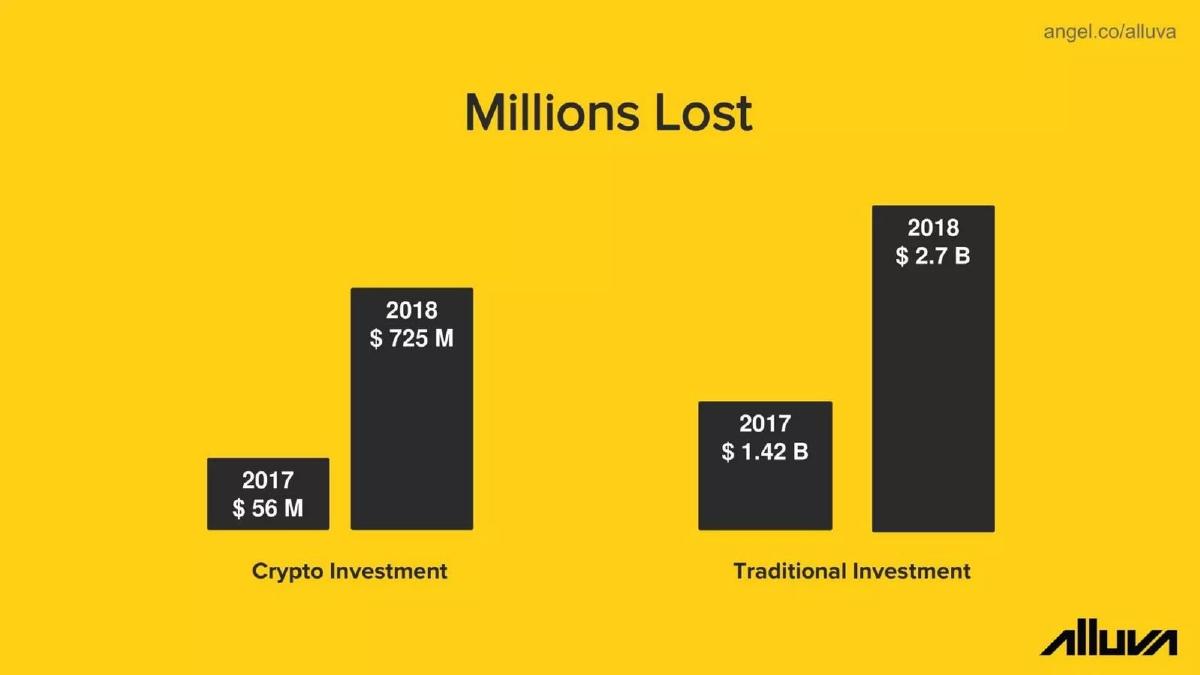
- A 'Millions Lost' comparison shows crypto investment losses jumped from $56M in 2017 to $725M in 2018 (Slide 4).
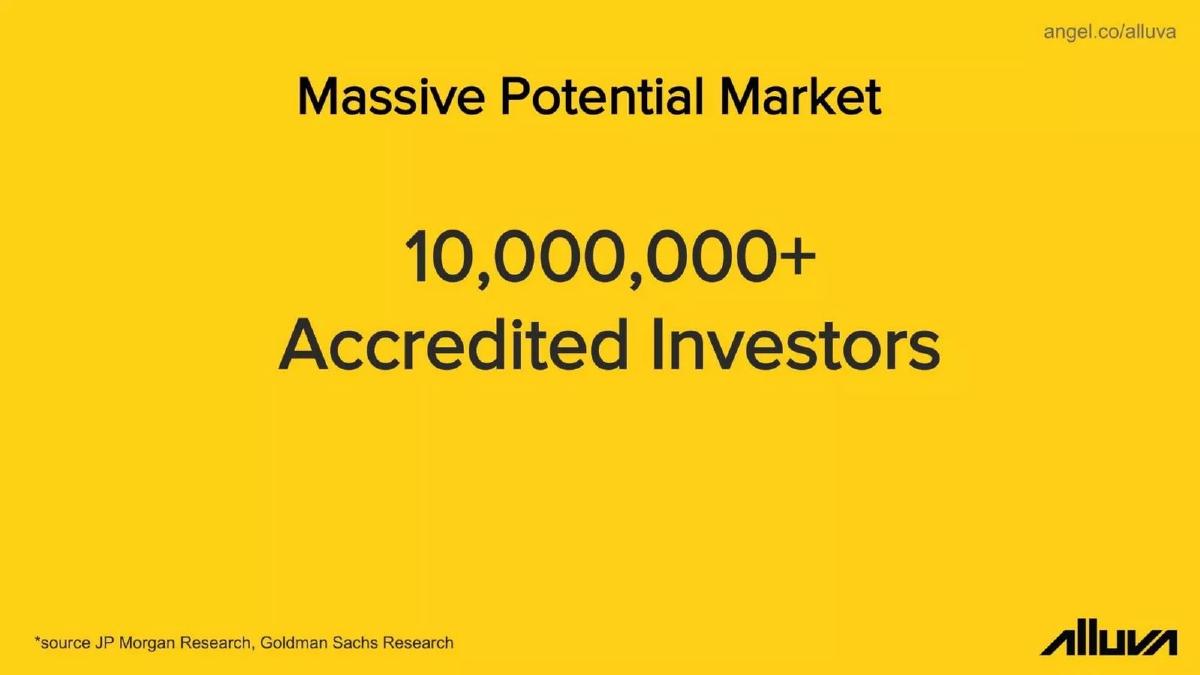
- The total addressable market is defined as 10,000,000+ Accredited Investors, citing JP Morgan and Goldman Sachs research (Slide 5).
- The platform claims a network of 10k+ Analysts and 100k Predictions to validate its marketplace model (Slide 7).
- High-profile trust signals are established by listing Bloomberg, Dow Jones, and Thomson Reuters as customers (Slide 8).
- The team slide features experience from major institutions including Goldman Sachs, J.P. Morgan, and Deloitte (Slide 9).
- The deck completely omits a specific 'Ask' slide, leaving the funding requirement and valuation unstated within the presentation.
- There is no slide dedicated to the business model or how the company generates revenue from its analyst marketplace.
The Minimalist Power of Traction
Alluva’s pitch deck is a fascinating example of how far a startup can get with very little information, provided that the information included is high-impact. In just 10 slides, the company secured a $10.2 million seed round in 2018. The deck follows a strict 'less is more' philosophy, using bright yellow backgrounds and minimal text to force the viewer to focus on a few key numbers: growth, losses in the market, and the pedigree of the team. It is a deck designed for a fast-moving environment where the 'fear of missing out' (FOMO) is a primary driver for investors.
Slide 1: Title Slide
The deck opens with a simple, bold logo on a bright yellow background. There is no subtitle, no mission statement, and no contact information on this first slide. It establishes the brand identity immediately but offers no context for what the company actually does. This level of minimalism is risky but sets a confident tone for the rest of the presentation.
Slide 2: Traction and Growth
Interestingly, Alluva places its traction slide second, immediately following the title. This is a strategic move often used by companies with impressive numbers to grab attention before explaining the product. The slide highlights 46% MoM (Month-over-Month) growth and a 1.2m ARR (Annual Recurring Revenue). A line graph shows a steady upward trajectory from January 2019 to August 2019. Note that while the catalogue listing says the year was 2018, the data on this slide extends into late 2019, suggesting this version of the deck was used for follow-on funding or updated during the raise process.
Slide 3: The Problem - Market Noise
Slide 3 introduces the problem: 'A market full of noise.' It features three photos of financial commentators and a cluster of social media and cryptocurrency icons (Telegram, Facebook, Twitter, Bitcoin, LinkedIn, Instagram, and YouTube). The implication is that the sheer volume of information in the crypto space makes it impossible for investors to find reliable signals. This sets the stage for Alluva’s analyst marketplace as the filter for this noise.
Slide 4: The Problem - Financial Impact
To quantify the 'noise' problem, Slide 4 titled 'Millions Lost' uses a bar chart to compare losses in 2017 and 2018. For Crypto Investment , losses rose from $56 M in 2017 to $725 M in 2018. For Traditional Investment , the jump was from $1.42 B to $2.7 B . By including traditional investment losses, Alluva suggests their solution isn't just for the niche crypto market but has broader applications in the wider financial world.
Slide 5: Market Size
The 'Massive Potential Market' slide identifies the target audience as 10,000,000+ Accredited Investors . The slide cites JP Morgan Research and Goldman Sachs Research as sources. This is a very specific way to define a market; rather than using a dollar amount (TAM/SAM/SOM), they focus on the number of qualified individuals who could potentially use their analyst data.
Slide 6: The Transition
Slide 6 is a blank yellow slide. In a live presentation, this serves as a visual break or a transition point. In a digital deck, it feels like a missed opportunity to provide more context, though it maintains the deck's aesthetic consistency.
Slide 7: The Solution - The Analyst Marketplace
This slide provides the only real glimpse into the platform's scale. It claims 10k+ Analysts and 100k Predictions . An illustration shows a person interacting with a curved data dashboard. This slide attempts to prove the 'network effect' of the marketplace—that Alluva already has the supply side (analysts) locked in to provide value to the demand side (investors).
Slide 8: Social Proof and Customers
Slide 8, 'Customers That Trust Alluva,' is perhaps the strongest slide in the deck for building credibility. It features logos for Dow Jones, Thomson Reuters, Refinitiv, ET Now, Bloomberg, The Economic Times, and The Times of India . For a seed-stage company, having these major financial institutions and media outlets as customers is a significant validator of their data quality.
Slide 9: The Team
The team slide features three key members: James Giancotti (CEO) , Adam Alsen (Technology) , and Rishika Jhamb (Marketing) . Below their headshots are logos for oddup, Goldman Sachs, J.P. Morgan, Deloitte, and Capgemini . This slide is designed to show that the founders have 'been there, done that' at the highest levels of global finance and consulting, reducing the perceived execution risk for investors.
Slide 10: The Closing and Reiteration
The final slide returns to the logo and the traction metrics. It adds the tagline: 'Tomorrow's Prices, Today.' By repeating the 46% MoM and 1.2m ARR figures, the deck ensures that the last thing an investor sees is the company's growth and revenue, rather than a generic 'Thank You' slide.
What Works in This Deck
The primary strength of Alluva’s deck is its unwavering focus on traction . By leading and ending with revenue and growth figures, they make it difficult for an investor to ignore the business's momentum, regardless of whether they fully understand the underlying blockchain technology. The use of institutional logos (both for the team's history and current customers) provides a layer of 'traditional' legitimacy to a 'crypto' startup, which was essential in 2018 to attract serious capital. The minimalist design also works in its favor; it is readable in seconds and doesn't get bogged down in the technical complexities of how the analyst marketplace actually functions on the backend.
What Is Missing
The deck is almost entirely devoid of product details . There are no screenshots of the app or platform, no explanation of how an analyst submits a prediction, and no detail on how those predictions are verified or ranked. Furthermore, the business model is completely absent. While the deck mentions $1.2M ARR, it doesn't explain if this comes from subscriptions, transaction fees, or data licensing to the media companies listed on Slide 8. Finally, there is no 'Ask' slide . Investors viewing this deck wouldn't know how much money the company is looking for or what the intended use of funds would be, which usually necessitates a follow-up conversation or a separate document.
What a Founder Should Copy
Founders should take note of how Alluva quantifies the problem . Instead of saying 'investing is hard,' they showed exactly how many millions were lost in a single year due to bad information. This creates a sense of urgency. Additionally, the repetition of key metrics is a smart tactic. By placing the growth and ARR on both the second and last slides, they ensure those numbers are the most memorable part of the pitch. Finally, the strategic use of logos —both for customers and team pedigree—is a highly effective way to build trust quickly without writing paragraphs of text. If you have the numbers and the names, let them speak for themselves.
Company: Alluva · Sector: Other (Analyst Marketplace / Crypto) · Stage: Seed · Year: 2018 · Slides: 10 · Outcome: Raised $10,200,000 · HQ: Not stated in deck (Catalogue:
Frequently asked questions
- What is the primary value proposition of Alluva according to the deck?
- Alluva positions itself as a solution to a 'market full of noise.' By leveraging a marketplace of over 10,000 analysts who have generated 100,000 predictions, the company aims to provide clarity in the cryptocurrency and blockchain investment space. The tagline 'Tomorrow's Prices, Today' suggests a focus on predictive analytics to help investors avoid the massive losses highlighted in their problem slides.
- How does Alluva demonstrate market demand?
- The deck uses two primary methods to show demand: macro-level loss data and micro-level traction. Slide 4 shows that traditional investment losses reached $2.7B in 2018, while crypto losses grew over 10x in one year. Simultaneously, Slide 2 shows a steep growth curve in their own revenue, reaching a $1.2M ARR with 46% month-over-month growth by August 2019.
- Who are the key team members and what is their background?
- The team is led by CEO James Giancotti, with Adam Alsen heading Technology and Rishika Jhamb leading Marketing. The deck emphasizes their institutional pedigree, displaying logos from Goldman Sachs, J.P. Morgan, Deloitte, and Capgemini. This suggests the founders have the professional background necessary to bridge the gap between traditional finance and the emerging crypto sector.
- What is missing from this pitch deck?
- The deck is missing several standard components: a detailed product walkthrough (UI/UX), a business model/monetization slide, a competitor analysis, and a formal 'Ask' slide detailing how much capital is being raised. It relies almost entirely on the 'traction-team-market' trifecta to carry the narrative without explaining the underlying mechanics of the platform.
- Is the $10.2M raise typical for a deck of this length?
- A $10.2M Seed round is significantly higher than average, especially for a 10-slide deck. However, in 2018, the combination of high MoM growth (46%), a seven-figure ARR, and a team with Goldman/JPM experience was highly attractive to investors in the blockchain space. The brevity likely served to create an air of exclusivity and momentum.