Alpe is an audio-first educational platform designed for 'on-the-go' learning, positioning itself between traditional MOOCs like Coursera and entertainment-focused audio like Audible. The deck emphasizes the explosive growth of audio consumption, citing that 70% of US adults are familiar with podcasts (Slide 2). Alpe’s core value proposition lies in its 'AI based course creation engine' (Slide 4), which aims to solve the scalability issues of high-quality educational content. While the deck provides a clear roadmap from user research to a 5-cohort beta launch (Slide 9), it lacks critical fina…
Key takeaways
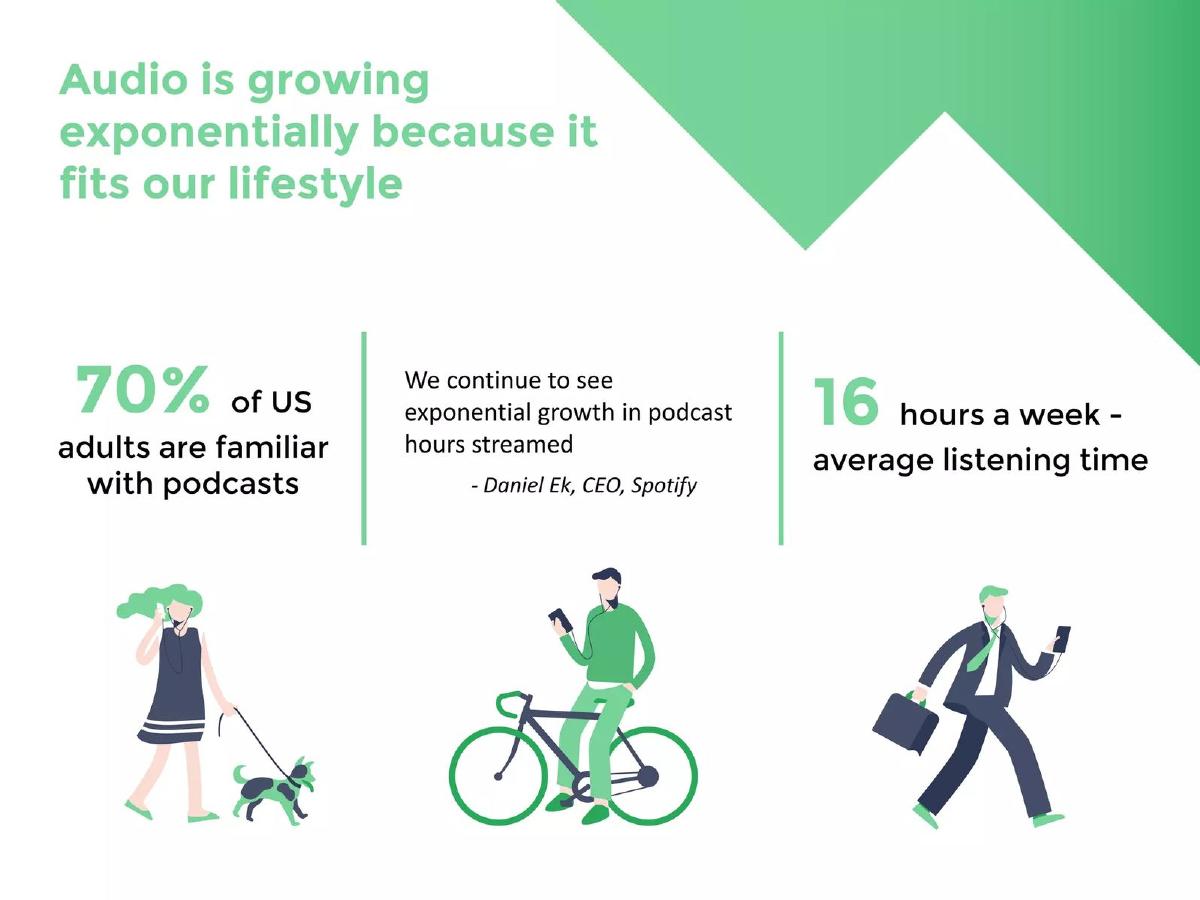
- The platform targets the 'on-the-go' lifestyle, leveraging the fact that average listening time is 16 hours a week (Slide 2).
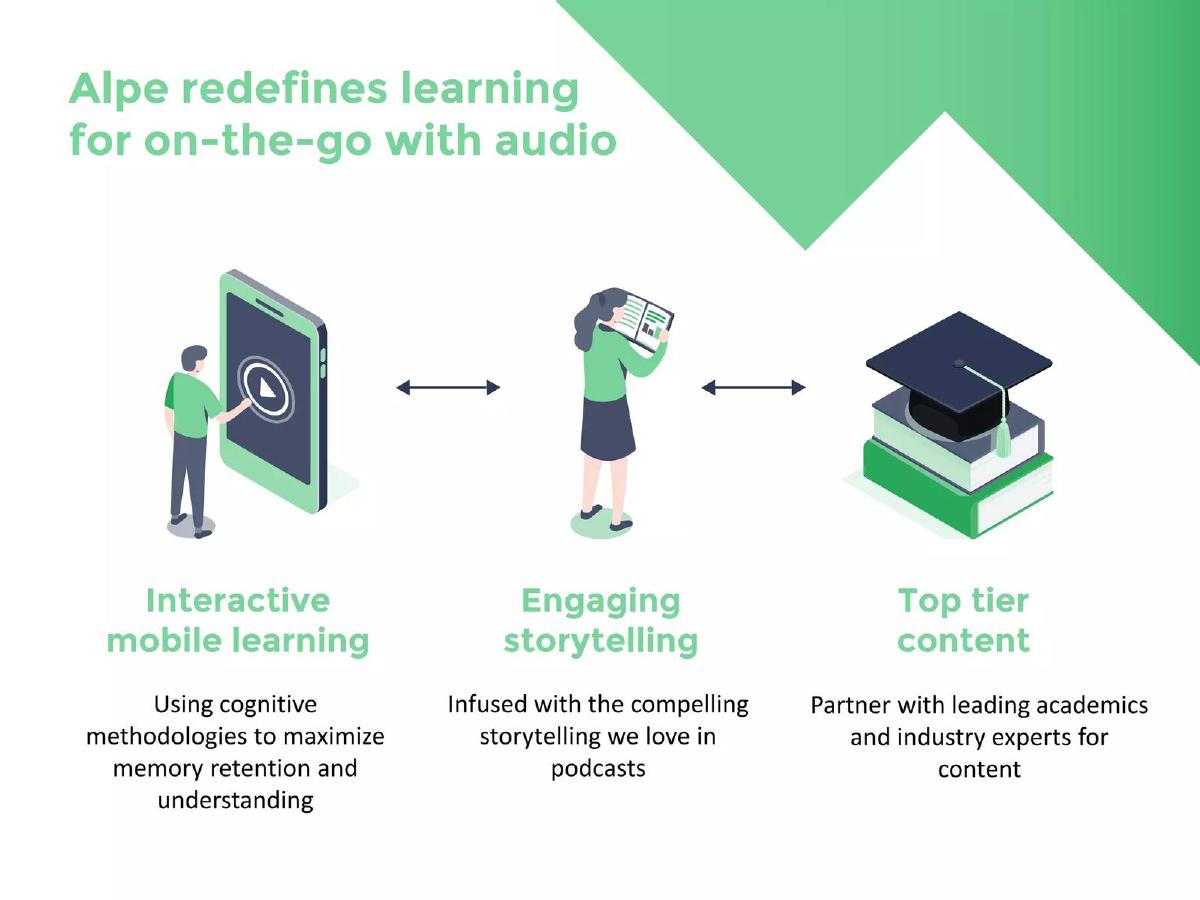
- Alpe uses cognitive methodologies to maximize memory retention through interactive mobile learning (Slide 3).
- The business model is multi-tiered, offering pay-per-course ($6.99 - $39.99), premium tutoring, and a monthly subscription (Slide 6).
- A key technical differentiator is the AI-based course creation engine intended to scale quality content production (Slide 4).
- The company identifies six specific target cohorts for its beta, including gig economy drivers, overseas students, and executives (Slide 5).
- Competitive positioning claims Alpe is the only player offering interactive, non-frontal, scalable audio courses (Slide 7).
- The roadmap shows a progression from 80+ interviews in May-June to a planned expansion of content in Q2 2020 (Slide 9).
- The deck omits a dedicated team slide, detailed unit economics, and a specific funding 'ask' or valuation.
Executive Summary: Audio-First EdTech
Alpe enters the market at the intersection of two major trends: the rise of the 'ear share' economy and the demand for flexible, lifelong learning. The deck presents a vision for a platform that moves beyond passive listening to active, interactive education. By focusing on the 'on-the-go' learner, Alpe attempts to solve the low completion rates of traditional video-based MOOCs by meeting users where they already spend 16 hours a week: in their headphones.
Slide 1: Title Slide
The title slide is minimalist, featuring the company name 'Alpe' and the tagline 'Redefining learning for on-the-go.' The background imagery of snow-capped mountains reinforces the brand name but does not provide immediate context for the product. It serves as a standard, clean entry point into the presentation.
Slide 2: The Market Opportunity
Slide 2 establishes the 'Why Now?' by focusing on the growth of audio. It cites that 70% of US adults are familiar with podcasts and highlights a quote from Daniel Ek, CEO of Spotify, regarding exponential growth in podcast hours. The most compelling figure here is the '16 hours a week' of average listening time, which represents the total addressable attention Alpe hopes to capture. The illustrations of people walking dogs, cycling, and commuting emphasize the 'on-the-go' nature of the target behavior.
Slide 3: The Value Proposition
This slide breaks down the product into three pillars: Interactive mobile learning, Engaging storytelling, and Top tier content. It specifically mentions 'cognitive methodologies to maximize memory retention,' which is a direct jab at the passive nature of competitors like Audible. The mention of partnering with 'leading academics and industry experts' suggests a focus on high-authority content rather than user-generated content.
Slide 4: The Alpe Platform Architecture
Slide 4 is perhaps the most important for a technical investor. It describes the business as a three-part ecosystem: Supply (premium content), Tech platform (AI-based course creation engine), and Distribution (the app). The inclusion of an 'AI based course creation engine' is a critical claim, as it suggests the company can produce high-quality educational audio faster and cheaper than traditional production houses. However, the deck does not explain how this AI works or what stage of development it is in.
Slide 5: Beta Launch and Cohort Strategy
Titled 'February Beta Launch,' this slide uses a 'crossing the chasm' metaphor. It lists six target cohorts: gig economy drivers, overseas students, vocational training, individuals with ADD/Dyslexia/visual impairments, founders/executives/VCs, and universities. On the right side, it lists the goals of the beta: Retention, Tech platform roadmap, Usership, and Pain points. This slide shows a structured approach to testing, though it doesn't provide results from these tests.
Slide 6: Revenue and Business Model
Alpe presents a three-pronged monetization strategy. Pay per course is the entry-level transaction, priced between $6.99 and $39.99. Premium learning adds a service layer with personal tutoring. Subscription offers a recurring revenue model. While this shows flexibility, it also suggests the company has not yet decided on its primary driver of growth.
Slide 7: Competitive Landscape
The competition matrix compares Alpe against Audible, Podcasts, Coursera, and Knowable. Alpe claims to be the only platform that offers courses, is non-frontal (meaning not just a lecture recorded on video), is interactive, and has scalable content. Notably, it marks Coursera as 'Frontal: Yes' and 'Interactive: Yes,' while marking Knowable as 'Scalable content: No.' This slide effectively positions Alpe as a unique hybrid of education and audio-native design.
Slide 8: Contact and Socials
This slide provides the contact information for Yehoshua Zlotogorski and links to various social platforms. It functions as a closing slide but lacks the 'Team' information usually expected in a pitch. The use of a personal Gmail address rather than a corporate domain is a minor but noticeable detail for a professional pitch.
Slide 9: Progress and Product Roadmap
The final slide in this set provides a timeline from May-June (User research) to Q2 2020 (Expansion). Key milestones include 80+ interviews, live tests at two universities, and partnerships with professors from Columbia and IDC. The roadmap shows a clear path from validation to beta launch, but as this is a historical deck, the 'Q2 20' expansion date indicates the deck was likely used in late 2019 or early 2020.
What Alpe Does Well
The deck is exceptionally clear about the problem-solution fit . By identifying the 16-hour-a-week audio habit, Alpe makes a strong case for why education should move to audio. The focus on 'cognitive methodologies' and 'interactivity' addresses the primary criticism of audio learning—that it is too passive for complex subjects. The visual design is consistent, using a green and white palette that feels modern and educational.
What Is Missing from the Deck
The most glaring omission is a Team Slide . Investors invest in people, especially at the early stage, and excluding the backgrounds of the founders is a significant oversight. Additionally, there is no Financial Ask . The deck explains what they are building but not how much money they need or what milestones that money will buy. Finally, there is a lack of Unit Economics . While they list prices for courses, they do not provide data on the cost to acquire a user (CAC) or the cost to produce a course using their AI engine, which are the two most important numbers for a platform business.
Founder Takeaways: What to Copy
Founders should look at Slide 5 as a model for segmentation . Instead of saying 'everyone who listens to podcasts,' Alpe identified six distinct groups with different pain points. This allows for much more targeted marketing and product testing. The 'Progress & Product Roadmap' (Slide 9) is also a strong example of how to show momentum through non-financial metrics, such as the number of user interviews and the prestige of early academic partners. Finally, the competitive matrix (Slide 7) is well-constructed because it uses specific product attributes (Interactive, Scalable) rather than vague terms like 'Better' or 'Faster.'
Conclusion
Alpe’s deck is a strong product-centric presentation that successfully argues for the existence of a new category: Interactive Audio Education. It relies heavily on the 'AI based course creation engine' as its moat, though it leaves the details of that technology to the imagination. To be a truly top-tier fundraising deck, it would need to add a robust team slide and clear financial projections to prove that the business model is as scalable as the content production engine.
Frequently asked questions
- What is Alpe's primary product offering?
- Alpe offers audio-based educational courses designed for mobile use. Unlike standard podcasts, these courses use cognitive methodologies for memory retention and are interactive. The platform aims to provide 'top tier content' by partnering with academics and industry experts, delivered through a dedicated app that fits into a user's daily commute or active lifestyle.
- How does Alpe plan to make money?
- According to slide 6, the company employs three revenue streams: a transactional 'Pay per course' model with prices ranging from $6.99 to $39.99, a 'Premium learning' tier that includes personal tutoring, and a 'Subscription' model for all-inclusive monthly access. This diversified approach suggests they are testing which model best suits their various target cohorts.
- What is the 'AI based course creation engine' mentioned in the deck?
- Slide 4 identifies this engine as the 'Tech platform' layer of their business. It is described as a tool for 'scalable quality content creation.' This suggests that Alpe isn't just a distribution app, but a technology company attempting to automate or streamline the expensive process of turning academic knowledge into engaging audio storytelling.
- Who is the target audience for Alpe?
- Slide 5 lists several specific cohorts for their beta launch: gig economy drivers (who spend long hours on the road), overseas students, vocational trainees, individuals with ADD/Dyslexia or visual impairments, and high-level professionals like founders, executives, and VCs. This broad list indicates an early-stage search for product-market fit.
- What are the major missing elements in this pitch deck?
- The deck is missing a 'Team' slide, which is standard for early-stage fundraising to establish credibility. It also lacks a 'The Ask' slide detailing how much capital is being raised and how it will be used. Furthermore, there are no financial projections, unit economics (CAC/LTV), or specific metrics regarding current user engagement or retention.