Altan's 16-slide deck is a masterclass in visual storytelling for the 'AI Agent' era, though it leans heavily on aesthetics over hard data. The Spanish startup, which raised $2.5M in 2024 as reported by Business Insider, uses a dark-mode, high-fidelity design to illustrate how autonomous agents—named Genesis, Flow, Database, and Interface—collaborate to build custom software. The deck eschews traditional slides like market sizing, competitive landscapes, and financial projections in favor of a step-by-step product walkthrough. While this approach successfully communicates the 'magic' of their…
Key takeaways
- The deck utilizes a minimalist 'dark mode' aesthetic with high-fidelity UI mockups to demonstrate product capabilities (Slides 1-8).
- Altan categorizes its AI functionality into four distinct agent types: Genesis, Flow, Database, and Interface (Slide 1).
- The product narrative is structured around a three-step process: 'How it works', 'Plans it', and 'Builds it' (Slides 2-4).
- A 'New agent is born' visualization suggests a dynamic, expandable ecosystem of autonomous workers (Slide 6).
- The team slide emphasizes academic credentials from the University of Cambridge and Boston College (Slide 8).
- The founders highlight their status as 'Previous founders' to mitigate early-stage execution risk (Slide 8).
- There is a total absence of market size (TAM/SAM/SOM) or competitive analysis slides in the provided materials.
- The deck contains no financial data, pricing models, or specific 'Ask' regarding the $2.5M raise reported by Business Insider.
The Visual Narrative of Autonomous Coding
Altan’s pitch deck is a striking example of the 'show, don't tell' philosophy. In an industry—AI coding—that is becoming increasingly crowded, Altan chose to lead with a high-fidelity vision of the future. According to publisher reports, this Spanish startup raised $2.5M in a 2024 pre-seed round. The deck they used is less of a business plan and more of a product manifesto. It focuses on the interaction between 'agents' and the resulting software, banking on the investor's ability to see the massive market potential without needing a dedicated TAM slide.
Slide 1: The Agent Ecosystem
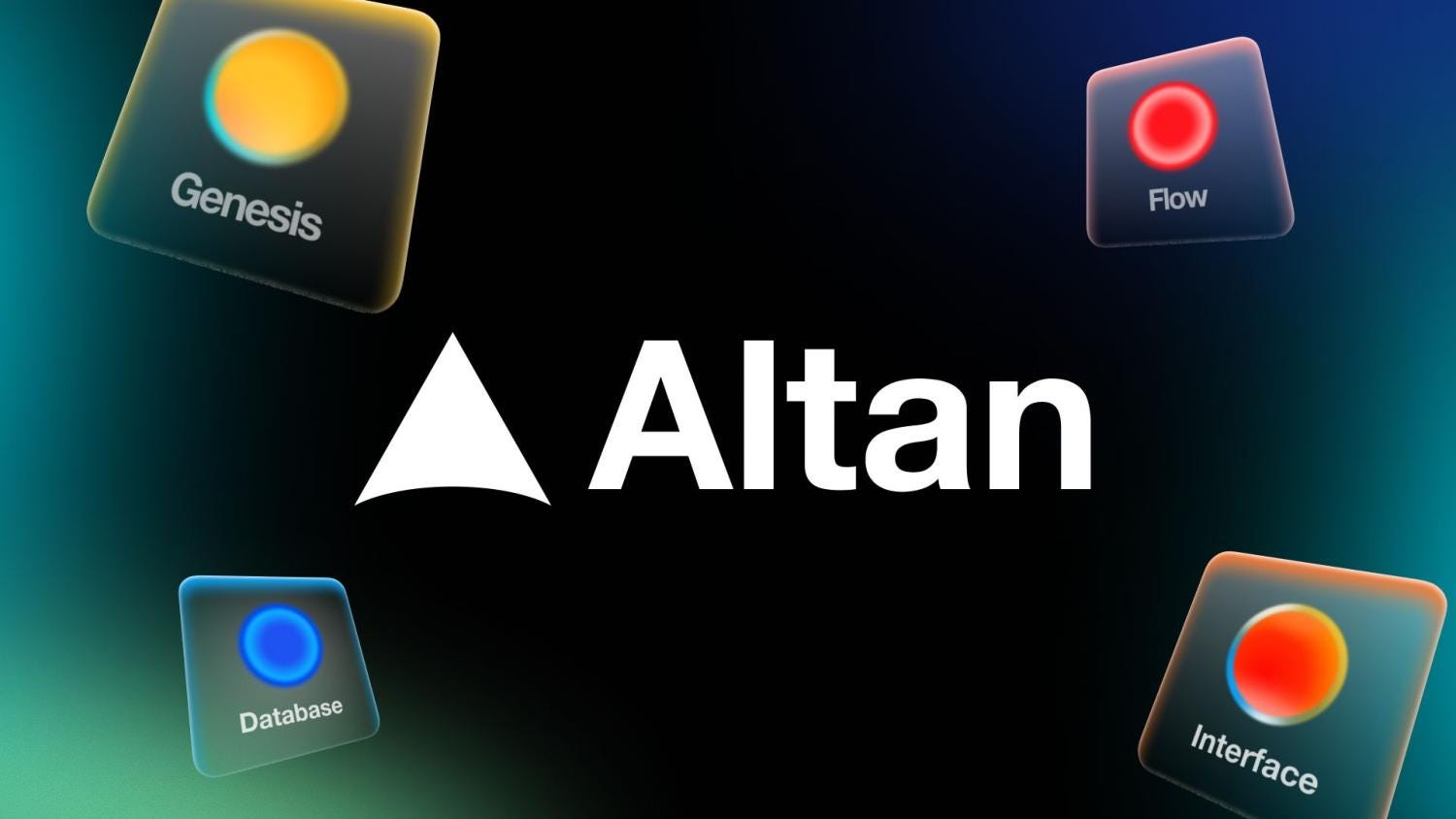
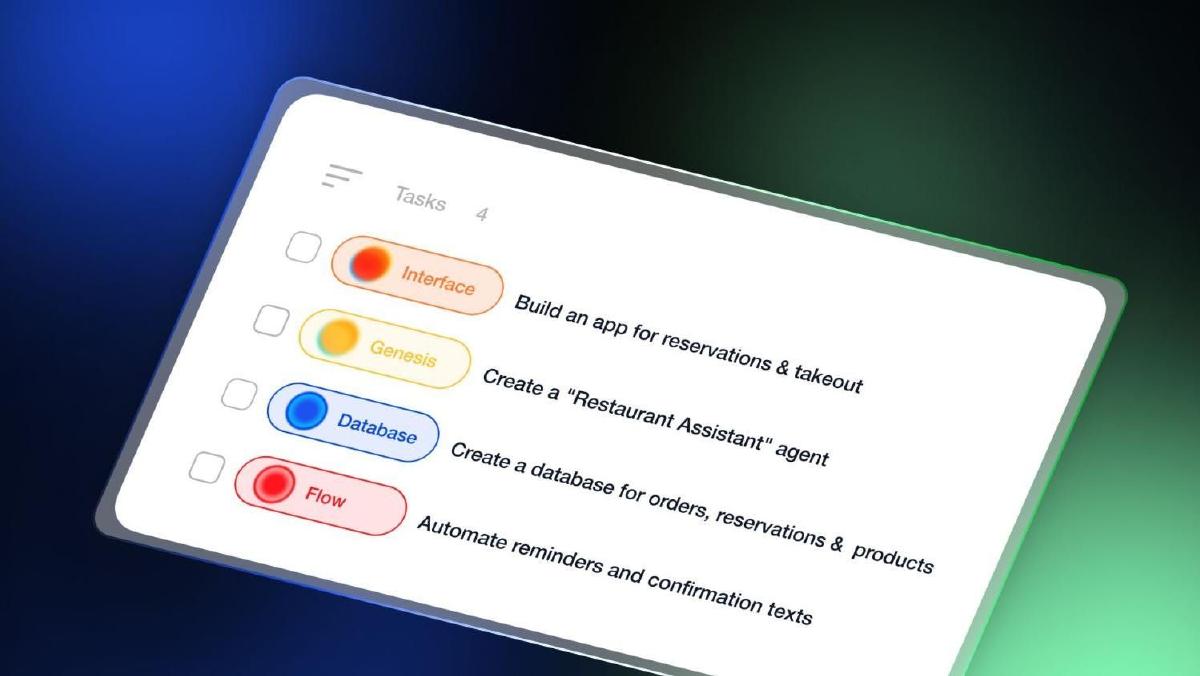
The title slide introduces the brand and its four primary pillars: Genesis , Flow , Database , and Interface . Each is represented by a distinct, glowing icon. This immediately frames Altan not just as a 'chatbot that writes code,' but as a multi-agent system. By naming these components, the company creates a proprietary language for its technology stack, making the abstract concept of 'AI coding' feel like a tangible suite of tools.
Slides 2-4: The Process Framework
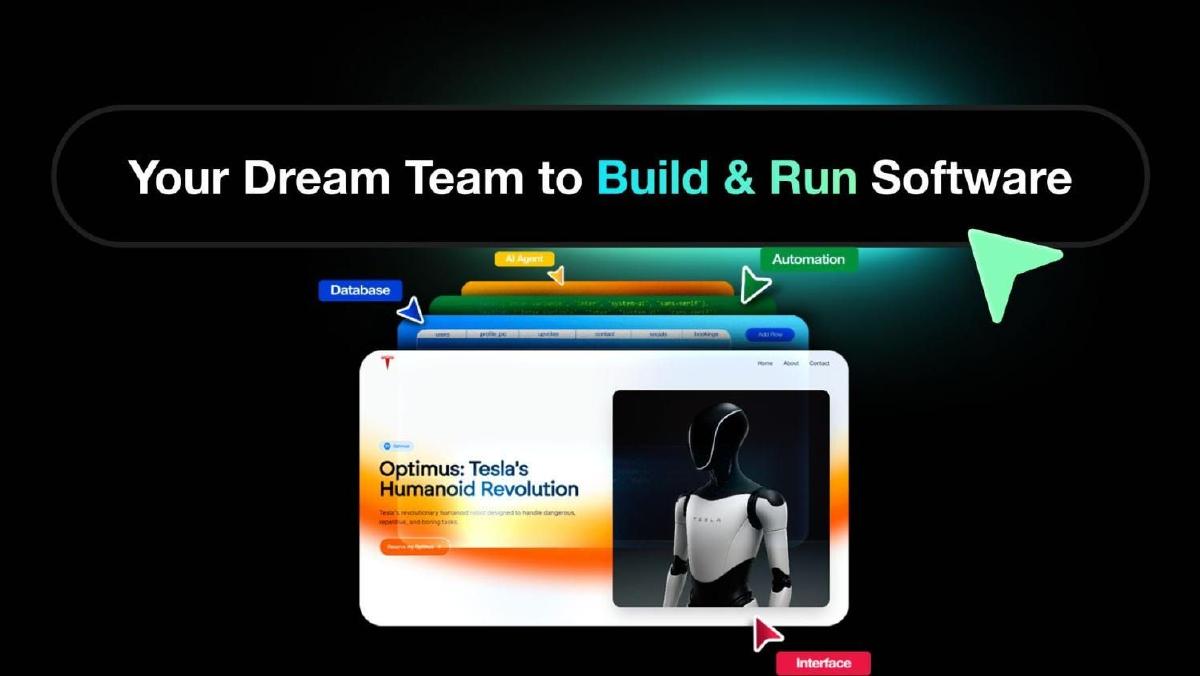
These slides are minimalist to the point of being provocative. Slide 2 simply says 'How it works' . Slide 3 states 'Altan Plans it' , and Slide 4 concludes with 'Builds it' . This three-part structure is designed to address the biggest skepticism in AI software generation: can it actually handle the planning phase, or does it just spit out disconnected snippets of code? By giving 'Planning' its own beat in the presentation, Altan signals that their agents handle the architectural heavy lifting before a single line of code is written.
Slide 5: The Database Agent in Action
Slide 5 provides the first look at the UI. It shows a 'Database' agent notification stating, 'Database created & connected!' superimposed over a clean, functional table of reservations. The data includes fields like 'Date & Time', 'Customer name', 'Phone number', and 'Status'. This slide is crucial because it demonstrates that the AI isn't just generating a mockup; it is allegedly handling the backend connectivity required for a real-world application. The blue 'Database' tag at the bottom left reinforces which part of the ecosystem is performing the task.
Slide 6: The Genesis of New Agents
This slide introduces the concept of scalability within the agent team. A notification from Genesis reads, 'An new agent was added to the project!' (note: the slide contains a minor grammatical error, 'An new'). A dropdown menu lists the existing agents (Interface, Database, Flow, Genesis) and a highlighted 'New Agent' option. This suggests that the platform is not limited to a fixed set of capabilities but can dynamically 'birth' new agents to handle specific project requirements. This is a high-level technical promise that appeals to the 'Agentic AI' trend currently dominating VC interest.
Slide 7: The Final Product Output
Slide 7 is the 'money shot' of the deck. It displays a complex, high-fidelity fitness application interface titled 'The Power Workout' alongside a 'Restaurant Assistant' widget. The slide shows the various agents contributing to the whole: Database managing guest names, Flow handling text confirmations, and Interface showing a progress bar at '76% completed' . This slide successfully visualizes the end-state: a world where a user provides a prompt and a team of invisible agents builds a professional-grade, multi-platform application.
Slide 8: The Team Pedigree
The final slide in the provided sequence introduces the founders. Albert Salgueda (CEO) and Tristan Pou (CTO) are presented alongside the logos of the University of Cambridge , Boston College , and Universitat Pompeu Fabra Barcelona . The text '& Previous founders' is used to establish credibility. At the pre-seed stage, investors are primarily buying into the team's ability to execute on a complex technical vision. By highlighting elite academic institutions and past entrepreneurial experience, Altan attempts to de-risk the investment.
What Altan’s Deck Does Well
The primary strength of this deck is its visual consistency and branding . In the AI space, where many startups look like generic wrappers for OpenAI, Altan has built a distinct visual identity. The use of dark mode, glassmorphism, and vibrant accent colors makes the product feel 'premium' and 'next-generation'.
Furthermore, the modular explanation of AI is highly effective. Instead of promising a 'magic box' that does everything, they break the software development lifecycle into logical components (Database, Flow, Interface). This makes the technical challenge seem more manageable and the solution more robust. It allows an investor to understand the 'workforce' analogy—that they are funding a digital factory rather than just a tool.
What is Missing from the Altan Deck
While the deck is visually stunning, it is analytically hollow. The following elements are completely missing from the 16-slide sequence:
Market Sizing (TAM/SAM/SOM): There is no mention of how large the custom software market is or what portion Altan intends to capture. · Competitive Landscape: The deck does not acknowledge other players in the AI coding space (e.g., Devin, Anysphere/Cursor, or Replit). Failing to differentiate from these well-funded competitors is a significant omission. · Business Model: It is unclear if Altan is a SaaS platform, a per-project fee service, or an enterprise solution. There is no mention of pricing. · Traction and Roadmap: There are no dates, no mention of a beta waitlist, and no milestones for what the $2.5M will achieve. · The Ask: The deck concludes without a slide stating how much money is being raised or what the valuation expectations are.
Lessons for Founders
Founders can learn two conflicting lessons from Altan. First, design matters . A high-quality deck can signal a high-quality product. If you are building a tool that creates 'Interface', your own interface (the deck) must be flawless. Altan uses their deck to prove they have good taste, which is a proxy for product-market fit in the developer tools space.
Second, pedigree can replace data at the Pre-Seed level . If you have degrees from Cambridge and have founded companies before, you can get away with a 'vision deck' that lacks a spreadsheet. However, for founders without that specific background, omitting the market and competition slides is a dangerous gamble. Most investors will require the 'boring' slides to understand the floor of the investment, even if the 'exciting' slides show the ceiling.
Ultimately, Altan’s deck is a specialized tool for a specific moment in the AI hype cycle. It leans into the 'Autonomous Agent' narrative perfectly, using a sleek aesthetic to bridge the gap between a bold technical claim and a realized product.
Frequently asked questions
- What is the core value proposition of Altan based on the deck?
- Altan proposes a shift from manual coding to autonomous software generation. By using specialized AI agents—Genesis for planning, Database for backend, Flow for logic, and Interface for frontend—the platform aims to build functional applications like restaurant management systems or fitness apps from high-level prompts, as visualized in Slide 7.
- Does the deck provide any traction metrics or user numbers?
- No. The 16-slide deck, as presented, contains zero metrics, user counts, or revenue figures. It functions primarily as a vision and product-concept deck, which is common for pre-seed rounds where the technology's potential and the team's pedigree are the primary selling points.
- How does Altan differentiate its AI agents?
- The deck identifies four specific roles: Genesis (project management/planning), Flow (workflow logic), Database (data structure), and Interface (visual design). Slide 6 also shows a 'New Agent' being added to a project, suggesting the system is modular and can spawn new specialized entities as needed.
- What information is missing from the team slide?
- While Slide 8 lists the CEO and CTO and their university affiliations, it lacks specific details on their previous companies or specific roles. It mentions they are 'Previous founders' but does not name the ventures or the outcomes of those startups.
- Is there a clear 'Ask' or use of funds in the deck?
- The provided slides do not include an 'Ask' slide. While Business Insider reports a $2.5M raise, the deck itself does not specify the amount being sought, the valuation, or how the capital will be allocated across engineering, marketing, or operations.