The ScriptDash (now Alto Pharmacy) deck is a lean, 14-slide presentation that successfully bridges the gap between a high-level vision and granular execution. By anchoring the 'Why Now' in the Affordable Care Act (Obamacare), the founders established immediate urgency for a legacy industry ripe for disruption. The deck’s strongest asset is its transparency regarding unit economics; it explicitly compares two customer acquisition channels—selling to doctors versus online advertising—showing a massive disparity in CAC ($3.20 vs $72.00). While it lacks a formal 'Ask' slide and detailed financial…
Key takeaways
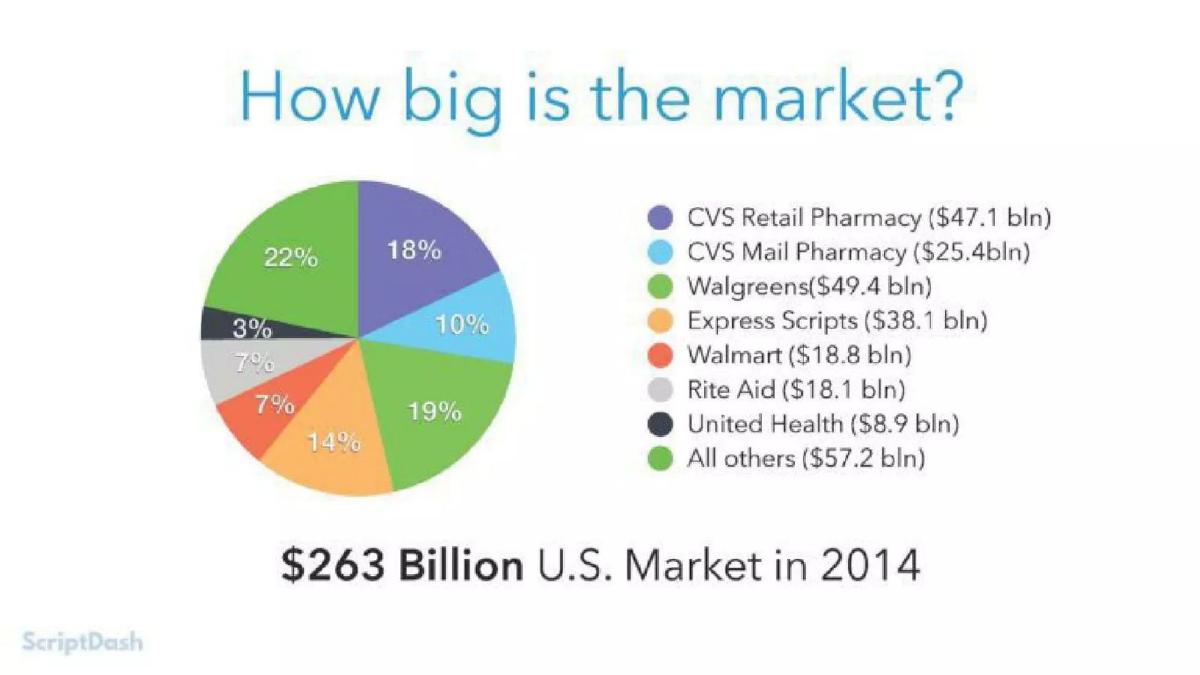
- The deck identifies a $263 Billion U.S. market as of 2014, dominated by CVS and Walgreens (Slide 4).
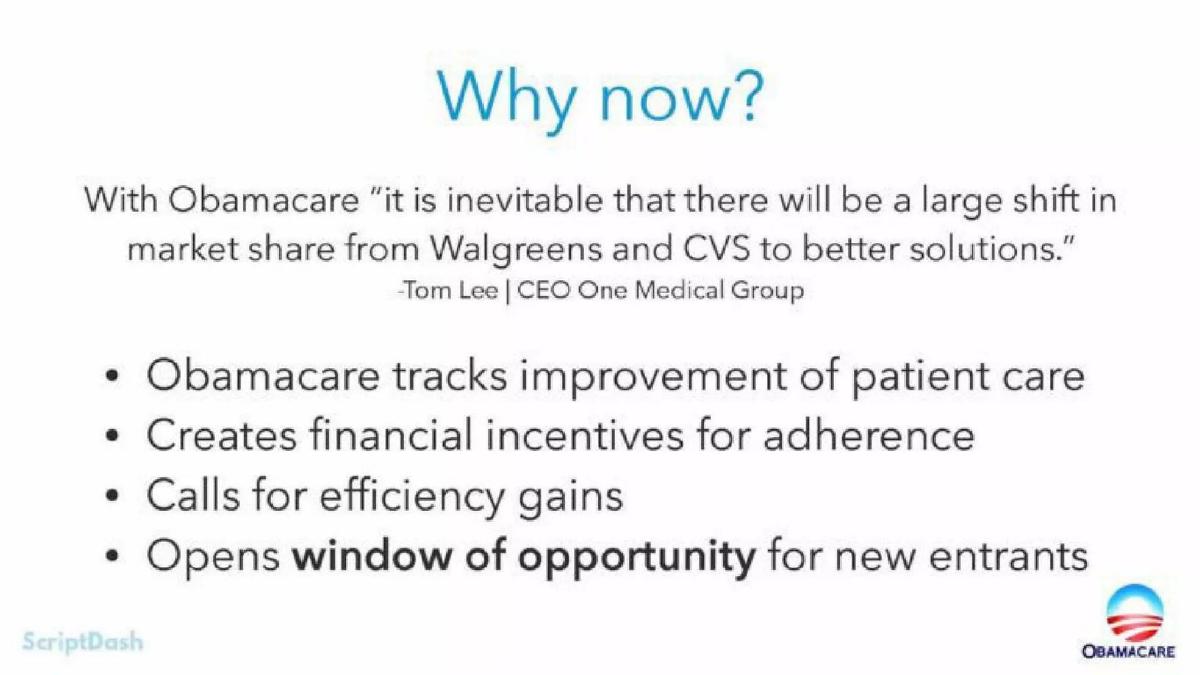
- Regulatory tailwinds are central to the pitch, citing Obamacare as a catalyst for market share shifts (Slide 3).
- The company uses birth control as a strategic entry point due to its 15-year average duration and $108 annual LCV (Slide 7).
- A stark contrast in acquisition costs is presented: $3.20 CAC via doctors versus $72.00 CAC via online ads (Slide 9).
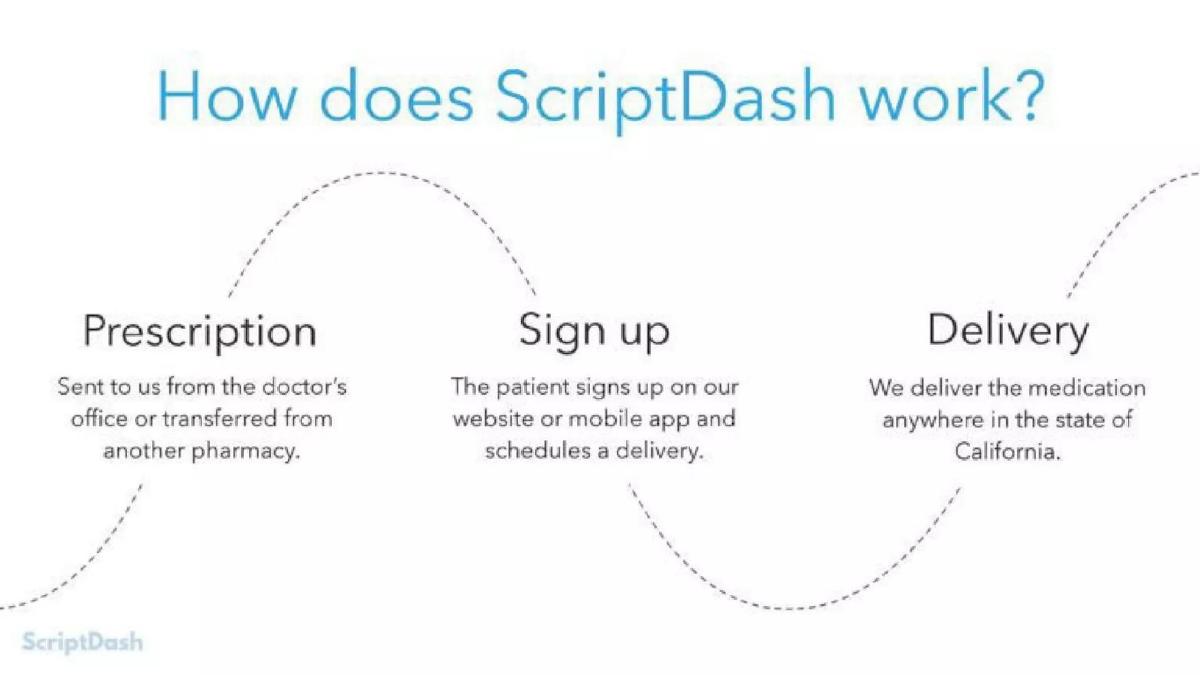
- The product experience is simplified into a three-step process: Prescription, Sign up, and Delivery (Slide 5).
- The team slide highlights technical pedigree from Parse, Facebook, and Dell (Slide 10).
- The deck omits a specific funding 'Ask' or a slide dedicated to current traction metrics.
- The 'Appendix' includes a slide framing the solution as a 'Life Saver' by addressing the 4th leading cause of death in the U.S. (Slide 13).
The ScriptDash (Alto) Pitch Deck: A 14-Slide Deep Dive
In 2015, the company now known as Alto Pharmacy was pitching under the name ScriptDash. This 14-slide deck represents a classic 'wedge' strategy: identifying a massive, inefficient market and finding a specific, high-retention entry point to break in. The deck is remarkably clean, avoiding the clutter often found in healthcare presentations.
The Vision and the 'Why Now'
Slide 1: Title The deck opens with the logo 'ScriptDash' and the tagline 'The pharmacy. Reinvented.' It is a minimalist start that focuses on the core value proposition: a total overhaul of a legacy experience.
Slide 2: A better pharmacy experience This slide defines the product as a 'technology focused online pharmacy.' It highlights two delivery modes: recurring monthly delivery by mail and on-demand delivery within a 2-hour window. This immediately sets the expectation for a logistics-heavy operation powered by software.
Slide 3: Why now? ScriptDash leans heavily on the Affordable Care Act (Obamacare). They quote Tom Lee, CEO of One Medical Group, stating that a shift from Walgreens and CVS to 'better solutions' is inevitable. The slide lists four drivers: tracking patient care, financial incentives for adherence, efficiency gains, and a window of opportunity for new entrants. This is a strong use of regulatory tailwinds to justify the timing of the investment.
Market Size and Mechanics
Slide 4: How big is the market? The deck cites a '$263 Billion U.S. Market in 2014.' A pie chart breaks down the incumbents, with Walgreens ($49.4 bln) and CVS Retail ($47.1 bln) holding the largest shares. This slide serves to show that even a small percentage of market capture represents a massive business.
Slide 5: How does ScriptDash work? The process is simplified into three steps: 1. Prescription (sent from doctor or transferred), 2. Sign up (via website or app), and 3. Delivery (anywhere in California). This slide confirms their initial geographic focus is limited to California.
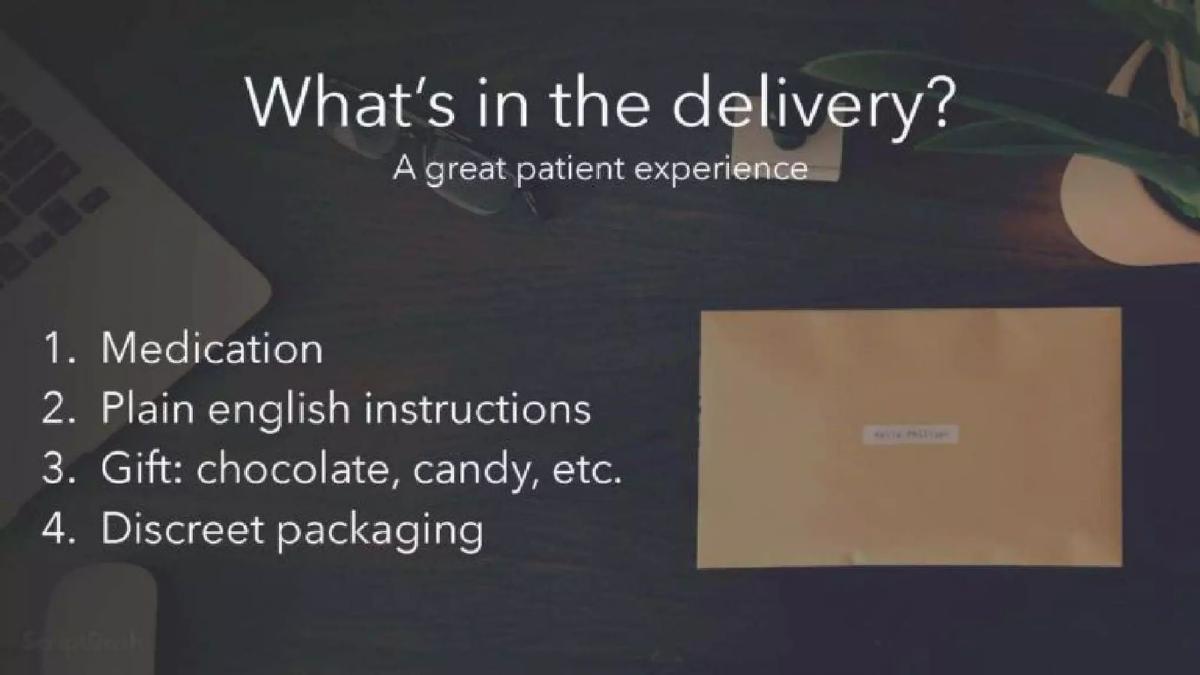
Slide 6: What’s in the delivery? This is a 'customer delight' slide. It lists medication, 'plain english instructions,' a gift (chocolate/candy), and discreet packaging. It emphasizes that the company isn't just delivering pills; it is delivering a 'great patient experience.'
The Economics of the Wedge
Slide 7: Starting with birth control This is the most strategic slide in the deck. ScriptDash identifies birth control as their 'wedge.' They note a 15-year average duration (Age 18-33), a $9 monthly margin, and a $108 annual LCV (Lifetime Customer Value), which can scale up to $1,600 over the full duration. By starting with a predictable, long-term medication, they solve the retention problem early.
Slide 8: Expanding to all prescriptions The deck then shows the scale-up path. They cite 160 million active patients in the US and 4.1 billion prescriptions filled in 2014. They project an average annual LCV of $323 for a general patient, significantly higher than the birth control wedge, suggesting that the initial product is just the 'top of the funnel.'
Slide 9: Cost of Acquisition This slide provides rare transparency. It compares two channels: 'Sell To Doctors' and 'Online Advertising.' Selling to doctors is projected at a $3.20 CAC per prescription (based on 10 man-hours per doctor). Online advertising via Facebook/Google is projected at a $72 CAC per prescription. This clearly signals to investors that their primary growth lever will be B2B2C (doctor referrals) rather than expensive direct-to-consumer ads.
The Team and Appendix
Slide 10: Founding Team The team consists of Mattieu Gamache-Asselin (5th engineer at Parse), Jamie Karraker (Engineer at Parse and Facebook), and Vlad Blumen (Founder of WalkSource). The pedigree is heavily weighted toward engineering and business development, which aligns with the 'technology focused' description on Slide 2.
Slide 12: Technology Focused Approach This slide lists the tech stack: iPhone/Web apps, push notifications, 'text to talk,' automatic refills, and 'smart management of insurance.' The final bullet point, 'By generation Y for generation Y,' reinforces the target demographic of their birth control wedge.
Slide 13: Not Just Better Tech: Life Saver! The final content slide provides a moral and social imperative. It notes that 16% of hospital admissions are related to adverse reactions and that medication errors are the 4th leading cause of death in the U.S. This frames the business as a solution to a public health crisis, not just a delivery app.
Slide 14: Closing Slide A repeat of the title slide with the logo and tagline.
What Works in the ScriptDash Deck
The Wedge Strategy: Choosing birth control as a starting point is brilliant. It has high retention, a young/tech-savvy demographic, and predictable margins. · CAC Transparency: Most decks hide their acquisition costs or blend them. ScriptDash explicitly shows that one channel is 22x more expensive than the other, which tells investors exactly how the founders plan to spend their money. · Regulatory Alignment: By tying their success to Obamacare, they make the company's growth feel like a mathematical certainty of a changing legal landscape.
What is Missing from the ScriptDash Deck
The Ask: There is no slide stating how much money they are raising, the valuation, or the specific milestones they intend to hit with the capital. · Traction: While the deck mentions they deliver in California, it doesn't state how many prescriptions they have already filled or how many doctors are currently on the platform. · Financial Projections: There is no 3-5 year roadmap showing when the company expects to reach profitability or what the burn rate looks like. · Competitive Analysis: While they list incumbents like CVS, they don't address other 'digital-first' pharmacy startups that were emerging at the same time.
What a Founder Should Copy
The 'Why Now' Slide: Use external, macro-economic, or regulatory shifts to create urgency. Don't just say your product is better; say the world has changed in a way that makes your product necessary. · Unit Economics Comparison: If you have multiple acquisition channels, show the math. It demonstrates a deep understanding of your business model and helps investors see the 'engine' of the company. · Simplified Workflow: Slide 5 is a perfect example of how to explain a complex healthcare process in three simple steps. If your product involves logistics, keep the explanation high-level.
Frequently asked questions
- What was the company's original name?
- The company was originally named ScriptDash, as seen on the title slide (Slide 1) and throughout the deck. It later rebranded to Alto Pharmacy.
- How did ScriptDash plan to acquire customers cheaply?
- According to Slide 9, the company planned to 'Sell To Doctors.' They estimated that 10 man-hours per doctor at $50/hour would yield 160 monthly prescriptions, resulting in a CAC of just $3.20 per prescription.
- What was their initial product focus?
- They focused on birth control (Slide 7). They chose this because it is a recurring prescription with a long lifecycle (ages 18-33) and a predictable $9 monthly margin.
- Who were the primary competitors identified?
- Slide 4 lists the major incumbents: CVS Retail ($47.1 bln), Walgreens ($49.4 bln), Express Scripts ($38.1 bln), Walmart ($18.8 bln), and Rite Aid ($18.1 bln).
- What is missing from this deck?
- The deck lacks a slide showing current traction (revenue or user growth), a formal 'Ask' slide detailing how much capital is being raised, and a detailed 3-5 year financial forecast.