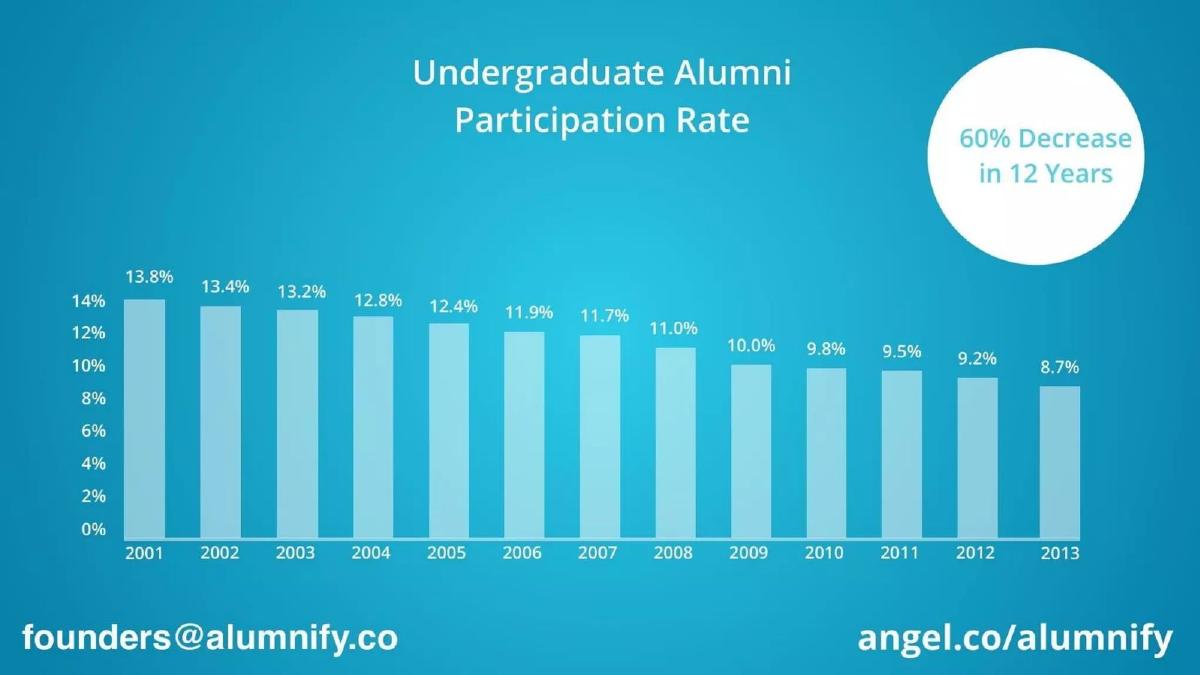
Alumnify’s 2013 seed deck is a masterclass in identifying a specific, measurable decline in an established market and positioning a modern solution as the inevitable fix. By highlighting a 60% decrease in undergraduate alumni participation over 12 years (Slide 5), the founders established an urgent need for universities to modernize their outreach. The deck successfully balances the emotional appeal of 'community' with the hard logic of a B2B business model featuring 4-5 year contracts (Slide 10). While it lacks granular unit economics and a specific financial ask, the inclusion of 130+ beta…
Key takeaways
- The deck identifies a massive market failure: a 60% decrease in alumni participation rates between 2001 and 2013 (Slide 5).
- It uses personal founder imagery to establish 'founder-market fit,' showing the team in fraternity and athletic settings (Slide 2).
- The solution is framed as a virtuous cycle where community, rewards, and meetups lead directly to university donations (Slide 7).
- Traction is demonstrated through a roster of 130+ beta schools, including major institutions like Boise State and the University of Mississippi (Slide 8).
- The business model relies on long-term stability, citing 4-5 year contracts as the primary revenue driver (Slide 10).
- The deck highlights a significant milestone of reaching $1 million in prior funding and participation in the 500 Startups accelerator (Slide 12).
- Product functionality is showcased through high-fidelity mobile mockups focusing on connections, meetings, and messaging (Slides 13-14).
- The deck completely omits a specific 'Ask' slide, leaving the desired funding amount and valuation for the 2013 round unstated.
Introduction: The Alumnify Narrative
Alumnify entered the market in 2013 with a clear mission: to modernize the way universities interact with their graduates. At the time, alumni relations were dominated by antiquated methods like physical mail and cold calling. This teardown examines the 14-slide deck that helped the company raise $1.3 million by highlighting a dying legacy system and offering a mobile-first alternative.
Slides 1-3: Establishing Founder-Market Fit
The deck opens with a clean title slide (Slide 1) featuring the logo and the tagline "connect with opportunity." Immediately following this, the founders take an unconventional approach by using personal photos. Slide 2 shows the founders in their university days, specifically highlighting "Fraternity" and "Cross Country" involvement. Slide 3 continues this theme with a candid photo of the team in costumes. While some investors might find this too informal, in the context of a seed round for a community-based product, it serves to prove that the founders are the target demographic. They aren't just building software; they are the very alumni they are trying to reach.
Slides 4-6: The Data-Driven Problem
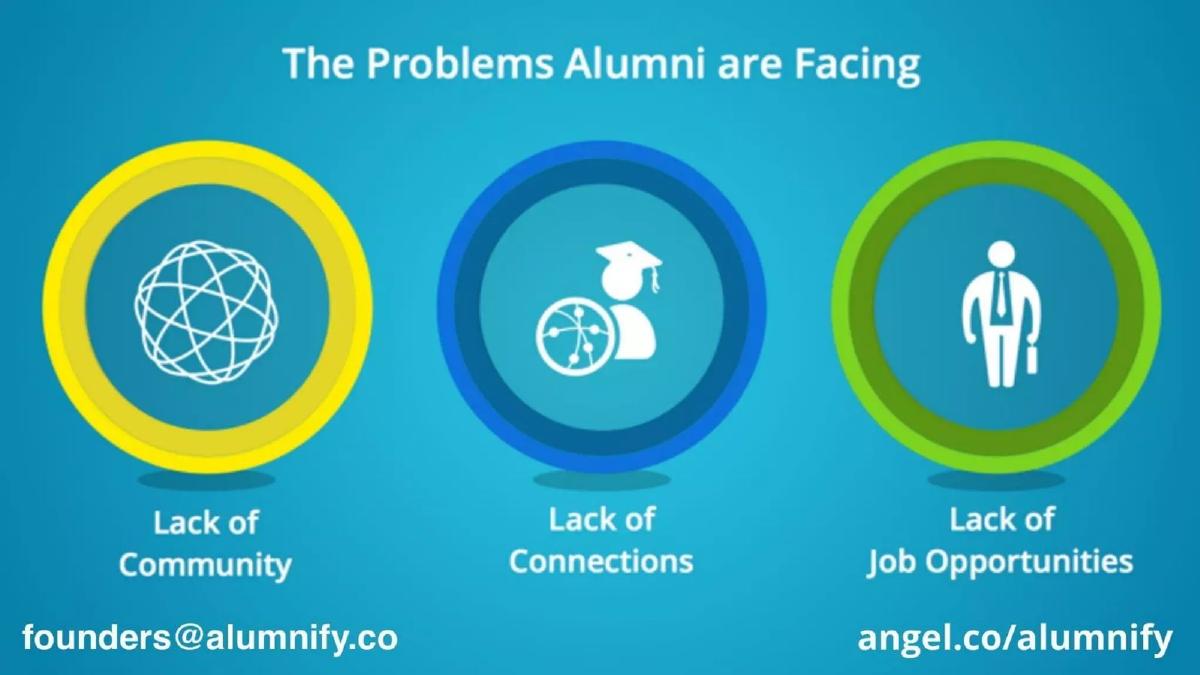
Slide 4 uses simple iconography to mock the status quo: Emails, Cold Calls, and Snail Mail. The inclusion of a 'disappointed' backpack icon at the bottom signals that these methods are failing the modern student. The 'hook' of the deck is Slide 5, which presents a bar chart of Undergraduate Alumni Participation Rates. It shows a steady decline from 13.8% in 2001 to 8.7% in 2013. The callout bubble stating a "60% Decrease in 12 Years" is the most compelling piece of data in the entire presentation. It transforms a vague feeling of 'disconnection' into a quantifiable financial crisis for universities. Slide 6 then categorizes the specific pains for the alumni themselves: Lack of Community, Lack of Connections, and Lack of Job Opportunities.
Slides 7-9: The Solution and Early Traction
Slide 7 illustrates the 'virtuous cycle' of the Alumnify solution. It posits that by providing Community, Rewards, and Meetups, the platform naturally "leads to donations." This is a critical bridge for the investor; it explains how a social app for graduates turns into a revenue-generating tool for the university. Slide 8 provides the 'Social Proof.' By listing "130 + Beta Schools" and displaying logos for institutions like FIU, Miami University, and Boise State, Alumnify proves that their solution has legs. Slide 9 reinforces this with a press clipping from TechCo, labeling them the "Fastest Growing Company in Alumni Engagement."
Slides 10-12: Business Model and Roadmap
The business model (Slide 10) is presented with extreme brevity. It mentions "4-5 Year Contract" and "Email, social media blasts." This suggests a high-retention B2B SaaS model, though it lacks specific pricing tiers or Average Contract Value (ACV) figures. Slide 11 introduces the team: AJ Agrawal, Eghosa Aihie, and Tony Suber. Notably, the slide focuses on their titles rather than their resumes, which is a missed opportunity to highlight past successes. Slide 12 provides a timeline, showing their progression through 500 Startups and their $1 million funding milestone, while setting a future target of 6 million invites by Fall 2015.
Slides 13-14: Product Vision
The deck concludes with high-fidelity mockups of the mobile app. Slide 13 shows a user interface featuring a sidebar with Home, Connections, Meetings, and Messages. Slide 14 expands this into a gallery of screens, showing chat interfaces, location-based meetups (featuring a Starbucks logo), and profile views. These slides are essential because they prove the product is not just a concept but a functional, well-designed mobile application ready for the 2013 smartphone era.
What Works in the Alumnify Deck
The 'Macro' Problem: Slide 5 is the strongest slide in the deck. It uses a single, undeniable metric—the 60% drop in participation—to create a sense of urgency. Investors love markets that are clearly broken, and this chart proves the legacy model is failing.
B2B Clarity: By explicitly stating that the community leads to donations (Slide 7), the founders answer the 'who pays and why' question early. They aren't trying to monetize the alumni directly; they are selling a solution to the university's fundraising problem.
Traction as a Shield: With 130+ beta schools (Slide 8), the founders effectively neutralize the argument that universities are too slow or bureaucratic to adopt new tech. The sheer volume of logos suggests a repeatable sales process was already in place.
What is Missing from the Alumnify Deck
The Financial Ask: The deck never explicitly states how much money they are looking to raise in this specific round or what the funds will be used for (e.g., hiring, sales, R&D). While the catalogue listing says $1.3 million, a pitch deck should ideally include a slide detailing the use of proceeds.
Unit Economics: While Slide 10 mentions 4-5 year contracts, it provides no information on the cost to acquire a university (CAC) versus the lifetime value (LTV) of that contract. For a seed round, even estimated figures are better than no figures.
Competitive Landscape: There is no mention of competitors like LinkedIn or other legacy alumni management software. A 'Competitive Matrix' or 'Why We Win' slide would have helped define their unique value proposition more clearly.
What a Founder Should Copy
Visual Consistency: The deck uses a consistent blue gradient and clean iconography throughout. This gives the presentation a professional, 'product-ready' feel that matches the mockups at the end.
The 'We Are Here' Marker: Slide 12 uses a simple timeline with a 'We are here!' callout. This is an excellent way to show momentum. It tells the investor that the company is already moving and that the investment is fuel for an existing engine, not a jumpstart for a stalled one.
Founder-Market Fit via Imagery: If you are building a product for a specific subculture (like college students or alumni), don't be afraid to show that you belong to that group. The photos on Slides 2 and 3 humanize the team and suggest they have a deep, intuitive understanding of the user base.
Conclusion
Alumnify’s deck is a lean, narrative-driven presentation. It succeeds by identifying a massive, quantifiable decay in an old industry and presenting a modern, mobile-first alternative. While it leaves many financial questions unanswered, its focus on traction and the 'virtuous cycle' of donations was clearly enough to resonate with seed investors in 2013. For founders today, the lesson is clear: find the one chart that proves the status quo is dying, and make it the centerpiece of your pitch.
Frequently asked questions
- How much did Alumnify raise with this deck?
- According to the catalogue listing from pitchdeckhunt.com, Alumnify raised $1,300,000 in 2013 during their Seed round. The deck itself mentions reaching a milestone of $1 million in funding on Slide 12, suggesting this deck was used to bridge or extend that initial momentum into the full $1.3 million seed total.
- What is the primary problem Alumnify aims to solve?
- The deck identifies three core problems for alumni on Slide 6: lack of community, lack of connections, and lack of job opportunities. However, the 'macro' problem for the paying customer (universities) is the 60% drop in alumni participation rates shown on Slide 5, which directly impacts the university's ability to secure donations.
- Who are the founders of Alumnify?
- Slide 11 introduces the leadership team: AJ Agrawal (CEO & Co-Founder), Eghosa Aihie (Co-Founder), and Tony Suber (Chief Operating Officer). The deck uses early slides (Slides 2 and 3) to show the founders in collegiate environments, reinforcing their personal connection to the problem space.
- What is Alumnify's business model?
- As shown on Slide 10, the business model is built on 4-5 year contracts with universities. The slide also mentions 'Email, social media blasts' as part of the operational flow, implying a B2B SaaS model where the university pays for the platform to engage their graduate base.
- What major milestones had the company achieved at the time of this deck?
- Slide 12 outlines three key milestones: participation in the 500 Startups accelerator, reaching $1 million in funding, and a goal of 6 million invites by Fall 2015. Additionally, Slide 8 lists over 130 beta schools, providing significant evidence of early market interest.