Advanced Medical Isotope Corporation (AMI), trading under the ticker ADMD, presents a 20-slide investor deck (10 slides provided) for its proprietary RadioGel technology. The company positions itself as a late-stage developer of a brachytherapy device that uses Yttrium-90 phosphate particles suspended in a hydrogel. The core of the pitch is a strategic pivot: using the veterinary market as a low-barrier entry point to generate revenue by January 2018, while simultaneously navigating the more complex FDA pathways for human oncology. AMI estimates a $40 million annual revenue opportunity in the…
Key takeaways
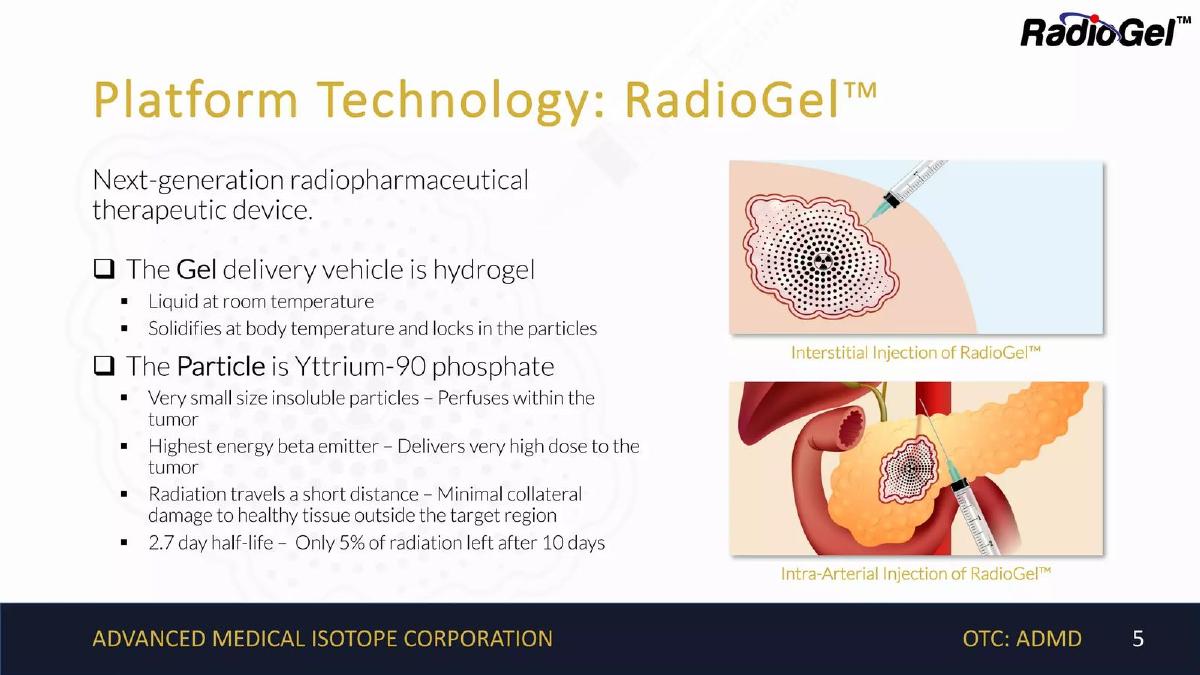
- The company is developing RadioGel, a brachytherapy device using Yttrium-90 phosphate particles in a hydrogel that is liquid at room temperature but solidifies at body temperature (Slide 5).
- AMI targets the veterinary market as an initial revenue source, with sales to private clinics planned to follow testing at research universities (Slide 7).
- The veterinary market opportunity is calculated based on 78 million dogs and 86 million cats in the U.S., projecting $40M in annual revenue by capturing 10% of cases at $5,000 per therapy (Slide 9).
- Human skin cancer projections suggest a $1.5 billion annual revenue potential based on a 10% market share of 3.3 million people at a $5,000 price point (Slide 11).
- The growth strategy follows a phased approach starting with skin cancer, moving to lymph nodes, and eventually targeting liver and pancreatic cancers (Slide 13).
- Intellectual property is secured through a sublicensing agreement with Battelle for eight patents and trademark protection in 17 countries (Slide 15).
- The leadership team relies heavily on a Medical and Scientific Advisory Board featuring chairs from radiology, nuclear science, and veterinary medicine (Slide 17).
- The company intends to uplist from the OTC (ticker: ADMD) to a senior exchange such as NASDAQ or NYSE MKT (Slide 19).
Advanced Medical Isotope Corporation: The RadioGel Strategy
The investor presentation for Advanced Medical Isotope Corporation (AMI), dated August 1, 2017, focuses on the commercialization of RadioGel. The deck is structured to present a high-tech medical solution with a pragmatic, dual-market entry strategy. By addressing both the veterinary and human oncology markets, the company attempts to mitigate the long-lead times typically associated with medical device development.
Slide 1: Title Slide
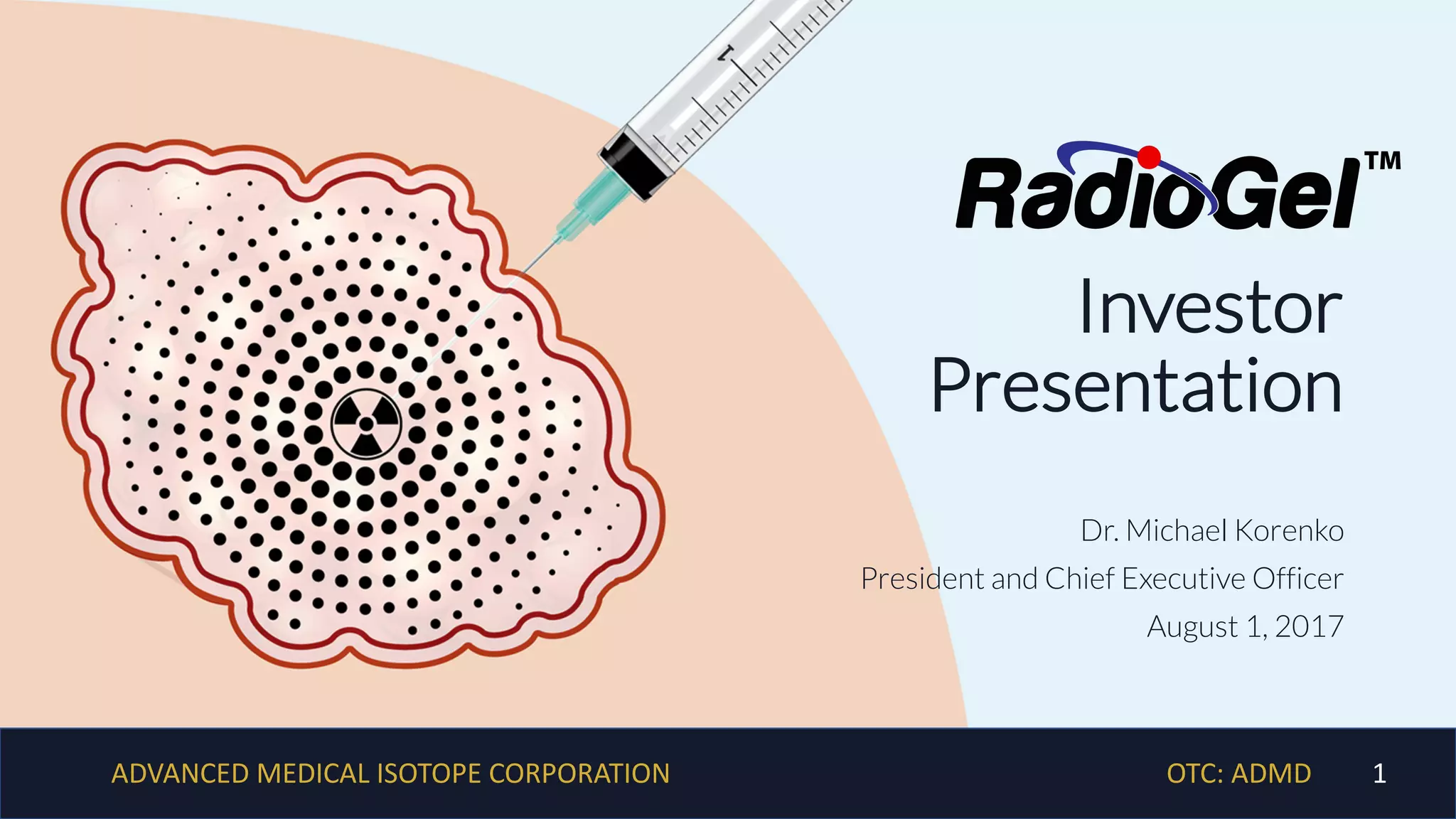
The title slide introduces the product brand, RadioGel, and identifies Dr. Michael Korenko as the President and CEO. It clearly displays the company's OTC ticker, ADMD, establishing its status as a publicly traded entity. The visual includes a medical illustration of a syringe injecting a substance into a cellular mass, immediately signaling the localized nature of the therapy.
Slide 3: Overview and Definitions
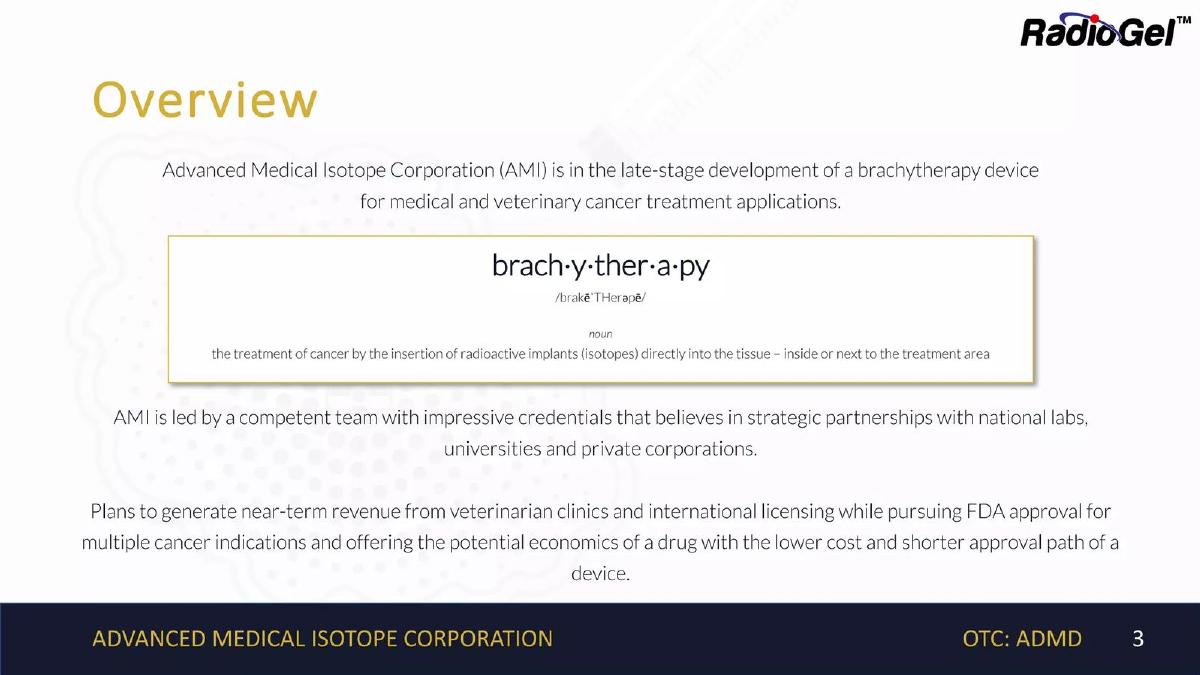
AMI defines itself as a late-stage developer of brachytherapy devices. The slide includes a dictionary-style definition of 'brachytherapy'—the treatment of cancer by inserting radioactive isotopes directly into tissue. This is a helpful inclusion for generalist investors who may not be familiar with oncology terminology. The slide also mentions a strategy involving partnerships with national labs and universities, and it introduces the concept of using the veterinary market for near-term revenue.
Slide 5: Platform Technology: RadioGel
This slide details the technical composition of the product. RadioGel is described as a 'next-generation radiopharmaceutical therapeutic device.' The delivery vehicle is a hydrogel that is liquid at room temperature but solidifies at body temperature. The active component is Yttrium-90 phosphate, a high-energy beta emitter with a 2.7-day half-life. The slide emphasizes that the radiation travels a short distance, which is intended to minimize collateral damage to healthy tissue. Illustrations show both interstitial and intra-arterial injection methods.
Slide 7: Initial Market: Veterinary Applications
AMI outlines a three-step plan for the veterinary market: obtaining approval to test, demonstrating therapies at research universities, and beginning sales to private clinics. This slide serves as the 'Go-to-Market' strategy for the animal health segment, positioning it as the precursor to human applications.
Slide 9: Veterinary Market Opportunity
The company quantifies the pet market, noting 78 million dogs and 86 million cats in the U.S. They state that cancer is the leading cause of death for 50% of dogs over age 10. The financial projection is specific: treating 10% of these cancers with a $5,000 therapy would generate $40 million in annual revenue. The slide sets a target date for revenue to begin by January 2018.
Slide 11: Human Skin Cancer Market Projections
Shifting to human medicine, the deck focuses on Basal Cell and Squamous Cell skin cancers. It cites 5.4 million cases annually in the U.S. across 3.3 million people. Using the same $5,000 price point, AMI projects a $1.5 billion annual revenue opportunity if they capture 10% of the market. They also suggest that international licensing could start generating revenue in early 2018.
Slide 13: Medical Sector Growth Strategy
This slide uses a staggered arrow graphic to show the progression of 'Indications for Use.' The company plans to start with skin cancer, move to lymph nodes, and finally address liver and pancreatic cancers. This 'quantum growth' strategy suggests that the company is starting with the most accessible tumors (skin) to build clinical evidence before moving to internal organs.
Slide 15: Intellectual Property Protection
AMI lists its IP assets, including a sublicensing agreement with Battelle for eight patents. They also mention retained IP counsel, trademark protection in 17 countries, and proprietary production procedures. The slide notes 'all test data' as part of their proprietary IP, which is a standard claim in the pharmaceutical industry where data exclusivity is as important as patent protection.
Slide 17: Medical & Scientific Advisory Boards
The team slide focuses exclusively on advisors rather than the internal executive team (beyond the CEO mentioned on the title slide). It features Dr. Barry D. Pressman (Medical Board Chair), Dr. Alan E. Waltar (Scientific Board Chair), and Dr. Alice Villalobos (Veterinary Board Chair). This is a common tactic for early-stage biotech companies to build credibility through the reputations of established industry experts.
Slide 19: Highlights and Summary
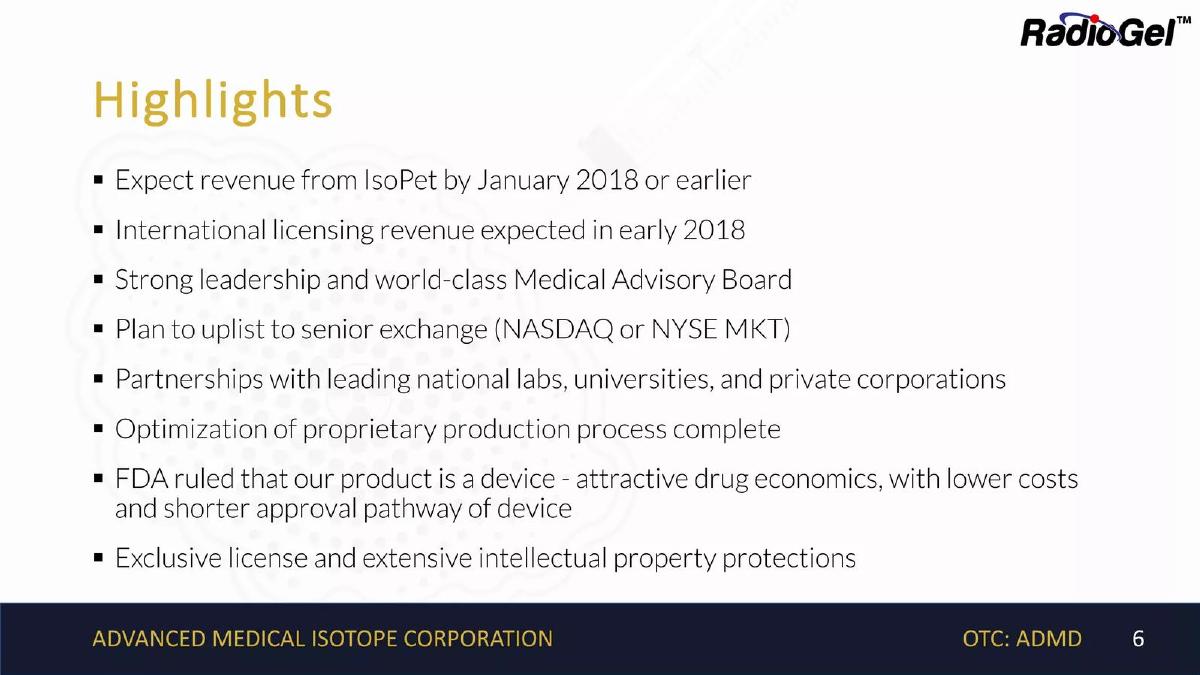
The final provided slide summarizes the investment thesis. It reiterates the January 2018 revenue targets for 'IsoPet' (the veterinary brand) and international licensing. It also explicitly states the company's intention to uplist to a senior exchange (NASDAQ or NYSE MKT). The slide emphasizes the 'attractive drug economics' combined with the 'shorter approval path of a device.'
What AMI Does Well
The deck excels at explaining a complex medical technology in simple terms. By breaking RadioGel down into its two components—the hydrogel vehicle and the Yttrium-90 particle—the founders make the science accessible. The dual-track strategy (Veterinary vs. Human) is a strong business model choice; it shows investors a path to cash flow that doesn't depend entirely on the multi-year, high-risk FDA human trial process. The use of specific revenue projections (10% market share at $5,000 per treatment) gives investors a clear 'unit' to evaluate, even if the 10% penetration assumption is aggressive.
What is Missing from the Deck
The most significant omission is a clear 'Ask.' There is no slide detailing how much capital the company is raising, the valuation, or how the funds will be allocated (Use of Proceeds). Furthermore, while the advisory board is impressive, the deck lacks a slide for the core management team, their history, and their ability to execute the commercialization plan. There is also a lack of competitive landscape analysis; the deck assumes a vacuum where no other brachytherapy or skin cancer treatments exist. Finally, for a company already trading on the OTC, there are no historical financial statements or current burn rate figures provided in the slides.
Founder Takeaways: The 'Device-Drug' Hybrid
Founders in the life sciences space should take note of how AMI positions its product as a 'device' to benefit from a 'shorter approval path' while claiming 'drug economics.' This is a powerful value proposition for investors who are wary of the 10-year timelines of traditional drug development. Additionally, the strategy of using a secondary market (veterinary) to validate a primary market (human) technology is a masterclass in risk mitigation. If you are building a product that requires heavy regulation, finding a 'lower-hurdle' market to prove the technology and generate early revenue is a compelling way to reduce the perceived risk of the venture.
Frequently asked questions
- What is the primary technology being pitched?
- The technology is RadioGel, a next-generation radiopharmaceutical therapeutic device. It consists of Yttrium-90 phosphate particles (a high-energy beta emitter) delivered via a hydrogel vehicle. The gel is designed to be injected as a liquid and then solidify at body temperature, locking the radioactive particles in place within a tumor to minimize collateral damage to healthy tissue.
- How does AMI plan to generate revenue before FDA human approval?
- AMI is pursuing a 'veterinary first' strategy. Because the regulatory path for animal health is often shorter than for human medicine, the company plans to begin sales to private veterinary clinics by January 2018. They also mention international licensing as a near-term revenue stream for human applications in regions with different regulatory requirements.
- What are the specific human medical indications targeted?
- The company has a tiered growth strategy for the medical sector. The initial focus is on Basal Cell and Squamous Cell skin cancers. Subsequent phases target cancers of the lymph nodes, followed by high-complexity targets like the liver and pancreas. This suggests a strategy of moving from superficial to deep-tissue applications as the technology matures.
- What is the status of the company's intellectual property?
- AMI does not own all its patents outright; instead, it has a sublicensing agreement with Battelle that grants rights to eight patents. The deck also claims proprietary intellectual property regarding production procedures, advanced product development (such as resorption time and imaging), and all internal test data, along with trademarks in 17 countries.
- What is the company's current corporate status?
- At the time of the presentation (August 2017), the company was publicly traded on the OTC markets under the ticker ADMD. A key highlight of the deck is their stated plan to 'uplist' to a major exchange like the NASDAQ or NYSE MKT, which usually requires meeting specific share price and financial transparency benchmarks.