The Amity pitch deck from June 2014 is a classic example of category creation within the B2B SaaS ecosystem. At a time when Salesforce dominated the CRM market, Amity identified a gap: traditional CRMs were built for closing deals, not managing the ongoing post-sale relationship. The deck uses a compelling economic model to show how a mere 1% difference in churn can lead to a $9 million swing in revenue over 48 months. While the deck is strong on problem identification and market timing, it lacks a dedicated team slide and specific financial asks in this 9-slide subset. It relies heavily on t…
Key takeaways
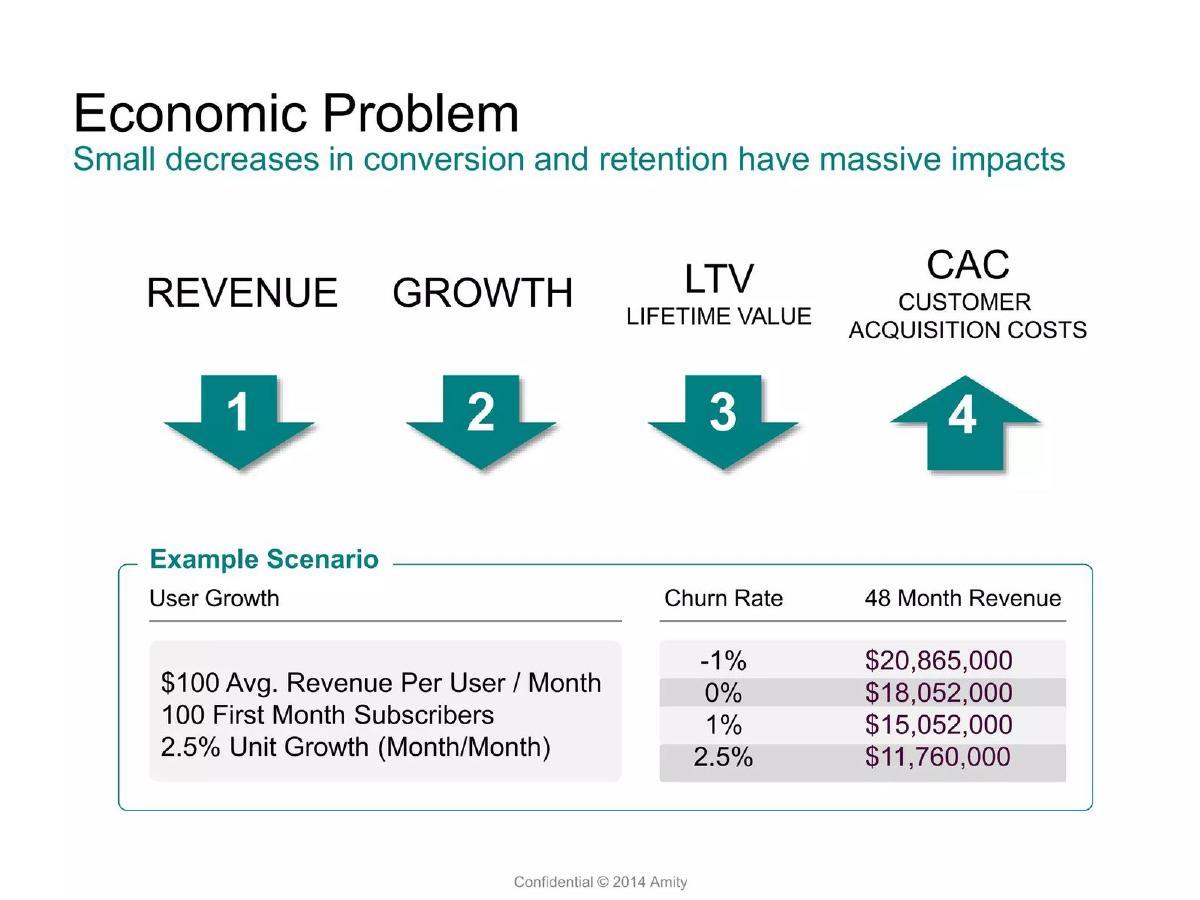
- The deck positions Amity as a solution for the 'Economic Problem' where small changes in retention have massive revenue impacts, citing a $9M difference between 1% and 2.5% churn (Slide 3).
- It directly attacks incumbent CRMs, using a broken Salesforce logo to argue that traditional tools fail to manage trials, onboarding, and renewals (Slide 4).
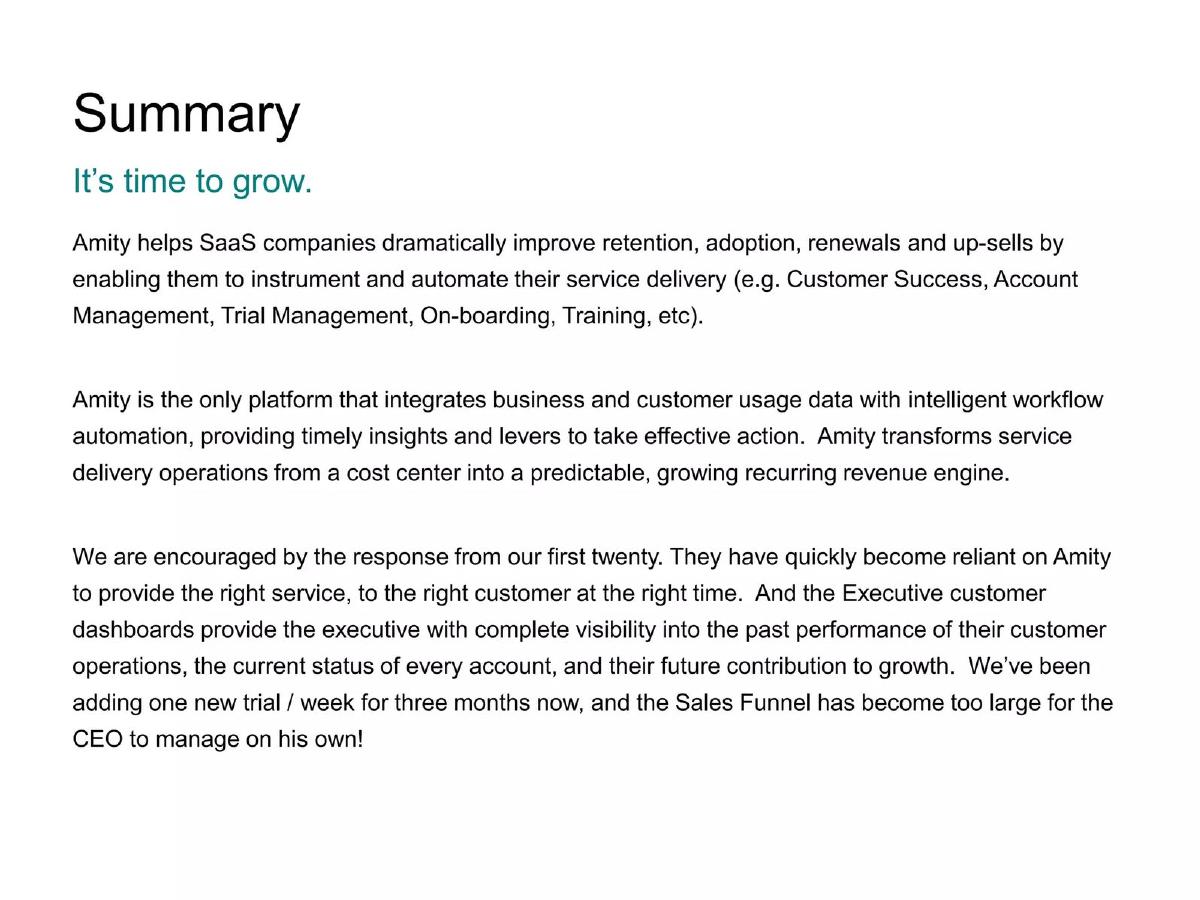
- Amity reports early traction with its 'first twenty' customers and a trial growth rate of one new trial per week for three months (Slide 2).
- The market slide uses Forrester data to show the SaaS market growing from $33B in 2012 to a projected $93B by 2016 (Slide 6).
- The product is presented through four core pillars: Customer Dashboard, Portfolio Dashboard, Automated Workflows, and Reporting (Slide 5).
- Pricing is tiered into three segments: PersonalHub ($49/user/mo), PowerHub ($99/user/mo), and TeamHub ($199/user/mo) (Slide 7).
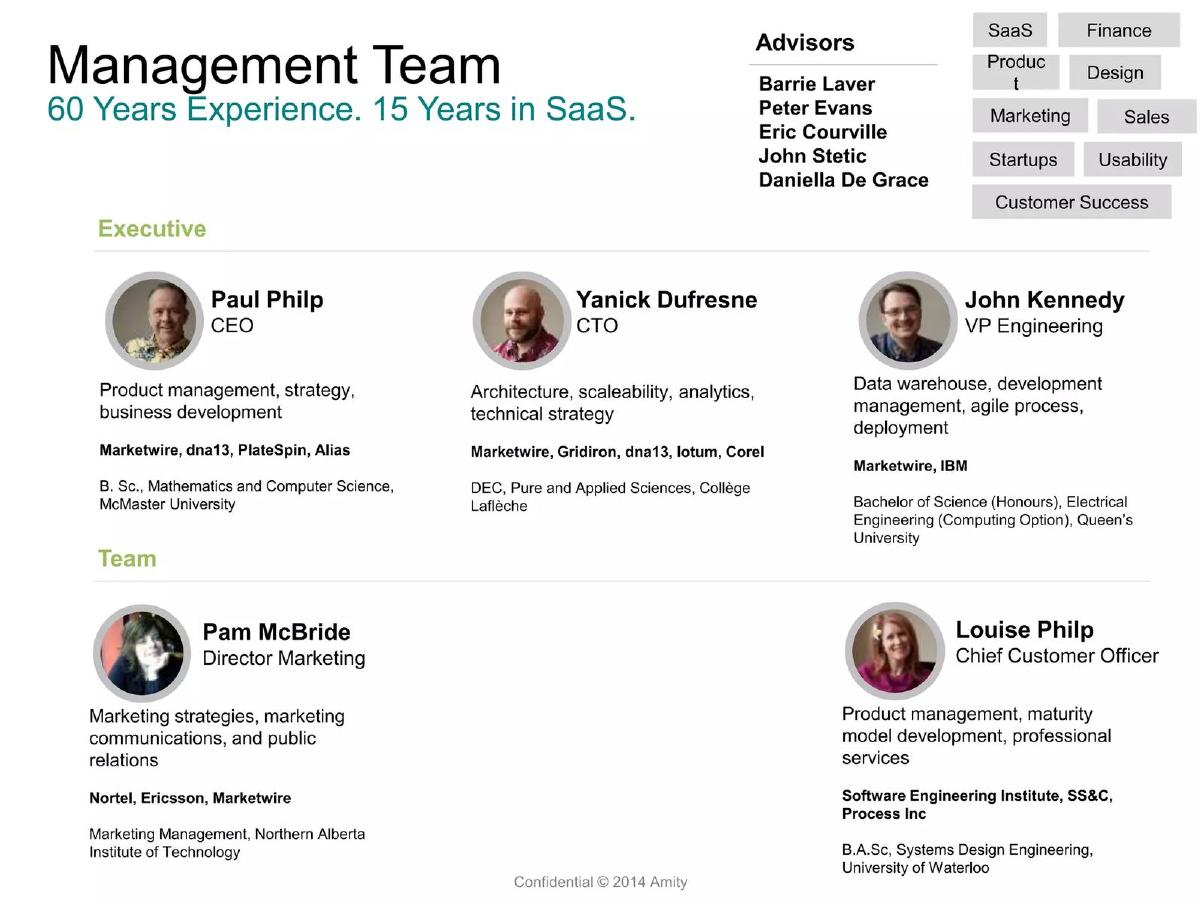
- The deck lacks a team slide, a specific funding ask, and a detailed roadmap in the provided 9-slide sequence.
- Competitive advantage is summarized as being the 'world's first automated service delivery platform' focusing on workflow, intelligence, and automation (Slide 8).
Introduction and Summary
Slide 1: Title Slide
The title slide establishes Amity as "The single platform to manage the entire SaaS customer lifecycle." It features a clean logo and a high-fidelity product mockup on a desktop monitor. The presentation is dated June 2014 and identifies Paul Philp as the Founder & CEO. The visual design is professional, utilizing a teal and white color palette that was standard for enterprise SaaS in the mid-2010s.
Slide 2: Summary
Slide 2 provides a text-heavy executive summary. It claims Amity helps SaaS companies improve retention, adoption, renewals, and up-sells. A key technical differentiator mentioned is the integration of "business and customer usage data with intelligent workflow automation." The slide also notes early traction: twenty initial customers who have become "reliant on Amity," and a growth rate of "one new trial / week for three months." Notably, it mentions the sales funnel has become too large for the CEO to manage alone, signaling a need for scale.
The Problem and Market Opportunity
Slide 3: Economic Problem
This is the strongest analytical slide in the deck. It uses a table to demonstrate how "small decreases in conversion and retention have massive impacts." By comparing churn rates ranging from -1% to 2.5%, Amity shows a 48-month revenue variance of over $9 million. This slide effectively moves the conversation from a "nice-to-have" tool to a financial necessity for any SaaS CFO. It quantifies the cost of inaction.
Slide 4: Business Problem
Slide 4 takes a direct shot at the market leader, Salesforce. It features a graphic of the Salesforce cloud logo literally cracked in half with the text "CRM is Broken for the SaaS Customer Lifecycle." Below the broken logo are several icons representing Trials, Onboarding, Subscription, Customer Success, Renewals, and Land and Expand—all marked with red "prohibited" symbols. The message is clear: the current tools (CRMs) are built for the initial transaction, not the recurring relationship.
Slide 6: The SaaS Market is Growing Rapidly
To justify the opportunity, Amity cites Forrester data showing the growth of the Global Public Cloud Market. The chart highlights the SaaS segment specifically, showing it growing from $33B in 2012 to a projected $92.75B in 2016 (and $132.57B by 2020). By labeling this as "Entering the tornado now," the deck uses Geoffrey Moore’s terminology to suggest that the market is in a period of hyper-growth where category leaders are established.
The Solution and Product
Slide 5: Amity Solution
This slide showcases the product interface through four angled screenshots. It categorizes the platform's utility into four buckets: Customer Dashboard (individual account views), Portfolio Dashboard (aggregate views for management), Automated Workflows (the engine for service delivery), and Reporting (data visualization). While the screenshots are small, they convey a sense of product maturity and a data-rich environment.
Slide 7: Pricing Model
Amity presents a transparent, three-tiered pricing strategy. The PersonalHub ($49/user/mo) focuses on churn minimization and basic integrations (Gmail, Support Desk, CRM). The PowerHub ($99/user/mo) targets conversion with usage tracking and health dashboards. The TeamHub ($199/user/mo) is the premium offering for maximizing LTV through collaboration and portfolio-wide monitoring. This structure suggests a bottom-up adoption model within Customer Success teams.
Competitive Landscape and Conclusion
Slide 8: Competitive Advantage
Rather than a standard feature-comparison grid, Amity uses a Venn diagram of "Intelligence," "Workflow," and "Automation." The slide lists several claims, including being the "World’s first automated service delivery platform built for the B2B 2.0 era." It emphasizes that Amity "solved the hard problem first – workflow." This positioning suggests that competitors might have data (intelligence) but lack the ability to act on it automatically (workflow/automation).
Slide 9: Thank You
The final slide is a standard contact page. It repeats the Founder & CEO’s contact information and the company logo. It maintains the "Confidential © 2014 Amity" footer seen throughout the deck.
What Works and What is Missing
What Works
The Economic Argument: Slide 3 is a masterclass in showing the ROI of a tool. By using a concrete example of how churn affects the bottom line over four years, the founders make a compelling case for why a company must invest in retention software. · Clear Positioning: The deck does not shy away from naming the problem. By calling out the limitations of CRM, Amity carves out a specific niche in the "post-sale" environment. · Market Timing: Using the "tornado" metaphor alongside Forrester data effectively communicates that the SaaS market is large enough to support specialized sub-verticals like Customer Success.
What is Missing
The Team: In the provided 9-slide set, there is no team slide. For a 2014 startup, investors would want to see the technical and domain expertise of the founders, especially given the claim of "Unique solution expertise" on Slide 8. · The Ask: There is no mention of how much money is being raised, the valuation, or the specific milestones the company intends to hit with the new capital. · Unit Economics: While the pricing is clear, the deck does not show the company's own CAC (Customer Acquisition Cost) or LTV (Lifetime Value), only theoretical examples for their customers. · Roadmap: The deck focuses on what the product does now but offers little vision for where the platform goes in 3-5 years, other than a brief mention of "future mining" of big data.
Founder Takeaways
Founders should emulate Amity's use of quantifiable problem slides . If your software saves money or increases revenue, do not just say it—model it. The table on Slide 3 is far more persuasive than a bullet point saying "we reduce churn." Additionally, the use of a tiered pricing slide in a pitch deck is a bold move that shows the founders have a clear understanding of their unit economics and target segments. However, founders must ensure they include a Team slide to build trust and an Ask slide to give investors a clear path to action.
Frequently asked questions
- What is the core value proposition of Amity according to the deck?
- Amity positions itself as the single platform to manage the entire SaaS customer lifecycle. Its primary goal is to transform service delivery from a cost center into a predictable recurring revenue engine. It achieves this by integrating business and customer usage data with intelligent workflow automation to improve retention, adoption, and renewals.
- How does Amity justify the need for a new software category?
- The deck argues that CRM is 'broken' for the SaaS lifecycle. Slide 4 illustrates that while CRMs handle the initial sale, they fail to address trials, onboarding, subscriptions, customer success, renewals, and expansion. By showing a broken Salesforce logo, Amity suggests that a specialized tool is required for post-sale management.
- What specific metrics does the deck use to show the impact of churn?
- On Slide 3, Amity provides an example scenario of a company with $100 ARPU and 2.5% monthly unit growth. It shows that at a -1% churn rate, 48-month revenue hits $20,865,000, whereas at a 2.5% churn rate, that revenue drops to $11,760,000. This $9.1M gap serves as the primary economic justification for the platform.
- What is Amity's go-to-market and pricing strategy?
- Amity utilizes a tiered SaaS pricing model. The 'PersonalHub' at $49/user/mo targets individual professionals. The 'PowerHub' at $99/user/mo adds usage tracking and health dashboards. The 'TeamHub' at $199/user/mo is designed for teams, offering collaboration tools and portfolio dashboards. This suggests a land-and-expand strategy starting with individual contributors.
- What are the most notable omissions in this pitch deck?
- The provided slides do not include a team slide, which is critical for early-stage fundraising to establish founder-market fit. Additionally, there is no 'Ask' slide detailing how much capital is being raised or how it will be deployed. The deck also lacks a detailed competitor matrix, opting instead for a high-level Venn diagram of advantages.