Green Li-ion’s pitch deck focuses on the massive economic opportunity within the lithium-ion battery (LIB) recycling market, projecting the value of scrapped LIBs to reach $100B by 2040 (Slide 3). The core value proposition is a technological leap that allows the company to bypass traditional supply chain intermediaries, such as refineries and cathode manufacturers, to produce battery-grade materials directly from black mass (Slide 8). By claiming a 4x increase in profitability and a 10x improvement in efficiency (Slide 5), the deck targets the pain points of current hydro and pyro processes.…
Key takeaways
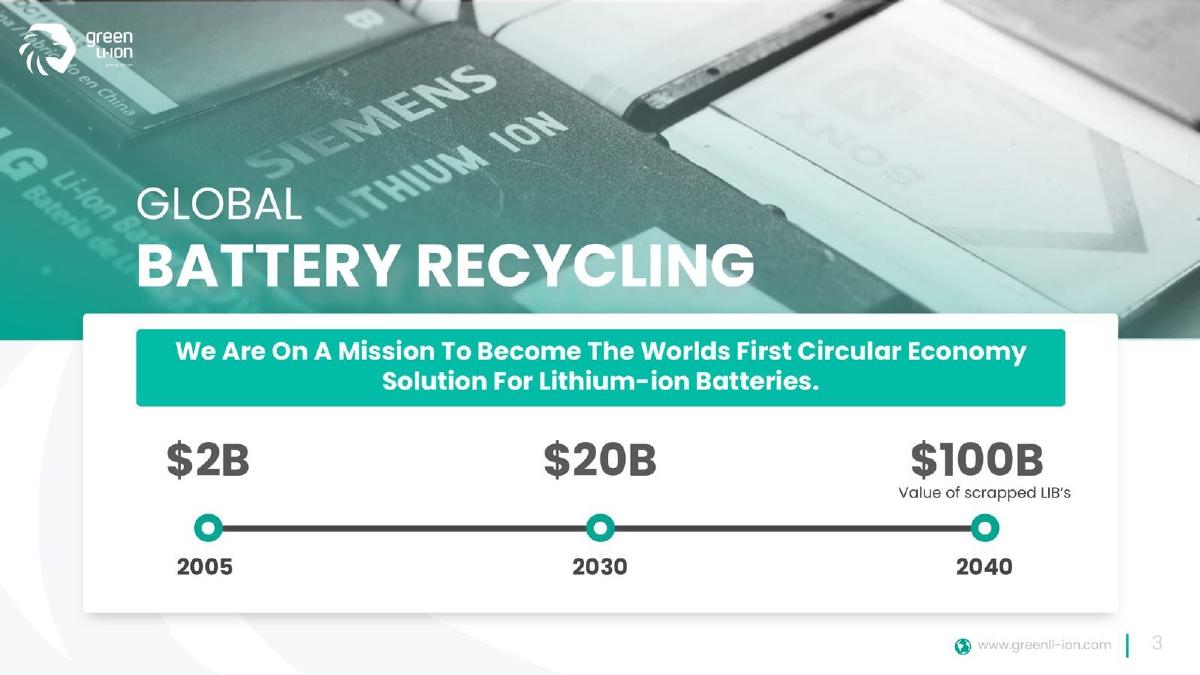
- The market for scrapped lithium-ion batteries is projected to grow from $2B in 2005 to $100B by 2040 (Slide 3).
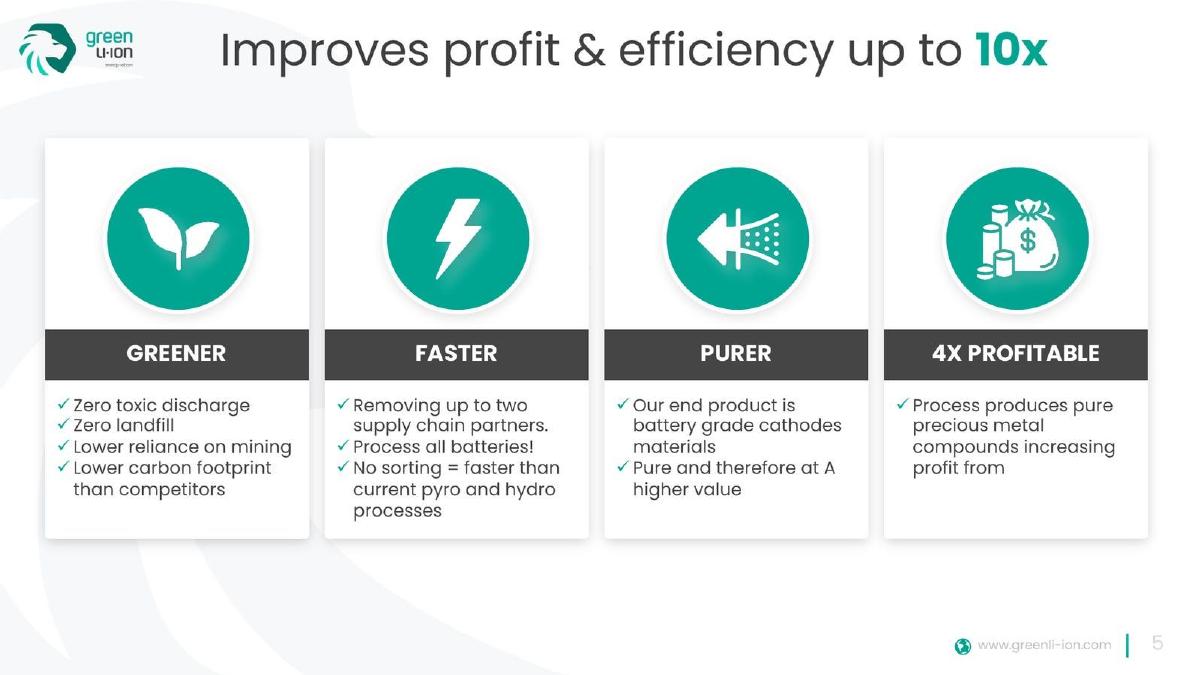
- Green Li-ion claims its process is 4x more profitable than traditional methods by producing pure precious metal compounds (Slide 5).
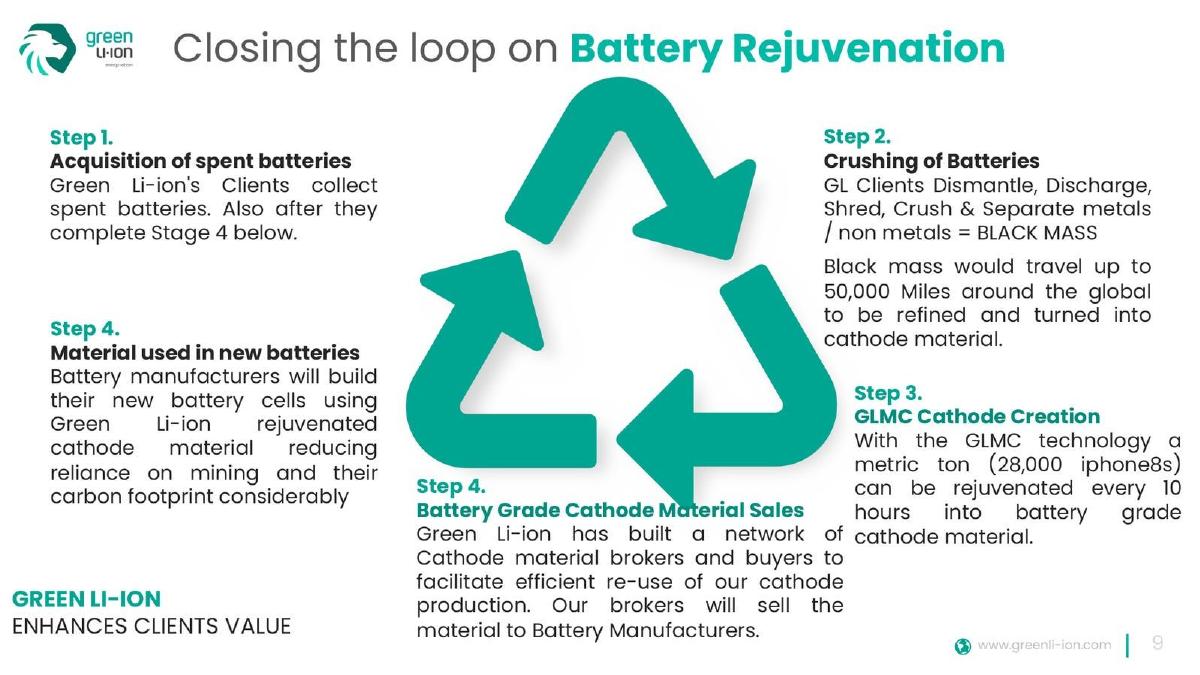
- The technology removes up to two supply chain partners by converting black mass directly to battery-grade cathode material (Slide 8).
- The solution is chemistry-agnostic, capable of rejuvenating 100% of Li battery chemistries including LCO, LMO, NMC, LFP, NCA, and LTO (Slide 10).
- CTO Dr. Reza Katal holds a PhD from the National University of Singapore and 10 years of experience in hydrometallurgical processing (Slide 20).
- The deck highlights significant industry recognition, including Microsoft's Global Social Entrepreneurs award and SOSV's Climate Tech 100 (Slide 20).
- The company is headquartered in Singapore, as indicated by the contact information on the final slide (Slide 24).
- Despite the successful $11.6M raise, the provided slides contain no specific financial 'Ask' or use-of-funds breakdown.
Green Li-ion: Scaling the Circular Battery Economy
Green Li-ion’s pitch deck for their $11.6M Series A round is a focused, technical, and market-driven presentation. As reported by Business Insider, the company successfully raised these funds in 2024 to further their mission in the hardware and battery recycling sector. Headquartered in Singapore, the company leverages a high-tech approach to a growing environmental crisis: battery waste. The deck is structured to move from the macro market opportunity to the specific technical disruption, concluding with the strength of the founding team.
Slide 1: Title and Vision
The opening slide introduces the Green Li-ion branding with the tagline "energy reborn." It explicitly states their position as "The Circular Economy Solution for Batteries." The visual of a glowing lithium-ion battery reinforces the focus on energy storage and sustainability. This slide sets a professional, industrial tone suitable for a hardware-heavy Series A pitch.
Slide 3: The $100B Market Opportunity
Slide 3 establishes the "Why Now?" for investors. It presents a timeline of the global battery recycling market. In 2005, the market was a modest $2B. By 2030, it is projected to hit $20B. The most striking figure is the $100B valuation for scrapped lithium-ion batteries (LIBs) by 2040. By framing the mission as becoming the "World's First Circular Economy Solution," Green Li-ion positions itself at the forefront of a massive, inevitable industrial shift.
Slide 5: Value Proposition and Efficiency
This slide breaks down the competitive advantages into four pillars: Greener, Faster, Purer, and 4X Profitable. The company claims to improve profit and efficiency up to 10x . Key technical claims include:
Greener: Zero toxic discharge and zero landfill. · Faster: Removing up to two supply chain partners and requiring no sorting of batteries. · Purer: Producing battery-grade cathode materials at a higher value. · 4X Profitable: Increasing profit by producing pure precious metal compounds.
This slide is critical because it addresses the two most important factors for industrial investors: environmental compliance and bottom-line profitability.
Slide 8: Disrupting the Supply Chain
Slide 8 is the most important slide for understanding the business model. It compares "Current Recycling" to "Green Li-ion." The current process is a five-step journey involving battery recyclers, refineries (like Tanaka or SK), and cathode manufacturers (like Sumitomo) before reaching battery manufacturers (like Panasonic or LG). Green Li-ion uses a red "X" to show they eliminate steps 3 and 4. Their process takes Black Mass (Step 2) and converts it directly into Battery Grade Cathode material (Step 3 in their model). This vertical integration is the core of their "4x Profitable" claim, as it captures the margins usually lost to mid-stream processors.
Slide 10: Technical Versatility
A common risk in battery tech is chemistry obsolescence. Slide 10 mitigates this by showing that Green Li-ion can rejuvenate 100% of Li Battery Chemistries . The slide provides a detailed table covering LCO, LMO, NMC, LFP, NCA, and LTO. It lists the specific cathode and anode materials for each, their applications (from mobile phones to Tesla electric powertrains), and the resulting recycling products. This demonstrates that their hardware is a platform, not a single-use tool, making it a safer long-term bet for investors.
Slide 20: The Founders and Recognition
The team slide focuses on the two pillars of the company: technical expertise and commercial leadership. Dr. Reza Katal (CTO) is highlighted for his PhD from the National University of Singapore and 10 years of hydrometallurgical experience. Leon Farrant (CEO) is presented as an experienced leader with 15 years in the energy industry. The right side of the slide is crowded with "Recognition" logos, including Microsoft, HSBC, and Business Insider. Notable awards include being a Global Winner of Urban Champions 2021 and a member of SOSV’s Climate Tech 100. This slide serves to de-risk the investment by showing that the founders are both qualified and externally validated.
Slide 24: Contact and Call to Action
The final slide is a standard contact page. It provides a Singapore address (46 Kim Yam Road), a phone number, and an email address for Leon Farrant. The imagery of a handshake reinforces the goal of the deck: to initiate a partnership or investment deal.
What Green Li-ion Does Well
The deck excels at visualizing disruption . Slide 8 is a masterclass in showing how a new technology changes the economics of an entire industry. By literally crossing out competitors and intermediaries, they make the value of their IP immediately obvious. Furthermore, the deck avoids overly dense scientific jargon in the early slides, opting instead for clear, bold claims like "4X Profitable" and "10x Efficiency." This allows the investor to buy into the business case before diving into the chemistry table on Slide 10.
What is Missing from the Deck
While the deck is strong on vision and technology, it is notably thin on financials and the specific 'Ask.' There is no slide detailing the current revenue, the cost per unit of their machines, or the projected ROI for a recycling plant using their technology. Additionally, the $11.6M raise mentioned in publisher reports is not detailed within these slides—there is no breakdown of how that capital will be deployed (e.g., R&D, manufacturing scale-up, or international expansion). The absence of a competitor landscape beyond the supply chain chart is also a gap; while they show how they bypass refineries, they don't explicitly name other startups attempting similar direct-to-cathode recycling.
Founder Takeaways
1. Visualize the Supply Chain: If your startup removes steps from a process, use a diagram like Slide 8. It is the fastest way to communicate how you create value. 2. Address Obsolescence Early: In fast-moving industries like EV batteries, show that your solution is flexible. Slide 10’s chemistry table proves the company isn't tied to a single, potentially dying battery type. 3. Leverage Third-Party Validation: If you have won awards or been part of prestigious accelerators (like SOSV), dedicate space to those logos. In the early stages, external credibility can be just as important as internal metrics.
Frequently asked questions
- What is the primary market opportunity identified by Green Li-ion?
- Green Li-ion identifies a massive surge in the value of scrapped lithium-ion batteries. According to Slide 3, the market was valued at $2B in 2005, is expected to reach $20B by 2030, and will balloon to $100B by 2040. They position themselves as the first circular economy solution to capture this value efficiently.
- How does Green Li-ion's technology differ from current recycling methods?
- Traditional recycling involves a five-step process including black mass production, refinement at refineries, and cathode manufacturing. Green Li-ion disrupts this by moving directly from black mass to battery-grade cathode material in a single step (Slide 8), eliminating the need for external refineries and cathode manufacturers like Tanaka or Sumitomo.
- What battery chemistries can the company process?
- The company claims to be able to rejuvenate 100% of lithium battery chemistries. Slide 10 lists specific compatibility with Lithium Cobalt Oxide (LCO), Lithium Manganese Oxide (LMO), Lithium Nickel Manganese Cobalt Oxide (NMC), Lithium Iron Phosphate (LFP), Lithium Nickel Cobalt Aluminum Oxide (NCA), and Lithium Titanate (LTO).
- Who are the founders and what is their background?
- The company was founded by Dr. Reza Katal (CTO) and Leon Farrant (CEO). Dr. Katal has a PhD from the National University of Singapore and a decade of experience in hydrometallurgy. Leon Farrant brings 15 years of leadership experience in the global energy industry and holds an MBA (Slide 20).
- What are the specific environmental benefits claimed in the deck?
- Slide 5 outlines four 'Greener' benefits: zero toxic discharge, zero landfill, lower reliance on mining, and a lower carbon footprint compared to competitors. This is achieved through their 'energy reborn' process which focuses on rejuvenation rather than just destructive recycling.