Green Endeavors, an OTC-listed company (GRNE), utilizes this 2016 investor presentation to outline a two-stage capital raise totaling $11.2 million. The strategy is built on acquiring established, high-revenue salons (averaging $7.5 million annually) and applying the 'Qnity' operating system to improve margins and retention. The deck highlights a specific acquisition target, Landis, which grew EBITDA by 177% between FY15 and FY16. With a focus on 'baby boomer' owners seeking exits, the company projects a combined revenue of $38.4 million by 2020 through the acquisition of four targets and the…
Key takeaways
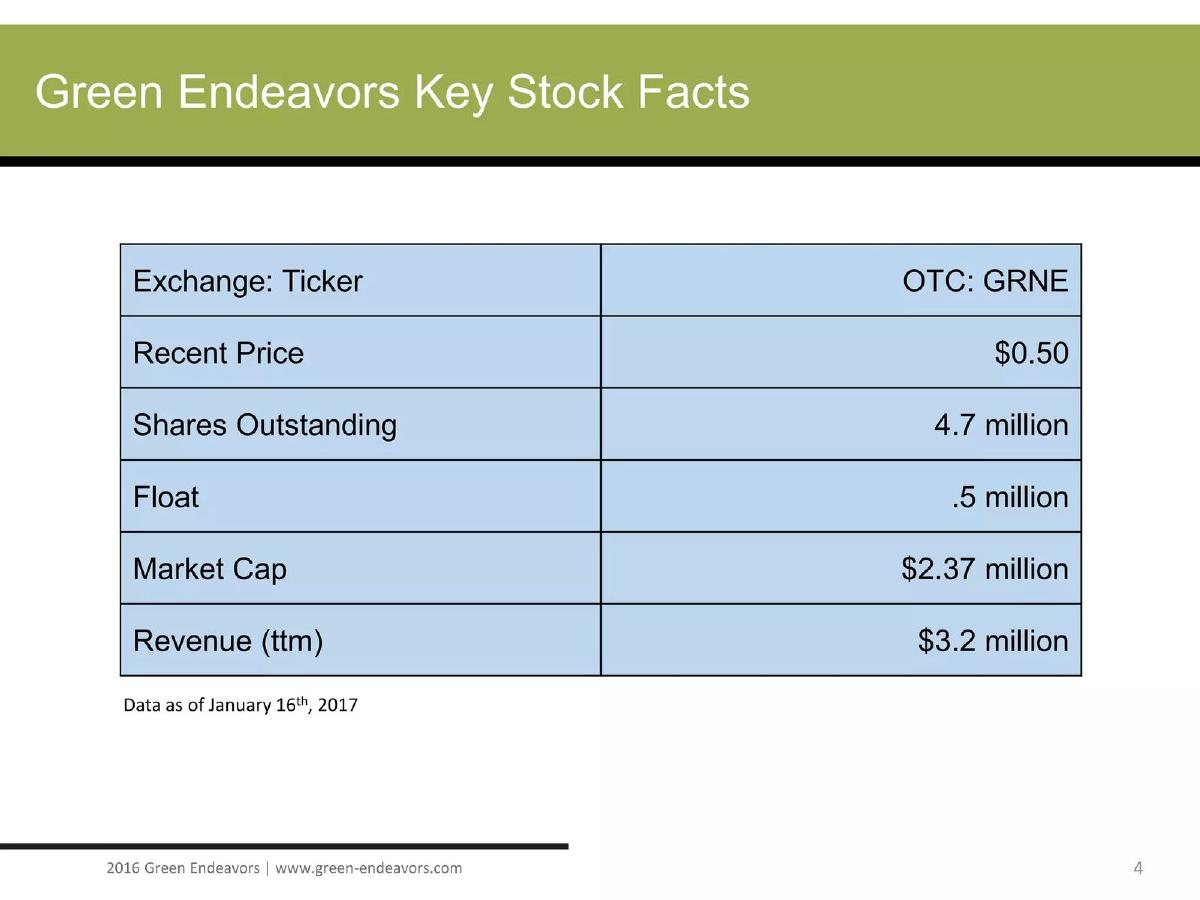
- The company is publicly traded on the OTC market under the ticker GRNE with a market cap of $2.37 million as of November 2016 (Slide 4).
- The leadership transition focuses on Tom Kuhn, a former CPA and CFO with 35 years of industry experience, as the CEO candidate for GRNE (Slide 7).
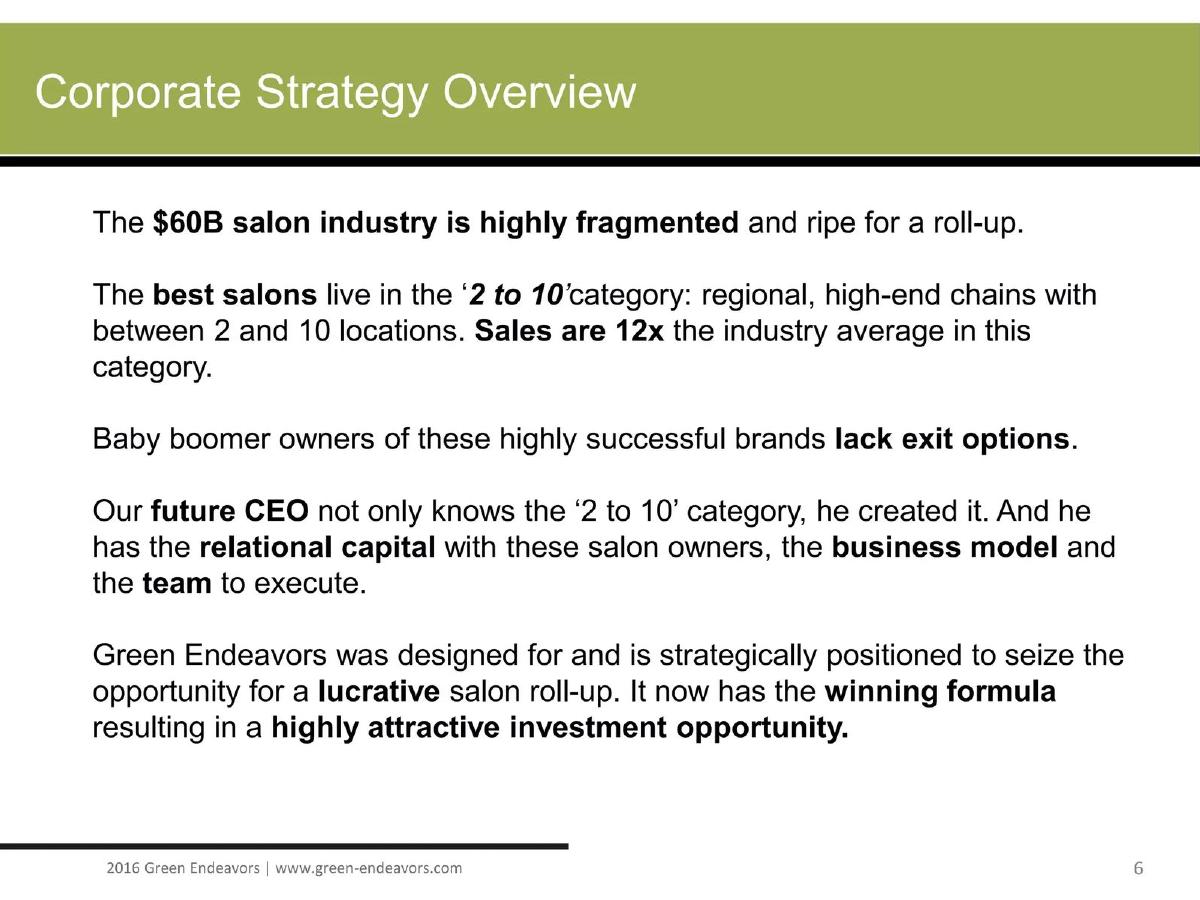
- The roll-up strategy targets salons with 2 to 10 locations and an average annual revenue of $7.5 million (Slide 16).
- A two-tiered funding ask is defined: a $1.2M bridge loan for the first two acquisitions, followed by a $10M round to scale (Slide 19).
- The 'Qnity' program is the core value-add, claiming to yield 2x-3x normal sales growth for participating stylists (Slide 13).
- Historical performance for the 'Landis' asset shows a shift from a $208k EBITDA loss in FY15 to a $161k profit in FY16 (Slide 22).
- Pro forma projections estimate that by FY20, the combined entity will reach $38.4 million in revenue with a 12.7% EBITDA margin (Slide 28).
- The investment thesis relies on the lack of technological obsolescence and foreign competition in the salon service industry (Slide 10).
Executive Summary and Market Position
Green Endeavors, Inc. (OTC: GRNE) presents an investor deck dated November 2016 that outlines a consolidation strategy within the professional hair salon industry. The presentation establishes the company as a publicly traded entity on the OTC market, providing immediate transparency regarding its valuation and share structure. The core thesis is built on the fragmentation of the salon market and the opportunity to acquire high-performing, independent salon groups from retiring baby boomers.
Slide 4: Key Stock Facts
This slide provides a snapshot of the company's public standing as of November 16, 2016. It lists the ticker as OTC: GRNE with a recent price of $0.50 . The company reports 4.7 million shares outstanding and a relatively tight float of .5 million . The market capitalization is stated at $2.37 million , supported by a trailing twelve-month (ttm) revenue of $3.2 million . This slide is essential for public market investors to understand the liquidity and current valuation baseline before diving into the growth projections.
Slide 7: Key Leadership
The leadership slide focuses heavily on Tom Kuhn , identified as the CEO of Qnity and the 'CEO candidate for GRNE.' The slide details his 35 years of experience, specifically highlighting his role as the former President, COO, and Co-Owner of JUUT Salonspa , which grew to 8 locations and $24+ million in revenue . His background as a former CPA and CFO is emphasized to reassure investors of his financial management capabilities. The inclusion of a link to a 'visual bio' suggests a focus on transparency and personal branding within the industry.
Slide 10: Investment Highlights
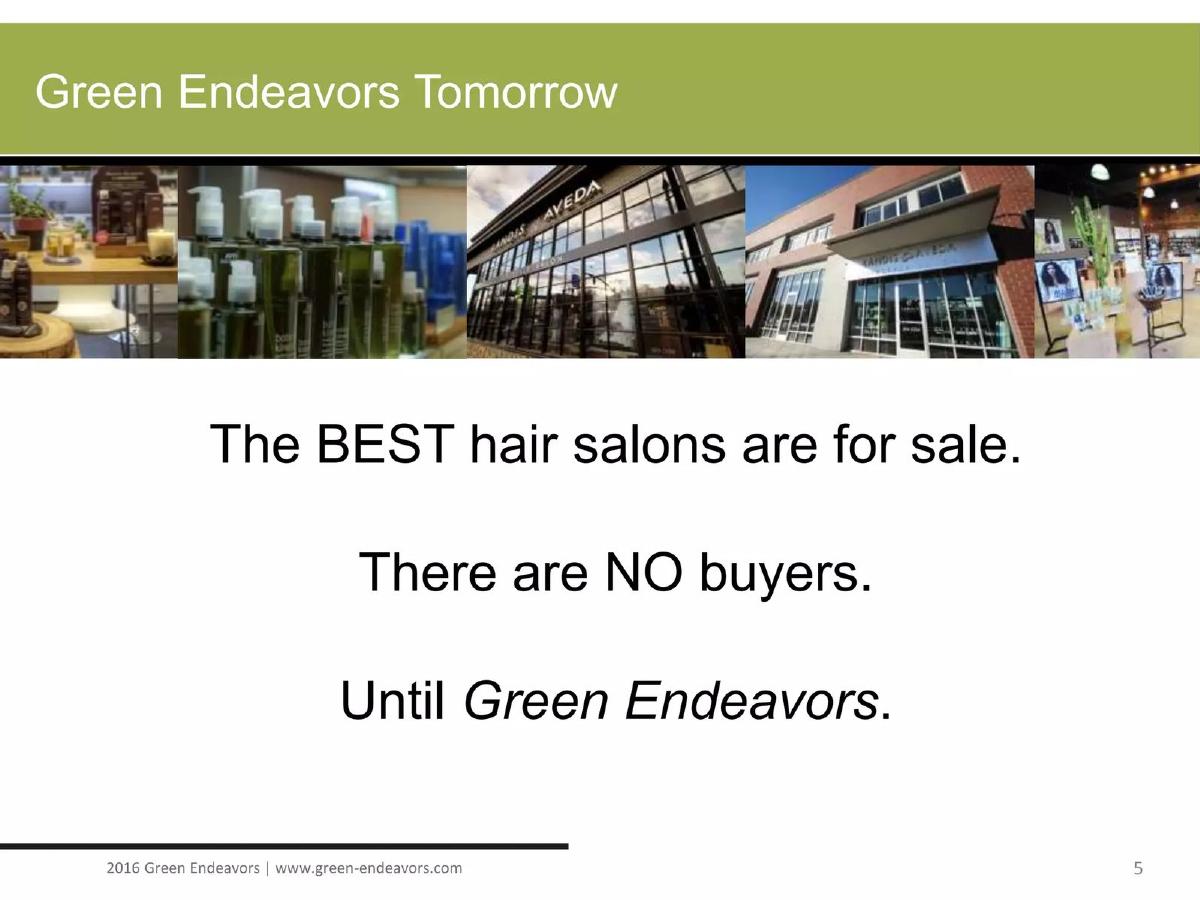
Green Endeavors categorizes its investment appeal into three buckets: timing, risk mitigation, and growth. They note a 'lack of viable buyers' for retiring baby boomer salon owners, which creates favorable valuations for GRNE. The deck argues that the salon industry has 'fewer risk factors' because it is a 'predictable, replenishment business' with no threat of technological obsolescence or foreign competition . This is a classic defensive industry play, positioned here as a stable foundation for a roll-up strategy.
Slide 13: Qnity – The Operating System
This slide introduces Qnity , the proprietary 'turnkey operating system' that GRNE intends to deploy across its acquisitions. The slide claims that the Qnity program yields 2x-3x normal sales growth and that 32% of participants earn 17%+ sales growth . By positioning Qnity as a way to solve 'gaps' in engagement and execution, the company attempts to move beyond a simple holding company model toward an operationally integrated firm. The 'Result' section emphasizes a culture that is 'heart-centered AND performance driven.'
Slide 16: Target Salon Acquisition Profile
The company provides specific guardrails for its M&A activity. Targets must have 2 to 10 locations and an average of $7.5M in annual revenue (with a $4.5M floor). They are specifically looking for non-franchise, employee-based salons with commission pay structures. This specificity is a strength of the deck, as it demonstrates a disciplined approach to growth rather than a 'buy anything' mentality. The mention of the '2 to 10 Project' suggests an existing pipeline or community of salons that fit this exact criteria.
Slide 19: Capital Raise Strategy
The funding request is split into two phases. First, a $1.2M Bridge to assemble the team and secure the first two acquisitions: Qnity (Q4 2016) and Target 1 (Q1 2017). Second, a $10M Raise to 'take out' the bridge and fund three additional targets through Q2 2018. This roadmap provides a clear timeline for investors to track progress and understand how their capital will be deployed in stages.
Slide 22: Historical Financial Performance (Landis)
Using 'Landis' as a case study, this slide shows the impact of management changes. While revenue grew by a modest 10% (from $3.031M to $3.329M), the EBITDA improved by 177% , moving from a ($208k) loss in FY15 to a $161k profit in FY16. The 15% reduction in operating expenses is the key driver here, demonstrating the company's ability to trim fat and reach profitability in a relatively short timeframe.
Slides 25 & 28: Pro Forma Performance (2017 & 2020)
These slides project the future of the consolidated entity. For FY17 , the company projects a combined revenue of $23.4 million with an EBITDA of $2.49 million (10.6% margin) . By FY20 , the projections scale to $38.4 million in revenue and $4.86 million in EBITDA (12.7% margin) . The tables break down the contribution of each target (Landis, Targets 1-4, and Qnity), showing that the bulk of the growth is expected to come from the successful integration of Target 2, which is projected to contribute $14M in revenue by 2020.
What Green Endeavors Does Well
The deck is exceptionally clear about its acquisition criteria . By defining the revenue floor ($4.5M) and the location count (2-10), they signal to investors that they are not wasting time on 'lifestyle' businesses that lack scale. Furthermore, the Landis case study provides empirical evidence that their management interventions work. Showing a swing from negative to positive EBITDA is often more persuasive than showing a company that was always profitable, as it highlights the 'value-add' of the parent company.
The two-stage capital raise is also a pragmatic approach. It allows the company to prove the model with a smaller amount of bridge capital before asking for the larger $10M check. This de-risks the investment for later-stage participants and provides a clear set of milestones for the management team to hit.
What is Missing from the Deck
The most glaring omission is a detailed breakdown of the 'Target' pipeline . While they describe the profile of the targets, they do not indicate how many salons are currently in due diligence or under LOI. For a roll-up strategy, the 'deal flow' is as important as the operating model. Without a named pipeline, the $10M raise feels speculative.
Additionally, there is no mention of the competitive landscape for acquisitions. If these baby boomer owners are looking to exit, are there other private equity firms or larger salon chains (like Regis) bidding for them? The deck assumes a 'lack of viable buyers,' but does not provide data to support why GRNE is the preferred exit partner over a local competitor or a national franchise.
Finally, the unit economics of a single location are not detailed. While we see the 'Landis' aggregate numbers, we don't see the 'per chair' or 'per stylist' metrics that would allow an investor to benchmark these salons against industry standards.
Founder Takeaways: What to Copy
Specific Acquisition Profiles: If you are pitching a roll-up or a platform play, follow Slide 16’s lead. Don't just say 'we buy salons'; say exactly what kind, what size, and what revenue bracket. · Bridge to Scale: Slide 19’s phased funding approach is a great way to handle large capital needs. It shows you are thinking about milestones and valuation inflection points. · Operational 'Secret Sauce': The Qnity slides (13 and others) show that the company isn't just a bank; it has a proprietary method for improving the assets it buys. Every roll-up needs an 'internal consulting' arm to justify the consolidation. · Public Market Context: For OTC or micro-cap companies, Slide 4 is a mandatory inclusion. It sets the stage for the 'why now' by showing the current market cap relative to the revenue and the proposed growth.
Frequently asked questions
- What is the primary business model of Green Endeavors?
- Green Endeavors operates as a roll-up play in the hair salon industry. They identify 'entrepreneurial, non-franchise' salons that are regional leaders, acquire them, and then implement a proprietary operating and educational system called Qnity to increase sales growth and staff retention. The goal is to consolidate a fragmented market where aging owners are looking for exit strategies.
- How much capital is Green Endeavors seeking and what is the use of proceeds?
- According to slide 19, the company is seeking a total of $11.2 million. This is broken down into a $1.2 million bridge loan to secure the Qnity acquisition in Q4 2016 and a first salon target in Q1 2017. This is followed by a $10 million raise to take out the bridge loan and fund four additional salon acquisitions through 2018.
- What are the specific criteria for their acquisition targets?
- Slide 16 outlines a very specific profile: salons must have between 2 and 10 locations, average $7.5 million in annual revenue (minimum $4.5 million), be employee-based with a commission pay structure, and possess a management team likely to stay post-acquisition. They specifically avoid franchise models, focusing instead on independent regional brands.
- What is 'Qnity' and why is it central to the pitch?
- Qnity is a training and coaching firm that Green Endeavors intends to acquire and use as its internal 'turnkey operating system.' Slide 13 claims the program yields 2x-3x normal sales growth and helps close gaps in engagement and execution. By owning the training platform, GRNE intends to standardize performance across all acquired salon locations to ensure consistent margins.
- What does the financial track record look like for their existing assets?
- The deck uses 'Landis' as the primary case study on slide 22. Between FY15 and FY16, Landis saw a 10% increase in revenue to $3.329 million. More significantly, operating expenses were reduced by 15%, allowing the asset to swing from a 6.9% EBITDA loss to a 4.8% EBITDA profit, representing a 177% improvement in EBITDA.