Green Drinking presents a UV-light electronic device designed to wash and sterilize reusable bottles in under 30 seconds. The deck, structured for the Baruch College 'smartpitch 2016' competition, identifies a hygiene gap in the growing reusable bottle market, specifically targeting parents and eco-conscious consumers. The company proposes three distinct hardware models: Institutional, Industrial, and Homebase. While the deck successfully identifies a clear pain point—the difficulty of cleaning moist, bacteria-prone containers—it lacks critical business data. There are no financial projection…
Key takeaways
- The product uses UV light to sterilize any kind of bottle in less than 30 seconds, according to slide 3.
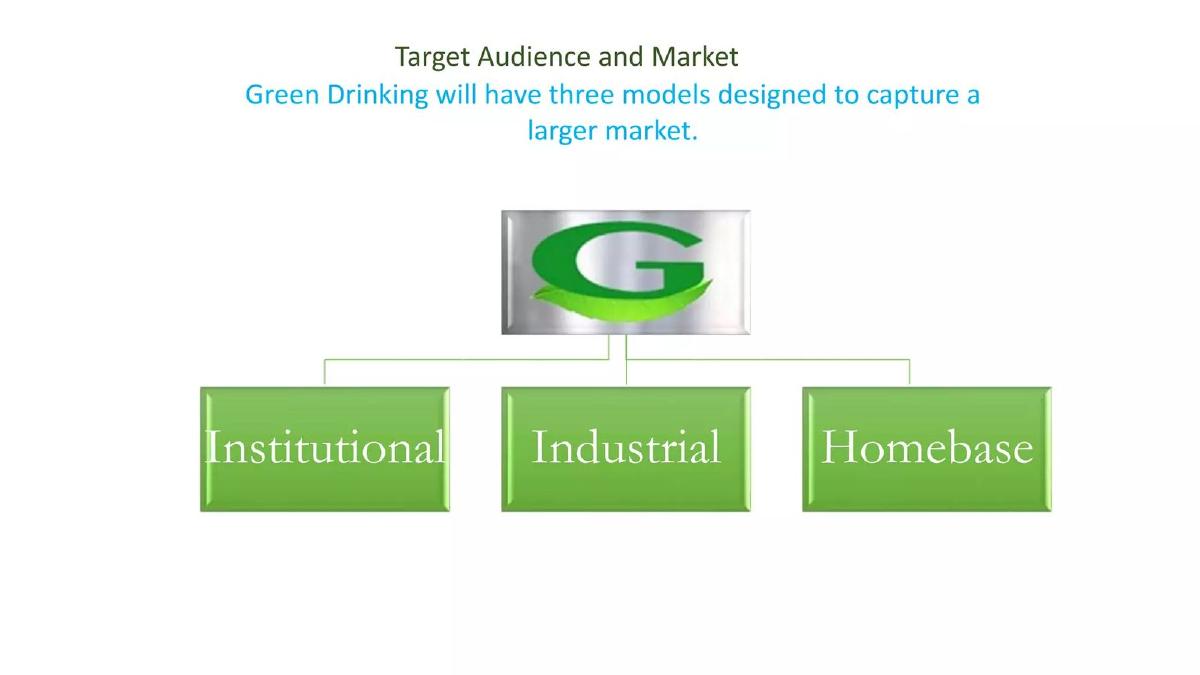
- The company plans to launch three distinct hardware models: Institutional, Industrial, and Homebase (slide 4).
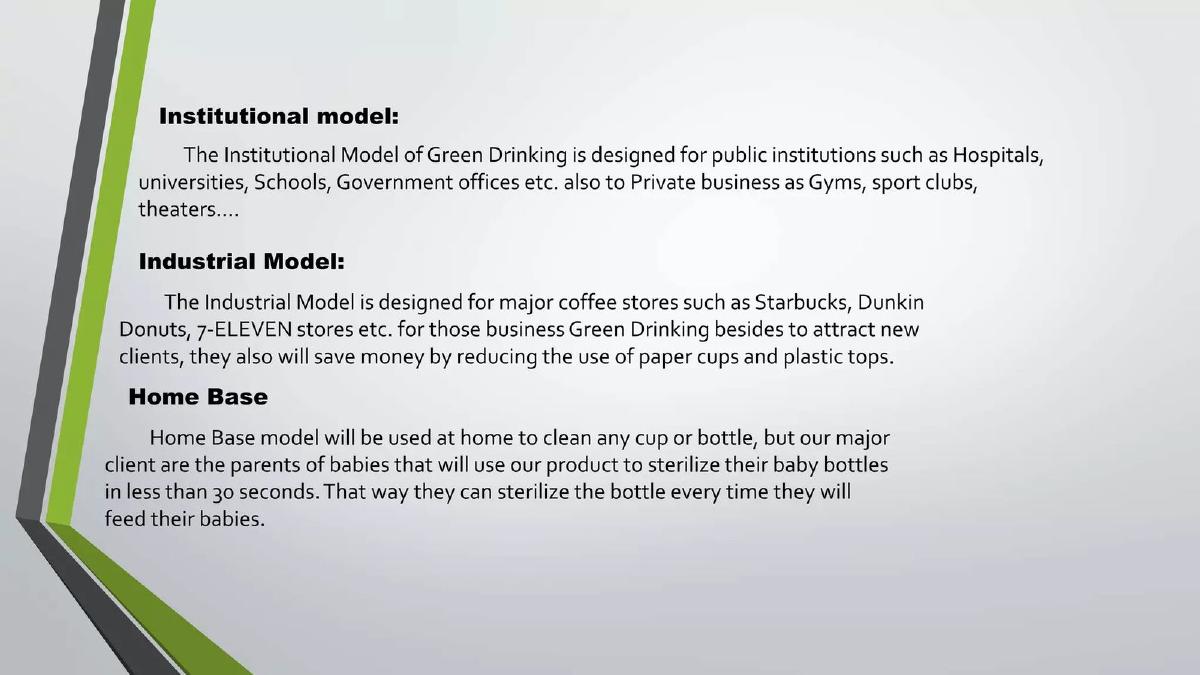
- The Industrial model specifically targets major coffee chains like Starbucks and Dunkin' to reduce paper cup waste (slide 5).
- The founders are seeking $100,000 to transition from design to a final manufactured product (slide 7).
- The deck cites a New York Times poll stating 77% of people care about global warming as a primary market driver (slide 8).
- The team consists of four members, including a CEO, Chief Health Dep., Technology Officer, and Executive Vice President (slide 1).
- The project is associated with the Imperial Partner Group, as mentioned in the problem statement (slide 2).
- The deck omits all financial metrics, including COGS, MSRP, and revenue projections.
Green Drinking: The Student Pitch Deck Teardown
Green Drinking is a hardware concept aimed at the intersection of hygiene and sustainability. The deck is clearly formatted for a university-level business plan competition, specifically the Baruch College smartpitch 2016. It focuses on a single hardware solution: a UV-based bottle sterilizer intended to make the use of reusable containers more convenient and sanitary.
Slide 1: Title and Team
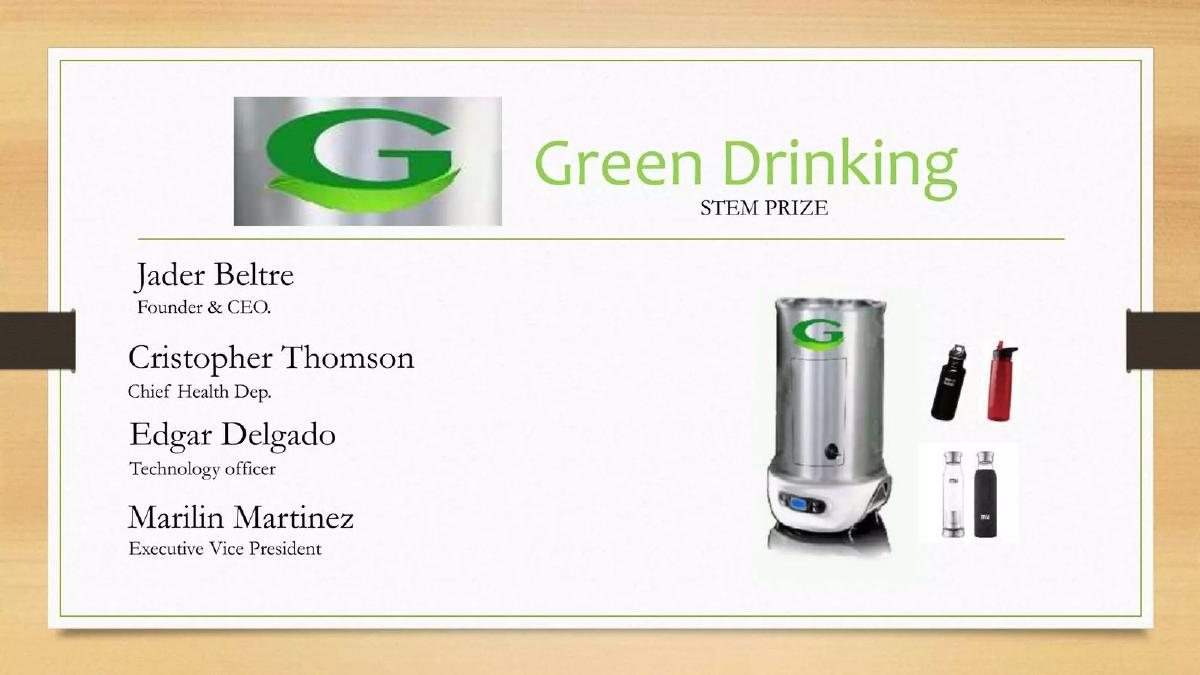
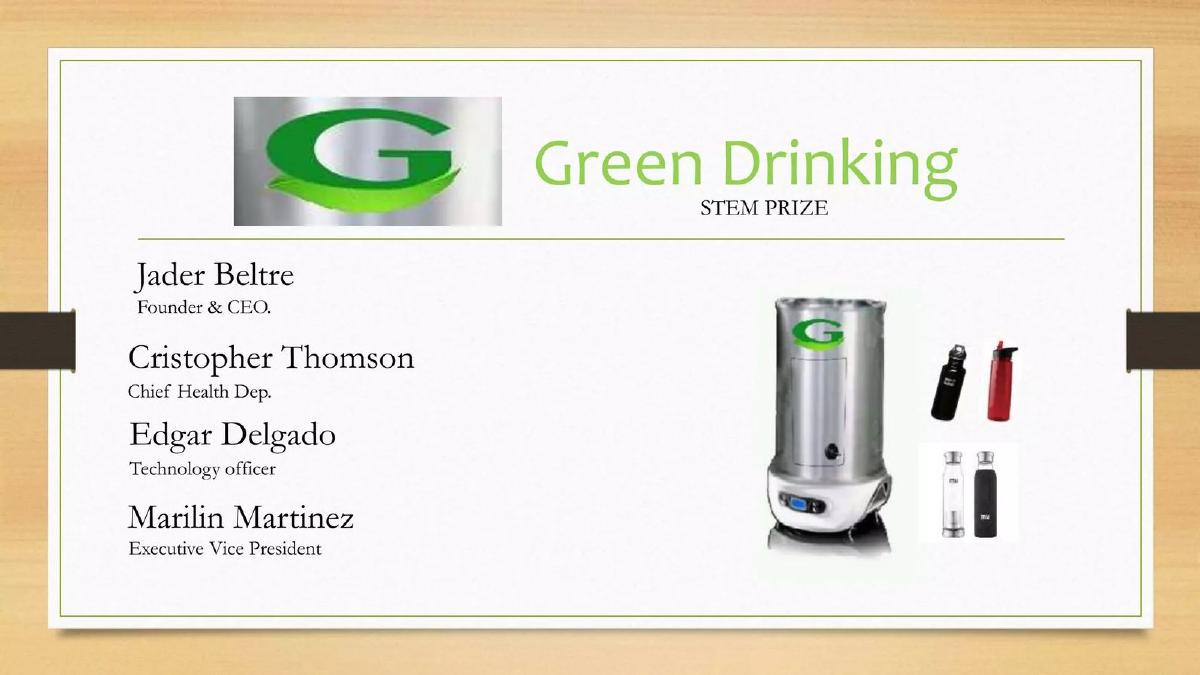
The cover slide introduces the company name, 'Green Drinking,' and the subtitle 'STEM PRIZE.' It lists four team members: Jader Beltre (Founder & CEO), Cristopher Thomson (Chief Health Dep.), Edgar Delgado (Technology officer), and Marilin Martinez (Executive Vice President). The slide also features a low-resolution rendering of a stainless steel cylindrical device alongside various water bottles, providing an immediate visual of the product category.
Slide 2: The Problem
The problem statement focuses on the hygiene risks of reusable water bottles. The text notes that because bottles 'continually stay wet,' they become breeding grounds for bacteria. It highlights that current sterilization methods—specifically cleaning pills or boiling water—are costly, time-consuming, or 'risky.' The slide introduces the 'Imperial Partner Group' as the designer of the solution. This slide effectively identifies a relatable consumer pain point, though it lacks data on the actual prevalence of bottle-borne illnesses.
Slide 3: The Solution
This slide defines the product as an 'electronic device that washes and sterilizes any kind of bottles using UV light in less than 30 seconds.' The value proposition is centered on speed and versatility, suggesting use cases in offices, schools, and coffee stores. The ultimate goal stated is to 'avoid the use of paper cups, plastic, and glass beverages containers' by making it easier for consumers to maintain their own bottles.
Slide 4: Target Audience and Market
The company proposes a three-tiered product strategy. A simple organizational chart branches from the Green Drinking logo into three categories: Institutional, Industrial, and Homebase. This suggests the founders recognize that a 'one size fits all' hardware approach may not work for a hospital versus a kitchen counter, though no specific design differences are shown here.
Slide 5: Model Descriptions
Slide 5 provides more detail on the three segments. The Institutional model is for public and private spaces like hospitals, gyms, and theaters. The Industrial Model is pitched as a B2B solution for coffee giants like Starbucks and Dunkin', claiming it will 'save money by reducing the use of paper cups.' The Home Base model focuses on parents, emphasizing the ability to sterilize baby bottles in under 30 seconds to prevent infection. This slide is the most descriptive in terms of market application but lacks any validation from these potential partners.
Slide 6: Environmental Context
This slide attempts to build a macro-economic case for the product by citing global warming and municipal waste policies. It mentions Hamburg, Germany's 'plastic 0' policy and New York City's project to 'cut NYC trash by 90% by 2030.' By aligning with these government goals, the deck argues that Green Drinking is a 'good option that aggregate value and social responsibility' for businesses. This is a common tactic in student decks to substitute regulatory trends for actual sales traction.
Slide 7: The Ask
The financial request is explicit: '$100,000.00.' The slide lists three intended uses for the 'money prize': 1) Get the final product from the manufacturer for the three models, 2) Begin the patenting process, and 3) Build the website. This indicates the company is currently in the pre-prototype or early prototype stage, as they have not yet secured manufacturing or intellectual property protection.
Slide 8: The Vision and Validation
The final slide reiterates the goal of winning the 'smartpitch 2016' at Baruch College. It uses a New York Times poll to claim that '77% of the people in this nation... cares about global warming and 65% that is willing to act and/or invest to prevent it.' The slide concludes by framing the device as a tool for both planetary health and personal health. It serves as a summary of the 'why' behind the project rather than a 'how' for the business operations.
What Green Drinking Does Well
The deck is highly focused on a single, understandable problem. By narrowing the scope to UV sterilization for bottles, the founders avoid the 'feature creep' that often plagues early-stage hardware pitches. The segmentation of the market into Institutional, Industrial, and Homebase models is a logical way to think about scaling a hardware product, as it acknowledges that the needs of a Starbucks are different from the needs of a new parent.
Furthermore, the 30-second sterilization claim is a strong 'hook.' In hardware, speed of use is a primary driver of adoption. If the technology can truly deliver medical-grade sterilization in that timeframe, the convenience factor becomes a significant competitive advantage over traditional dishwashing or chemical cleaning.
What is Missing from the Deck
As a student competition entry, the deck is missing almost all the 'hard' data required for a professional venture capital raise. There is no Competitive Landscape slide; the founders mention 'pills' and 'boiling,' but they do not address other UV-C bottle products or self-cleaning bottles (like LARQ) that were emerging around the same time.
The Financials are non-existent. There is no mention of the Bill of Materials (BOM), the expected retail price for any of the three models, or the projected revenue. Without these numbers, the $100,000 ask feels arbitrary. It is unclear if $100k is enough to manufacture three different hardware models, which typically requires significant tooling and R&D costs.
Finally, the Technical Validation is missing. Sterilizing the inside of a bottle with UV light requires 'line of sight.' If a bottle has complex geometry or residue, UV light alone may not be sufficient. The slide mentions the device 'washes' the bottle, but there is no explanation of how it handles physical debris or what the water/detergent requirements are.
Founder Takeaways: What to Copy and What to Avoid
Copy the clear segmentation: Defining your product's utility across different environments (Home vs. Industrial) helps investors visualize the total addressable market. It shows you have thought about the different 'jobs to be done' for different users.
Avoid the 'Regulatory Fluff': While citing NYC's trash goals (Slide 6) provides context, it doesn't prove that a business will buy your specific machine. Founders should spend less time on global trends and more time on 'bottom-up' market sizing—how many hospitals are there, and what is their current spend on hygiene solutions?
Be specific about the 'Ask': Green Drinking did a good job of listing what the $100,000 would be used for (Slide 7). However, they should have included a timeline. Investors want to know not just what you will buy, but when those actions will result in a marketable product or a significant increase in company valuation.
Address the 'How': In hardware, the 'how' is as important as the 'what.' If you claim to wash and sterilize in 30 seconds, you must provide at least a high-level schematic or a description of the mechanism to prove it is physically possible within the stated constraints.
Frequently asked questions
- What is the core technology behind Green Drinking?
- Green Drinking relies on UV light sterilization. Slide 3 describes the product as an 'electronic device that washes and sterilizes any kind of bottles using UV light in less than 30 seconds.' The deck does not provide technical specifications regarding the UV wavelength, power requirements, or the 'washing' mechanism mentioned alongside the sterilization.
- Who are the target customers for the different models?
- Slide 5 breaks down three segments: The Institutional model targets hospitals, universities, and gyms. The Industrial model is intended for high-traffic retail environments like Starbucks and 7-Eleven. The Homebase model targets individual consumers, specifically parents who need to sterilize baby bottles quickly and frequently.
- How much funding is the company seeking and for what purpose?
- According to slide 7, the company is seeking $100,000. The funds are earmarked for three specific milestones: obtaining the final manufactured product for all three models, beginning the patent application process, and building the company website. The deck refers to this as a 'money prize' rather than an equity investment.
- Does the deck include any information on competitors?
- No. The deck completely omits a competitive landscape slide. While slide 2 mentions alternative cleaning methods like 'pills' or 'boiling,' it does not name any other UV sterilization hardware companies or existing bottle-cleaning products currently on the market.
- What environmental impact does the company claim?
- The deck positions the product as a tool to reduce plastic and paper waste. Slide 6 cites Hamburg's 'plastic 0' policy and New York City's goal to cut trash by 90% by 2030 as regulatory tailwinds that make a reusable bottle sterilization device a 'social responsibility' for businesses.