The GraphCMS Series A deck is a highly focused narrative piece that prioritizes market evolution and technical positioning over traditional metrics. With only 8 slides, the company avoids the common trap of data-dumping, instead building a logical case for why the 'Headless CMS' era is ending and the 'Content Federation' era is beginning. They identify a specific pain point—the expensive custom middleware required to connect modern microservices—and position themselves as the first platform to solve it. While the deck lacks a formal 'Ask' slide, financial projections, or a customer logo wall,…
Key takeaways
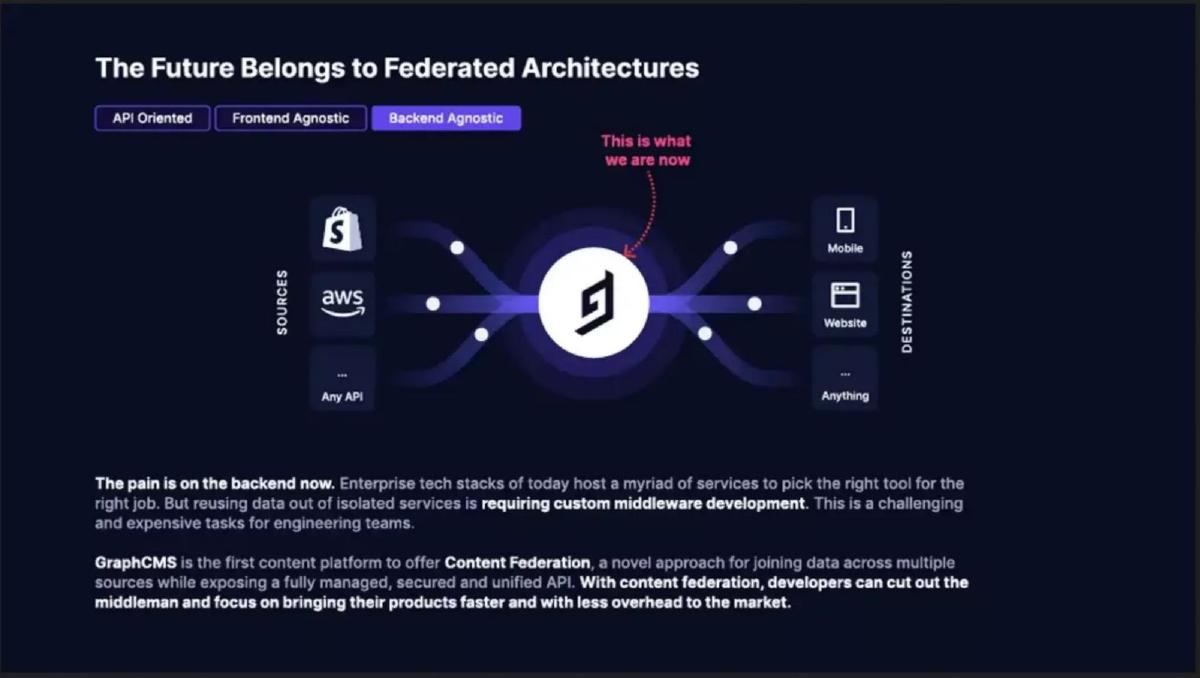
- The deck defines a new category, 'Content Federation,' to differentiate from crowded headless CMS competitors on slide 4.
- GraphCMS identifies the 'Custom Middleware' layer as a primary enterprise pain point that is 'expensive and painful to develop' on slide 2.
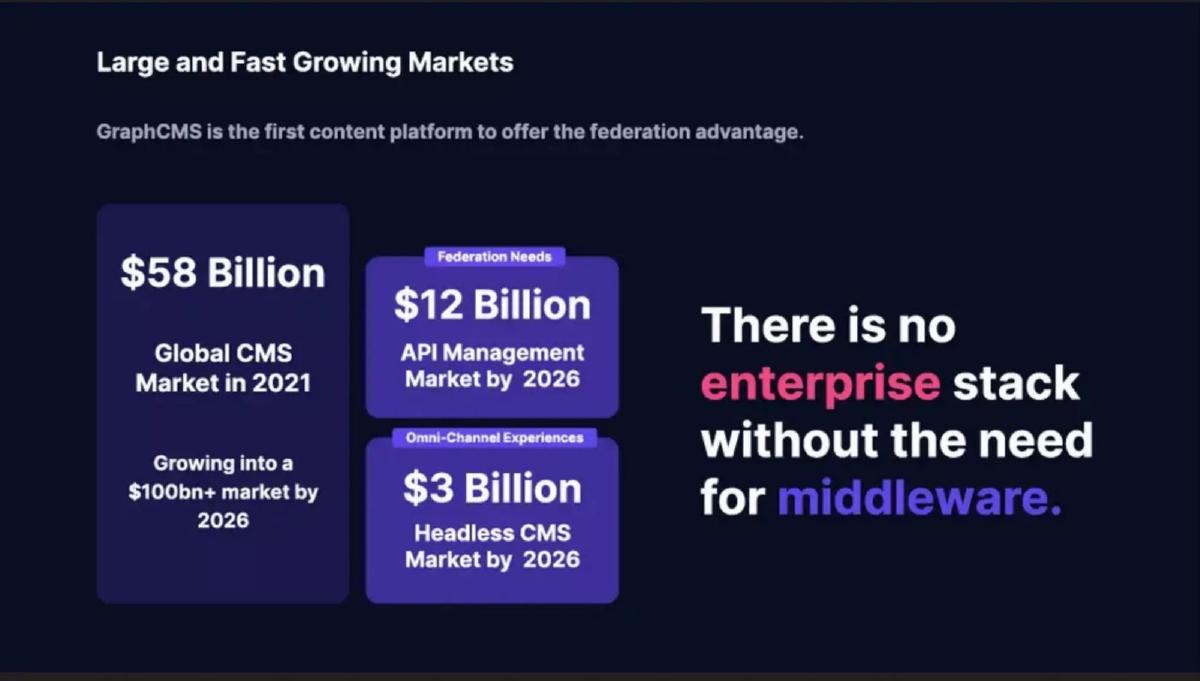
- The market size is anchored by a $58 Billion Global CMS Market figure for 2021, projected to exceed $100 Billion by 2026 on slide 6.
- The competitive landscape is mapped on a 2x2 grid that separates 'Frontend Agnostic Only' from 'Frontend + Backend Agnostic' solutions on slide 7.
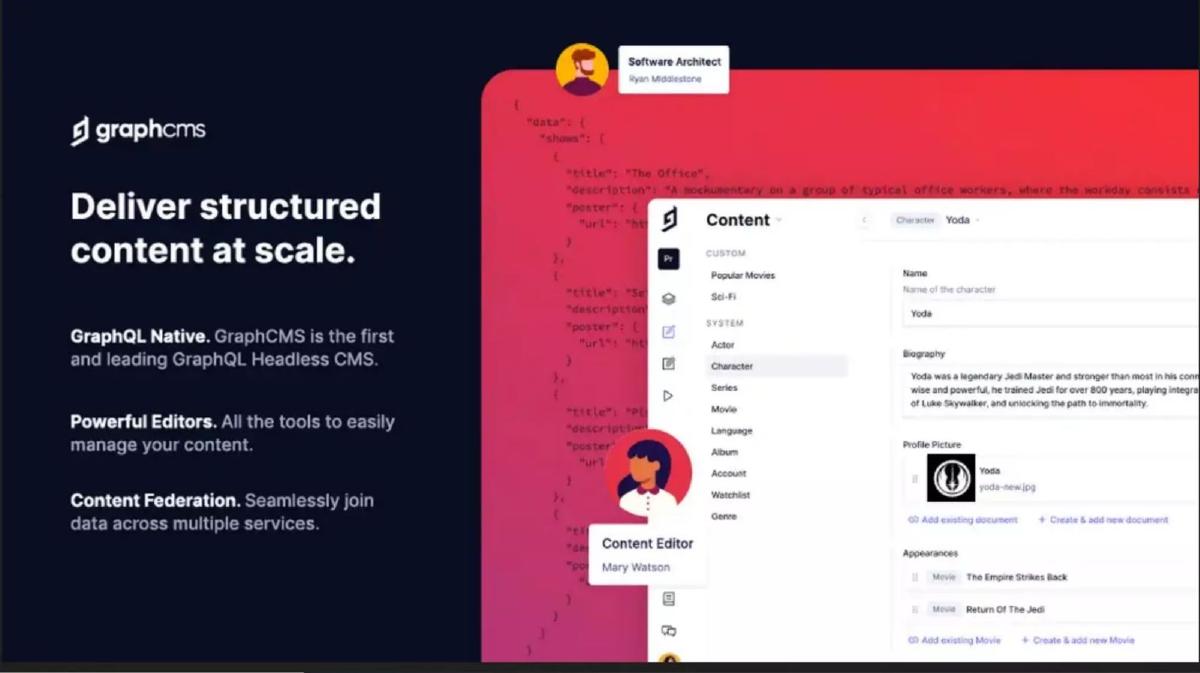
- The product vision is described as 'GraphQL Native,' claiming to be the first and leading GraphQL Headless CMS on slide 5.
- The leadership team highlights a combined 29 years of web development and cloud architecture experience between the CEO and CTO on slide 8.
- The deck completely omits a slide for financial performance, traction metrics, or a specific funding request.
- The narrative structure follows a clear 'Past, Present, Future' evolution of content management across slides 3 and 4.
The Strategic Pivot: Category Creation in 8 Slides
The GraphCMS pitch deck is a lean, highly technical narrative that focuses on the evolution of software architecture. Unlike many SaaS decks that spend half their time on user growth and CAC/LTV metrics, GraphCMS spends its limited real estate explaining why the current way of building digital products is broken. The deck is less of a business report and more of a manifesto for 'Content Federation.' Headquartered in Berlin, the company uses this deck to transition from being a participant in the Headless CMS market to the leader of a new, backend-agnostic category.
Slide 1: The Unified Vision
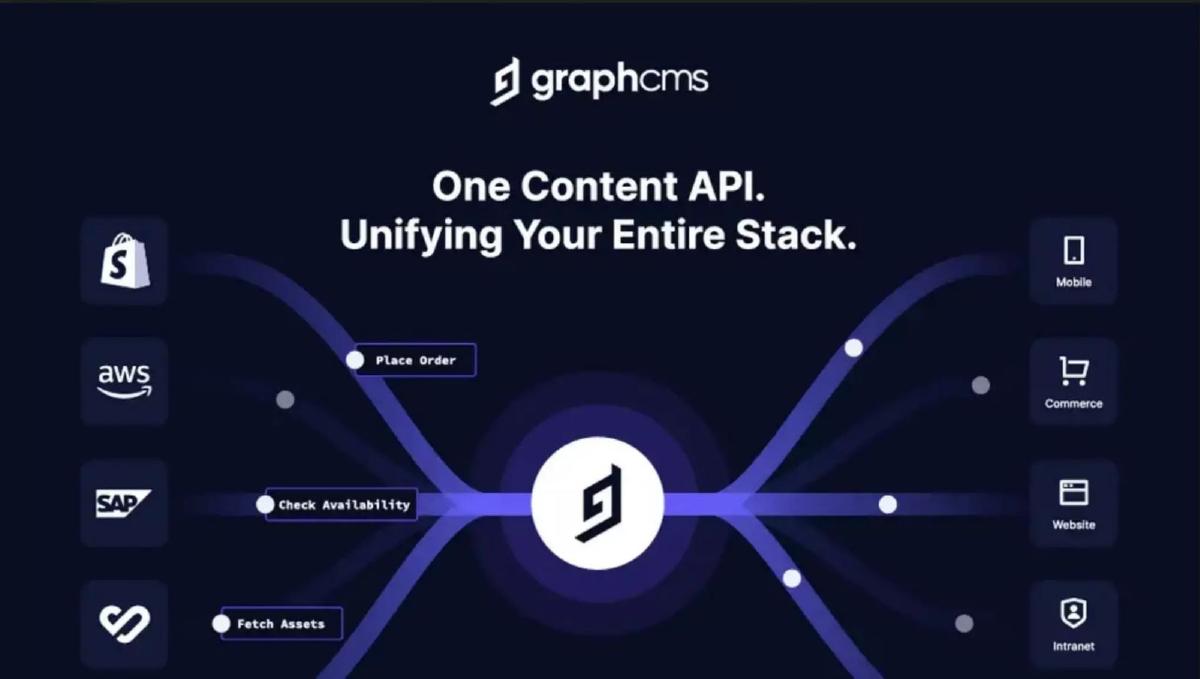
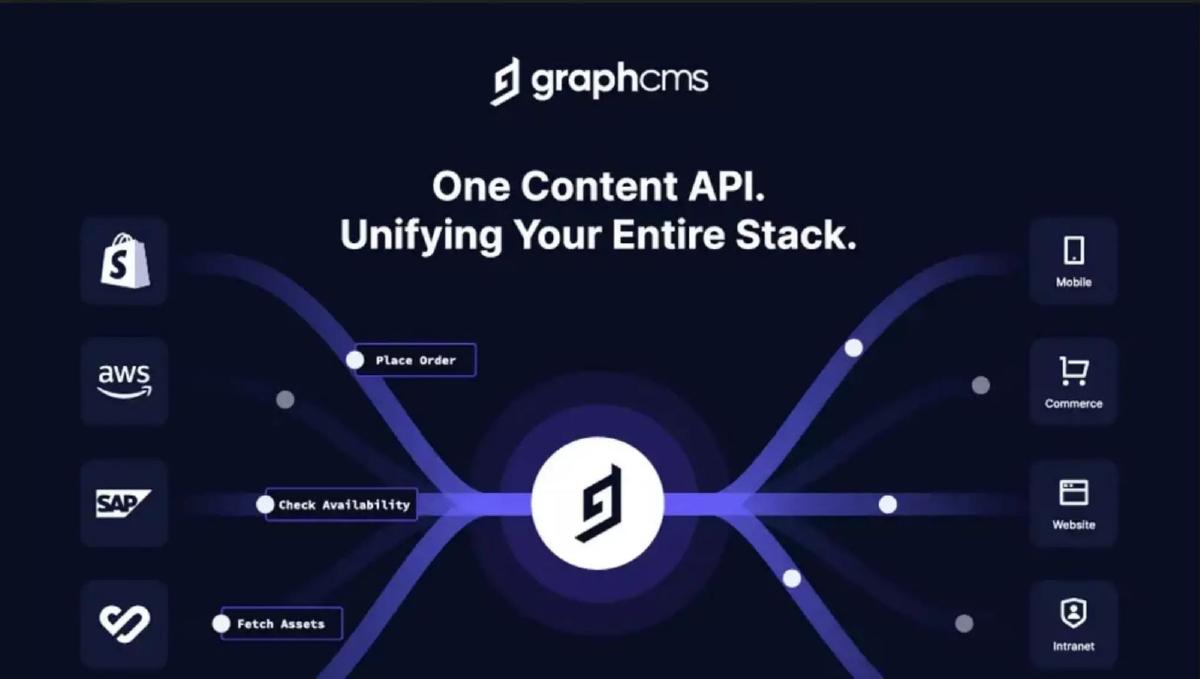
The cover slide introduces the core value proposition: "One Content API. Unifying Your Entire Stack." The visual is a hub-and-spoke model. On the left, it shows sources like Shopify, AWS, and SAP. On the right, it shows destinations like Mobile, Commerce, Website, and Intranet. The GraphCMS logo sits at the center, acting as the bridge. This immediately tells the investor that this is a middleware play, not just a storage play. It promises to handle complex actions like "Place Order," "Check Availability," and "Fetch Assets" through a single point of entry.
Slide 2: The Problem of Complexity
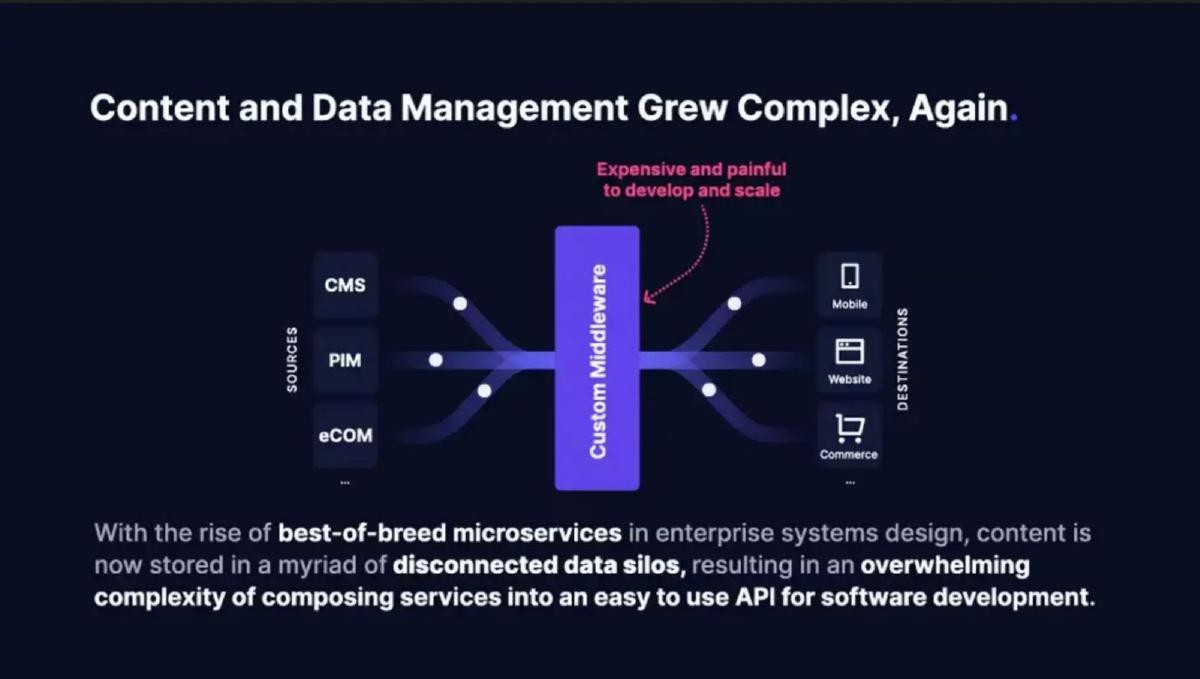
Slide 2, titled "Content and Data Management Grew Complex, Again," identifies the villain of the story: Custom Middleware. The slide explains that the rise of "best-of-breed microservices" has led to disconnected data silos. The diagram shows a large purple box labeled "Custom Middleware" that is described as "Expensive and painful to develop and scale." This is a crucial strategic move. By labeling the current solution (custom code) as painful, they create a market vacancy for a pre-built platform to take its place.
Slide 3: The Evolution of CMS
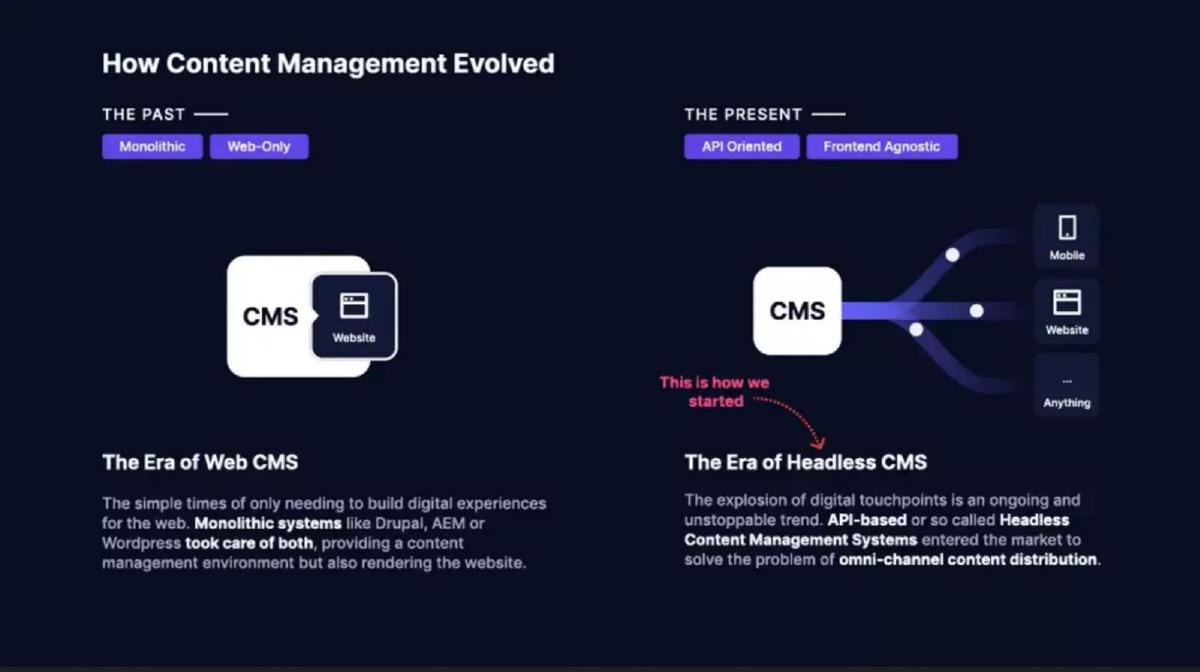
Slide 3 provides historical context, titled "How Content Management Evolved." It breaks history into two eras. The Era of Web CMS (The Past) is defined by monolithic systems like Drupal, AEM, or WordPress that were "Web-Only." The Era of Headless CMS (The Present) is defined as API-oriented and frontend agnostic. Crucially, a small red arrow points to the Headless CMS diagram with the text "This is how we started." This slide builds credibility by acknowledging their roots while signaling that they have already outgrown the current market standard.
Slide 4: The Future is Federated
Slide 4 completes the narrative arc: "The Future Belongs to Federated Architectures." Here, GraphCMS adds a third pillar to their identity: "Backend Agnostic." They claim to be the first content platform to offer "Content Federation." The text argues that engineering teams are currently wasting time building custom middleware to join data across multiple sources. GraphCMS positions itself as the tool that allows developers to "cut out the middleman." This is the 'Aha!' moment of the deck, where the product is presented as the inevitable next step in the industry's evolution.
Slide 5: Product Capabilities
Slide 5, "Deliver structured content at scale," shifts from architecture to user experience. It highlights three key features: GraphQL Native (claiming to be the first and leading GraphQL Headless CMS), Powerful Editors (tools for content management), and Content Federation (joining data across services). The visual includes a code snippet and a UI screenshot, showing that the platform serves two masters: the Software Architect (represented by 'Ryan Middlestone') and the Content Editor (represented by 'Mary Watson'). This addresses the classic CMS tension between developer flexibility and editorial ease of use.
Slide 6: Market Opportunity
Slide 6, "Large and Fast Growing Markets," puts numbers to the vision. It cites a "$58 Billion Global CMS Market in 2021," projected to grow to over $100 Billion by 2026. However, the more interesting figures are the sub-markets: a $12 Billion API Management Market and a $3 Billion Headless CMS Market by 2026. By including the API management market, GraphCMS is signaling that their TAM (Total Addressable Market) is much larger than a traditional CMS because they are replacing middleware. The slide concludes with a bold statement: "There is no enterprise stack without the need for middleware."
Slide 7: Competitive Mapping
Slide 7, "Beyond Headless," uses a 2x2 grid to position the company. The Y-axis separates "Data Services" from "Headless Content Services," while the X-axis separates "Frontend Agnostic Only" from "Frontend + Backend Agnostic." GraphCMS places itself in the top-right quadrant, alone. They place competitors like Contentful, Contentstack, and Strapi in the "Frontend Agnostic Only" category. Interestingly, they place technical heavyweights like Apollo, Hasura, and Firebase on the map, which serves to validate the technical complexity of the space they are playing in. A red arrow points to their quadrant, noting a "High entry barrier due to demanding architectural challenges."
Slide 8: The Team
The final slide, "Complementary Leadership," introduces the three key executives. Michael Lukaszczyk (CEO) is noted as a SaaS builder with 19 years of experience. Daniel Winter (CTO) is highlighted for a decade of experience in scalable cloud architectures. Christopher Kühn (CCO) brings the commercial weight, noting 5 years of experience in B2B enterprise SaaS and participation in a "300M€ exit." All three hold Master's degrees (Computer Science or Business Administration), reinforcing the image of a highly educated, technically proficient founding team.
What Works in This Deck
Clear Categorization: The deck does an excellent job of moving GraphCMS out of a 'red ocean' (Headless CMS) and into a 'blue ocean' (Content Federation). · Visual Consistency: The use of the hub-and-spoke diagram across multiple slides (2, 3, and 4) makes the technical evolution easy to follow even for a non-technical investor. · Pain Point Identification: By focusing on the 'pain' and 'cost' of custom middleware, they create a financial justification for their product that goes beyond just 'better UI.' · Strategic Mapping: The 2x2 grid on Slide 7 is a masterclass in positioning. It doesn't just say they are better; it says they are doing something fundamentally different from their most famous competitors.
What is Missing
Traction Metrics: There is no mention of ARR, growth rates, churn, or the "nearly 50,000 teams" mentioned in the company's self-description. This is a significant omission for a Series A deck. · Customer Proof: The deck lacks a logo wall or case studies. While it mentions enterprise use cases, it doesn't name any specific companies currently using the platform. · The Ask: There is no slide detailing how much capital is being raised or how that capital will be deployed (e.g., hiring, marketing, R&D). · Unit Economics: For a SaaS company, investors typically expect to see LTV/CAC ratios or payback periods, none of which appear here.
What a Founder Should Copy
The 'Evolution' Narrative: If you are in a crowded market, don't just say you are 'faster' or 'cheaper.' Use a slide like Slide 3 and 4 to show how the market has changed and why your architecture is the only one built for the new reality. · The Middleware Argument: If your software automates something that companies currently pay engineers to build manually, highlight that 'hidden' cost. It makes your software feel like a cost-saving measure rather than an expense. · Focused Simplicity: This deck is only 8 slides. It doesn't wander. Every slide is dedicated to proving one specific point: that Content Federation is the future and GraphCMS owns it. · Technical Credibility: If you are building a developer-tooling product, your team slide should emphasize technical longevity and specific architectural experience, just as GraphCMS does on Slide 8.
Frequently asked questions
- Why does the deck focus so heavily on 'Federation' instead of just 'CMS'?
- By the time this deck was produced, the 'Headless CMS' market was already saturated with players like Contentful and Strapi. GraphCMS needed to move the goalposts. By focusing on 'Content Federation' (Slide 4), they position themselves as a layer that unifies other services (like Shopify or SAP) rather than just another place to store text. This increases their perceived value from a simple utility to essential enterprise infrastructure.
- Is the lack of a traction slide a red flag for a Series A deck?
- In a traditional sense, yes. Most Series A decks lead with a 'hockey stick' growth chart. However, GraphCMS relies on a 'vision-led' sale. The catalogue facts mention they have nearly 50,000 teams, but this specific deck chooses to sell the architectural inevitability of their solution. It assumes the investor already knows the space is growing and focuses entirely on why GraphCMS wins the technical battle.
- How does GraphCMS use the competitive landscape to its advantage?
- Slide 7 is a strategic masterpiece. Instead of a standard feature checklist, they use a 2x2 grid. They place themselves in a quadrant labeled 'Frontend + Backend Agnostic,' which they claim has a 'high entry barrier.' By grouping respected names like Apollo and Hasura near them, they borrow credibility while distancing themselves from 'legacy' headless CMS providers like Contentful.
- What is the significance of the 'Custom Middleware' argument?
- Slide 2 and Slide 6 emphasize that 'there is no enterprise stack without the need for middleware.' By highlighting that custom middleware is 'expensive and painful,' GraphCMS is identifying a hidden cost in their customers' budgets. They aren't just selling a CMS; they are selling a way to reduce engineering headcount and development time, which is a much stronger ROI argument for enterprise buyers.
- Who is the intended audience for this specific 8-slide deck?
- This appears to be a 'teaser' or a high-level narrative deck used to anchor a verbal presentation. Because it lacks deep financials and an 'Ask,' it is likely designed to get a first meeting or to serve as a leave-behind that summarizes the strategic 'Why Now.' It speaks the language of CTOs and technical VCs who care about GraphQL and microservice orchestration.