Grain's 12-slide Series A deck is a concise demonstration of product-led growth (PLG) efficiency. Rather than spending time on broad market education, the deck focuses on the specific friction of video meeting data and the viral loops that solve it. With a reported $0 in paid acquisition (Slide 7) and 133% Net Dollar Retention (Slide 9), the narrative centers on the product's ability to 'land and expand' within enterprise organizations. The deck successfully illustrates how internal sharing leads to new user acquisition, with 45% of growth coming from content discovery (Slide 5). While it lac…
Key takeaways
- The company claims $0 in paid acquisition costs, relying entirely on word-of-mouth and product-led growth loops (Slide 7).
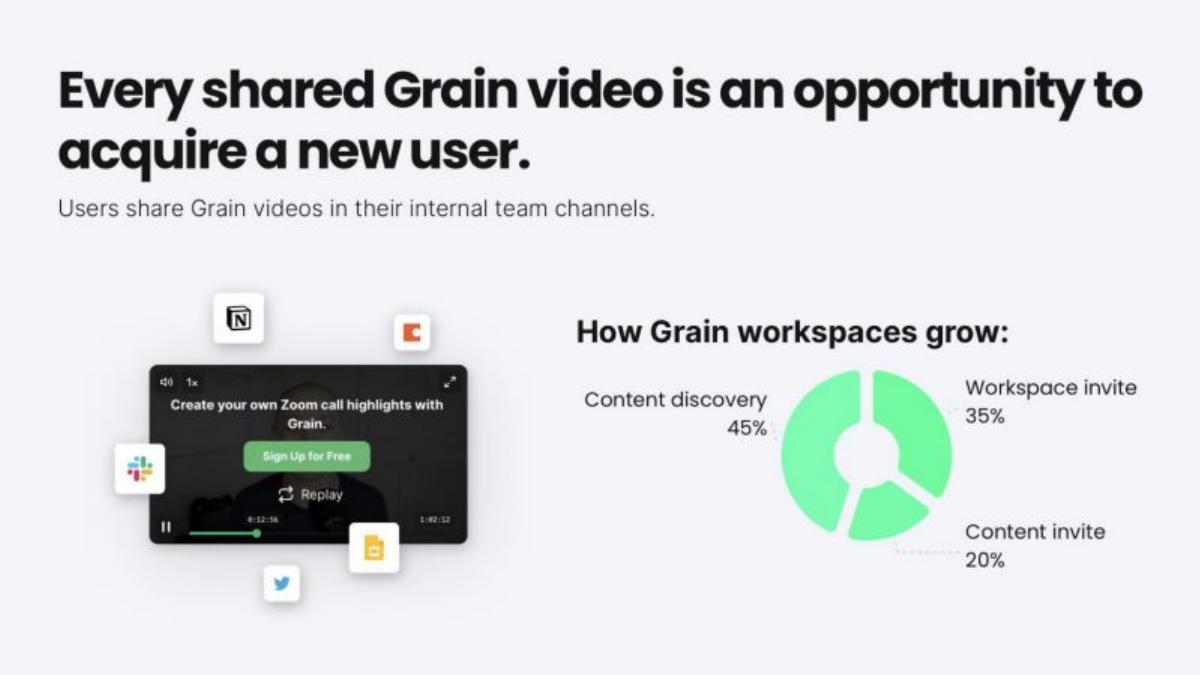
- Content discovery is the primary driver of workspace growth, accounting for 45% of new user acquisition (Slide 5).
- Grain achieved 133% Net Dollar Retention for team workspaces with 2+ licenses, indicating strong expansion potential (Slide 9).
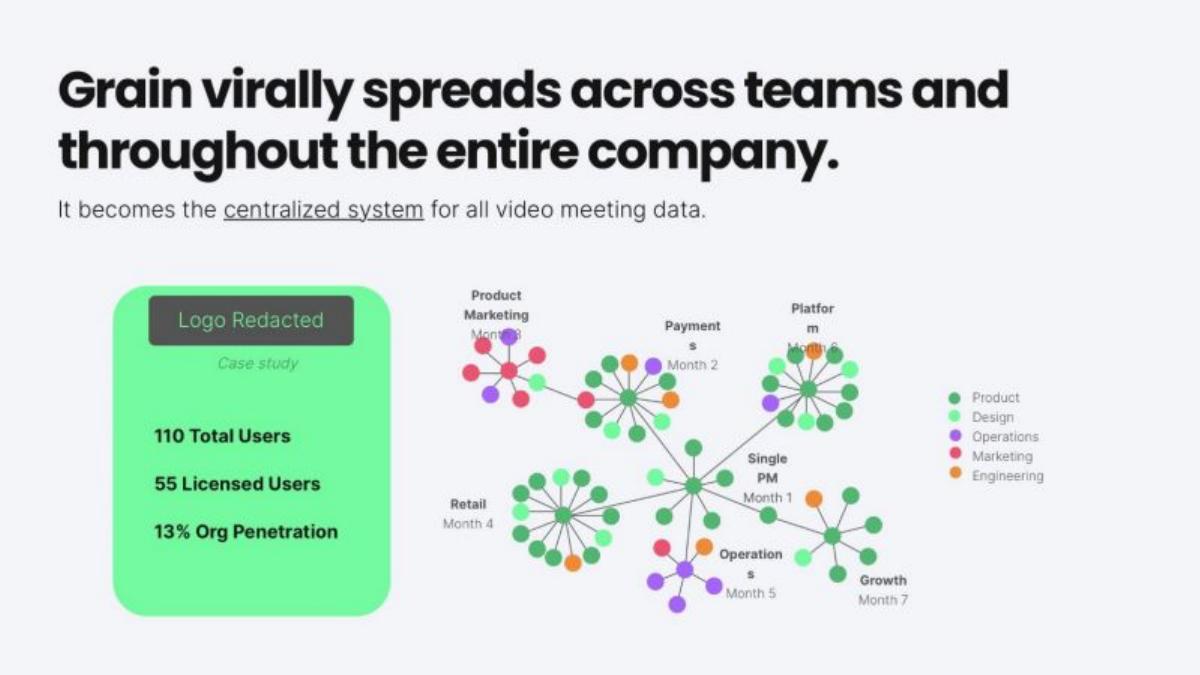
- The product demonstrates high virality, with a case study showing expansion from a single PM to 110 total users across multiple departments in 8 months (Slide 6).
- Usage grew 4.2x over a six-month period leading up to July 2021, while MRR increased 5.2x since January of the same year (Slide 8).
- The founding team has significant experience, including a CEO who co-founded a company acquired by WeWork and a CPO who was the first hire at Branch (Slide 10).
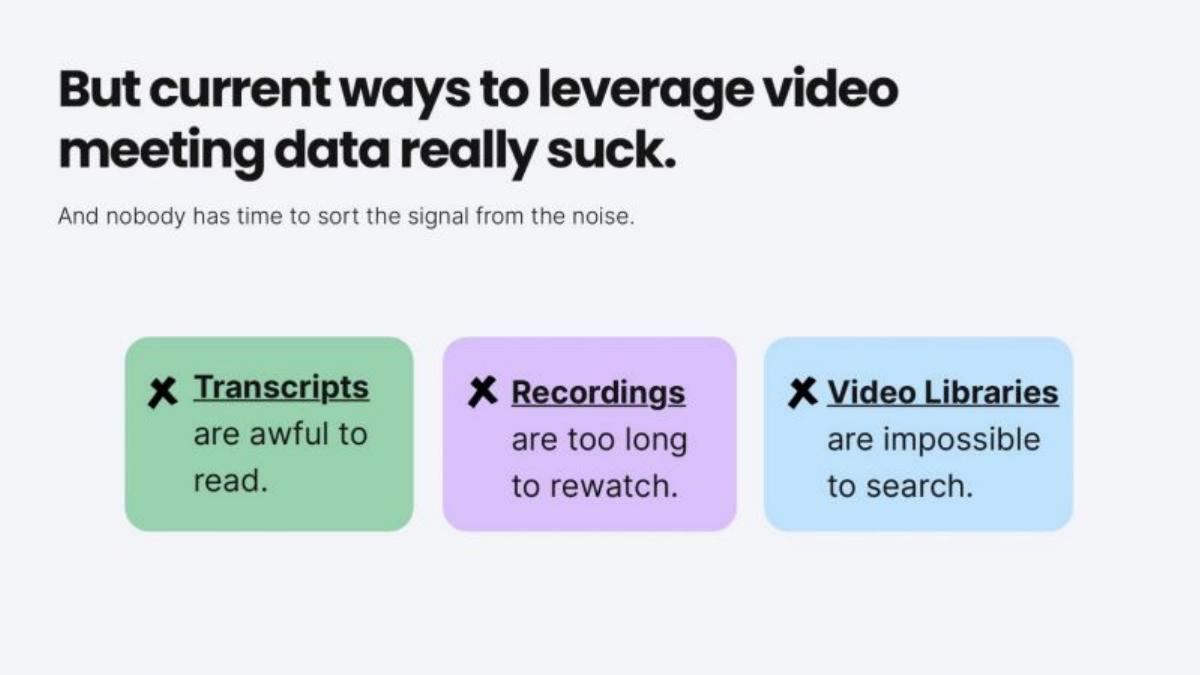
- The deck identifies three specific pain points in current video data: transcripts are hard to read, recordings are too long, and libraries are unsearchable (Slide 3).
- The business model leverages free users to secure five-figure mid-market contracts through self-serve channels (Slide 7).
The Product-Led Growth Engine: A Teardown of Grain's Series A Deck
Grain's Series A pitch deck is a focused, data-driven presentation that prioritizes product mechanics and user behavior over traditional market sizing. In an era where video meetings became the primary workspace, Grain positioned itself not just as a recording tool, but as a system of record for spoken knowledge. The deck, used to raise $16M in 2022, is notable for its brevity and its reliance on cohort data to prove its 'land and expand' thesis.
Slide 1: Title and Mission
The deck opens with a clean title slide featuring the Grain logo and the tagline: "Turn Video Meetings into Assets." This immediately establishes the value proposition. Grain isn't promising better meetings; it is promising to extract value from the time already spent in them. The branding is minimalist, using a soft green palette that carries throughout the presentation.
Slide 2: The Macro Trend
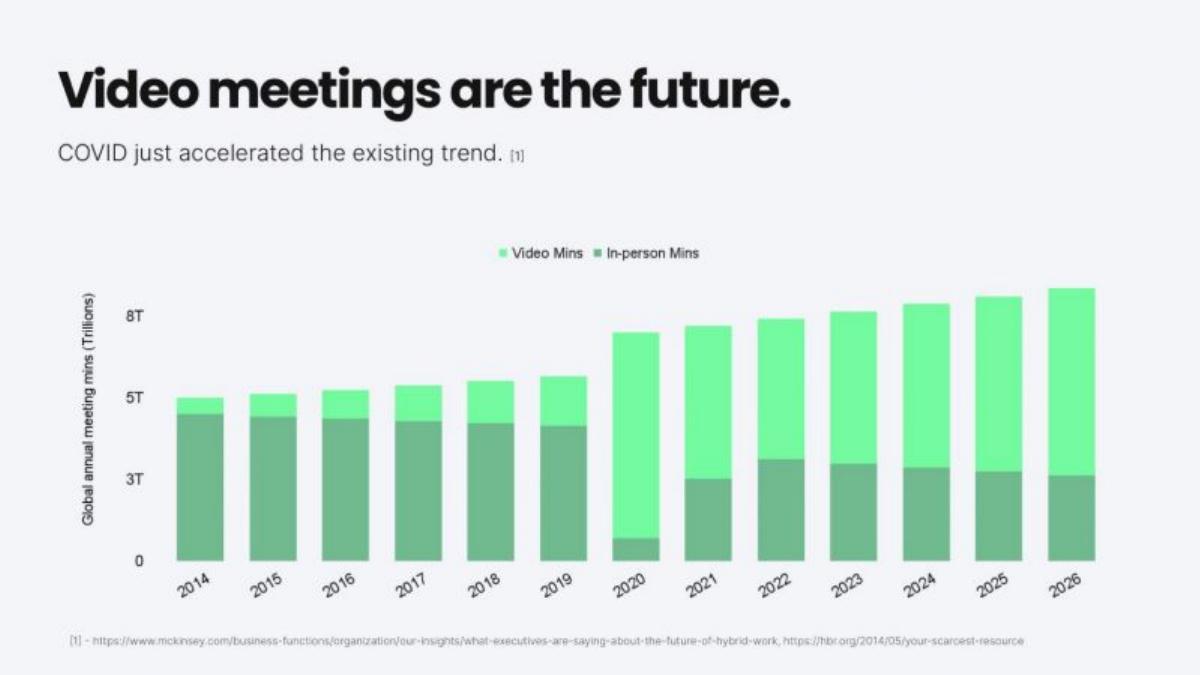
Slide 2 uses a bar chart to show the shift from in-person to video minutes. It cites McKinsey and HBR to support the claim that "COVID just accelerated the existing trend." The chart projects global annual meeting minutes reaching over 8 trillion by 2026, with video minutes (light green) significantly outpacing in-person minutes (dark green). This serves as the 'Why Now' slide, justifying the need for a tool that manages this explosion of digital conversation.
Slide 3: The Problem Statement
Grain identifies three specific failures in the current market on Slide 3: Transcripts are awful to read, Recordings are too long to rewatch, and Video Libraries are impossible to search. By framing these as the 'noise' that prevents users from finding the 'signal,' Grain sets the stage for its specific feature set. The language is blunt, stating that current ways to leverage data "really suck."
Slide 4: The Solution and Product Interface
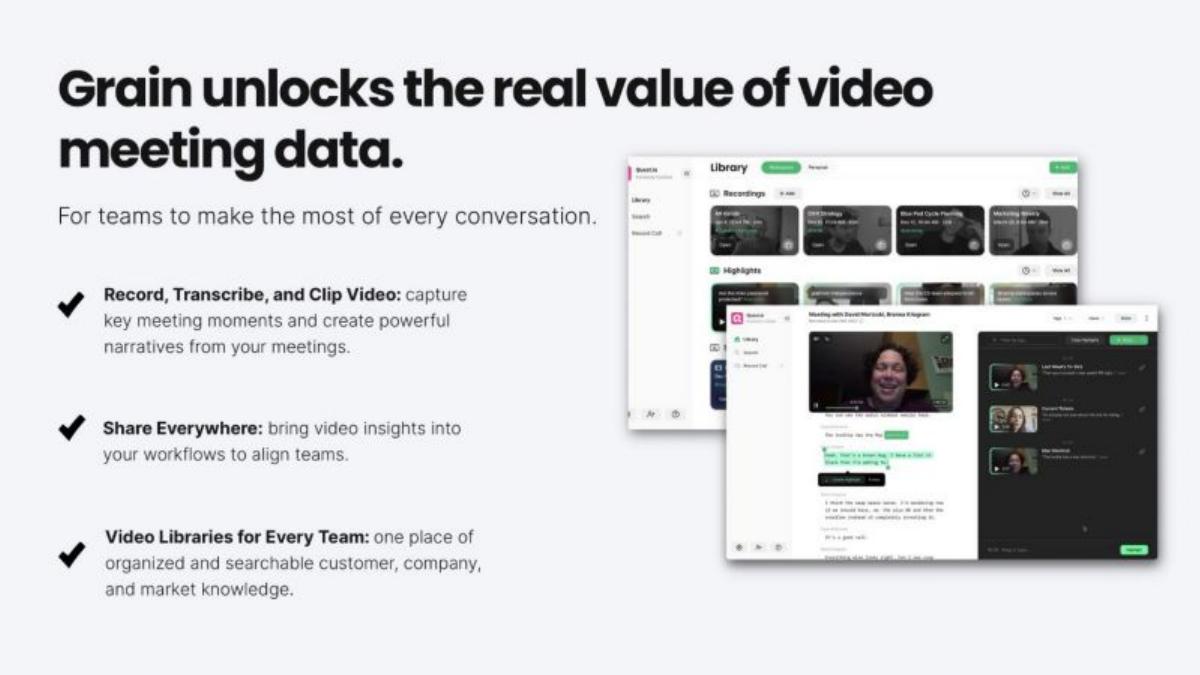
Slide 4 introduces the product as the tool that "unlocks the real value of video meeting data." It lists three core functions: Record/Transcribe/Clip, Share Everywhere, and Video Libraries for Every Team. The slide includes two screenshots of the interface, showing a library view and a specific meeting view where text is highlighted to create a video clip. This demonstrates the ease of turning a transcript into a shareable asset.
Slide 5: The Viral Loop
This is arguably the most important slide in the deck. It explains the acquisition model: "Every shared Grain video is an opportunity to acquire a new user." A donut chart breaks down how workspaces grow: 45% Content discovery , 35% Workspace invite, and 20% Content invite. This proves that the product has built-in virality; the more users use the tool for its intended purpose (sharing clips), the more the user base grows organically.
Slide 6: Enterprise Expansion Case Study
Slide 6 visualizes the 'land and expand' strategy. It shows a redacted logo case study where the product started with a "Single PM" in Month 1 and expanded to 110 Total Users by Month 8. The visualization shows nodes spreading across Product, Design, Operations, Marketing, and Engineering. The slide claims a 13% Org Penetration , demonstrating that Grain is not a siloed tool but a cross-functional utility.
Slide 7: Efficiency and Social Proof
Slide 7 reinforces the PLG (Product-Led Growth) narrative by stating there is "$0 IN PAID ACQUISITION." It shows four redacted categories of success: Paid Users, Free Users via WOM & PLG, ARR generated with no marketing or sales team, and the Largest Annual Contract being 100% self-serve. This slide tells investors that the unit economics are highly favorable because the product sells itself.
Slide 8: Growth Metrics
Slide 8 provides the 'hard' traction data. It features two charts: one for active usage (DAUs, WAUs, MAUs) and one for revenue (MRR, ARR). The slide claims 20-30% month over month growth . Specifically, it notes that "USAGE GREW 4.2X OVER THE LAST 6 MONTHS" and "MRR IS UP 5.2X SINCE JANUARY." The dates on the X-axis range from January 2020 to July 2021, showing a consistent upward trajectory.
Slide 9: Retention and Stickiness
Slide 9 focuses on cohort revenue retention. The heatmap shows that for team workspaces with 2+ licenses, the Net Dollar Retention is 133% . It also highlights a ~2% Logo & Rev Churn . These are 'best-in-class' SaaS metrics that signal a highly sticky product where customers not only stay but increase their spending over time.
Slide 10: The Team
The team slide is brief, focusing on the CEO and CPO. The CEO is noted as a former co-founder of MissionU (acquired by WeWork) and Degreed ($1.4B val). The CPO was the first hire at Branch Metrics ($2.2B val). By highlighting these specific exits and high-growth experiences, Grain establishes founder-market fit and the ability to scale a unicorn-level company.
Slide 11: The Iceberg Metaphor
Slide 11 features an illustration of an iceberg, with Grain's logo next to the visible tip. This is a common metaphor in tech to suggest that while the current product is useful, the potential (the submerged part of the iceberg) is much larger. It serves as a transition to a conversation about the future roadmap, though the deck does not explicitly detail that roadmap in the following slides.
Slide 12: Contact Information
The final slide is a standard contact page with a redacted email address and the Grain logo. It maintains the minimalist aesthetic of the rest of the deck.
What Grain's Deck Does Exceptionally Well
The primary strength of this deck is its focus on mechanics over fluff . Many founders spend five slides on 'The Future of Work,' but Grain spends only one. They move quickly into how their product grows. By showing the specific percentages of growth attributed to content discovery (Slide 5), they provide a level of transparency that builds significant trust with sophisticated Series A investors.
The use of cohort heatmaps (Slide 9) is another highlight. For a Series A round, investors are looking for proof of product-market fit. A 133% NDR is a definitive signal that the product is providing increasing value to its users. Furthermore, the claim of $0 paid acquisition (Slide 7) makes the growth charts on Slide 8 much more impressive; it shows that the growth is organic and sustainable rather than bought with venture dollars.
What is Missing from the Grain Deck
Despite its success, the deck omits several traditional elements that are usually expected in a Series A pitch:
The Ask: There is no slide stating how much money the company is raising or what the specific milestones for the next 18-24 months are. · Competition: The deck ignores the competitive landscape. In 2022, companies like Otter.ai, Gong, and Chorus were already established. Grain does not explain how it differentiates from these players beyond the 'clipping' mechanic. · Market Size: There is no TAM (Total Addressable Market) calculation. While Slide 2 shows the growth of video minutes, it doesn't translate that into a dollar-value market opportunity. · Financial Projections: While historical MRR is shown, there are no forward-looking projections or a breakdown of the cost structure (burn rate, headcount plans).
Founders: What to Copy from Grain
Founders building PLG (Product-Led Growth) startups should study Slide 5 and Slide 6. Visualizing the viral loop is far more effective than simply saying "we have a viral product." By breaking down the sources of growth (Content discovery vs. Invites), you show that you understand the levers of your own business.
Additionally, the Enterprise Expansion visualization on Slide 6 is a powerful way to show how a 'bottom-up' tool moves through a company. If your product is designed to be adopted by individuals and then sold to the enterprise, you must show a map of how that actually happened in a real-world scenario. Redacting the logo is fine; the data and the pattern of movement are what matter to the investor.
Finally, keep the Problem Slide (Slide 3) simple. Grain didn't use complex diagrams to explain why video data is hard to use. They used three bullet points and three icons. If your problem is intuitive, don't over-explain it. Spend that time on your metrics instead.
Final Thoughts
Grain's deck is a 'show, don't tell' masterpiece. It assumes the investor already knows that video meetings are important and moves immediately into proving that Grain has found a unique, viral, and highly retentive way to capture that value. It is a lean, efficient presentation that mirrors the efficiency the product itself promises to deliver to its users.
Frequently asked questions
- How does Grain acquire new users without a marketing budget?
- According to Slide 5 and Slide 7, Grain relies on a product-led growth model where the act of sharing a video clip serves as a discovery mechanism. 45% of growth comes from content discovery, 35% from workspace invites, and 20% from content invites. This allows them to maintain $0 in paid acquisition while converting free users into five-figure contracts.
- What are the core metrics for Grain's retention and expansion?
- Slide 9 highlights a Net Dollar Retention (NDR) of 133% for team workspaces with two or more licenses. The overall NDR for all accounts is 114%. Additionally, the company maintains a low churn rate of approximately 2% for both logos and revenue, suggesting high product stickiness once a team adopts the tool.
- What specific problem is Grain solving in the video meeting space?
- Slide 3 explicitly states that current methods for leveraging video data 'suck' because transcripts are difficult to read, full recordings are too long to rewatch, and video libraries are impossible to search. Grain addresses this by allowing users to record, transcribe, and specifically clip key moments to create searchable narratives (Slide 4).
- How quickly does Grain scale within a single organization?
- Slide 6 provides a case study of a redacted company where Grain grew from a single Product Manager in Month 1 to 110 total users by Month 8. This expansion covered departments including Product, Design, Operations, Marketing, and Engineering, reaching a 13% total organization penetration within that timeframe.
- What is missing from the Grain Series A pitch deck?
- The deck omits several standard components, including a formal 'Ask' slide detailing the amount being raised and the intended use of funds. It also lacks a detailed 'Market Size' (TAM/SAM/SOM) slide, a competitor matrix, and long-term financial projections. The focus is almost entirely on past performance and product mechanics rather than future roadmap details.