The go to emma GmbH pitch deck, presented at NOAH18 Berlin, outlines a B2B platform strategy to digitalize the food retail sector. The company targets two primary groups: fragmented wholesalers facing cost pressures and retail chains managing between 3 and 200 stores with limited personnel. Their product suite—Scout, Assist, and Connect—aims to streamline product discovery, offer bundling, and supplier network management. The core value proposition centers on a 'secret sauce' where retailers invite their own suppliers to the platform, creating a low-cost customer acquisition loop. While the d…
Key takeaways
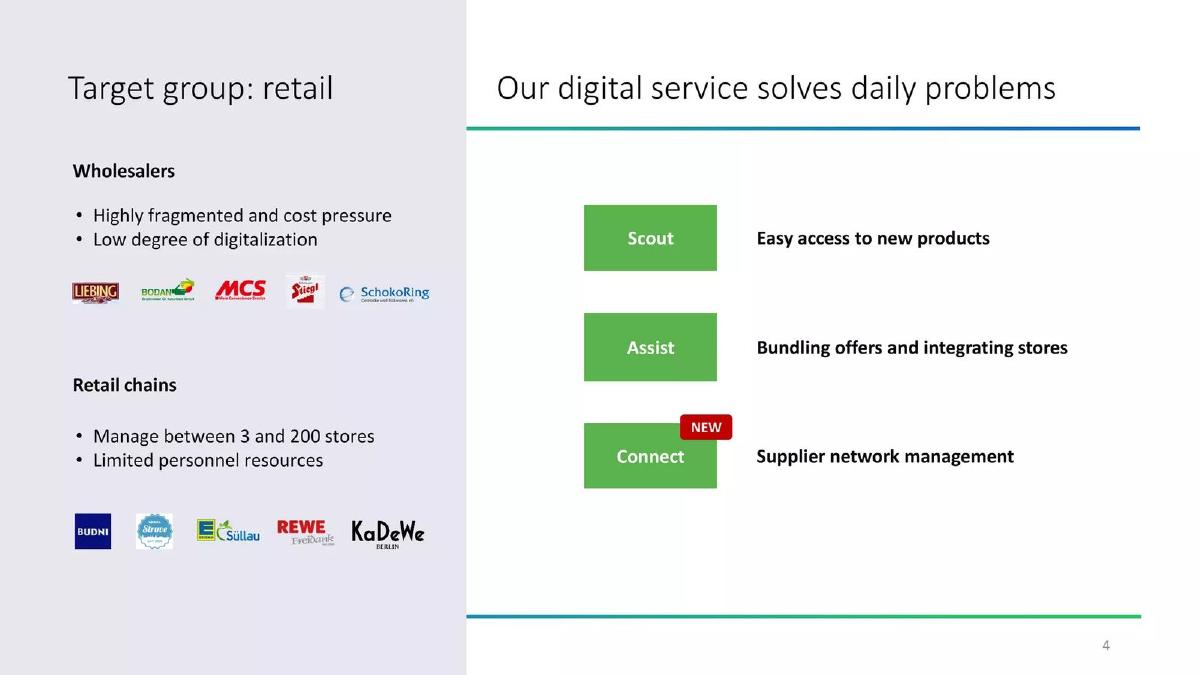
- The company targets retail chains managing between 3 and 200 stores (Slide 4).
- The product is divided into three functional pillars: Scout (product access), Assist (store integration), and Connect (supplier management) (Slide 4).
- A 'SaaS + network effect' is cited as the core growth strategy, relying on retailers to invite suppliers to the platform (Slide 6).
- The technology stack is built on an event-driven architecture with a separation of UI and business logic (Slide 8).
- The platform strategy intends to expand beyond core retail into logistics, financing, HR, and AI data services (Slide 8).
- The deck identifies wholesalers as a key target group characterized by a low degree of digitalization (Slide 4).
- The provided slides do not include a team overview beyond one co-founder, nor do they state a funding goal or valuation (Slide 12).
Deck Overview
The go to emma GmbH pitch deck, presented at the NOAH18 conference in Berlin, is a product-centric presentation focused on the digitalization of the European food retail industry. The deck emphasizes a platform-based approach to solving inefficiencies in the supply chain between wholesalers and retail outlets. While the visual style is clean and professional, the narrative relies heavily on the 'network effect' of its SaaS model to justify its growth potential.
Slide 1 & 2: Title and Branding
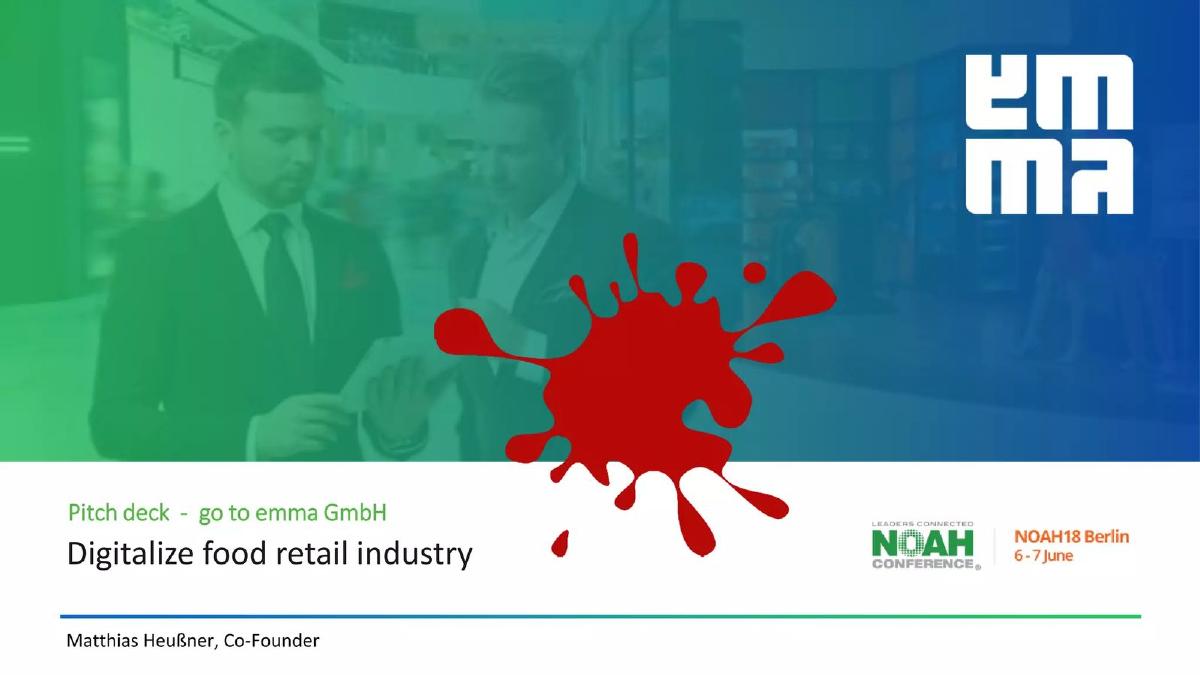
The deck opens with a standard title slide identifying the company as 'go to emma GmbH' and their mission to 'Digitalize food retail industry.' The presentation was delivered by Matthias Heußner, Co-Founder, at the NOAH18 Berlin conference. Slide 2 is a duplicate of the title slide but features a large red 'splat' graphic, likely used as a visual transition or to emphasize a 'pain point' during a live presentation, though no text is added to explain the graphic.
Slide 4: Target Group and Problem Definition
This slide bifurcates the market into two distinct segments. First, Wholesalers , which the company describes as 'Highly fragmented' with 'cost pressure' and a 'Low degree of digitalization.' Several logos are displayed, including Liebing, Bodan, MCS, Stiegl, and SchokoRing. Second, Retail chains , defined as entities managing 'between 3 and 200 stores' with 'Limited personnel resources.' Logos for Budni, Struve, Edeka Süllau, Rewe Freidank, and KaDeWe Berlin are shown as representative examples. The right side of the slide introduces three service tiers: Scout (access to new products), Assist (bundling offers and store integration), and Connect , which is marked as 'NEW' and focuses on supplier network management.
Slide 6: The 'Secret Sauce' - emma Connect
Slide 6 focuses entirely on the 'Connect' feature, which the company labels as the 'accelerator for our business model.' The functionality includes allowing retailers to invite suppliers to the platform to 'Collaborate and interact' via messaging, requests, appointments, and reorders. A red call-out box explicitly states their growth thesis: 'SaaS + network effect = secret sauce.' The claim is that by having retailers invite their own suppliers, the platform gains access to new potential customers with 'no marketing costs.' A screenshot of the interface shows a supplier profile (Elbler GmbH) with activity logs, interaction buttons, and contact details for sales representatives.
Slide 8: Technology and Platform Strategy
This slide outlines the technical foundation and the long-term ecosystem vision. The 'Technology powers functionality' section lists four key attributes: separation of UI and business logic, event-driven architecture, public interactions without registration, and a 'high performant technology stack.' The right side of the slide features a 'Platform strategy' diagram. At the center is the 'Core' emma brand, surrounded by logistics, marketing services, store optimization, AI, voice & data services, and HR/financing services. This suggests that the company views its initial retail tool as an entry point to becoming a comprehensive operating system for the retail industry.
Slide 12: Contact and Interface Preview
The final slide provides contact information for Matthias Heußner, Co-Founder & Managing Partner, based in Hamburg. It features a large mockup of the platform's web interface, showing a product page for 'Bio-Riegel' (organic bars) and a dashboard that tracks orders, feedback, and delivery dates. The interface appears to be a B2B marketplace or procurement portal where retailers can view product details, margins, and logistics information.
What Works in This Deck
Clear Segmentation: Slide 4 does an excellent job of defining exactly who the product is for. By specifying that they target retail chains with 3 to 200 stores, they demonstrate a focused go-to-market strategy rather than a vague 'we sell to everyone' approach. · Visualizing the Network Effect: The 'secret sauce' slide (Slide 6) clearly explains how the company intends to scale. Investors generally value organic growth loops, and the mechanism of 'retailer-invites-supplier' is a classic B2B growth lever. · Platform Vision: Slide 8 shows that the founders are thinking beyond a simple procurement tool. By mapping out logistics, financing, and AI services, they present a much larger 'Terminal Value' for the company. · Product Maturity: The inclusion of detailed screenshots (Slides 6 and 12) suggests that the product is not just a concept but a functional platform with a developed UI/UX.
What is Missing from This Deck
Market Sizing (TAM): There is no mention of the total addressable market. While they list target groups, they do not quantify the number of such retailers in Germany or Europe, nor the potential revenue per store. · Business Model/Unit Economics: The deck mentions 'SaaS,' but it does not disclose pricing tiers, average contract value (ACV), or churn rates. It is unclear if they charge the retailer, the supplier, or take a transaction fee. · The Team: Only one co-founder is mentioned. A standard pitch deck should include a dedicated team slide highlighting the backgrounds of the technical and commercial leadership. · Competition: The deck lacks a competitive landscape slide. In the crowded retail-tech and B2B marketplace space, failing to differentiate from incumbents or other startups is a significant omission. · The Ask: There is no slide indicating how much money the company is raising, what milestones that capital will achieve, or their current funding status.
Founder Takeaways
Leverage your users for acquisition. The most compelling part of this deck is the 'Connect' strategy. If your software sits between two parties (like a buyer and a seller), building features that require one party to invite the other is the most efficient way to lower your Customer Acquisition Cost (CAC). Founders should look at Slide 6 as a template for explaining B2B virality.
Define your 'Goldilocks' customer. Go to emma doesn't just say 'retailers.' They say 'retailers with 3 to 200 stores.' This specificity tells an investor that the founder understands their sales cycle. Too small, and the revenue isn't there; too large, and the sales cycle is too long. Finding that 'just right' segment is crucial for early-stage traction.
Show, don't just tell, the tech. Instead of just saying 'we have a good platform,' Slide 8 lists specific architectural choices like 'event-driven architecture.' While most investors aren't engineers, these details provide 'technical social proof' that the product is built to scale and isn't just a simple CRUD (Create, Read, Update, Delete) application.
Balance product and finance. This deck is very heavy on 'how it works' and very light on 'how it makes money.' Founders should ensure that for every slide showing a product feature, there is a corresponding slide showing the business impact—whether that is revenue growth, market share, or cost savings for the customer.
Frequently asked questions
- What problem is go to emma trying to solve?
- The company addresses the lack of digitalization in the food retail industry. Specifically, it targets the high fragmentation and cost pressures faced by wholesalers, as well as the limited personnel resources of retail chains managing multiple locations. By providing digital tools for product discovery and supplier management, they aim to modernize manual retail operations.
- How does the 'Connect' feature drive growth?
- According to slide 6, 'emma Connect' acts as a business model accelerator. It allows retailers to invite their existing suppliers to the platform to collaborate on messaging, reorders, and returns. This creates a network effect where the platform gains access to potential new customers (the suppliers) at zero marketing cost.
- What is the technical architecture of the platform?
- Slide 8 details a 'high performant technology stack' featuring an event-driven architecture and a strict separation between the user interface and business logic. The platform is designed to allow 'public interactions without registration,' suggesting a low-friction entry point for external partners and suppliers.
- Who are the primary customers for this service?
- The deck lists two main segments on slide 4: Wholesalers (citing examples like Liebing, Bodan, and MCS) and Retail Chains (citing brands like Budni, Rewe, and KaDeWe). They specifically focus on chains that operate between 3 and 200 individual store locations.
- What is missing from this pitch deck?
- The provided slides are missing several standard venture components, including a comprehensive team slide (only one co-founder is shown), market size (TAM/SAM/SOM), competitor analysis, historical financial performance, and a clear 'Ask' regarding how much capital they are raising and how it will be deployed.