Good Gaming (OTCQB: GMER) presented this deck in December 2021 to position itself as a diversified gaming company entering the blockchain space. At the time, the company reported a trailing twelve-month revenue of $348,000 and a market capitalization of $1 million. The deck serves as a transition narrative, moving away from its roots in Minecraft server development toward a new NFT-based ecosystem called MicroBuddies. While the deck provides clear capital structure data and a high-level overview of NFT market growth, it lacks granular unit economics, a specific funding ask, and a detailed bre…
Key takeaways
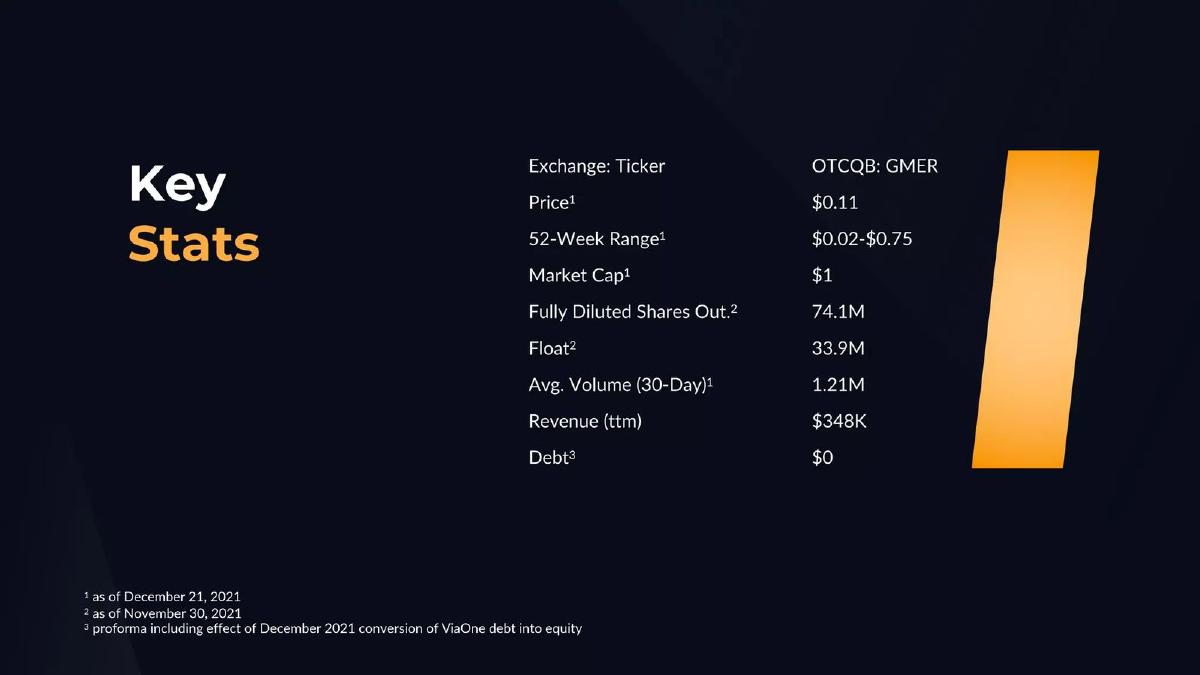
- The company is publicly traded on the OTCQB under the ticker GMER, with a stated price of $0.11 as of December 21, 2021 (Slide 2).
- Revenue for the trailing twelve months was reported at $348,000, with $0 in proforma debt following a debt-to-equity conversion (Slide 2).
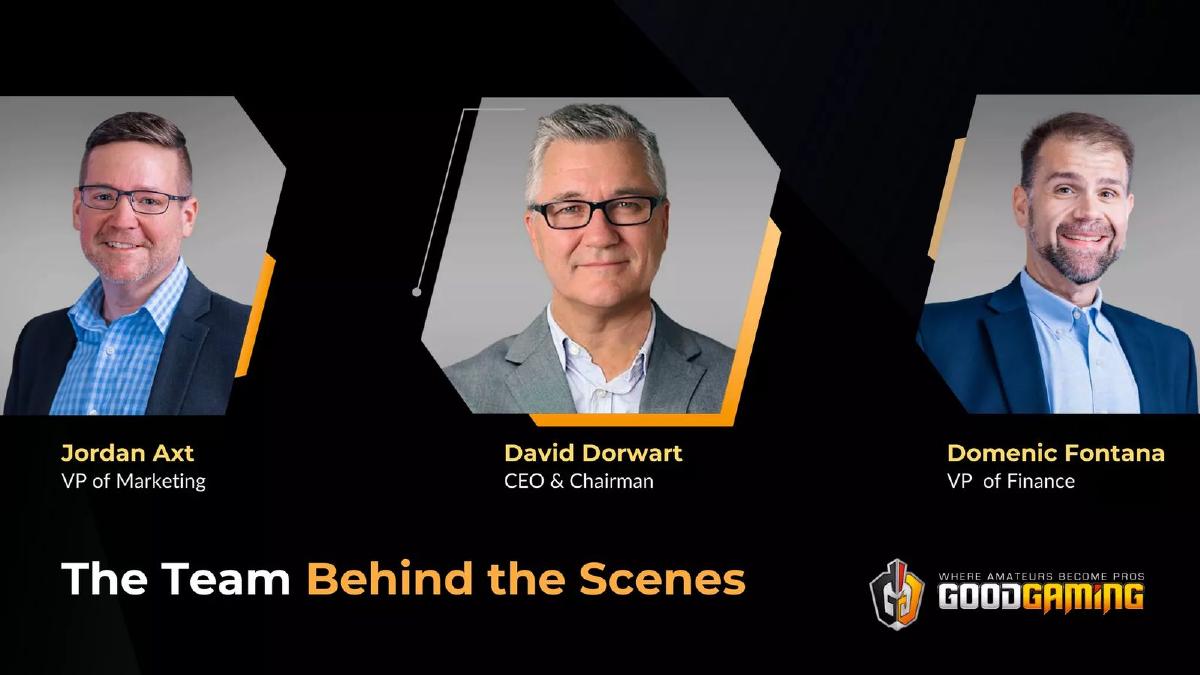
- The leadership team consists of three key executives: David Dorwart (CEO), Jordan Axt (VP Marketing), and Domenic Fontana (VP Finance) (Slide 3).
- The deck leans heavily on macro NFT data, citing $10.7 billion in total Q3 2021 sales volume to validate the sector (Slide 4).
- A core component of the new strategy involves 'GOO,' an in-game currency intended for use across multiple future games (Slide 5).
- The business model relies on three primary streams: Nano Factory Token sales, 5% royalties on NFT trades, and buybacks of GOO (Slide 6).
- The company identifies Minecraft server development as one of its three key growth drivers alongside blockchain implementation (Slide 8).
- MicroBuddies gameplay involves a three-step process: synthesizing tokens, replicating generations, and using a 'Recombobulator' to optimize traits (Slide 10).
Good Gaming: A Micro-Cap Pivot to Web3
The Good Gaming investor deck from December 2021 represents a specific moment in time when traditional gaming micro-caps were aggressively pivoting toward blockchain and NFT integration. Listed on the OTCQB, the company used this presentation to bridge the gap between its legacy Minecraft operations and its future as a producer of collectible NFT games. The deck is structured to educate traditional investors on the blockchain space while presenting a streamlined financial snapshot of the public entity.
Slide 1: Title and Market Position
The cover slide establishes the brand identity with the tagline "Where Amateurs Become Pros." Crucially, it prominently displays the OTCQB: GMER ticker symbol. This immediately signals to the viewer that this is not a private seed-stage startup, but a publicly traded micro-cap company. The December 2021 date places this deck at the peak of the NFT market cycle.
Slide 2: Key Stats and Capital Structure
This is one of the most informative slides in the deck, providing a transparent look at the company's valuation and liquidity. It lists a price of $0.11 and a 52-week range of $0.02 to $0.75, showing significant volatility. The market cap is stated at $1 million, which is exceptionally low for a public company. The revenue (ttm) of $348K suggests a company in a very early stage of commercialization or one that is undergoing a significant contraction of its previous business. The mention of $0 debt, attributed to a debt-to-equity conversion, is a strategic inclusion intended to show a clean balance sheet.
Slide 3: The Leadership Team
The team slide features David Dorwart (CEO), Jordan Axt (VP Marketing), and Domenic Fontana (VP Finance). The slide is light on specific past company exits or pedigree, though a later summary slide (Slide 8) mentions 14 years of marketing experience for Axt. For a public company, investors typically look for deeper board bios and previous experience with SEC compliance, which are not detailed here.
Slide 4: The NFT Market Thesis
This slide serves as a "Why Now?" argument, relying entirely on external market data rather than internal company performance. It cites $10.7 billion in Q3 2021 sales volume and the $69.3 million Beeple sale. While these figures were impressive at the time, the slide functions more as an educational tool for investors who might not understand NFTs, rather than a specific explanation of why Good Gaming is the right player to capture this market.
Slide 5: Blockchain Utility and Interoperability
Here, the company explains its technical approach. It highlights the shift from traditional gaming (where only developers benefit) to blockchain gaming (where players own assets). A key takeaway is the introduction of "GOO," the in-game currency. The slide suggests that GOO will have interoperability, meaning it could be used in future games beyond their first release. This is a common promise in Web3 gaming decks intended to show long-term ecosystem value.
Slide 6: The Business Model
The revenue model is clearly defined into three buckets: 1. Upfront sales of Nano Factory Tokens. 2. A 5% royalty on secondary trades of MicroBuddies. 3. The ability to sell tokens for cash or buy back GOO. The 5% royalty model is standard for NFT projects, providing a path to recurring revenue if the game maintains a high volume of player-to-player trading.
Slide 7: The Missing Financial Model
Slide 7 is a placeholder titled "What is Our 5 Year Financial Model?" In the provided set, the actual data for this model is missing. For an investor, a title slide without the accompanying data is a significant red flag. It is possible the data was intended to be presented verbally or was contained in the subsequent slides not included in this selection, but as it stands, the deck lacks the very projections it promises.
Slide 8: Summary Highlights
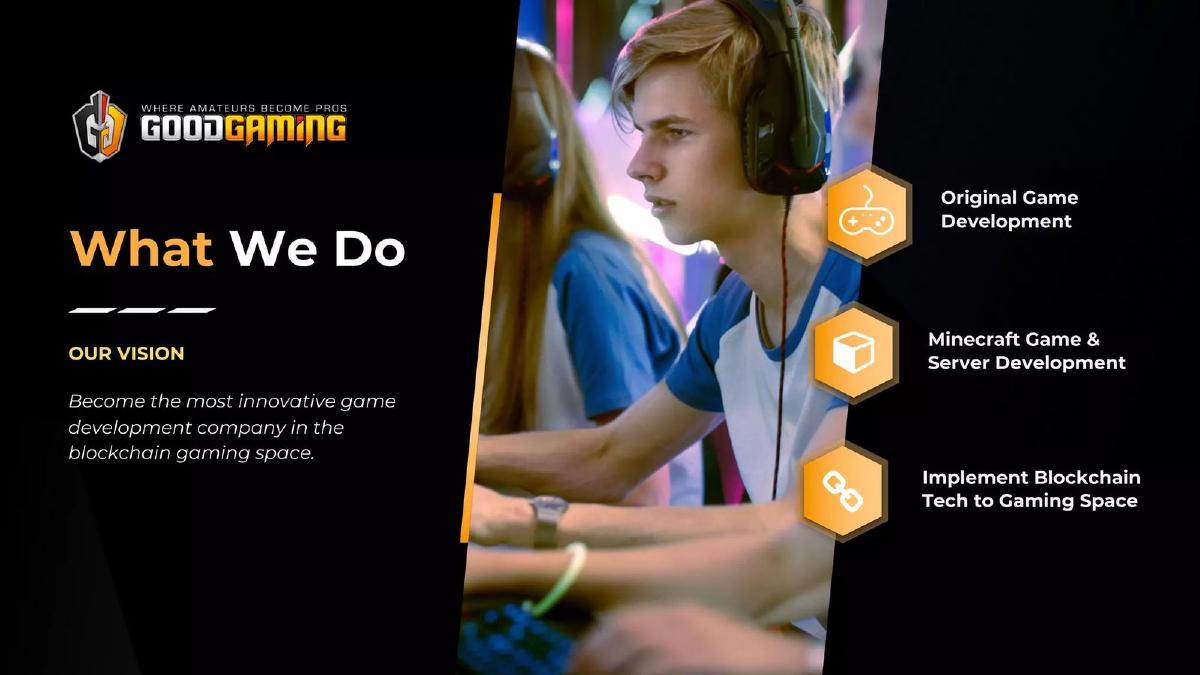
This slide reiterates the core value proposition. It identifies three growth drivers: blockchain implementation, original game development, and Minecraft server development. The inclusion of Minecraft is vital, as it suggests the company has a baseline of technical infrastructure and a community to leverage, rather than starting from zero in the NFT space.
Slide 9: Appendix Transition
A simple transition slide indicating the end of the main pitch and the beginning of supplemental technical or gameplay details.
Slide 10: MicroBuddies Gameplay Mechanics
The final slide in this set details the actual product. It describes a breeding and optimization loop: synthesizing a "Gen 0" buddy, replicating it to evolve traits, and using a "Recombobulator" to optimize rarity. The art style is cartoonish and accessible, targeting a casual gaming audience. This slide is important because it shows the company actually has a product concept with defined mechanics, moving beyond just high-level blockchain theory.
What Works in This Deck
The deck is successful in its transparency regarding the company's public market status. Slide 2 provides all the necessary data points—float, shares outstanding, and debt status—that a retail or institutional investor would need to evaluate the stock's structure. The business model on Slide 6 is also commendable for its simplicity; it avoids complex tokenomics jargon and focuses on how the company actually captures value from the ecosystem.
What is Missing or Needs Improvement
The most glaring omission is the lack of a specific "Ask." While the company is public, an investor deck usually accompanies a specific capital raise or a push for liquidity. There is no mention of how much capital is being sought or how those funds will be allocated between marketing, development, and operations. Furthermore, the absence of the 5-year financial model (despite having a title slide for it) leaves the growth trajectory entirely to the imagination. Finally, the deck lacks competitive analysis. In 2021, the blockchain gaming space was crowded with well-funded competitors like Axie Infinity; Good Gaming does not explain how it intends to compete for player attention against these giants.
Founder's Takeaway: Lessons from Good Gaming
Founders can learn from the way Good Gaming attempted to leverage a legacy asset (Minecraft servers) to validate a new technology pivot. However, the heavy reliance on macro-market hype (Slide 4) is a cautionary tale. When the market for a specific technology cools, decks that rely on "market growth" rather than "proprietary advantage" lose their persuasiveness. Always ensure that if you include a title slide for a financial model, the data is robust, visible, and clearly explained. For public companies, the clarity of the capital structure shown on Slide 2 is a gold standard that private companies should emulate when discussing their own cap tables with sophisticated investors.
Frequently asked questions
- What is the current financial status of Good Gaming according to the deck?
- As of late 2021, the company reported $348,000 in TTM revenue. It had a market cap of $1 million and a share price of $0.11. Notably, the deck claims $0 in debt, citing a December 2021 conversion of ViaOne debt into equity, which cleaned up the balance sheet for new investors.
- How does the company plan to make money from its NFT games?
- The business model focuses on recurring revenue through a 5% royalty fee on all secondary market trades of 'MicroBuddies' NFTs. Additionally, they generate upfront revenue through the sale of 'Nano Factory Tokens' prior to game launches and utilize an in-game currency called GOO to facilitate the ecosystem.
- What is the significance of the Minecraft mention in the deck?
- Good Gaming lists Minecraft game and server development as a 'Key Growth Driver.' This suggests that while they are pivoting to blockchain, their legacy business or existing technical expertise remains rooted in managing large-scale multiplayer environments, providing a foundation for their newer NFT initiatives.
- Who are the key people running the company?
- The team is led by CEO and Chairman David Dorwart. He is supported by Jordan Axt, who manages marketing and branding with 14 years of experience, and Domenic Fontana, who oversees the financial and accounting aspects of the OTC-listed entity.
- What is missing from this investor presentation?
- The deck is missing several critical components: a specific capital request (the 'Ask'), a detailed breakdown of the five-year financial projections (Slide 7 is just a title), and specific user acquisition costs or player retention metrics for their existing or upcoming games.