Goodcarbon’s 18-slide deck addresses the critical 'nature crisis' as a prerequisite for solving the climate crisis. The company positions itself as a managed service and marketplace for high-quality, nature-based carbon credits, targeting the 3,000+ global companies with science-based net-zero targets. By offering 'Spot,' 'Forward,' and 'Stream' contract options, Goodcarbon allows enterprises to hedge against a forecasted 10-15x increase in carbon removal prices by 2050. The deck emphasizes a proprietary 'Nature Analytics Framework' to mitigate greenwashing risks, which have historically plag…
Key takeaways
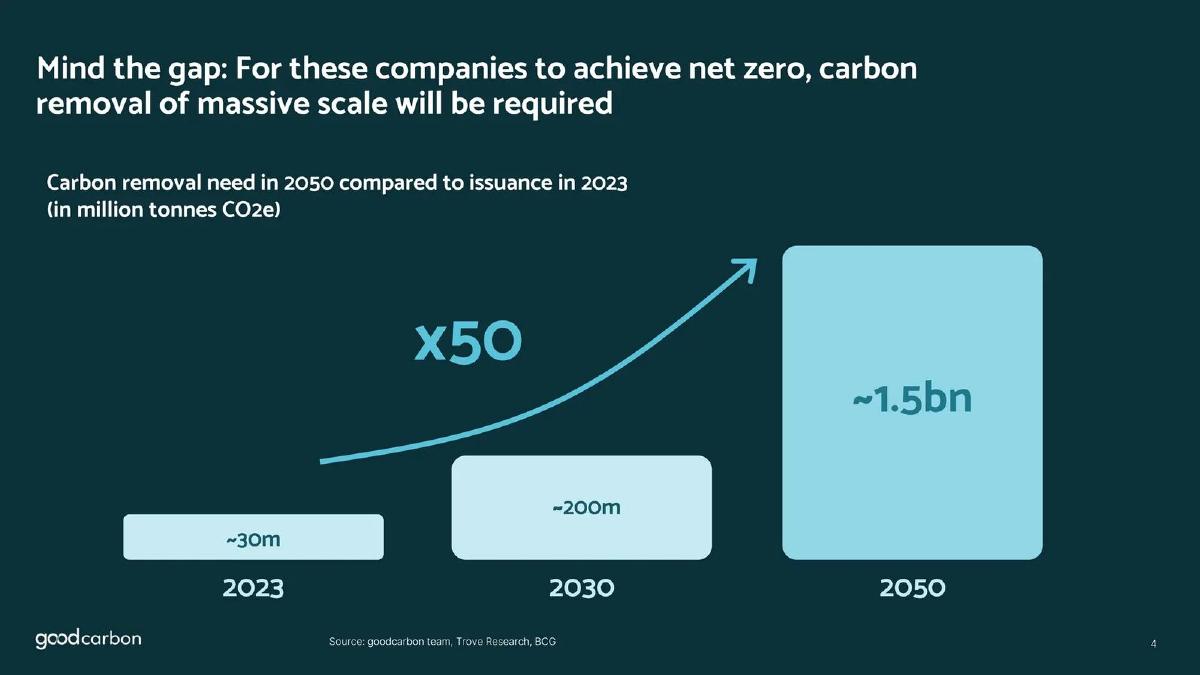
- The deck identifies a massive supply-demand gap, forecasting a 50x increase in carbon removal needs by 2050 compared to 2023 issuance (Slide 4).
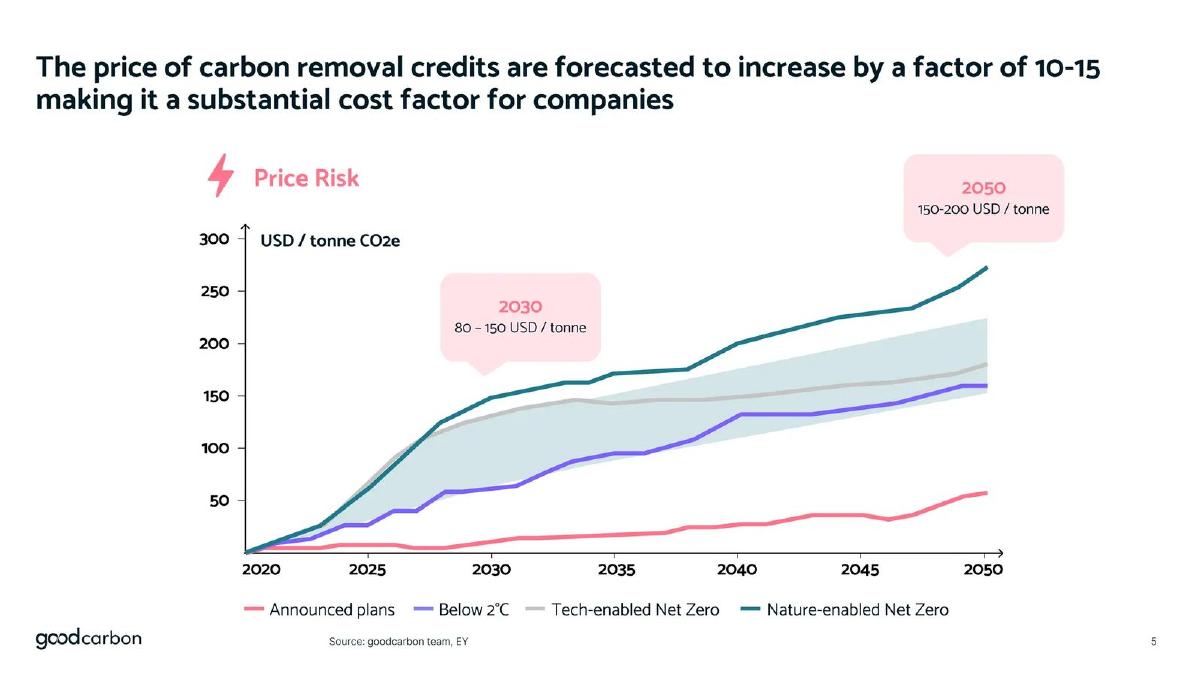
- Goodcarbon projects carbon removal prices will rise from current levels to between 150-200 USD per tonne by 2050 (Slide 5).
- The business model utilizes three contract tiers: Spot for short-term, Forward/Offtake for mid-term, and Stream for long-term bespoke projects (Slide 7).
- Supply is sourced through three channels: Marketplace projects, Goodcarbon Originals, and Bespoke project development (Slide 8).
- A proprietary Nature Analytics Framework scores projects out of 5 based on Impact, Risk Mitigation, and Integrity (Slide 10).
- The company claims to have built an exclusive inventory of approximately 9,000k tonnes across retail, platform, and original sources (Slide 15).
- The flagship 'Great Green Wall' project in Gujarat, India, aims to sequester over 2 million tonnes of CO2 and restore 10,000 hectares (Slide 16).
- The founding team features significant pedigree, including former McKinsey engagement managers and a multi-exit entrepreneur (Slide 17).
Executive Summary: The Nature-Based Solution to the Carbon Gap
Goodcarbon’s pitch deck is a masterclass in identifying a systemic market failure and positioning a startup as the essential infrastructure to fix it. The company focuses on the voluntary carbon market (VCM), specifically Nature-based Solutions (NbS). The core thesis, presented in the opening slides, is that the 'climate crisis' cannot be solved without solving the 'nature crisis.' By 2050, the demand for carbon removal is expected to outstrip 2023 supply by 50x, creating a massive price and reputational risk for the 3,000+ global companies that have committed to science-based net-zero targets.
Slides 1-2: The Problem and the Mission
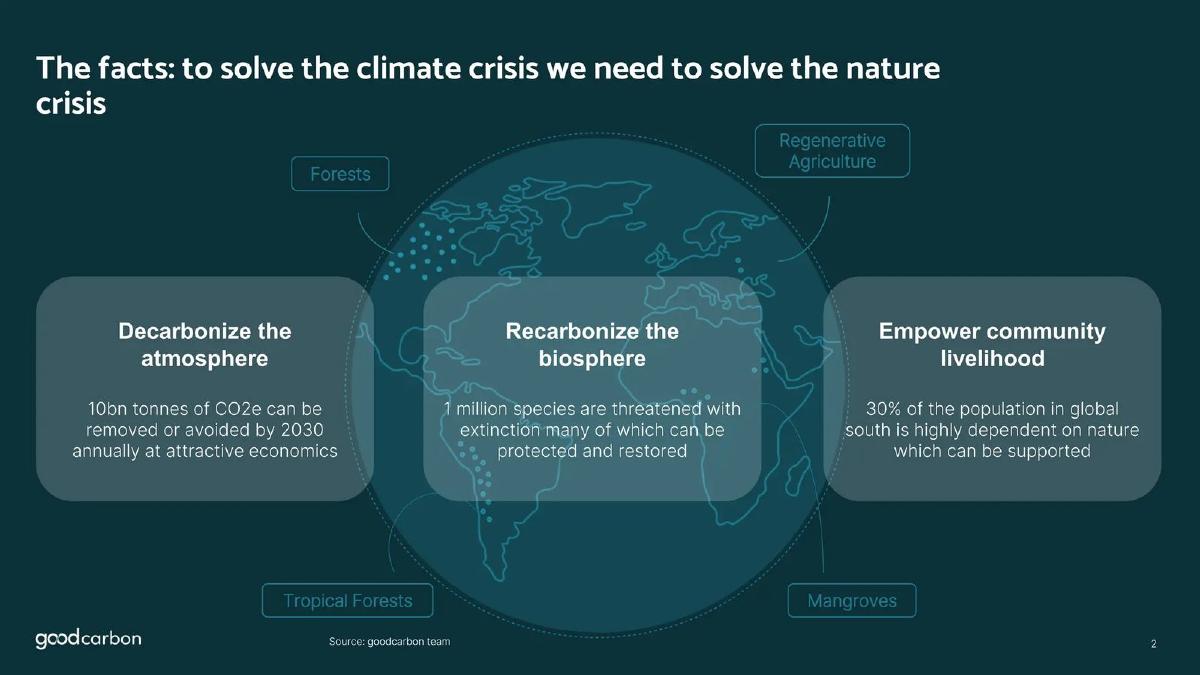
The deck opens with a clear mission statement: building and managing trustworthy, long-term carbon credit portfolios. Slide 2 establishes the 'Nature Crisis' context, citing that 10bn tonnes of CO2e can be removed or avoided annually by 2030 through nature, while 1 million species face extinction. This sets a high-stakes emotional and economic baseline for the pitch.
Slides 3-6: Market Dynamics and Risk Factors
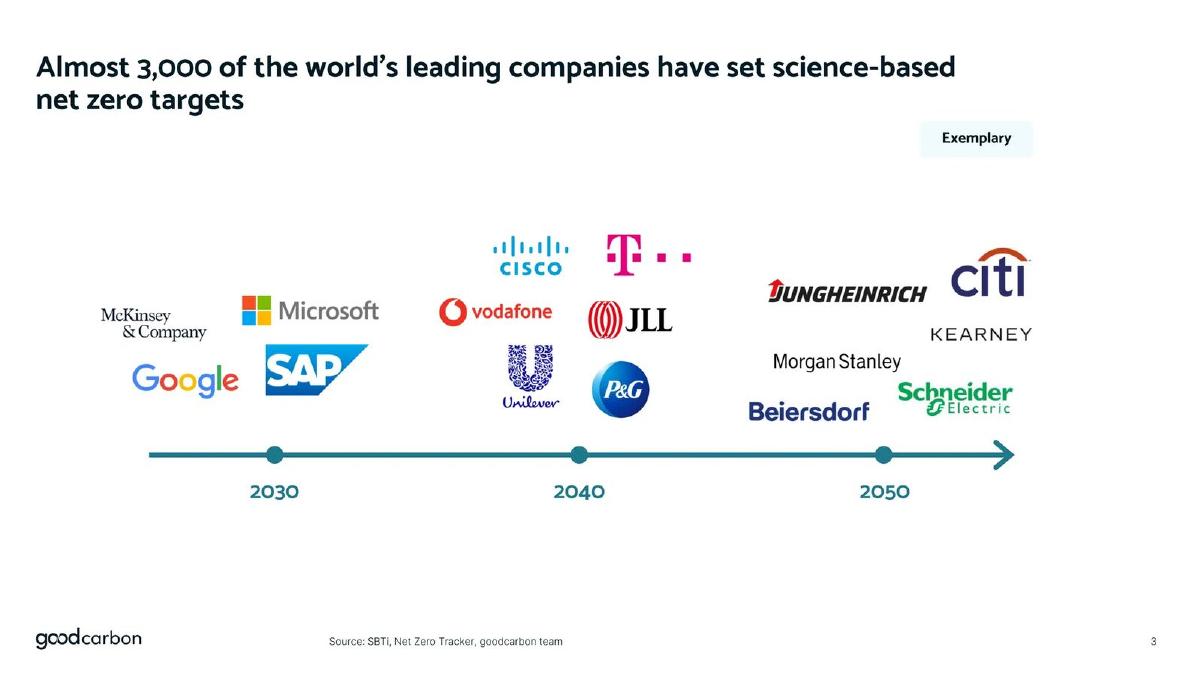
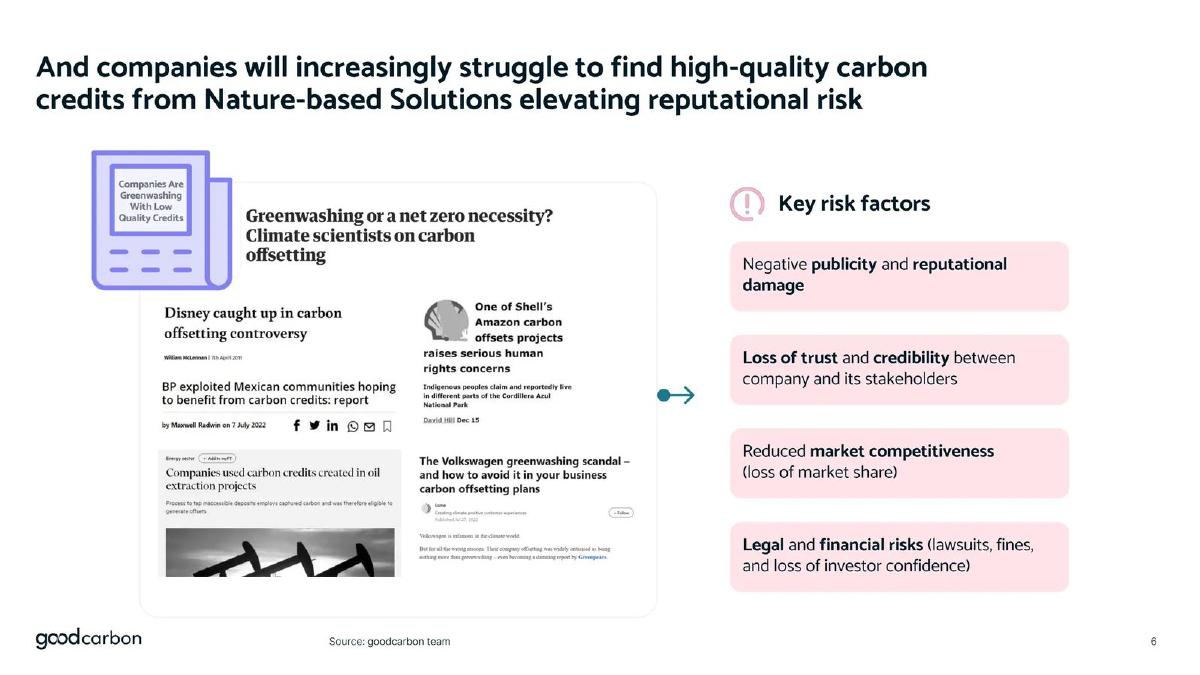
Slide 3 highlights the 'Exemplary' list of companies (Microsoft, Google, Unilever, etc.) with net-zero targets. Slide 4, titled 'Mind the gap,' is the most critical slide in the deck. It shows the supply shortfall: 30m tonnes issued in 2023 versus a 1.5bn tonne need by 2050. Slide 5 follows up with the financial consequence: prices are forecasted to rise from current lows to 150-200 USD per tonne by 2050. Slide 6 addresses the 'Greenwashing' elephant in the room, showing headlines of controversies involving Disney, BP, and Shell to emphasize the 'reputational risk' that Goodcarbon’s framework aims to mitigate.
Slides 7-9: The Solution and Portfolio Building
Goodcarbon moves from the 'why' to the 'how' on Slide 7. They introduce a tiered contract model: Spot , Forward/Offtake , and Stream . This is a sophisticated financial approach, treating carbon credits as a commodity that requires hedging. Slide 8 details their supply sources, including 'Goodcarbon Originals' and 'Bespoke project development,' which suggests they are moving up the value chain to control supply rather than just brokering it. Slide 9 provides a global map of their current projects, covering forest, soil, and ocean-based initiatives in locations like Mexico, India, and Germany.
Slide 10: The Nature Analytics Framework
This slide is the 'moat' slide. It details a three-step process: Data Collection (remote sensing, site visits), Analysis (impact, risk mitigation, integrity), and Scoring. By showing a sample score of '3.7 out of 5,' they demonstrate that their vetting process is rigorous and not every project passes. This is designed to build trust with conservative corporate ESG departments.
Slides 11-12: Portfolio Management and Social Proof
Slide 11 showcases their software interface, which allows clients to monitor their portfolio composition (e.g., 86% Avoidance vs. 14% Removal) and track performance over time. Slide 12 provides the 'Logo Slide,' featuring major European brands like Deutsche Telekom and Melitta, alongside partners like Conservation International and the World Bank.
Slides 13-15: Traction and Inventory
Slides 13 and 14 are traction deep-dives. While the version provided uses 'XX' and 'X%' placeholders, the structure is telling. They track 'Contracted Revenues' and 'Gross Margin' per client, along with metrics like sales cycle length and sales person efficiency. Slide 15 claims an inventory of ~9,000k tonnes, which is a significant volume intended to prove they have solved the supply side of the equation.
Slide 16: The Flagship Project
The deck spends a full slide on the 'Great Green Wall' project in Gujarat, India. This serves as a case study for their 'Originals' line. It lists specific outcomes: 2 million tonnes of CO2 sequestered, 10,000 hectares restored, and 1.6 million workdays created. This grounds the abstract financial talk in tangible environmental and social impact.
Slide 17: The Team
The team slide is exceptionally strong for a seed-stage company. The founders have significant 'Big Consulting' (McKinsey, Kearney) and 'Big Tech' (Zalando) experience. Jérôme Cochet’s background as a Global MD and David Diallo’s history as a multi-exit entrepreneur provide the operational and scaling credibility needed to handle large-scale enterprise contracts.
What Works in This Deck
The 'Price Risk' Argument: By framing carbon credits as a looming cost center that will increase 10-15x, they turn a sustainability 'nice-to-have' into a CFO-level 'must-have' risk mitigation strategy. · Supply Control: The emphasis on 'Originals' and 'Bespoke' projects addresses the primary bottleneck in the VCM: the lack of high-quality, verifiable supply. · Institutional Tone: The design is clean, professional, and avoids the 'hippie' aesthetic often found in climate tech, which helps when selling to Fortune 500 companies.
What Is Missing or Redacted
Actual Financials: The use of 'XX' placeholders makes it impossible to judge the current scale of the business or the health of their margins. · Unit Economics: While they mention 'attractive customer economics,' they don't explicitly break down the take-rate or the cost of project development versus marketplace brokerage. · Competitive Landscape: The deck does not mention other carbon marketplaces or project developers, leaving the investor to wonder how they differentiate from players like Patch or South Pole.
Founder Takeaways: What to Copy
The 'Gap' Slide: If you are in a supply-constrained market, a slide showing the widening gap between current supply and future demand is the best way to create urgency. · Framework Transparency: Don't just say your product is 'high quality.' Show the 165 criteria or the 3-step scoring process you use to define that quality. · Contract Tiering: If your product has long lead times (like growing a forest), offer different contract types (Spot vs. Stream) to capture different types of budget and risk appetite.
Frequently asked questions
- What is Goodcarbon's core value proposition?
- Goodcarbon helps companies build and manage trustworthy, long-term carbon credit portfolios using Nature-based Solutions (NbS). They act as both a marketplace and a project developer, providing a framework to ensure credit quality and a mechanism for companies to hedge against the rising costs of carbon removal credits as they work toward net-zero goals.
- How does Goodcarbon address the risk of greenwashing?
- The deck highlights a 'Nature Analytics Framework' on Slide 10. This system evaluates projects across 165 criteria, including permanence, additionality, and community benefits. By providing institutional-grade scoring and monitoring, they aim to protect corporate clients from the reputational and legal risks associated with low-quality carbon offsets.
- What are the different ways a company can buy credits through Goodcarbon?
- According to Slide 7, there are three contract options: Spot (immediate credits for short-term targets), Forward/Offtake (securing mid-term needs through agreements), and Stream (building long-term portfolios by funding new NbS projects or owning them directly). This tiered approach allows for flexible capital allocation based on the client's net-zero timeline.
- What kind of traction does the company show?
- Slide 12 lists several 'trusted' companies, including Deutsche Telekom, Bertelsmann, Melitta, and Solarisbank. Slide 13 shows a bar chart indicating significant growth in 'Contracted Revenues' from Q4 2022 through Q1 2024, although the specific Euro amounts are redacted in this public version of the deck.
- Who is behind Goodcarbon?
- The team is led by Co-Founders Jérôme Cochet (former Global MD at Dunnhumby and SVP at Zalando) and David Diallo (a multi-exit entrepreneur). The leadership also includes Dr. Nicola Rodewald, a PhD in Biology and former McKinsey manager, and Ricarda Röller, who brings a background from Kearney and London Business School.