Good-Loop’s Series A deck is a masterclass in aligning a social mission with hard commercial metrics. By positioning their advertising platform as a solution to the 'all-time low' of public trust in advertising (Slide 4), they successfully tapped into the surging ESG (Environmental, Social, and Governance) corporate mandate. The deck highlights a 100% year-over-year growth rate and a 168% increase in repeat deal size (Slide 2), proving that ethical advertising isn't just a moral choice but a high-performance one. With a clear focus on US expansion and proprietary programmatic technology, the…
Key takeaways
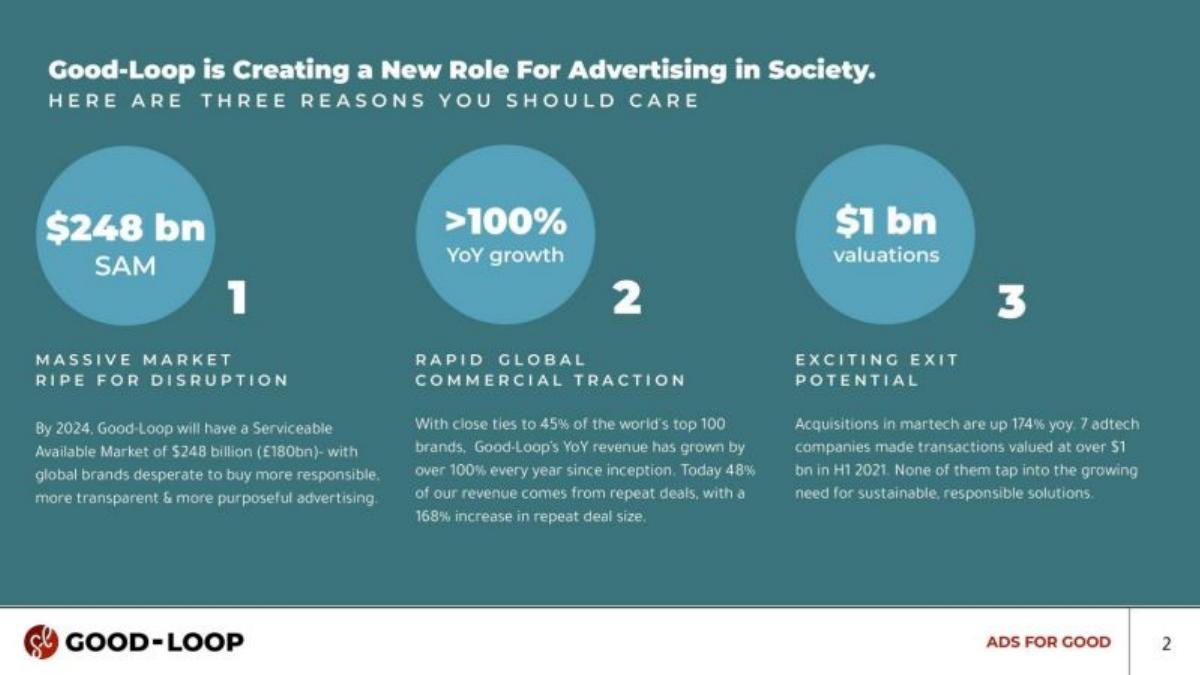
- The company identifies a $248 billion Serviceable Available Market (SAM) driven by brands seeking responsible advertising (Slide 2).
- Good-Loop reports consistent >100% year-over-year revenue growth since its inception (Slide 2).
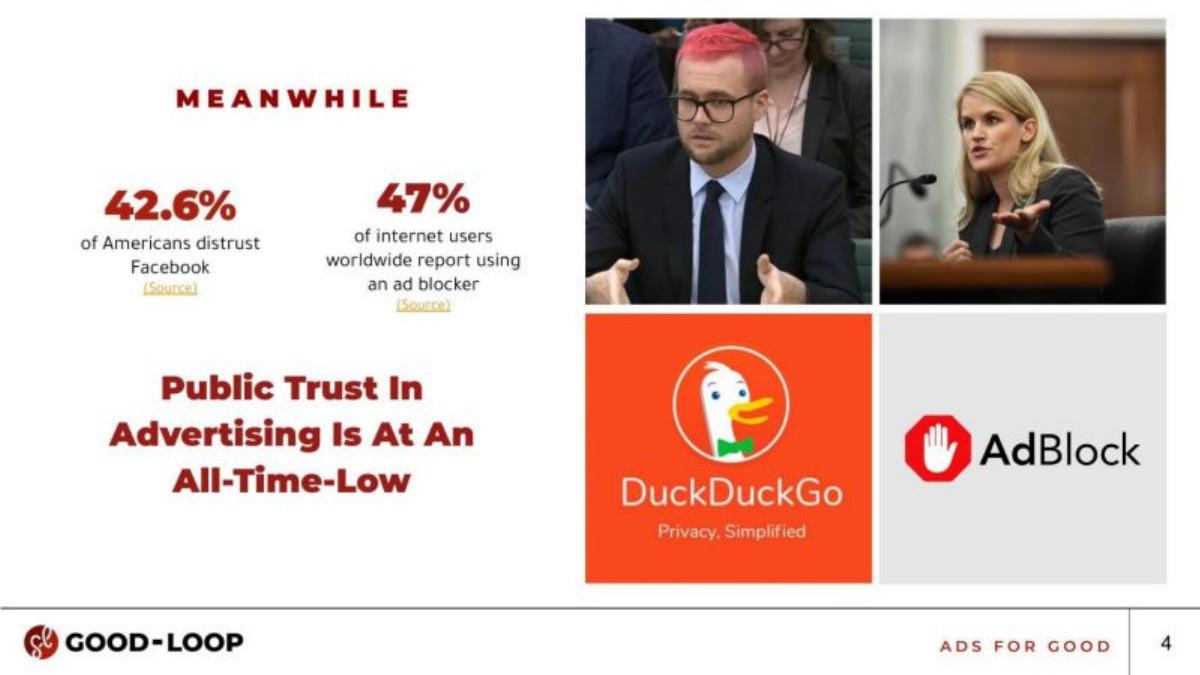
- Public distrust is a core pillar of the problem statement, noting that 47% of internet users report using ad blockers (Slide 4).
- The platform has already raised over $5m for charitable causes through its 'watch to donate' model (Slide 9).
- Commercial traction is evidenced by a jump from £12k GMS in 2017 to a forecast of £4m in 2021 (Slide 10).
- The company achieved 309% ROI on revenue-per-head, reaching £160k ($220k) in H1 2021 (Slide 10).
- US expansion is a primary growth lever, with US deals being >2.5X larger than the global average (Slide 11).
- The deck completely omits a dedicated team slide, which is highly unusual for a Series A round.
Introduction
Good-Loop’s Q4 2021 investment pitch deck represents a transition from a 'social impact startup' to a 'high-growth adtech powerhouse.' The deck, used to raise a £4m ($6M) Series A, focuses heavily on the intersection of corporate social responsibility and measurable marketing performance. By framing their solution as a remedy for the industry-wide crisis of consumer trust, Good-Loop positions itself as an essential tool for the modern CMO.
Slide 1: Title Slide
The cover slide is clean and professional, featuring the tagline 'Effective advertising that’s a force for good in the world.' It establishes the brand identity immediately: a blend of high-end advertising (visualized by Times Square) and social purpose. It is marked as an 'Abridged Version,' which explains why some sensitive data might be condensed.
Slide 2: The Three Reasons to Care
This is a high-impact executive summary slide. It hits three critical investor nerves: market size, traction, and exit potential. Slide 2 claims a $248 billion SAM by 2024, >100% YoY growth, and highlights that 7 adtech companies saw $1bn+ valuations in H1 2021. This immediately frames the company as a venture-scale opportunity rather than a small-scale social enterprise.
Slide 3: The ESG Mandate
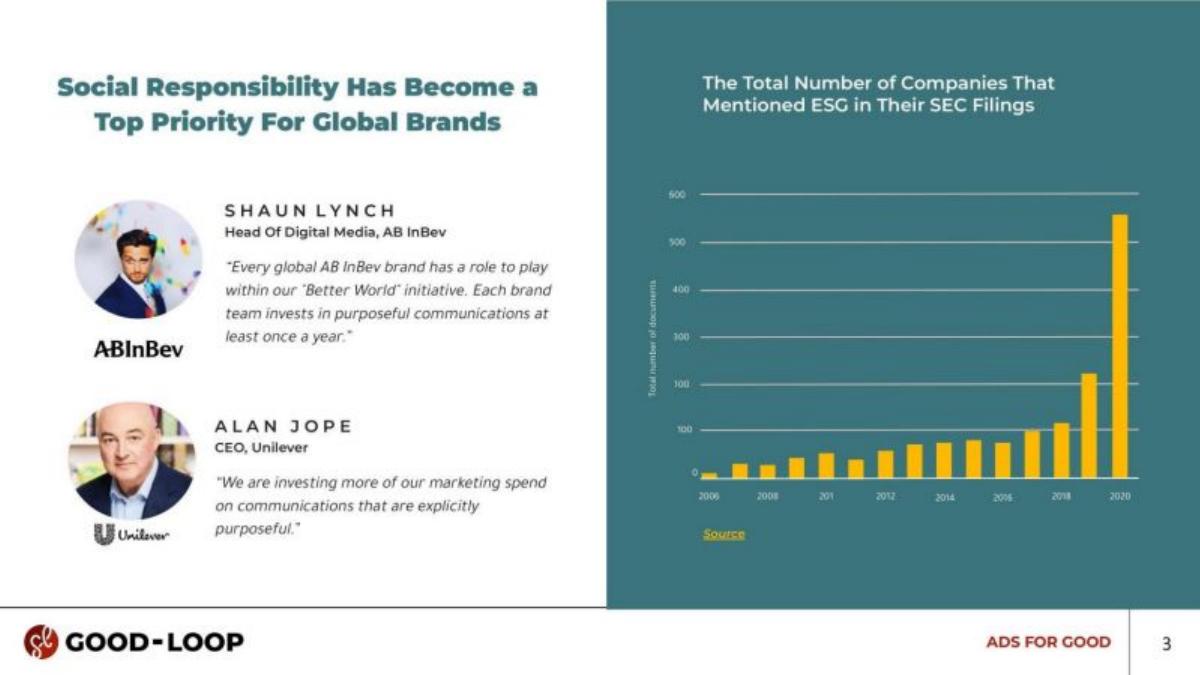
Good-Loop uses social proof from heavy hitters like AB InBev and Unilever. The slide features a chart showing a massive spike in ESG mentions in SEC filings, peaking in 2020. By quoting Alan Jope (CEO of Unilever) saying they are investing more in 'explicitly purposeful' communications, Good-Loop proves that their target customers have already committed to this spending shift at the board level.
Slide 4: The Crisis of Trust
This slide defines the 'Problem.' It cites that 42.6% of Americans distrust Facebook and 47% of internet users use ad blockers. By using images of Frances Haugen and Christopher Wylie (whistleblowers), the deck creates a sense of urgency. The message is clear: traditional advertising is broken, and brands need a new way to reach cynical consumers.
Slide 5: The Solution - Purpose-Powered Formats
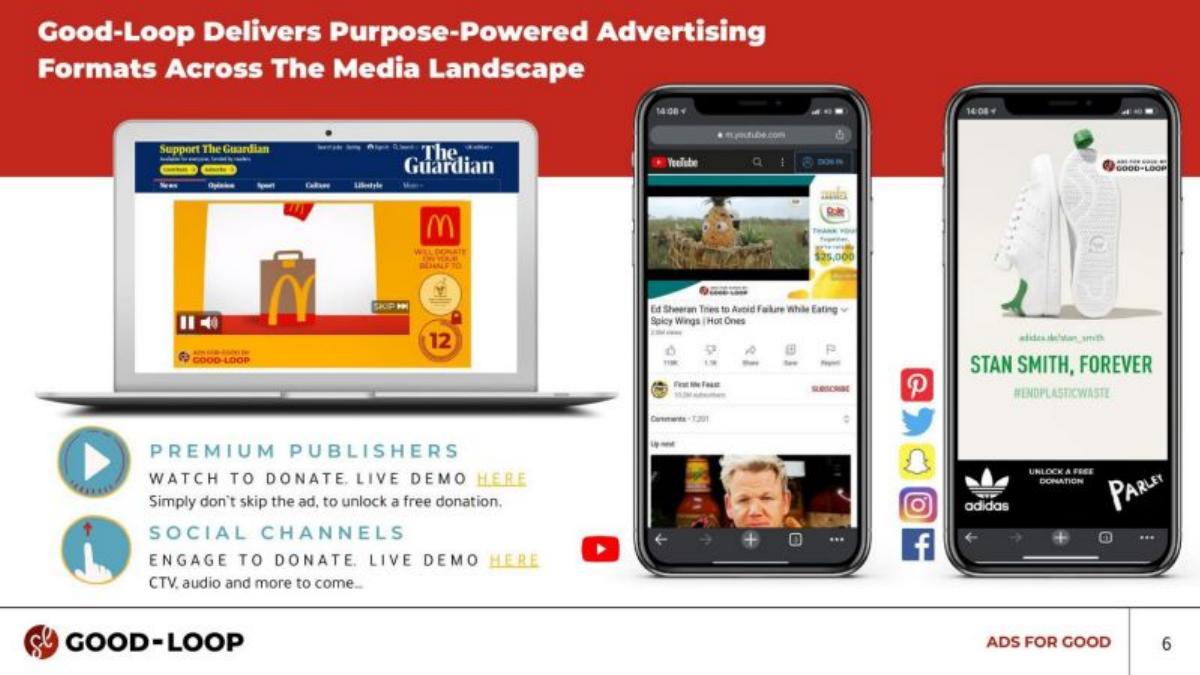
Slide 6 (labeled as 6 in the footer) shows the product in action across The Guardian, YouTube, and social channels like Instagram and Snapchat. The 'Watch to Donate' and 'Engage to Donate' mechanics are clearly visualized. This demonstrates that the technology is platform-agnostic and integrates into existing consumer behaviors rather than requiring a new app or site.
Slide 6: Ethical AdTech Infrastructure
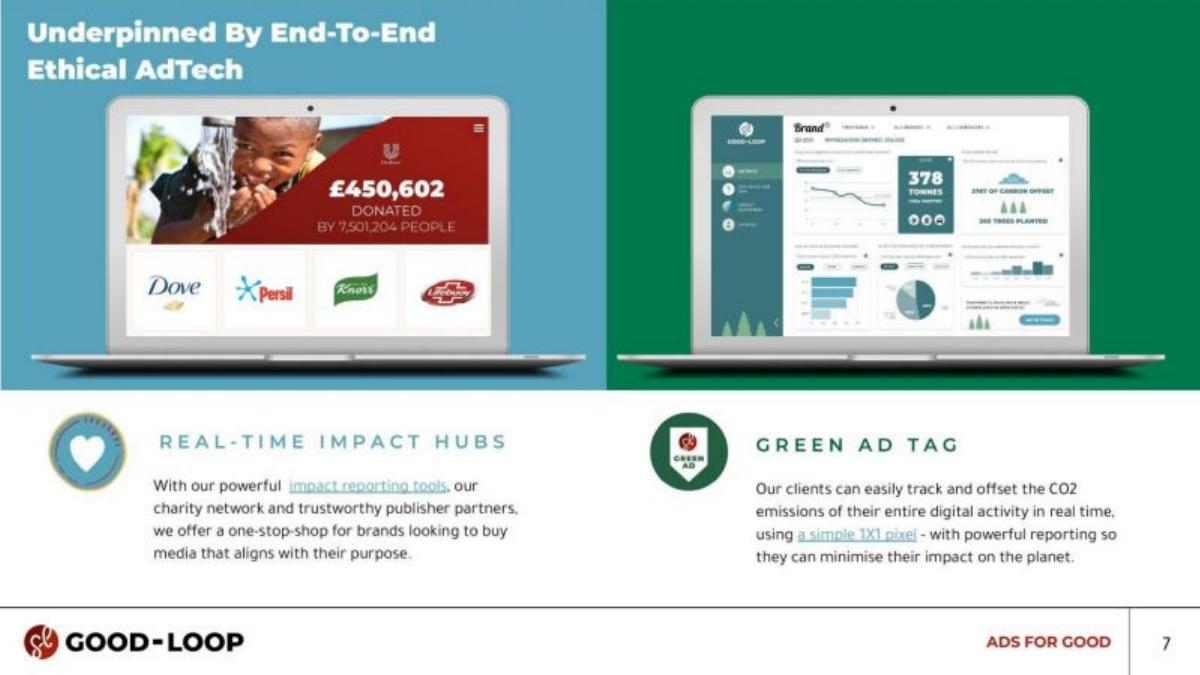
Slide 7 moves beyond the 'donation' hook to show the backend value. It highlights 'Real-Time Impact Hubs' for reporting and the 'Green Ad Tag.' The inclusion of a carbon-tracking pixel is a strategic move to capture the 'Planet' portion of the ESG market, allowing brands to track CO2 emissions from their digital activity in real-time.
Slide 7: Brand Performance Metrics
This is perhaps the most important slide for a Series A investor. Slide 8 proves that 'doing good' leads to 'doing well.' It lists specific uplift metrics: 34% for Bank of the West, 45% for Coca-Cola, and a staggering 71% of competitor customers likely to switch for Dove. This moves the conversation from 'charity' to 'conversion,' which is how adtech budgets are actually unlocked.
Slide 8: Charitable Impact
Slide 9 reinforces the mission. It states the company has raised over $5m for good causes and displays logos of partners like UNICEF, WWF, and Amnesty International. It also notes their B-Corp certification and Net Carbon Negative status, cementing their credibility as a truly ethical player in a often-criticized industry.
Slide 9: Commercial Traction and Growth
Slide 10 provides the hard numbers. Gross Marketing Spend (GMS) grew from £12k in 2017 to a forecast £4m in 2021. The headcount grew from 3 to 22 in the same period. Crucially, it notes that 48% of deals are repeats and the average deal size increased by 168%. This indicates strong product-market fit and a 'land and expand' sales success.
Slide 10: US Momentum and 'Bluesky' Potential
Slide 11 focuses on the future. It shows that the US market, despite having only 2 UK-based staff members, already accounts for over 1/3 of turnover. The 'Bluesky' goal is to secure a '2% of spend' commitment from the world's top 5 spenders (Amazon, P&G, L'Oreal, Samsung, Unilever), which would be worth $1bn annually. This gives investors a clear 'North Star' for the company's scale.
Slide 11: Industry Disruption Context
Slide 13 (skipping 12 in the provided sequence) compares the digital advertising shift to other disrupted industries. It lists Shopify (disrupting Amazon), Public (disrupting Robinhood), and Lemonade (disrupting Prudential). By placing Good-Loop at the end of this chain, it suggests that 'Brand Ethics' is the next logical evolution of 'Brand Safety.'
Slide 12: The Vision for Brand Ethics
Slide 14 contrasts 'Brand Safety Today' (avoiding fraud/hate speech) with 'Brand Ethics Tomorrow' (positive, sustainable, and quality-journalism-focused). It lists competitors and peers like Integral Ad Science (valued at $3.3bn) and DoubleVerify (valued at $4.2bn), positioning Good-Loop as the ethical equivalent of these multi-billion dollar verification platforms.
Slide 13: The Ask and Use of Funds
The final slide ( Slide 15 ) details the £4m Series A raise. The pie chart shows a heavy lean toward 'Ops / Tech / R&D' and 'US Expansion.' The two key priorities are developing proprietary programmatic technology and building an in-market US sales team. This is a standard and logical use of funds for a company at this stage of growth.
What Works in the Good-Loop Deck
The deck excels at bridging the gap between social impact and commercial viability . Many 'impact' decks fail because they focus too much on the 'why' and not enough on the 'how much.' Good-Loop avoids this by placing hard ROI metrics (Slide 8) and GMS growth charts (Slide 10) at the center of the narrative. The use of 'Bluesky Potential' (Slide 11) is also effective; it shows that the founders aren't just thinking about a small niche, but are targeting the largest advertising budgets on the planet.
The competitive positioning on Slide 14 is also very smart. Instead of comparing themselves to other small charities, they compare themselves to multi-billion dollar ad-verification companies like IAS and DoubleVerify. This changes the investor's mental model from 'charity platform' to 'essential adtech infrastructure.'
What is Missing
The most glaring omission is the Team Slide . In a Series A round, the 'who' is often as important as the 'what.' Investors need to know if the founders have adtech experience, if the engineering team can actually build the proprietary programmatic tech mentioned on Slide 15, and who is leading the US expansion. Without this, the deck feels slightly anonymous.
Additionally, there is a lack of Unit Economics . While GMS and revenue growth are shown, there is no mention of Customer Acquisition Cost (CAC), Lifetime Value (LTV), or gross margins. In adtech, where margins can be thin due to media costs and donation payouts, seeing the 'take rate' or net margin would be critical for a deep-dive analysis.
Founder Takeaways
Quantify the 'Soft' Benefits: If your product offers a social or ethical benefit, you must prove it leads to better business outcomes. Good-Loop’s Slide 8 is the perfect example of turning 'brand love' into 'uplift in ad recall.' · Leverage Macro Trends: Good-Loop didn't just say they were good; they showed that the entire corporate world is moving toward ESG (Slide 3). Aligning your startup with a massive, unstoppable regulatory or cultural shift makes your success seem inevitable. · Show, Don't Just Tell, the Product: Slide 6 uses mockups of the product on recognizable sites like The Guardian and YouTube. This makes the technology feel real and ready for scale, rather than a theoretical concept. · Focus on the 'Big Fish': By showing they already work with 4 out of the top 5 global ad spenders (Slide 11), Good-Loop removes the 'can they sell to big brands?' risk. Even if those deals are currently small, the foot is in the door.
Frequently asked questions
- What is Good-Loop's core business model?
- Good-Loop operates an ethical adtech platform where consumer engagement with advertisements (like watching a video) triggers a donation to a charity. According to Slide 10, they utilize two primary models: Managed Service campaigns, which involve a 50% donation, and Programmatic campaigns, which involve a 33-50% donation. This model aligns brand marketing spend with social impact.
- How does Good-Loop prove that ethical ads actually work for brands?
- Slide 8 provides specific performance metrics from major global brands. For example, Bank of the West saw a 34% uplift in consideration to switch banks, Coca-Cola saw a 45% uplift in ad recall, and Dove saw 71% of competitor customers become 'very likely' to switch after engaging with Good-Loop ads.
- What is the 'Green Ad Tag' mentioned in the deck?
- On Slide 7, Good-Loop introduces the 'Green Ad Tag,' a simple 1x1 pixel that allows clients to track and offset the CO2 emissions of their digital advertising activity in real-time. This expands their value proposition from social charity to environmental sustainability, catering to broader ESG requirements.
- Why is the US market so important for Good-Loop's Series A?
- Slide 11 highlights that the US market represents a massive opportunity because the average deal size there is more than 2.5 times larger than the global average. Despite having only two UK-based employees focused on the US at the time of the deck, the region accounted for over one-third of their 2021 turnover.
- What is missing from this pitch deck?
- The most significant omission is a Team slide. For a Series A round, investors typically want to see the pedigree of the founders and the strength of the leadership team. Additionally, while they mention 'proprietary technology,' there is little detail on the technical defensibility or patent status of their ad-serving stack.