Filestory's 14-slide October 2014 deck is an accelerator application — slide 12 is titled '500-Filestory Fit' — dressed as a pitch deck, and it ends on a sources bibliography with no ask, no valuation and no use of funds. It gets rare things right: real named competitor prices, an admission that Dropbox is a substitute, unbuilt features greyed out, and a measured $8.54 cost of acquisition. But its own competitor table shows Gteam beating its $11 per-seat price above eighteen users in a market it says is 75% small firms, its year-one revenue implies about $7 per user per month against that $11…
Key takeaways
- Filestory's 14-slide October 2014 deck is an accelerator application, not an investor deck — slide 12 is literally titled '500-Filestory Fit' — and it ends on a sources bibliography with no funding ask, no valuation and no use of funds.
- The competitor table is the deck's best slide and its biggest self-inflicted wound: Gteam's $200/month for unlimited users beats Filestory's $11 per user per month above roughly eighteen seats, in a market the deck says is 75% firms of under 49 people.
- The $8.54 acquisition cost is measured from real spend, but it is the cost of a registration, not a paying customer — and with a free PC/Mac tier and no conversion rate stated anywhere, it cannot be compared to the $11 price.
- Year-one financials imply about $7 per user per month against an $11 list price, and revenue per user then rises roughly 43% by year three with no price increase, seat expansion or add-on attach rate explained.
- Traction is 54 registrations over two months and two named beta studios; the very next slide forecasts 5,726 paying users in year one, a 106x jump with no funnel, conversion rate or channel budget bridging the two pages.
- The 627,000-person market is a sum of professional-body memberships that includes AIGA graphic designers — the exact segment the problem slide says is served by other tools — and it is never converted into a dollar figure.
- The team slide lists seven first names with no surnames, no backgrounds and no prior employers, and gives the title 'Spiritual Guide' to the person whose email is the deck's only contact route.
- The two product features that justify a subscription — cloud backup and teamwork — are both marked '(Soon)', leaving a single-machine desktop utility carrying an $11 monthly price.
What this deck actually is
Fourteen slides, built in PowerPoint 2013, dated 8 October 2014. The cover carries a wordmark, a URL, a Twitter handle and one email address. The eleventh slide is titled "500-Filestory Fit". That title tells you what this document really is: an accelerator application deck, written for 500 Startups, not a deck built to raise a priced round.
Filestory was a desktop file-management app for architects and industrial designers — version control, save reminders, cloud backup and team functionality, sold at $11 per user per month. The team was based in Querétaro, Mexico, out of the Tecnológico de Monterrey incubator. At the time of the deck they had 54 registrations, two architecture studios in beta and a measured $8.54 cost to acquire a registration.
Read as an accelerator application, this is a competent document: it names a specific vertical, cites its market sources, shows a real competitor table with real prices, and reports traction honestly rather than dressing up 54 sign-ups as momentum. Read as an investor deck, it is missing the two things that make a deck a deck — there is no ask and no use of funds — and its three-year revenue forecast quietly contradicts the pricing on its own competitor slide.
Slide-by-slide walkthrough
Slide 1 — Cover
The Filestory wordmark, centred, with three contact routes underneath: www.getfilestory.com, @filestory, and phil@getfilestory.com. Clean, on-brand, and unusually good for 2014 seed decks. No date, no round, no company entity, and no presenter name — the only human attached to the deck is "phil", who turns out later to be the one person on the team slide with no operating job title.
Slide 2 — The problem
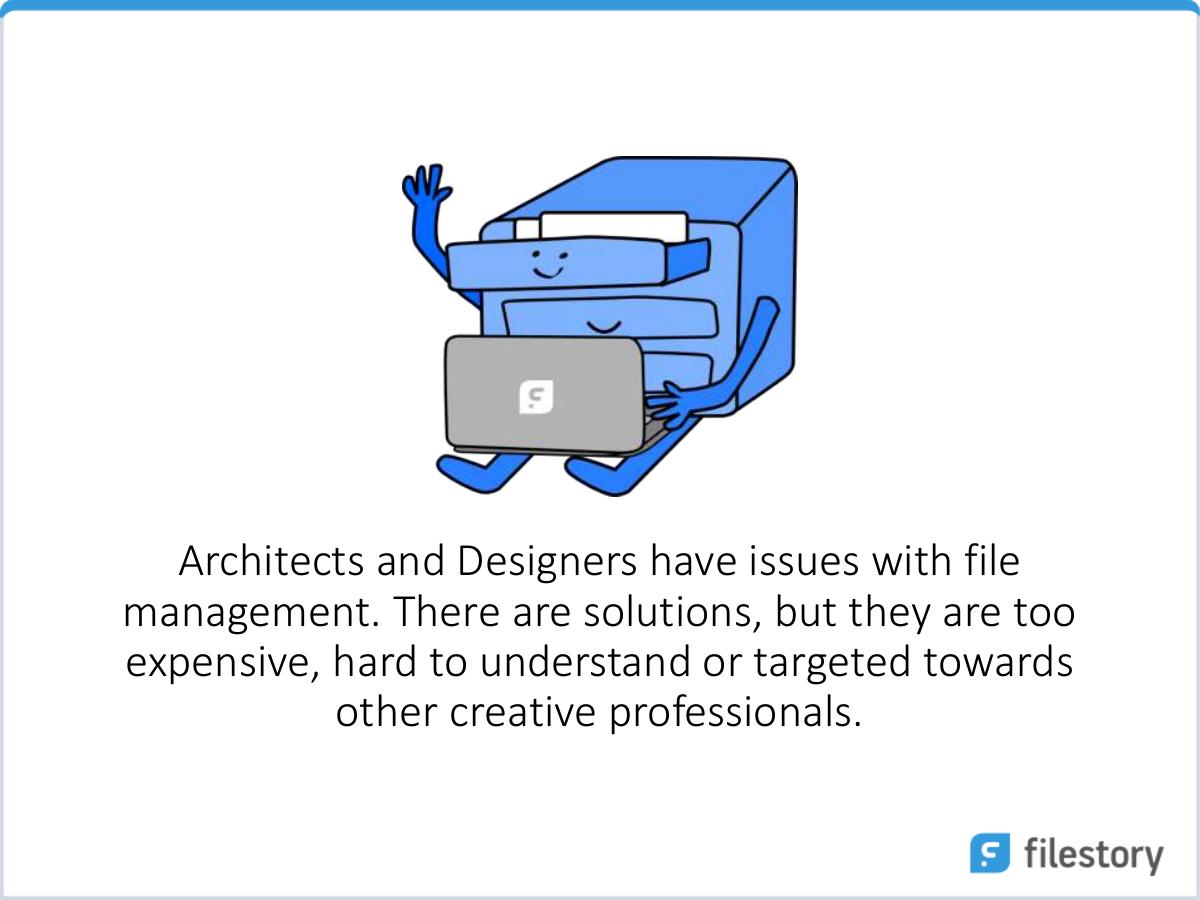
An illustration of a smiling stack of files holding a laptop, above one paragraph: "Architects and Designers have issues with file management. There are solutions, but they are too expensive, hard to understand or targeted towards other creative professionals."
Three claims in one sentence — too expensive, too complex, wrong audience — and the deck goes on to substantiate all three on the competitor slide. That is the right order of operations. What is missing is the shape of the pain: no cost of a lost file version, no hours per week, no quote from a practising architect, no story about a set of drawings overwritten the night before a planning submission. The problem is asserted at the category level and never made to hurt.
Slide 3 — Market opportunity
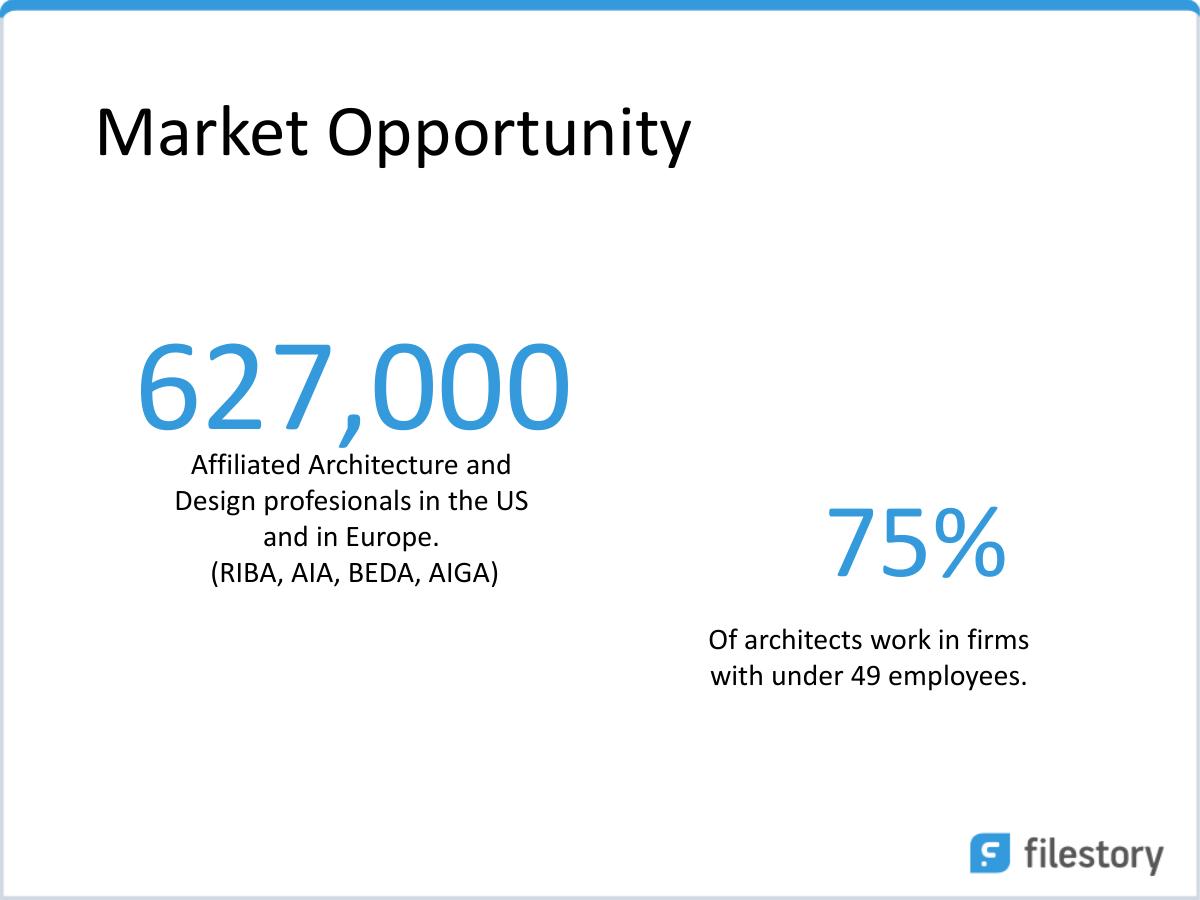
Two numbers. 627,000 affiliated architecture and design professionals in the US and Europe, sourced to RIBA, AIA, BEDA and AIGA. And 75% of architects work in firms with under 49 employees.
The second number is the more valuable of the two and the deck never uses it. A market where three quarters of buyers are in sub-50-person firms is a market where self-serve, credit-card, no-IT-department software wins — which is exactly what Filestory is, and exactly the argument that should have been made on this slide.
The first number has a construction problem. It is a sum of professional-body memberships, and one of those bodies, AIGA, is the American Institute of Graphic Arts. Graphic designers are the segment the deck's own competitor table assigns to Pixelapse and Layervault, and the problem slide explicitly complains about tools "targeted towards other creative professionals". Filestory has therefore counted the audience it says it is not for inside the market it says it is addressing. There is also no adjustment for architects who hold two memberships, and no conversion from headcount to dollars anywhere in the deck: 627,000 people is a population, not a market size. At $11 per user per month the arithmetic would have given roughly $83m of annual spend if every one of them paid — a smaller and far more defensible number than most 2014 decks were putting on this slide, and one they left on the table.
Slide 4 — Product
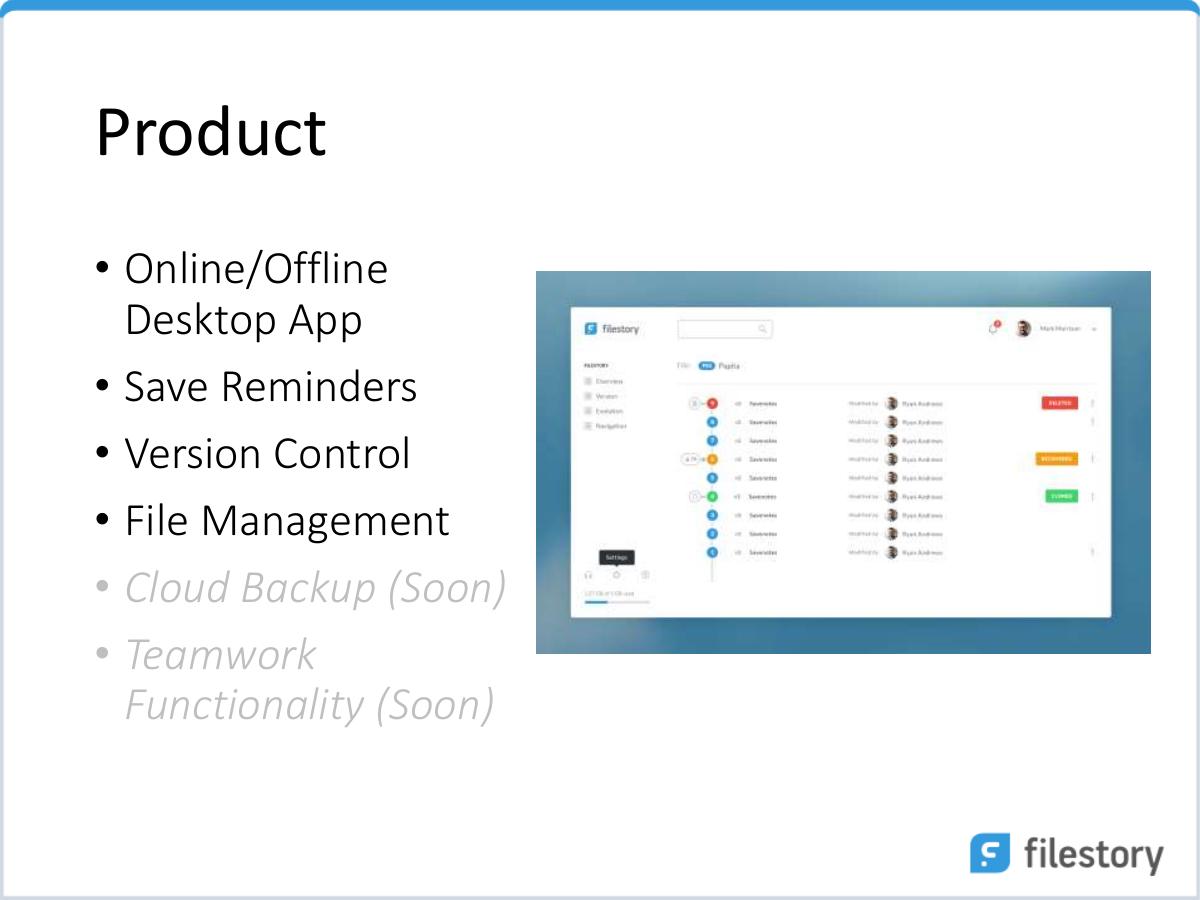
Six bullets beside a product screenshot: online/offline desktop app, save reminders, version control, file management, cloud backup (soon), teamwork functionality (soon). The two "soon" items are greyed out — a small, honest touch that most decks would not bother with.
The problem is what the greying reveals. Cloud backup and collaboration are the two features that make file management a subscription rather than a utility, and both are unbuilt. What ships today is a desktop app with reminders and local version control, priced at $11 a month per seat. The deck never addresses the obvious question: why does a single-machine desktop utility carry a recurring price?
"Save reminders" is also the most interesting thing on the slide and gets one word. A tool that nags an architect to save before AutoCAD crashes is a habit, and habits retain. It deserved a screenshot of its own.
Slide 5 — Competitors
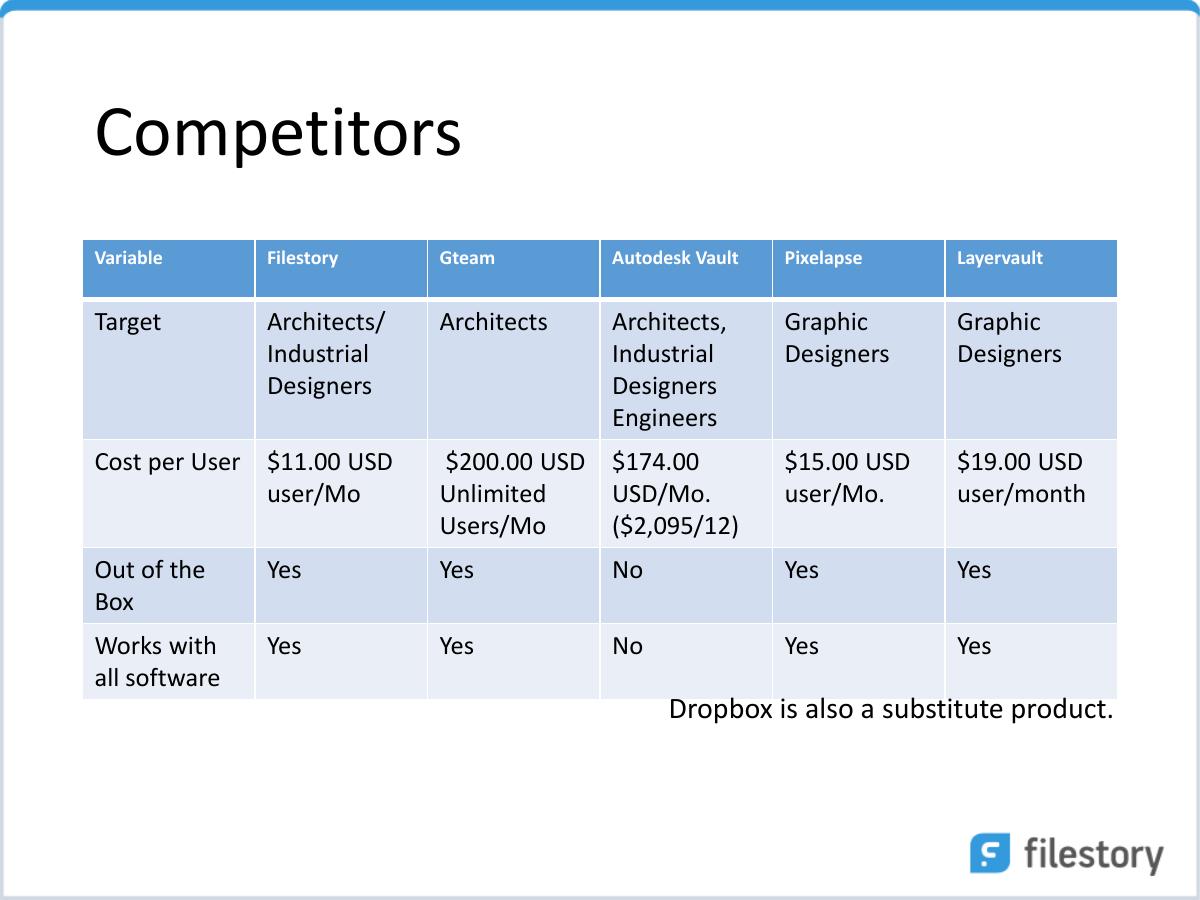
The best slide in the deck, and the one that does the most damage. A five-column table comparing Filestory against Gteam, Autodesk Vault, Pixelapse and Layervault across four variables: target user, cost per user, works out of the box, works with all software. Filestory is $11 per user per month, out of the box, software-agnostic, aimed at architects and industrial designers. Autodesk Vault is $174 per month ($2,095 a year, divided by twelve), does not work out of the box, and does not work with all software. Pixelapse ($15) and Layervault ($19) are graphic-design tools. A footnote adds, correctly, that "Dropbox is also a substitute product."
Naming Dropbox as a substitute is the single most credible line in the whole deck. Most founders in 2014 pretended the free general-purpose tool did not exist; these founders wrote it into their own competitor slide.
But look at the Gteam column: $200 per month for unlimited users, versus Filestory at $11 per user per month. Those two prices cross at eighteen users. Slide 3 has already established that 75% of the target market is in firms of under 49 people — which means a substantial slice of the addressable market, every firm above roughly eighteen seats, is cheaper on the competitor sitting immediately to Filestory's right. The deck presents this table as proof of a price advantage and never notices that its own numbers cap the advantage at small firms. Nothing on the slide addresses it: no per-firm bundle, no team tier, no "unlimited seats above X" answer.
Slide 6 — "Make work fun, even the boring parts like getting organized."
A full-bleed text slide, no data, no image, sitting in the middle of the deck between competitors and revenue model. As positioning it is memorable. As deck architecture it is a speed bump: it interrupts the commercial argument at exactly the point where the reader has just done the Gteam arithmetic and wants an answer.
Slide 7 — Revenue model
Three bullets: subscription model, add-ons, usage on PC or Mac for free.
This is the thinnest slide in the deck and it is carrying the business. "Subscription model" without a price is not a revenue model — and the price, $11, exists but is on the competitor slide two pages earlier, where it reads as a comparison rather than a decision. "Add-ons" is never defined: no examples, no attach rate, no pricing. And "usage on PC or Mac for free" introduces a freemium model in five words without saying what is free, what is paid, where the wall sits, or what conversion rate the forecast two slides later assumes.
Every question an investor has about this business — what do you charge, what do you give away, where is the upgrade trigger, what does a firm pay in year two versus year one — is answerable in three lines, and none of the three are here.
Slide 8 — Growth strategy
Six channels listed with no detail — display ads, search, social media ads, mailing, alliances with universities, in-app growth mechanisms — and one number in large blue type: $8.54, "current cost of registration".
That $8.54 is the most valuable figure in the deck and it is presented as decoration. A measured, real acquisition cost from money actually spent puts this deck ahead of most 2014 seed decks, which quoted CAC as a plan rather than a result. Against the implied revenue on slide 10 it looks excellent — roughly a month and a bit of subscription revenue to acquire a user.
The catch is in the wording: cost of registration , not cost of a paying customer. The revenue model gives the app away free on PC and Mac, so a registration is a free user. Without a registration-to-paid conversion rate, $8.54 cannot be compared to $11, and the deck never supplies one. If one in ten registrations pays, the real acquisition cost is $85.40 and the payback period is nine months, not one. That single missing percentage is the difference between a good business and an unknown one.
The six channels also have no allocation behind them. "Alliance with universities" for a tool used by practising architects is a long-cycle, low-yield channel; listing it beside paid search implies they are comparable, and they are not.
Slide 9 — Team
Seven people. Raúl (cofounder, CEO), Pablo (cofounder, CTO), Miguel (cofounder, lead engineer), Toquis (front-end developer), Cassis (intern), Julián (intern), and Phil, whose listed role is "Spiritual Guide". Beside them, a logo wall: Startup Weekend, LG, Tecnológico de Monterrey, Incubadora de Empresas, GE, Acción Emprendedora Corregidora, Selider and Querétaro.
Three technical cofounders on a desktop software product is a genuine strength, and this is a real team building a real thing. The presentation undercuts it in three ways. First names only, with no surnames, means an investor cannot look a single person up — no LinkedIn, no GitHub, no prior employer, no verification of any kind. There are no backgrounds at all: not one line about what any of them built before. And "Spiritual Guide" is a joke title on the one person whose email address is the only contact route on the cover — so the deck's designated point of contact appears to have no defined role in the company.
The logo wall has the same problem. LG and GE next to Startup Weekend and a university incubator, with no captions, invites the reader to assume commercial relationships that the deck never claims. Uncaptioned logos are read either as customers or as noise, and neither reading helps here.
Slide 10 — Traction
Four bullets: 54 registrations over two months, two architecture studios in beta (Bamboo Studio in Italy, TAH in Mexico), and "other studios were interested".
Naming the two beta studios is the right instinct — checkable, specific, and it demonstrates the product works across two countries. But 54 registrations in two months is 27 a month, and at $8.54 each the entire acquisition programme behind this slide cost around $460. That is not a growth experiment, it is a pilot budget, and the deck presents it without that context.
What is absent matters more than what is present: no active users, no retention, no weekly usage, no files managed, no paying customers, no revenue. For a product whose core feature is a save reminder, weekly active usage is the natural metric and it is nowhere. "Other studios were interested" is the weakest line in the deck; interest without a name or a number is not traction and reads as padding.
Slide 11 — Financials
A three-year projection: year one, 5,726 "real users" and $485,000; year two, 8,315 users and $949,000; year three, 10,224 users and $1,240,000. Underneath, "1.63% of target universe" — which checks out against the 627,000 figure for the year-three number.
Three problems, all arithmetic, all visible from the slide itself.
The revenue per user does not hold still. Year one is $485,000 across 5,726 users, or roughly $85 a user for the year — about $7 a month, some 36% below the $11 list price on slide 5. Year two works out at about $9.50 a month, and year three at about $10.10. Revenue per user therefore climbs 43% over three years with no explanation: no price increase, no seat expansion, no attach rate on the undefined add-ons. It reads like a spreadsheet where two rows were forecast independently rather than a model.
Users and revenue grow at different rates. Users rise 45% from year one to year two while revenue rises 96%; then users rise 23% and revenue 31%. Revenue growing at twice the rate of the user base is a claim about pricing or mix, and the deck makes no such claim anywhere.
And the starting point is unbridged. Today's number is 54 registrations in two months. Year one is 5,726 paying users — a 106-fold increase, from an acquisition programme currently spending a few hundred dollars a month across six unallocated channels. There is no line, no assumption and no funnel connecting the traction slide to the financials slide, which are adjacent pages in the same document.
Slide 12 — "500-Filestory Fit"
Four bullets on why the team suits 500 Startups: fun culture, passion for knowledge, "we also like Tetris", and "solving real problems in real life". Beside them, the "Is this real life?" meme.
This slide is the deck's identity badge — it is what makes the document an accelerator application rather than an investor deck — and it is also where the tone breaks. Personality is an asset in an accelerator application, where partners are explicitly selecting for people they will spend three months with. But a Tetris bullet and a meme are doing that job in the position where a priced round would put the ask, and this is the slide immediately after a financials page with an unexplained 106x jump on it. The humour lands as deflection rather than character.
Slide 13 — Special thanks
The Tec de Monterrey Querétaro incubator, "our friends at Sellpad", and the beta testers. Gracious and completely out of place. Acknowledgements belong in a demo-day script, not in a fourteen-slide document that has not yet asked for anything.
Slide 14 — Sources
Four URLs backing the market slide: BEDA, AIA, Wikipedia's RIBA entry, and AIGA. Three primary sources and one Wikipedia article.
A dedicated sources slide in a 2014 seed deck is rare and genuinely to the founders' credit — it invites verification instead of hoping nobody checks. But it also closes the deck. The last thing an investor sees is a bibliography: no ask, no use of funds, no milestones, no contact repeat, no next step. Fourteen slides end without a single request.
What this deck does better than most startup pitch decks
It names a vertical and stays in it. Architects and industrial designers, from the problem slide to the competitor table to the beta studios. No "creative professionals" hand-waving, no pivot to "all knowledge workers" halfway through. · The competitor table uses real prices. Five named products with dollar figures, including the annual-to-monthly conversion shown as $2,095/12. Most decks draw a 2x2 with themselves in the top right. · It names the free substitute. "Dropbox is also a substitute product" is the honest sentence almost no founder writes, and it buys credibility for everything above it. · The CAC is measured, not projected. $8.54 is a result from spent money, and it is stated to the cent. · Traction is reported at true size. 54 registrations and two named studios, with no attempt to inflate them into a growth chart. · Unbuilt features are marked unbuilt. Greying out "Cloud Backup (Soon)" and "Teamwork Functionality (Soon)" avoids the demo-day trap of selling a roadmap as a product. · It cites its market sources on a dedicated slide. Four links, three of them primary professional bodies.
Where this deck would fail in an investor meeting
There is no ask. No amount, no round, no valuation, no equity, no use of funds. The deck ends on a bibliography. · There is no milestone plan. Nothing on what the money buys or what the next twelve months are supposed to prove. · The revenue model is three bullets and no price. The only price in the deck is on the competitor slide, and the freemium wall is never described. · The forecast contradicts the price. Year-one revenue implies about $7 per user per month against an $11 list price, and revenue per user then rises 43% over three years with no stated reason. · Nothing bridges 54 registrations to 5,726 users. A 106x jump across two adjacent slides with no funnel, no conversion rate and no channel plan. · $8.54 is a cost per registration, not per customer. With a free tier and no conversion rate anywhere in the deck, the number cannot be compared to revenue. · The competitor table undercuts its own pricing. Gteam's $200 flat rate beats $11 per seat above eighteen users, inside a market the deck says is dominated by firms of up to 49 people. · No surnames and no backgrounds on the team. Seven first names, zero prior employers, zero verifiable identities. · "Spiritual Guide" is the deck's only contact. The email on the cover belongs to the person with the joke title. · Uncaptioned LG and GE logos. Read as customers by a generous investor and as noise by a careful one. · The market number includes the audience it excludes. AIGA graphic designers are counted in the 627,000 and assigned to competitors on the next slide. · The market is a headcount, never a dollar figure. No TAM, no SAM, no revenue-denominated sizing anywhere. · No retention or usage data. For a habit product with save reminders, weekly active use is the metric that matters and it is absent. · Two of the six product features are unbuilt — and they are the two that justify a subscription. · The tone breaks where the ask should be. A meme and a Tetris bullet occupy slide 12, immediately after the financials.
Accelerator application vs investor deck
Element What Filestory's deck does What a seed investor deck needs
Closing slide Sources bibliography Ask, use of funds, milestones, contact
Culture A full slide: "500-Filestory Fit", Tetris, a meme One line in the team slide, if at all
Team detail First names and roles only Full names, prior companies, why this team
Traction 54 registrations, 2 named betas Same, plus retention, usage and paying conversion
Pricing $11, appearing only inside a competitor table Its own slide: tiers, freemium wall, ARPU, add-ons
Market 627,000 professionals Dollar-denominated TAM/SAM/SOM with the same 627,000 as the input
Financials Three-year revenue with no assumptions Assumption rows visible: conversion, ARPU, churn, CAC
How you would rebuild this deck today
Add the ask as slide 13 and delete the bibliography's closing position. Amount, runway in months, three milestones the money buys, and the contact line. Move sources to an appendix. · Give pricing its own slide. $11 per user per month, what the free desktop tier includes, exactly where the paywall sits, what the add-ons are, and the observed registration-to-paid conversion — even if it is small and early. · Fix the Gteam problem out loud. Add a team plan above roughly fifteen seats. Then put it on the competitor table and make the pricing slide say so; investors trust a founder who has already found the hole in their own table. · Turn 627,000 into dollars. Strip AIGA out, keep architects and industrial designers, multiply by $132 a year, and show a defensible eight-figure serviceable market instead of an undifferentiated headcount. · Lead the traction slide with usage, not registrations. Weekly active users, files versioned, save reminders acted on, and how the two beta studios use it — then registrations as context. · Rebuild the financials as a funnel. Start at 27 registrations a month, state the paid conversion rate, the monthly ad budget, the resulting user count and ARPU. Show the assumptions as rows so the reader can argue with the inputs rather than dismiss the outputs. · Rewrite the team slide with surnames and two lines of background each , and either give Phil a real title or take him off the cover. · Cut the culture slide to one line and delete the acknowledgements slide. That is two slides recovered for the ask and the pricing. · Move "save reminders" to its own product slide. The habit loop is the reason this becomes a subscription rather than a one-off download. · Caption every logo or remove it. "Startup Weekend winner, 2014" is information; a bare GE mark is a liability.
The transferable lesson
Filestory's deck fails in a way that is unusually easy to fix, because the honesty is already there. The founders measured their acquisition cost to the cent, named their free substitute, marked their unbuilt features, and cited their sources. Those are the instincts you cannot teach. What they did not do is finish the argument: they let their strongest number, $8.54, sit next to an undefined free tier that makes it uninterpretable; they let a competitor's flat rate beat their own pricing on their own slide; and they closed fourteen pages without asking for anything.
The pattern generalises. Most decks that get declined are not declined for a missing insight — they are declined because the numbers on adjacent slides do not talk to each other. Traction to financials. Price to forecast. Market definition to competitor targeting. Before your deck leaves your laptop, read any two adjacent numbers and ask what has to be true for both of them to hold. If you cannot answer in one sentence, an investor will find the gap in about eleven seconds, and you will never be told that is what happened.
Frequently asked questions
- What was Filestory?
- Filestory was a desktop file-management application for architects and industrial designers, built in Querétaro, Mexico out of the Tecnológico de Monterrey incubator. It offered online/offline use, save reminders, version control and file management at $11 per user per month, with cloud backup and team collaboration listed as forthcoming. At the time of the October 2014 deck it had 54 registrations and two architecture studios in beta.
- Is the Filestory deck a real investor pitch deck?
- It is closer to an accelerator application. Slide 12 is titled '500-Filestory Fit' and argues the team's cultural suitability for 500 Startups, and the deck contains no funding ask, no valuation, no equity offered and no use of funds. It is widely circulated as a pitch deck example, which is how most readers encounter it, but its structure is built for an accelerator selection process.
- What is the biggest weakness in the Filestory pitch deck?
- The absence of any ask. Fourteen slides end on a list of source URLs, with no amount requested, no milestones the money would buy and no next step for the reader. The second biggest is the financials slide: 5,726 paying users in year one, projected directly after a traction slide showing 54 registrations, with nothing connecting the two figures.
- Why does Filestory's competitor slide work against it?
- The table prices Filestory at $11 per user per month and Gteam at $200 per month for unlimited users. Those two lines cross at about eighteen users, so every firm larger than that is cheaper on Gteam. The previous slide states that 75% of architects work in firms of up to 49 people, which means a large share of the target market sits above the crossover point. The deck presents the table as evidence of a price advantage and never addresses the limit on it.
- Which Filestory slides should founders copy?
- The competitor table, for using real named products with real dollar prices and admitting that Dropbox is a substitute. The growth slide, for quoting a measured $8.54 acquisition cost rather than a projected one. The product slide, for greying out unbuilt features instead of selling a roadmap. And the sources slide, for citing the professional bodies behind the market number and inviting verification.
- How should an early-stage SaaS deck present traction this small?
- Lead with behaviour rather than volume. 54 registrations means little on its own, but weekly active users, retention across the two beta studios, files versioned and reminders acted on turn a small number into evidence that the habit is forming. Then state the paid conversion rate, however early, so acquisition cost becomes interpretable, and build the forecast as a visible funnel from today's monthly sign-up rate rather than as a standalone revenue table.