Switch is a biotechnology company developing 'Switchable CAR-T Cell Innovation Therapy' to address serious adverse events associated with traditional CAR-T treatments, such as cytokine release syndrome and neurologic events. The deck, originating from an MS Biotech 2018-2019 program, targets hematological and solid tumor cancers. With a stated market context of 18.1 million new cancer cases annually and a global cost of $1.16 trillion, the company seeks a $25 million Series A round. The funding is intended to transition the company from the end of its pre-clinical phase into Phase 2 human cli…
Key takeaways
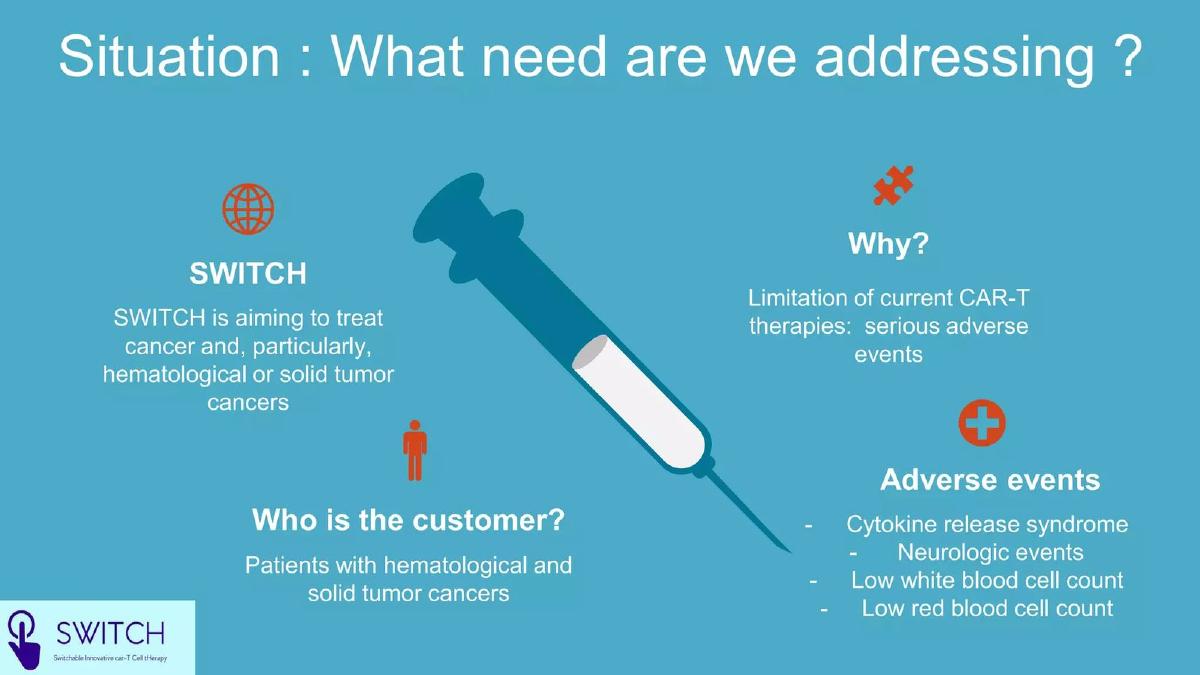
- The company is developing switchable CAR-T cells to mitigate adverse events like cytokine release syndrome (Slide 3).
- Switch is seeking a $25M Series A investment to move into human clinical trials (Slide 6).
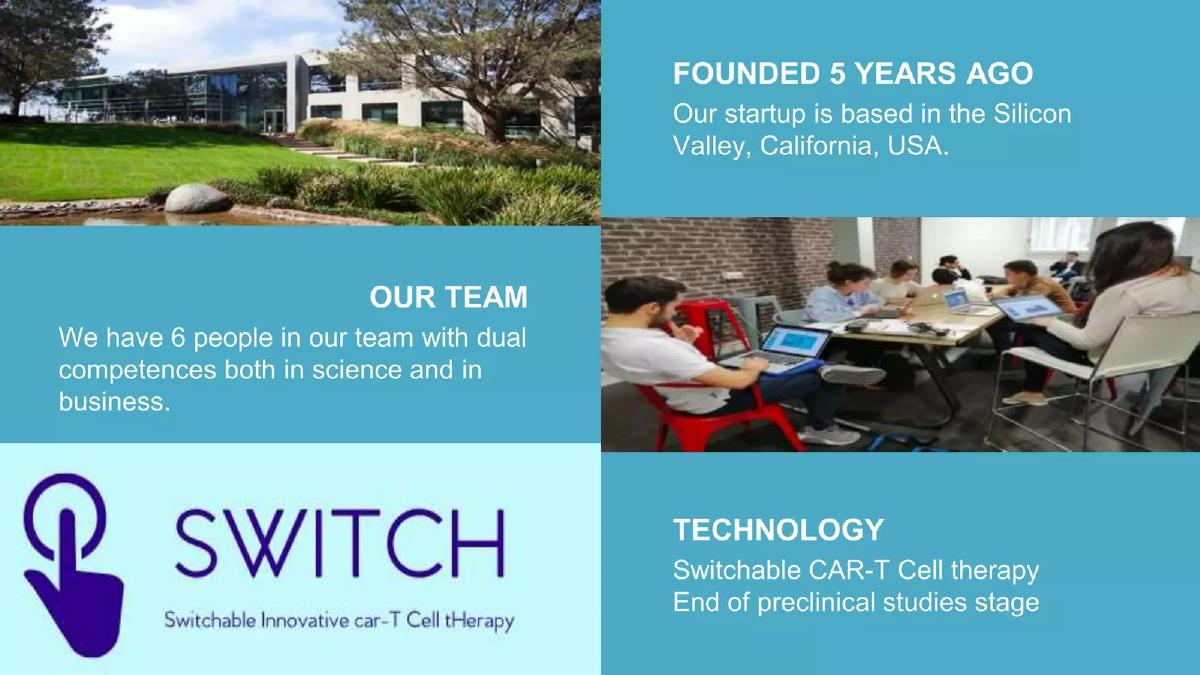
- The team includes six named members, though professional backgrounds and specific expertise are not detailed on the slide (Slide 2).
- Market data cites 18.1 million new cancer cases worldwide and 9.6 million deaths in 2018 (Slide 4).
- The deck explicitly targets a Merger and Acquisition exit, using Gilead's acquisition of Kite as a model (Slide 5).
- Current status is defined as being at the end of the pre-clinical phase with prior funding from the NIH (Slide 6).
- Proposed hiring includes a Head of Clinical, three Technicians, and a Head of IP (Slide 6).
- The deck provides projected Internal Rate of Return (IRR) figures ranging from 26% to 43% based on potential acquisition values (Slide 7).
Executive Summary
The Switch pitch deck, produced for the MS Biotech 2018-2019 cycle, outlines a high-stakes play in the oncology sector. The company focuses on a 'switchable' CAR-T cell therapy designed to reduce the toxicity and side effects common in first-generation immunotherapy. The deck is structured as a traditional life-sciences pitch, moving from the clinical need to market size, and concluding with a specific financial ask and exit projections. While it provides a clear roadmap for the use of funds, it relies heavily on external benchmarks rather than proprietary data to prove its value proposition.
Slide 1: Title Slide
The cover slide introduces the company as 'Switch' and defines the product as 'Switchable CAR-T Cell Innovation Therapy.' It notes the context of 'MS Biotech 2018-2019' and lists six names: Soumiya Amellah, Yasmine Benlounes, Diane Bugeaud, Mohamed Kaabouni, Margot Naëgelé, and Alexandre Trichies. The imagery is standard clinical laboratory photography, establishing the biotech sector immediately.
Slide 2: Our Team
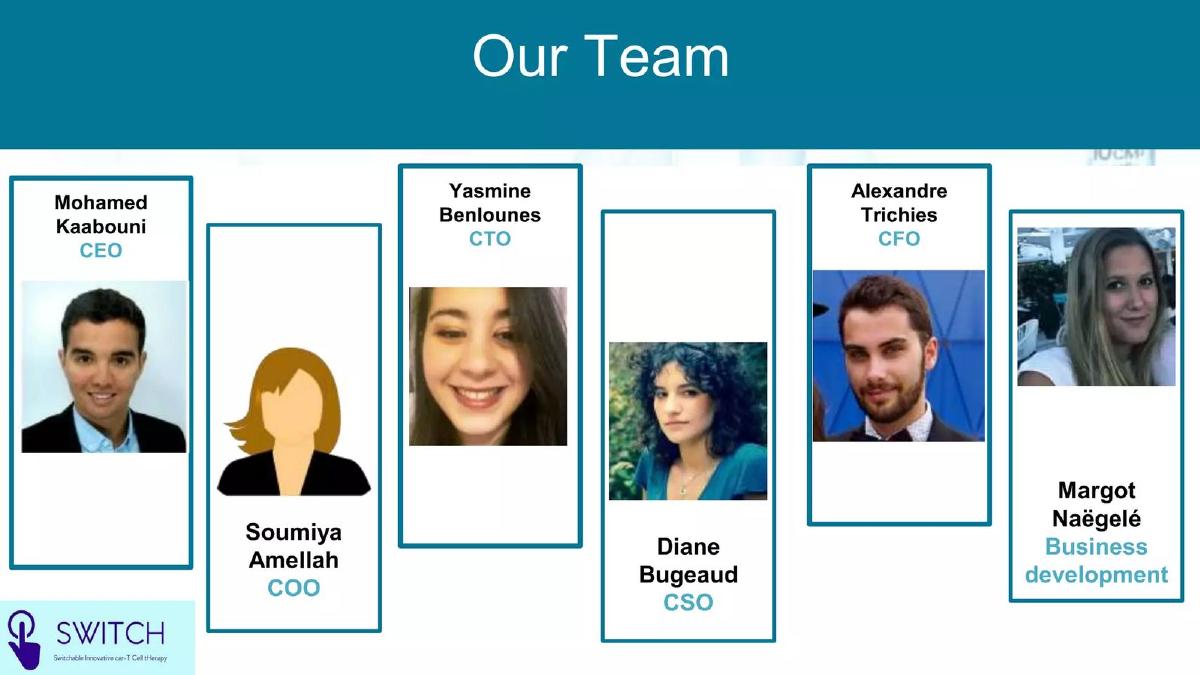
This slide introduces the organizational structure. The roles are defined as CEO (Mohamed Kaabouni), COO (Soumiya Amellah), CTO (Yasmine Benlounes), CSO (Diane Bugeaud), CFO (Alexandre Trichies), and Business Development (Margot Naëgelé). The slide uses headshots for most members but lacks any supporting text regarding their experience, education, or previous successes in the biotech or pharmaceutical industries. In a Series A pitch, the lack of founder pedigree is a significant omission.
Slide 3: Situation and Clinical Need
Slide 3 addresses the 'Why?' of the company. It identifies the limitations of current CAR-T therapies as 'serious adverse events.' Specifically, it lists cytokine release syndrome, neurologic events, and low blood cell counts (both red and white). The slide identifies the 'customer' as patients with hematological and solid tumor cancers. This slide successfully establishes the clinical pain point but does not explain the mechanism of how a 'switchable' therapy functions to prevent these events.
Slide 4: Market Size
The market slide uses a global map to present three macro statistics: 18.1 million new cancer cases per year worldwide, 9.6 million deaths due to cancer in 2018, and a total cost of cancer estimated at $1.16 trillion in 2010. While these numbers are large, they represent the total oncology market rather than the Serviceable Addressable Market (SAM) for CAR-T therapies or the specific subset of patients eligible for switchable cell therapy.
Slide 5: Exit Strategy
This slide is dedicated entirely to Merger and Acquisition (M&A). It uses the acquisition of Kite Pharma by Gilead in 2017 for $11.9 billion ($180.00 per share) as a case study. The slide includes a quote from John F. Milligan, PhD, Gilead’s then-CEO, regarding the path toward a potential cure. By highlighting that Kite was a private company in clinical phase 3 at the time of acquisition, Switch is signaling to investors that their goal is to be acquired by a 'Global Leader in Oncology' rather than reaching an IPO.
Slide 6: Investment Needed
This slide contains the core of the financial pitch. It states that Switch has been 'Granted from NIH since the corporation arised' and is currently at the 'end of the Pre-Clinical phase.' The company is seeking a $25M Series A round. To justify this, they provide a table of Series A rounds for competitors: Autolus Therapeutics ($30M), MolMed SpA ($58M), Crispr Therapeutics ($25M), Precision Biosciences ($25M), and TILT Biotherapeutics ($12M). The funds are earmarked for starting Phase 2 human clinical trials and hiring key personnel, including a Head of Clinical and a Head of IP.
Slide 7: The Offering and IRR
Slide 7 presents a hypothetical return on investment 'in the case of an Acquisition three years after entering Switch.' It maps out three scenarios based on acquisition prices: a $150M acquisition yielding a 26% IRR ($50M return), a $180M acquisition yielding a 34% IRR ($60M return), and a $220M acquisition yielding a 43% IRR ($73M return). This slide is highly speculative, as it assumes both the timing and the valuation of an exit before the company has even entered human trials.
Slide 8: Conclusion
The final slide is a standard 'Thank You' and 'Any questions?' slide featuring a scientist in a lab setting. It provides no contact information or call to action, which is a missed opportunity for a pitch deck intended for distribution.
What Works
Clear Problem Identification: The deck does a good job of identifying the specific side effects of CAR-T therapy that they intend to solve. This focuses the pitch on a specific clinical niche rather than a generic 'cure for cancer' message. · Direct Financial Ask: Slide 6 is very specific about the amount ($25M), the stage (Series A), and the intended use of funds (Phase 2 trials and specific hires). · Competitive Benchmarking: Including the Series A round sizes of other biotech firms helps ground the $25M ask in industry reality, making it seem reasonable to a life-sciences investor.
What is Missing
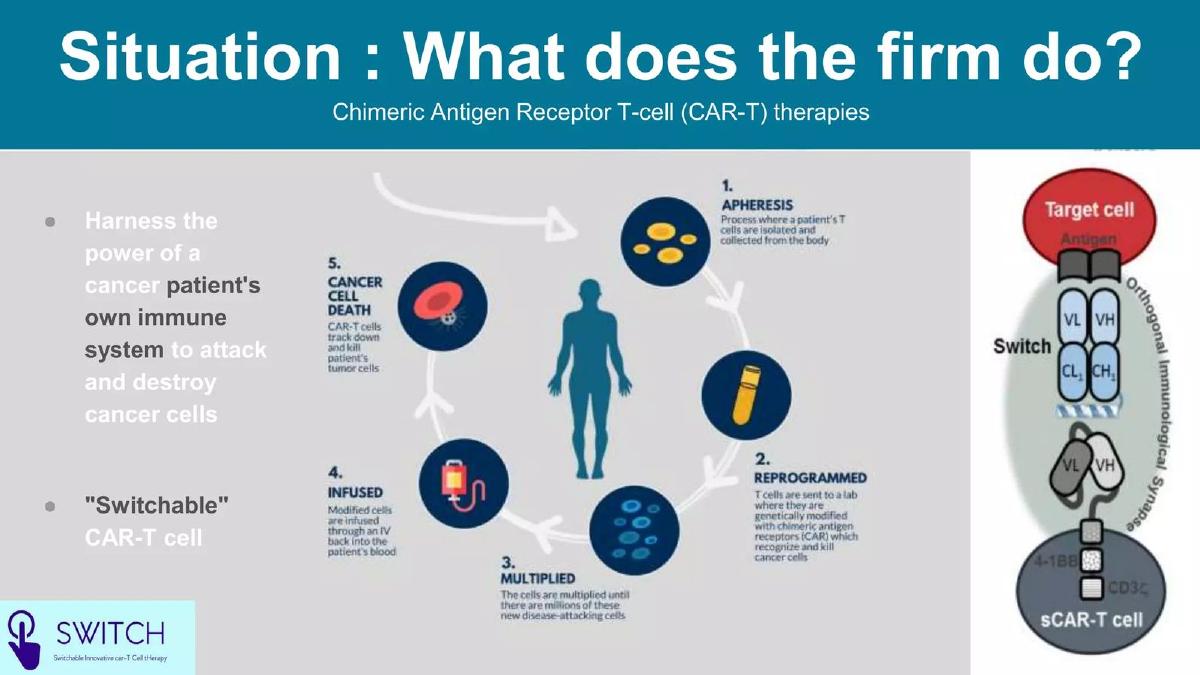
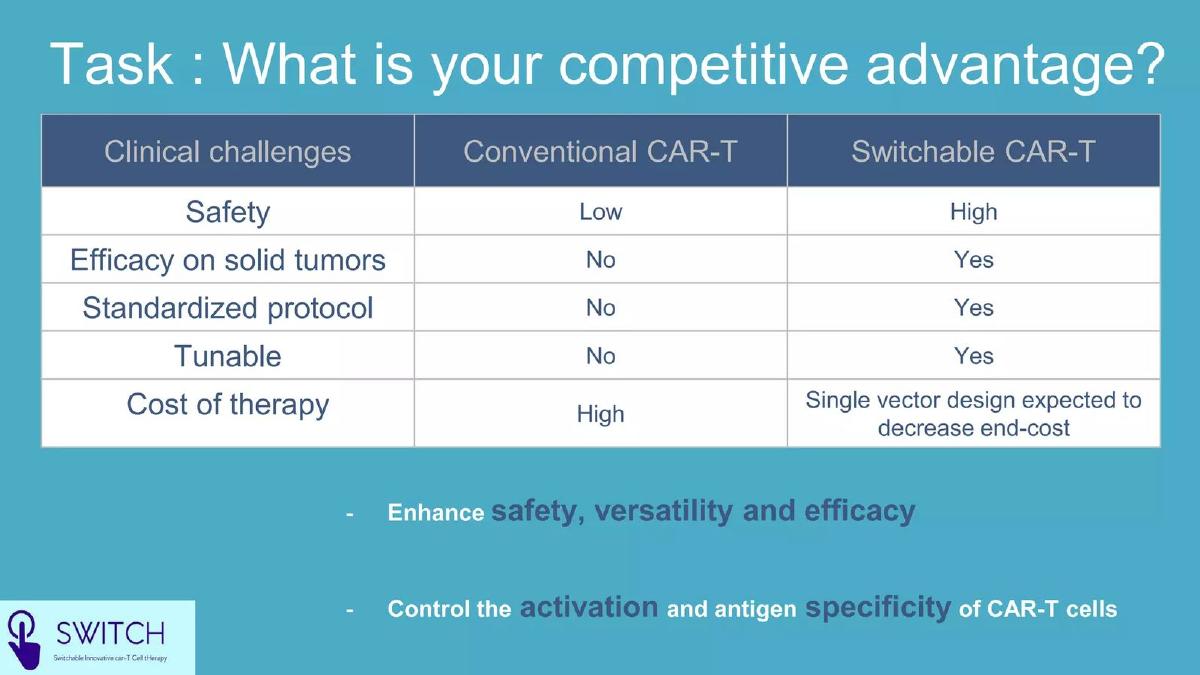
Proprietary Technology Details: The deck never explains how the 'switch' works. In biotech, the mechanism of action (MoA) is critical. There are no diagrams of the cell construct or explanation of the signaling pathways involved. · Pre-clinical Data: Since the company claims to be at the end of the pre-clinical phase, investors would expect to see data from in vitro or in vivo (animal) studies showing efficacy or reduced toxicity compared to standard CAR-T. No such data is present. · Team Pedigree: The team slide is exceptionally thin. In drug development, the scientific advisory board and the founders' previous clinical trial experience are often more important than the product itself at the early stages. · Intellectual Property Status: While they mention hiring a 'Head of IP,' they do not list any currently held or pending patents, which are the primary assets of a pre-clinical biotech company.
Founder Takeaways
Avoid Over-speculating on IRR: Slide 7 is risky. Calculating a specific IRR based on a hypothetical acquisition three years out can often alienate sophisticated investors who know how many variables (clinical trial failures, regulatory hurdles, market shifts) can disrupt that math. · Show, Don't Just Tell, the Market: Instead of showing the total global cost of cancer, founders should show the number of patients who specifically suffer from the 'adverse events' mentioned on Slide 3. That is the true market for a safety-focused innovation. · Prioritize the Science: For a $25M ask, a deck must include data. A biotech deck without a single chart showing cell lysis or cytokine levels is unlikely to move past an initial screening.
Frequently asked questions
- What stage of development is Switch currently in?
- According to slide 6, Switch is at the end of the pre-clinical phase. They have previously received grants from the NIH. The purpose of the current $25M Series A round is to transition the company into the human clinical trial process, specifically aiming to start Phase 2.
- What specific medical problems is Switch trying to solve?
- Slide 3 identifies the primary problem as the 'limitation of current CAR-T therapies,' specifically serious adverse events. These include cytokine release syndrome, neurologic events, low white blood cell counts, and low red blood cell counts. Their 'switchable' therapy aims to provide a safer alternative for patients with hematological and solid tumor cancers.
- How does the company justify its $25M Series A ask?
- Slide 6 provides a benchmark table of other biotech companies and their Series A rounds, including Autolus Therapeutics ($30M), MolMed SpA ($58M), and Crispr Therapeutics ($25M). Switch uses these figures to position their $25M request as standard for the sector to fund clinical trials and corporate growth.
- What is the intended exit strategy for investors?
- The deck is unusually explicit about an M&A exit. Slide 5 focuses entirely on the 2017 acquisition of Kite Pharma by Gilead for $11.9 billion. Slide 7 further illustrates this by showing potential returns ($50M to $73M) based on acquisition valuations between $150M and $220M three years after investment.
- Who are the key members of the Switch leadership team?
- Slide 2 lists Mohamed Kaabouni (CEO), Soumiya Amellah (COO), Yasmine Benlounes (CTO), Diane Bugeaud (CSO), Alexandre Trichies (CFO), and Margot Naëgelé (Business Development). While titles are provided, the slide lacks biographical information, past company experience, or academic credentials.