Moonlight’s Seed deck positions the company as a specialized alternative to broad professional networks like LinkedIn and transactional hiring platforms like Hired. The narrative centers on the 'Developer Coefficient'—the idea that access to talent is a primary business constraint. Moonlight differentiates itself by moving beyond simple job matching to offer a full-stack community experience, including managed payments and career support. Their traction is anchored by high-efficiency outbound operations, reporting a 90% open rate on hiring manager outreach and a low-churn subscriber base. Whi…
Key takeaways
- The deck identifies a core market pain point using Stripe's 'Developer Coefficient' report, stating access to developers is a bigger constraint than capital (Slide 11).
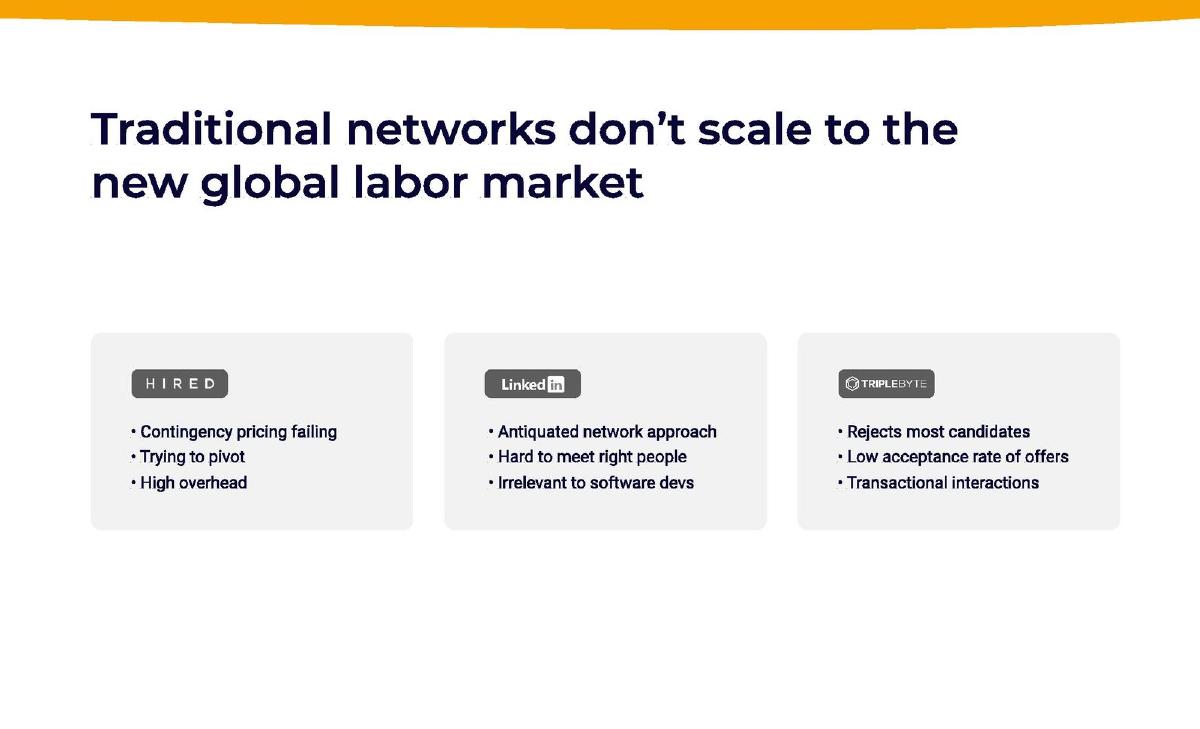
- Moonlight critiques incumbents like LinkedIn for being 'irrelevant to software devs' and Triplebyte for 'transactional interactions' (Slide 10).
- The business model is a SaaS hybrid, offering jobs and matching alongside managed payments and a weekly newsletter (Slide 18).
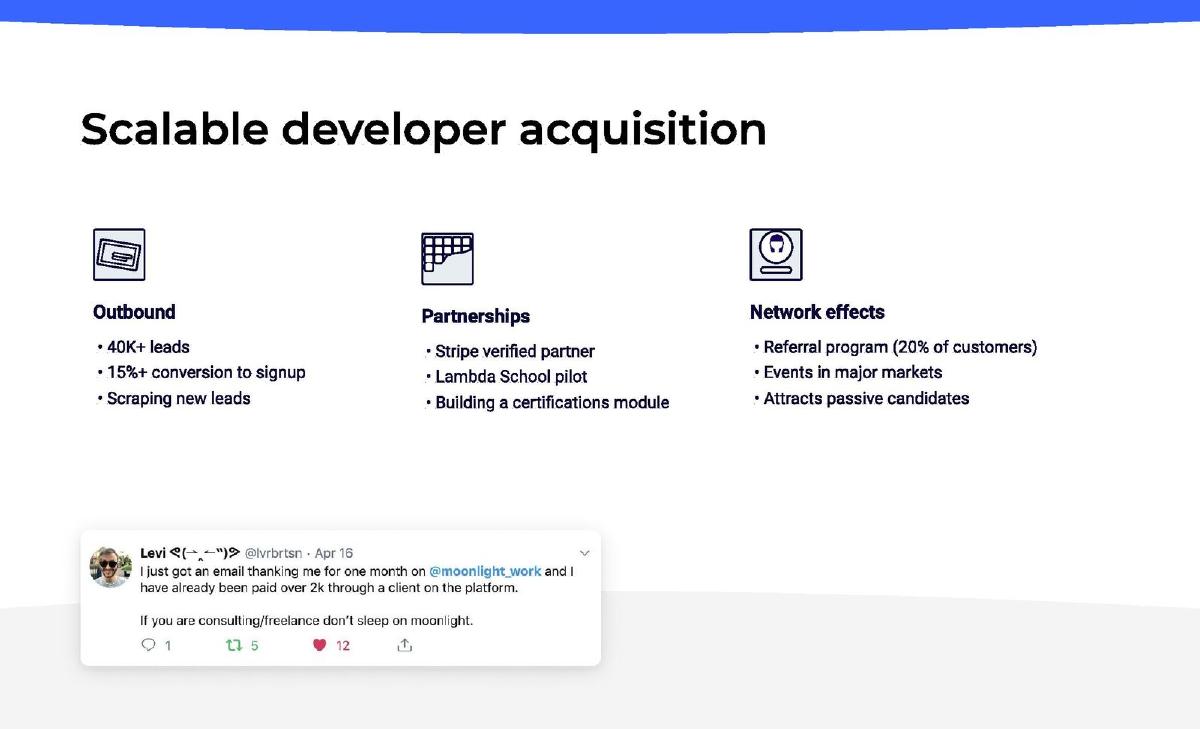
- Outbound efficiency is a primary growth lever, with 40k+ leads and a 15%+ conversion rate to signup (Slide 16).
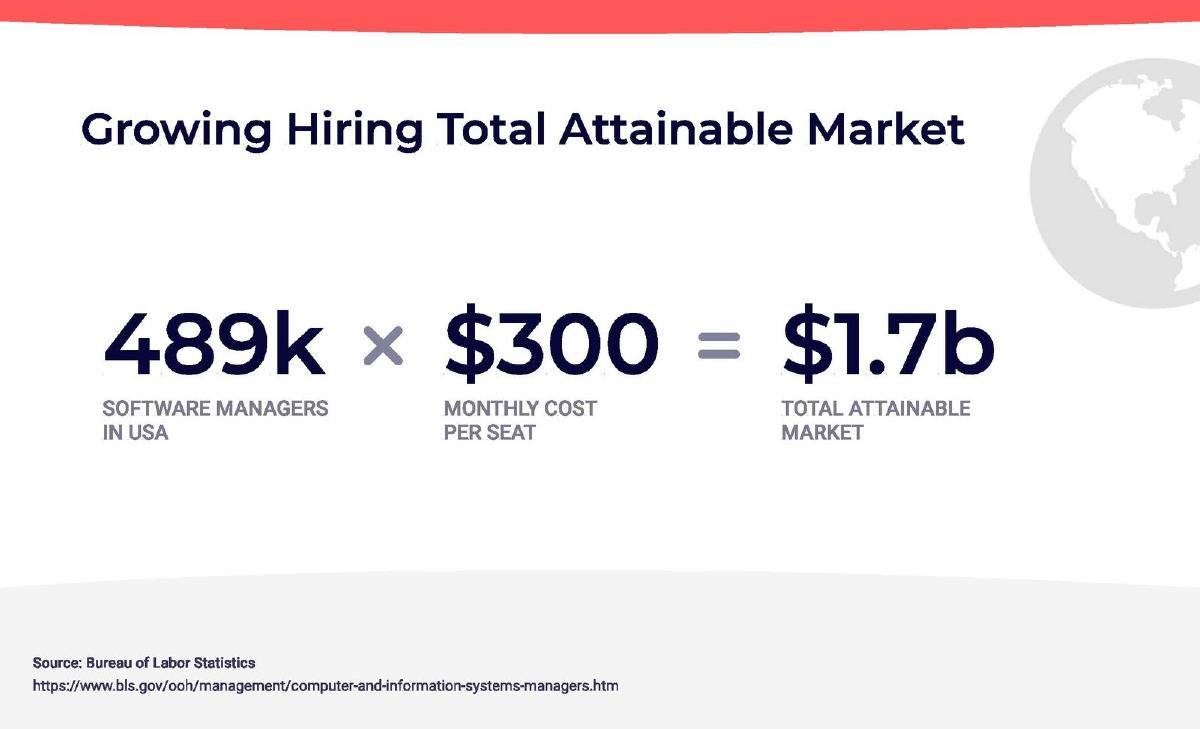
- The Total Attainable Market is calculated at $1.7b, based on 489k U.S. software managers paying $300 per month (Slide 19).
- Traction includes 1,124 company signups and 68 pre-subscription customers, including Cloudflare (Slide 17).
- The platform has achieved high retention, reporting only one subscriber churn event ever as of the deck's creation (Slide 17).
- The founders emphasize their authentic connection to the problem, having built the company from Airbnbs on five continents over two years (Slide 6).
Executive Summary: The Community-Led Talent Marketplace
Moonlight’s pitch deck is a study in specialized positioning. In a world dominated by horizontal professional networks, Moonlight argues that software developers require a bespoke ecosystem. The deck, reported by the publisher as a Seed round presentation, focuses on the friction of remote hiring and the limitations of existing platforms. By emphasizing 'community' over 'transactions,' Moonlight attempts to build a moat that incumbents like LinkedIn or Hired cannot easily replicate.
Slide 1: The Professional Community for Remote Developers
The cover slide establishes the brand identity immediately. The tagline, "Professional community of remote developers," is specific. It avoids the generic "hiring platform" label in favor of "community," which suggests higher engagement and lower churn. The visual style is clean, utilizing modern 2D illustrations that were characteristic of the late 2010s SaaS aesthetic.
Slide 6: Founder-Market Fit and Authenticity
Slide 6 is a powerful 'Why Us' slide. It states, "Moonlight solves our own needs," and notes that the founders built the company while living in Airbnbs across five continents for two years. By showing photos from San Francisco, Mexico City, London, Hyderabad, and New York, the founders prove they understand the nuances of the remote lifestyle. This isn't just a business opportunity for them; it is a lived experience. The inclusion of logos from the "International Network of Communities" (including Y Combinator's Startup School and Indie Hackers) further bolsters their credibility within the developer ecosystem.
Slide 10: The Competitive Landscape
Moonlight takes a direct approach to competition. Slide 10 breaks down the failures of three major players:
Hired: Criticized for failing contingency pricing and high overhead. · LinkedIn: Labeled as an "antiquated network approach" that is "irrelevant to software devs." · Triplebyte: Critiqued for rejecting most candidates and having "transactional interactions."
By highlighting these specific weaknesses, Moonlight carves out a niche for a platform that is high-acceptance (unlike Triplebyte), relevant (unlike LinkedIn), and low-overhead (unlike Hired).
Slide 11: The Problem Statement
The deck uses a high-authority quote from the Stripe Developer Coefficient Report: "Access to developers is a bigger constraint than access to capital." This framing elevates the company's mission from a simple HR tool to a fundamental solution for economic growth. If capital is abundant but talent is scarce, the platform that unlocks talent becomes the most valuable link in the chain.
Slide 16: Scalable Acquisition and Growth
One of the most impressive slides in the deck is Slide 16, which details their acquisition strategy. They aren't just waiting for organic growth; they are engineering it. Their "Outbound" pillar claims 40,000+ leads with a 15%+ conversion rate to signup, driven by custom scraping tools. They also mention a partnership with Lambda School and a referral program that drives 20% of their customers. This shows a sophisticated understanding of the sales funnel, moving beyond the "build it and they will come" mentality common in early-stage startups.
Slide 17: Traction and Q&A
Slide 17 serves as a dense data room in a single slide. It answers the most common investor questions before they are asked. Key figures include:
1,124 company signups. · 68 pre-subscription customers, including Cloudflare . · 19 subscribers at $300/mo and 2 at $10k/yr. · 90% open rate and 24% response rate on outbound campaigns.
The most striking metric is the churn: "Only one ever - and it was in their first month." For a Seed stage company, this level of retention is a strong signal of product-market fit.
Slide 18: The Business Model
Moonlight describes itself as a "SaaS business today." The slide lists four core components: Jobs and matching, Managed payments, Candidate alerts, and a Weekly Newsletter. The "Expanding community" section below it hints at future revenue streams: education on distributed team best practices and career support. This suggests the founders view hiring as the wedge to enter a much larger market for remote work infrastructure.
Slide 19: Market Sizing (TAM)
The TAM slide (Slide 19) uses a bottom-up calculation. It identifies 489,000 software managers in the USA (sourced from the Bureau of Labor Statistics) and multiplies that by a $300 monthly cost per seat. This results in a $1.7 billion Total Attainable Market. While this is a focused calculation, it is notably conservative as it only accounts for the U.S. market, despite the company's global remote focus.
Slide 22: The Long-Term Vision
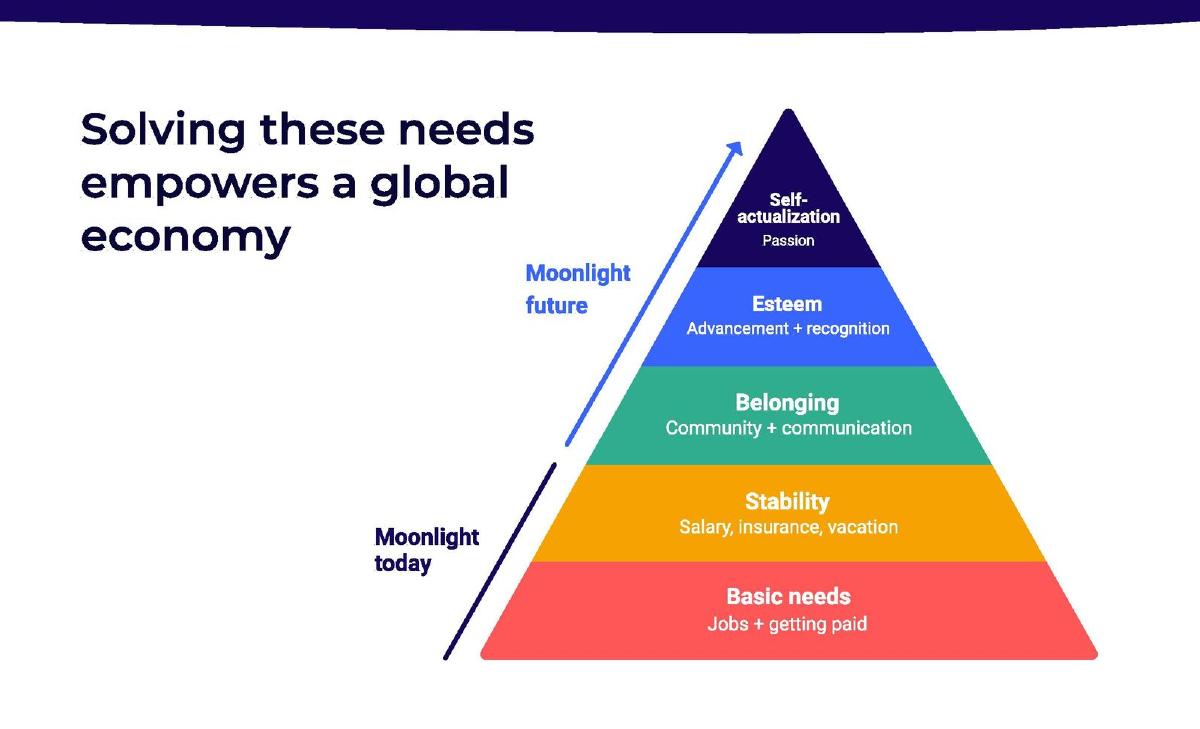
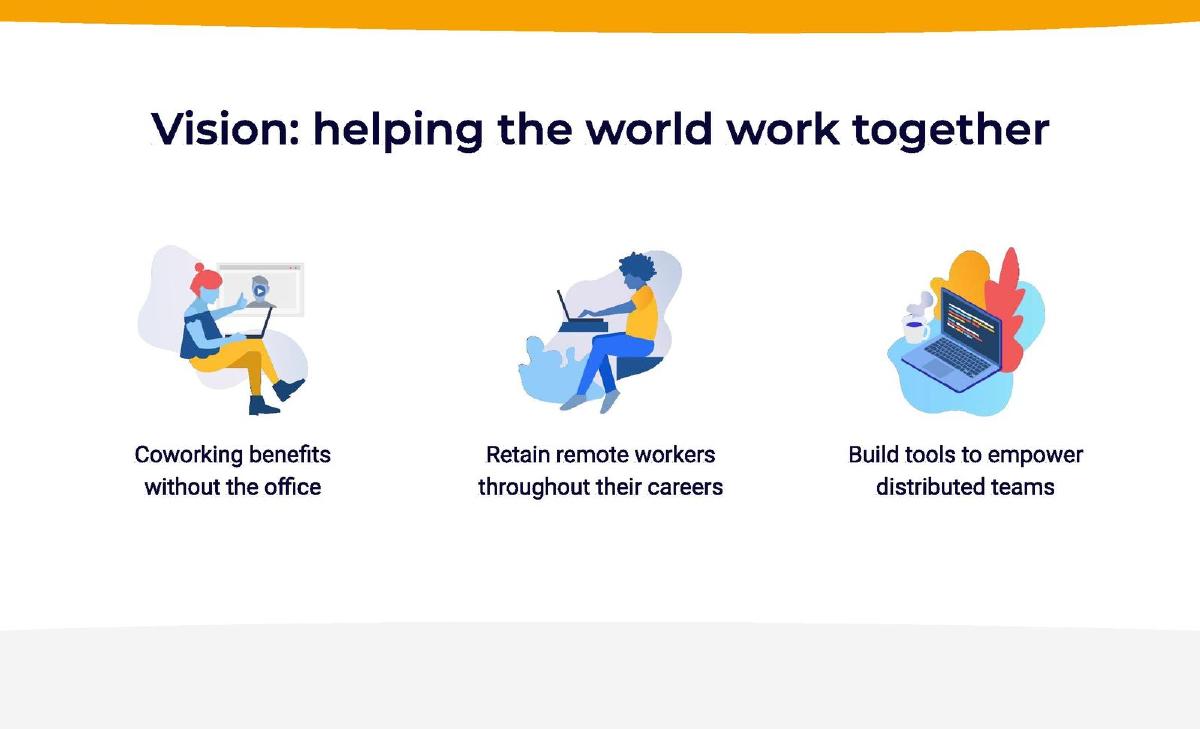
The deck concludes its narrative by looking forward. The vision is to "help the world work together." This involves three pillars: providing coworking benefits without the office, retaining remote workers throughout their careers, and building tools for distributed teams. This slide attempts to convince investors that Moonlight isn't just a niche job board, but a potential platform play for the future of work.
What Moonlight Does Well
The deck excels at establishing authenticity . The founders' story of building the company while traveling (Slide 6) is a perfect match for the product they are selling. It creates an immediate sense of trust that they understand their users.
Furthermore, the transparency of metrics on Slide 17 is refreshing. Many Seed decks hide behind vague percentages or "up and to the right" charts without Y-axis labels. Moonlight provides raw numbers—1,124 signups, 19 subscribers, 1 churn. This level of honesty usually suggests a founder who is disciplined about data and confident in their progress.
The competitive differentiation is also sharp. By identifying the specific "transactional" nature of competitors, Moonlight sets the stage for their "community" value proposition. They aren't just competing on features; they are competing on the quality of the relationship between the developer and the platform.
What is Missing from the Moonlight Deck
The most glaring omission in the provided slides is the Team Slide . While the text mentions Slide 3 and 4 are team-related, no content was captured. In a Seed round, the pedigree of the founders is often 50% of the investment decision. Without seeing their backgrounds, it’s hard to validate if they have the technical chops to build the "custom scraping tools" mentioned on Slide 16.
The Ask is also missing. Slide 21 is labeled "Funding," but no specific amount, valuation, or use of proceeds is detailed in the text. An investor needs to know how much runway this capital provides and what specific milestones (e.g., reaching 100 subscribers) will be hit with the new funds.
Finally, the Unit Economics are thin. While we see the $300/mo price point, we don't see the Customer Acquisition Cost (CAC) or the Lifetime Value (LTV). Given that they are doing heavy outbound scraping and manual outreach, understanding the labor cost of that acquisition is vital to knowing if the model scales profitably.
Founder Takeaways: Lessons to Copy
1. Use High-Signal Quotes: The use of the Stripe Developer Coefficient report (Slide 11) is a masterclass in market validation. Instead of the founder saying "hiring is hard," they let one of the most respected companies in tech say it for them. If you can find a report from a market leader that validates your problem, use it.
2. The Q&A Slide: Every founder should have a slide like Slide 17. Anticipate the top 5-8 questions an associate or partner will ask and put the data right there. It shows you are prepared, data-driven, and have nothing to hide. It also saves time during the meeting for deeper strategic discussions.
3. Specific Competitive Critiques: Don't just put logos on a 2x2 matrix. Use Slide 10's approach: list the specific reasons why the incumbents are failing. This forces you to define your unique value proposition in contrast to the market leaders.
4. Leverage Your Lifestyle: If your startup is a reflection of how you live, show it. The Airbnb photos on Slide 6 aren't just travel photos; they are evidence of product-market fit. They prove that the founders are their own "User Zero."
Frequently asked questions
- What is Moonlight's primary revenue model?
- Moonlight operates as a SaaS business. According to Slide 17 and Slide 18, they charge a subscription fee for access to their hiring platform. The deck notes two primary pricing tiers: $300 per month and $10,000 per year. They also offer 'managed payments,' suggesting they may facilitate the financial transactions between companies and remote developers.
- How does Moonlight acquire developers and companies?
- Their Go-To-Market strategy is three-pronged: Outbound, Partnerships, and Network Effects. Slide 16 highlights custom scraping tools that have generated 40,000 developer leads. They also leverage a referral program that accounts for 20% of their customers, offering $500 for company referrals that result in $1,000 of spend.
- Who are Moonlight's main competitors according to the deck?
- Slide 10 explicitly names Hired, LinkedIn, and Triplebyte as competitors. The deck criticizes Hired for high overhead and failing contingency pricing, LinkedIn for being antiquated and irrelevant to developers, and Triplebyte for high rejection rates and transactional interactions.
- What specific traction metrics does Moonlight share?
- On Slide 17, the company reports 1,124 company signups and 68 pre-subscription customers (including Cloudflare). They have 19 subscribers at the $300/mo level and 2 at the $10k/yr level. Notably, they claim a 90% open rate and 24% response rate on outbound campaigns to hiring managers.
- What is the long-term vision for the company?
- Slide 22 outlines a vision of 'helping the world work together.' This involves expanding beyond hiring to provide 'coworking benefits without the office,' career support for remote workers throughout their careers, and building tools to empower distributed teams.