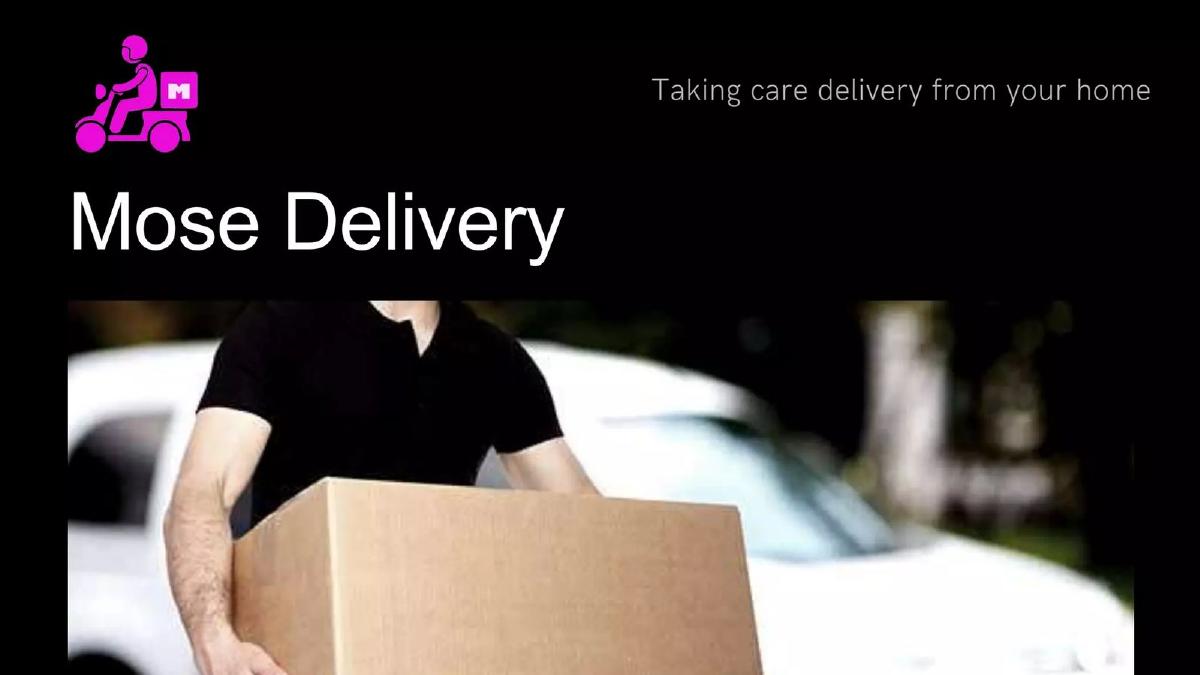
Mose Delivery is a logistics startup targeting the Indonesian market, specifically addressing the 'first-mile' problem for e-commerce sellers during COVID-19. The deck identifies a critical friction point: sellers in quarantine cannot deliver goods to shipping hubs, and major carriers do not offer home pickup. Mose proposes a mobile app to facilitate door-to-door pickup using motorcycles and trucks. While the deck provides a clear problem-solution fit and identifies major competitors like Gojek and Grab, it lacks essential financial data, including a specific funding ask, unit economics, or a…
Key takeaways
- The company identifies a specific market pain point in Indonesia where shipment companies do not pick up products from customers (Slide 2).
- The solution relies on a three-step mobile application process: filling information, choosing a courier, and sending the product (Slide 5).
- The deck cites a significant market opportunity with Indonesia's population of 266 million and a projection of over 39 million annual per capita online sales (Slide 6).
- Target customers are explicitly defined as young online sellers and local wholesale sellers on platforms like Lazada, Tokopedia, and Shopee (Slide 7).
- Mose Delivery claims a competitive advantage by offering a flat cost for distances up to 40 KM, compared to a standard 5 KM rate (Slide 9).
- The business model is based on a single revenue stream: a 'Service usage fee' (Slide 11).
- The deck identifies Gojek and Grab as both direct and indirect competitors but does not provide a feature-by-feature comparison (Slide 8).
- There is no mention of current traction, revenue figures, or a specific investment ask in the 13-slide presentation.
Slide-by-Slide Analysis
Slide 1: Title Slide
The title slide features the company name, 'Mose Delivery,' and a tagline: 'Taking care delivery from your home.' It includes a simple pink icon of a courier on a scooter. The visual style is minimalist, using a black background with white and pink accents. It immediately establishes the sector as logistics/delivery.
Slide 2: The Problem
This slide focuses on the 'COVID-19 Impact.' It lists three bullet points: e-commerce sellers in Indonesia are in quarantine and cannot reach shipment companies; shipment companies do not pick up from customers; and the process is time-consuming. This is a strong 'why now' slide, anchoring the business in a specific, timely friction point caused by the pandemic.
Slide 3: The Solution
The solution is presented as a three-pillar approach: Create an app for sellers to send orders, Build partnerships with e-commerce sites and shipment companies, and Fast pick-up directly from the seller's door. The slide is clean but lacks detail on how these partnerships will be secured or the technical feasibility of the app.
Slide 4: Service
This slide reinforces the solution by showing a stock image of a delivery within a smartphone frame. The text repeats the intent to create a mobile application for sellers to send products to shipment companies. It functions more as a visual transition than a source of new information.
Slide 5: Timeline of Service
This slide explains the user journey in three steps: 1. Filling information about the store and buyer; 2. Choosing the service and the nearest courier; 3. The courier picks up and sends the product to the shipment company. This clarifies that Mose is a first-mile aggregator rather than a long-haul carrier.
Slide 6: Timing
The 'Timing' slide provides market data. It cites Indonesia's population of 266M and a projection of 39M annual per capita online sales, taking over 58% of online sales. It also notes that COVID-19 cases (over 1M) have decreased mobility while increasing mobile device usage for e-commerce. The numbers provide scale, though the '39M' figure is slightly ambiguous (it likely refers to a total market value or user count rather than per capita spending).
Slide 7: Target Market
The target market is identified as 'Young online seller and Local wholesale seller.' It lists specific Indonesian marketplaces where these sellers operate: Lazada, Tokopedia, Blibli.com, Elevenia.co.id, Bukalapak.com, and OLX. This shows a good understanding of the local ecosystem.
Slide 8: Competitors
The deck identifies Gojek and Grab as direct and indirect competitors. These are the two 'super-apps' dominant in Southeast Asia. Acknowledging them is necessary, but the slide lacks a comparison of how Mose will survive against these well-funded giants.
Slide 9: Competitive Advantages
Mose attempts to differentiate here. They claim Lower Cost based on weight, Multi Vehicles Service (using trucks to lower costs for multiple destinations), and No Additional Cost for up to 40 KM. The 40 KM flat-rate pricing is a bold claim that would require significant density to be profitable.
Slide 10: Business Model (Part 1)
Using a Business Model Canvas format, this slide lists Partners, Value Proposition, Activities, Customer Relationships, Segmentation, and Resources. The value proposition is 'Helping sellers' mobility with a lower price.' The segmentation is 'Seller and courier.'
Slide 11: Business Model (Part 2)
This continues the canvas, listing Channels (Android/iOS app, website), Cost Structure (App development, salaries, marketing), and Revenue Streams (Service usage fee). It is a standard high-level overview but lacks the specific unit economics (CAC, LTV, margins) that investors require.
Slide 12: The Team
The team slide shows three individuals: Veronica, Unggi, and Ashley. Their roles are listed as 'eCommerce staff,' 'Developer,' and 'Shipment staff.' The lack of full names, LinkedIn profiles, or past achievements makes it difficult to assess the team's ability to execute this complex logistics play.
Slide 13: Contact Us
The final slide provides a generic phone number (123-456-7890) and an email address. The use of a placeholder phone number suggests this version of the deck may be a template or an incomplete draft.
What Mose Delivery Does Well
The deck excels at identifying a highly specific pain point . By focusing on the 'first-mile' gap in Indonesia—where sellers are stuck at home and carriers won't come to them—Mose identifies a clear niche. The market data on Slide 6 effectively communicates the massive scale of the Indonesian e-commerce market, which is essential for any regional logistics pitch. Furthermore, the competitive advantage slide (Slide 9) attempts to address the 'big player' threat by offering a specific pricing innovation (the 40 KM flat rate), which shows they are thinking about how to win on cost and service flexibility.
What is Missing from the Deck
The most glaring omission is traction . There are no mentions of current users, deliveries completed, or pilot programs. Without this, the deck remains purely theoretical. Second, the financials and 'The Ask' are completely absent. An investor has no idea how much money the company needs or how they plan to spend it. Third, the team slide is extremely weak; professional investors back people as much as ideas, and 'eCommerce staff' is not a sufficient description of a founder's expertise. Finally, the placeholder contact information on Slide 13 undermines the professionalism of the entire presentation.
What a Founder Should Copy
Founders should emulate the clear problem-solution mapping found in Slides 2 and 3. Mose doesn't bury the lead; they explain exactly why the service is needed right now. The Timeline of Service (Slide 5) is also a good addition, as it helps non-technical investors visualize how the product actually works for the end-user. Additionally, listing specific local platforms (Slide 7) demonstrates localized market knowledge , which is a key selling point for startups operating in fragmented international markets.
Final Verdict
This deck serves as a basic conceptual outline but falls short of being a fundable investment document. It identifies a valid market opportunity in the Indonesian logistics space but fails to provide the evidence of execution (traction), the strength of the team, or the financial roadmap necessary to attract professional capital. It feels more like a student project or a very early-stage internal ideation deck than a professional fundraising tool.
Frequently asked questions
- What is the primary problem Mose Delivery is solving?
- According to Slide 2, the primary problem is the impact of COVID-19 in Indonesia, where e-commerce sellers are required to quarantine and cannot transport products to shipment companies. Furthermore, existing shipment companies do not offer pickup services, forcing sellers to handle the time-consuming task of delivering products to hubs themselves.
- How does Mose Delivery plan to differentiate itself from Gojek and Grab?
- Slide 9 outlines three competitive advantages: lower costs based on product weight, a 'multi-vehicle service' using both motorcycles and trucks to lower costs, and a pricing structure with no additional cost for distances up to 40 KM (matching the 5 KM rate).
- What is the current stage of the product according to the deck?
- The deck is ambiguous regarding the product's stage. Slide 3 and Slide 4 mention 'creating a mobile application,' and Slide 11 lists 'App development' under the cost structure, suggesting the product may be in the development or early launch phase. No user metrics or download figures are provided.
- Who are the key team members and what are their roles?
- Slide 12 lists three team members: Veronica (eCommerce staff), Unggi (Developer), and Ashley (Shipment staff). The deck does not provide surnames, prior company experience, or educational backgrounds for these individuals, which is a significant omission for a professional pitch.
- What financial information is included in the deck?
- The deck contains almost no financial information. While Slide 11 mentions a 'Service usage fee' as the revenue stream and 'salaries and marketing' as costs, it lacks a budget, revenue projections, current burn rate, or a specific dollar amount for the funding ask.