How logistics, delivery and transport startups present the problem in a pitch deck: name the shipper who pays, show where the shipment breaks down.
Logistics Startup Problem Slide: Real Pitch Deck Examples
Eight problem slides from logistics, delivery and transport startups, shown in full, compare who the slide says has the problem (the shipper, the receiver or the carrier), where in the journey the shipment breaks down, and whether the delay or cost is measured.
TL;DR
A logistics problem slide should answer three questions: who ships and pays (a merchant, a consumer, a fleet operator), at which step does the shipment break down (packing, pickup, the warehouse, the last mile, booking), and how much it costs in days, money or failed deliveries. Bigblue contrasts legacy warehouses ("3+ days click-to-delivery") with what online shoppers now expect ("'Next-day' is the new standard"). Mandaê lists each step of posting a parcel and shows the queue at the post office. Taxi Call splits the problems between operators and customers in a two-column table. Farm Bazaar shows four labels (Delivery Time, Quality, Revenue, Logistics Cost) with no sentence at all, which is the weaker pattern.
Logistics startup problem slides from real pitch decks
Each example shows the exact stored slide above its analysis and links to the full teardown. Claims are as shown on the slides; we have not verified them.
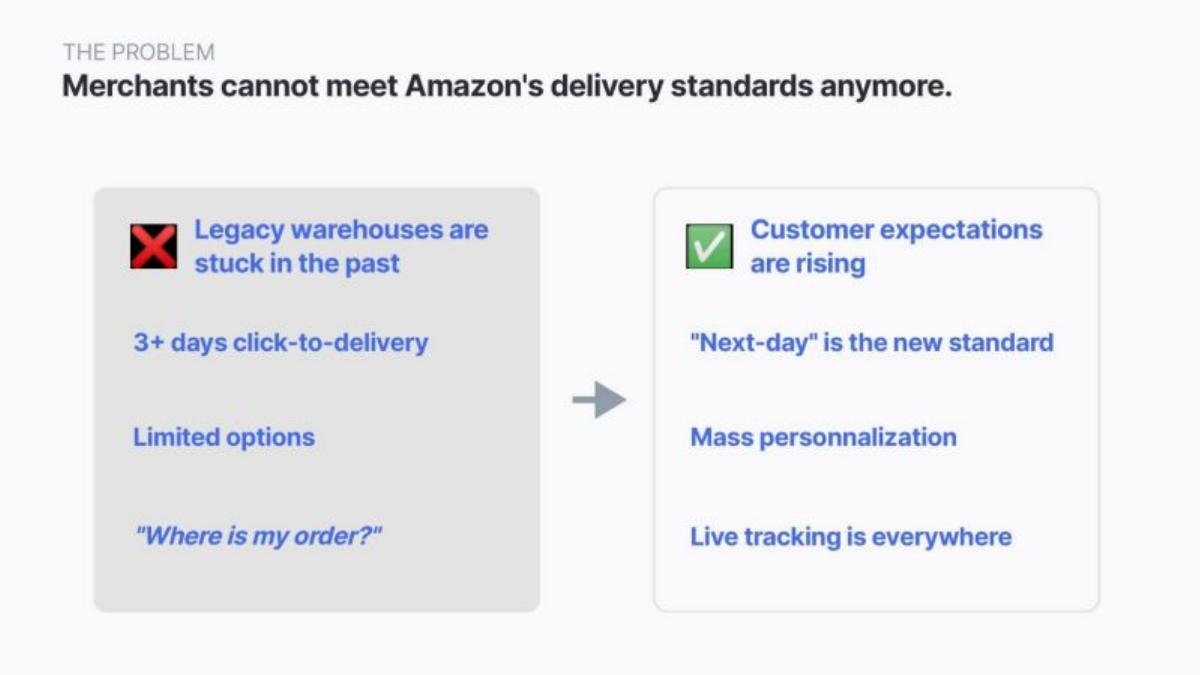
Bigblue problem slide — slide 3
E-commerce fulfilment for online brands. Two boxes compare legacy warehouses with what customers now expect.
Bigblue deck, slide 3. Exact stored slide matched to this analysis.
Our analysis: It names the payer (merchants), the broken step (the warehouse) and the gap between today's service and the new standard, line by line.
Evidence and limitation: "3+ days" is not sourced; the other lines are descriptions.
What a founder can adapt: Put today's service level and the expected one side by side, one matching pair per line, in the units your buyer uses.
Supporting analysis
What the deck claims: "Merchants cannot meet Amazon's delivery standards anymore." Left box, "Legacy warehouses are stuck in the past": "3+ days click-to-delivery", "Limited options", "'Where is my order?'". Right box, "Customer expectations are rising": "'Next-day' is the new standard", "Mass personnalization", "Live tracking is everywhere".
Presentation choice: Pairing each current failing with the matching expectation (3+ days vs next day, no tracking vs live tracking) makes the gap concrete without a chart.
When it does not fit: Add what the gap costs merchants: lost orders, support tickets or returns. "Where is my order?" hints at it but gives no figure.
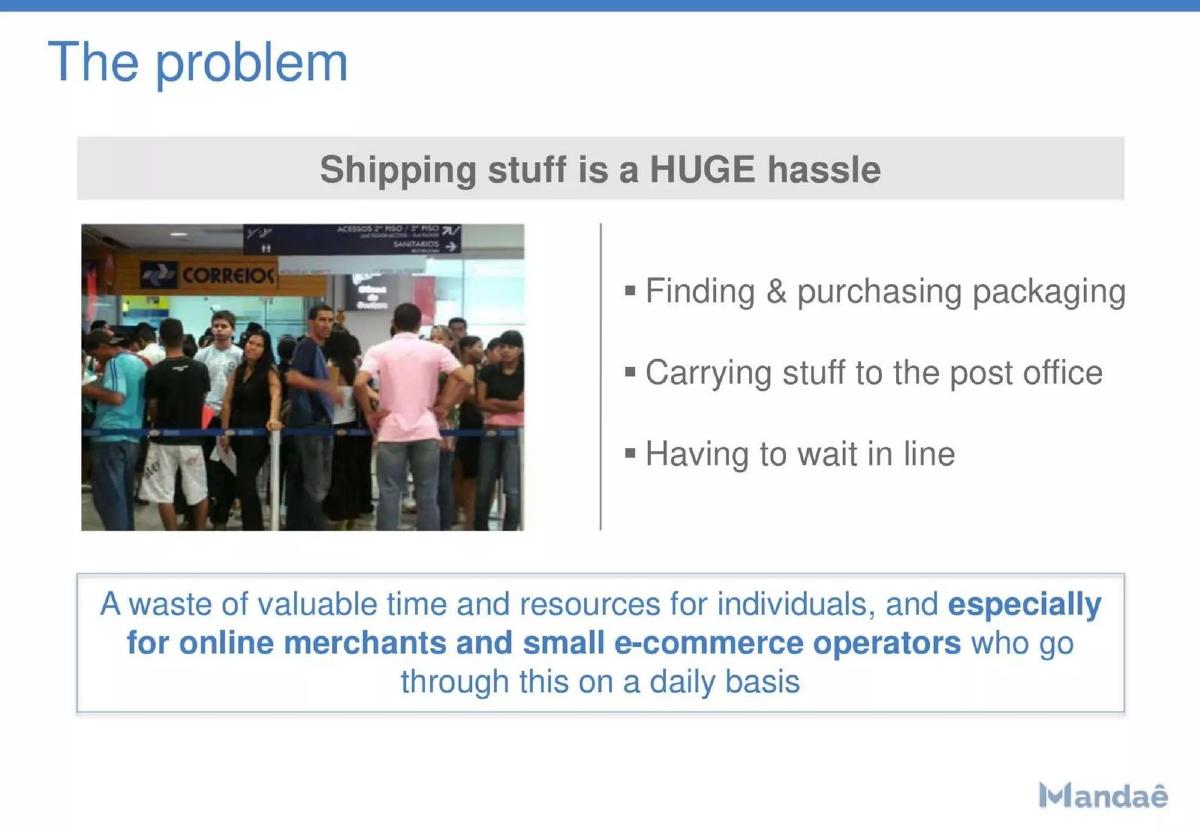
Parcel pickup and shipping for small online sellers in Brazil. A photo of a post office queue beside the three steps of posting a parcel.
Mandaê deck, slide 4. Exact stored slide matched to this analysis.
Our analysis: It breaks shipping into the steps the sender does today and names the customer who repeats them daily (small merchants).
Evidence and limitation: A photo of a crowded Correios counter; no figures.
What a founder can adapt: List the steps your customer does today in order, and say who repeats them often enough to pay for a fix.
Supporting analysis
What the deck claims: "Shipping stuff is a HUGE hassle." "Finding & purchasing packaging", "Carrying stuff to the post office", "Having to wait in line." "A waste of valuable time and resources for individuals, and especially for online merchants and small e-commerce operators who go through this on a daily basis."
Presentation choice: The photo makes the queue real, and the closing line picks the customer for whom the hassle is a recurring cost rather than an occasional annoyance.
When it does not fit: Measure the time: minutes per parcel or hours a week for a typical merchant.
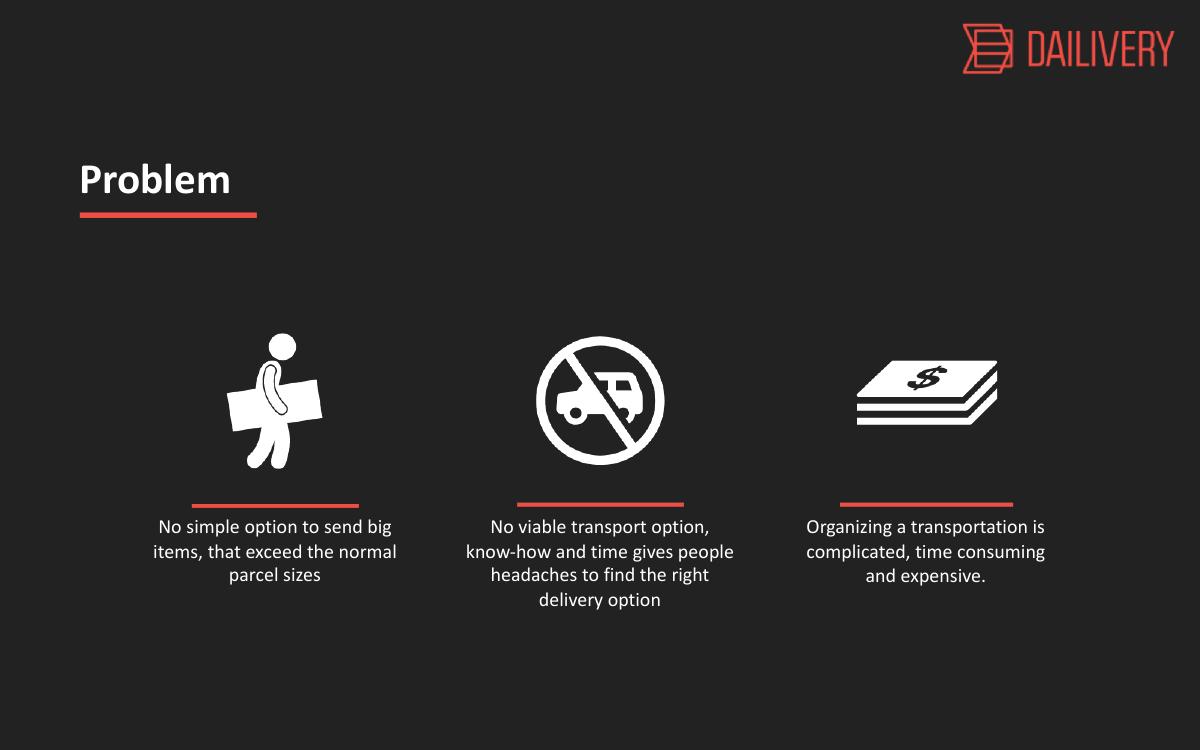
Delivery of large items between people. Three icons for three parts of one problem.
Dailivery deck, slide 2. Exact stored slide matched to this analysis.
Our analysis: It defines a clear gap: items too big for parcel services and too small to justify hiring a mover.
Evidence and limitation: No figures or sources.
What a founder can adapt: Say precisely where today's carriers stop serving the customer: size, distance, weight or timing.
Supporting analysis
What the deck claims: "No simple option to send big items, that exceed the normal parcel sizes." "No viable transport option, know-how and time gives people headaches to find the right delivery option." "Organizing a transportation is complicated, time consuming and expensive."
Presentation choice: "Exceed the normal parcel sizes" tells investors exactly where existing carriers stop, which is where the product starts.
When it does not fit: Name who sends big items (marketplace sellers, people moving house) and what it costs them today.
Pickup for e-commerce sellers in Indonesia. A dated trigger (COVID-19 quarantine) and three bullets about pickup.
Mose Delivery deck, slide 2. Exact stored slide matched to this analysis.
Our analysis: It names the customer (sellers in one country), the broken step (drop-off at the carrier) and why it broke now.
Evidence and limitation: No figures; the quarantine rule is described, not cited.
What a founder can adapt: If an event created the problem, say so, then explain why it lasts after the event passes.
Supporting analysis
What the deck claims: "COVID-19 Impact." "E-commerce sellers in Indonesia are required to do quarantine and can not send their products to the shipment company." "None of the shipment companies would pick the product from their customers, they have to send it directly to shipment." "Time-consuming on handling and delivering the products."
Presentation choice: Naming a specific trigger shows why the problem is urgent, and "none of the shipment companies would pick up" states the gap plainly.
When it does not fit: Show the problem outlasts the pandemic; investors will ask what happens when quarantine ends.
Marine cargo booking. Splits the problem by distance.
Naugo deck, slide 4. Exact stored slide matched to this analysis.
Our analysis: It separates two different failures (coverage and frequency on long routes, availability and price on short ones).
Evidence and limitation: No figures or named regions.
What a founder can adapt: If your problem differs by route, distance or shipment size, split it into two lines and say what fails in each.
Supporting analysis
What the deck claims: "Problems in marine logistics." "Long distance: Ships do not cover many regions and not often." "Short distance: No service or too expensive."
Presentation choice: Splitting by route type is a clean way to show a problem has more than one shape without listing ten bullets.
When it does not fit: Name the regions and give one measure, such as sailings per month or price per tonne.
Dispatch software for taxi operators. A two-column table of problems for operators and drivers versus customers.
Taxi Call deck, slide 5. Exact stored slide matched to this analysis.
Our analysis: It shows both sides of a transport service, but with thirteen items it does not say which one the product fixes first.
Evidence and limitation: Thirteen items; no figures.
What a founder can adapt: Keep two columns if both sides matter, but cut to the two or three items your product fixes.
Supporting analysis
What the deck claims: "Problems are typical for mature but low-tech market." Operator and driver column: "High call center overhead", "Frequent human errors", "Inability to i) manage supply (constant fleet/driver resource) and volatile demand, ii) detect hidden demand", "Suboptimal navigation, route mapping and traffic jam management" and more. Customer column: "Time spent on the phone to order a taxi", "Unclear time and cost of the trip", "Metering is perceived to be unfair" and more.
Presentation choice: The two columns are useful: they show the operator (who pays for software) and the rider (whose experience drives demand).
When it does not fit: Thirteen problems read as a market study, not a pitch. Lead with the operator's cost, such as call-centre overhead per trip.
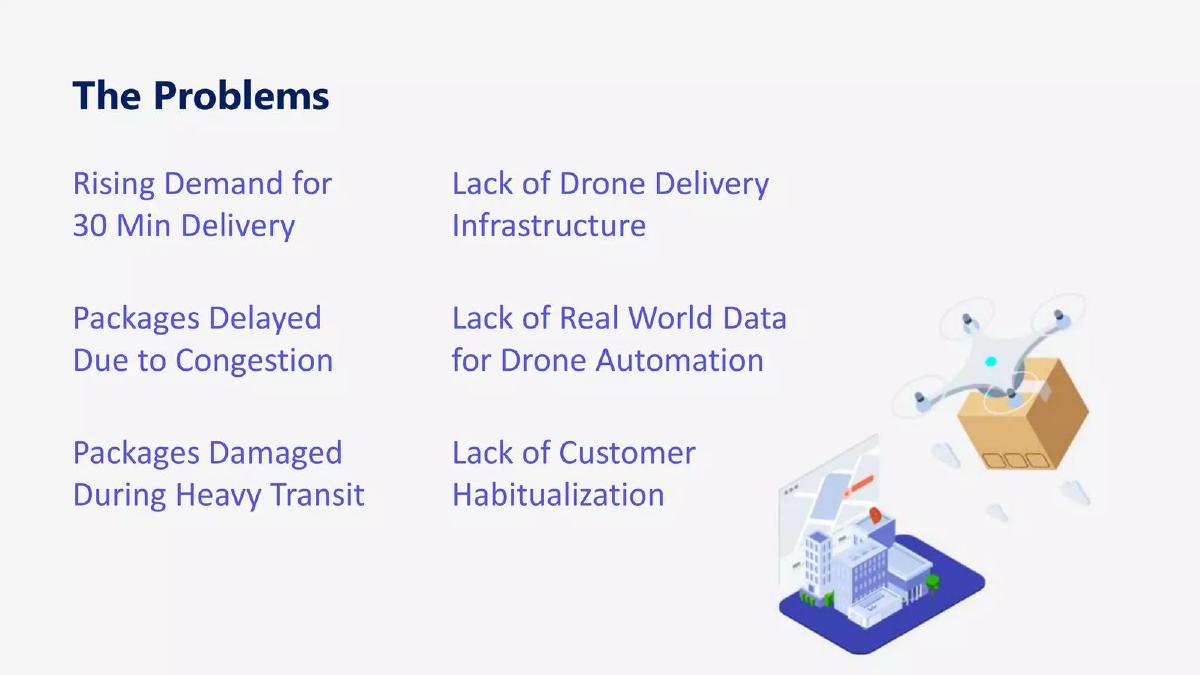
Drone Package Delivery Automation problem slide — slide 3
Drone delivery automation. A partial example: six problems, half of them about delivery, half about the startup's own industry.
Drone Package Delivery Automation deck, slide 3. Exact stored slide matched to this analysis.
Our analysis: The first three are customer problems (speed, delays, damage); the last three are obstacles facing drone companies, which are risks, not the customer's problem.
Evidence and limitation: No figures or sources.
What a founder can adapt: Keep the customer problems (delay, damage) and move infrastructure and data gaps to a risks or why-now slide.
Supporting analysis
What the deck claims: "The Problems." "Rising Demand for 30 Min Delivery", "Packages Delayed Due to Congestion", "Packages Damaged During Heavy Transit", "Lack of Drone Delivery Infrastructure", "Lack of Real World Data for Drone Automation", "Lack of Customer Habitualization."
Presentation choice: It shows a common mix-up: listing your own industry's gaps as if they were the customer's pain.
When it does not fit: Measure the customer problems: share of parcels late or damaged, minutes lost in congestion.
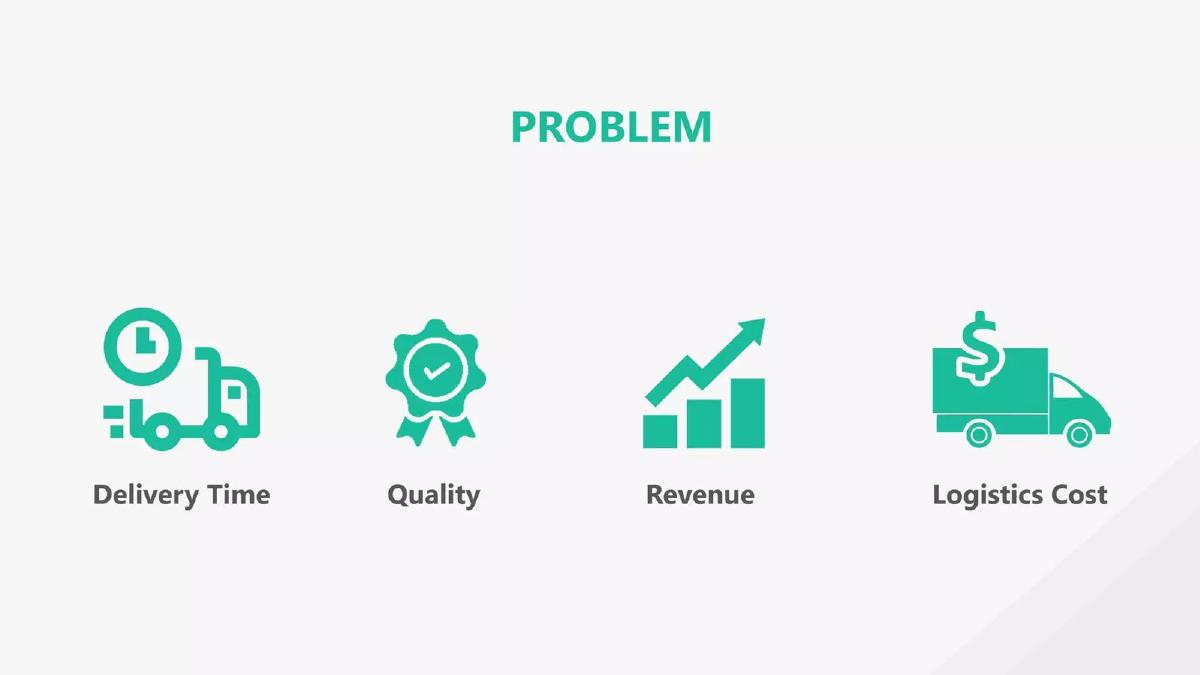
Farm produce delivery. A weaker example, included on purpose: four labelled icons and no sentences.
Farm Bazaar deck, slide 6. Exact stored slide matched to this analysis.
Our analysis: It names four topics but never says who has the problem, what goes wrong or how much it costs.
Evidence and limitation: No text beyond the labels.
What a founder can adapt: Turn each label into a sentence: who, what fails, how much. "Farmers lose 20% of produce because pickup takes three days" (illustrative).
Supporting analysis
What the deck claims: "PROBLEM." Four icons labelled "Delivery Time", "Quality", "Revenue", "Logistics Cost".
Presentation choice: It shows the minimum a logistics problem slide needs: a customer, a broken step and a measure.
When it does not fit: Don't rely on the presenter to explain icons; decks are often read without one.
Who the slide says pays, which step of the journey breaks down, and whether the problem is measured.
Example
Who pays
Step that breaks
Measured
Bigblue
Online merchants
Warehouse and fulfilment
Partly (3+ days)
Mandaê
Small online merchants
Packing and post office drop-off
No (photo only)
Dailivery
People sending large items
No carrier for oversize items
No
Mose Delivery
E-commerce sellers (Indonesia)
Pickup from the seller
No
Naugo
Cargo owners
Booking long and short sea routes
No
Taxi Call
Taxi operators (and riders)
Dispatch and booking
No
Drone Package Delivery
Unclear
Mixed (delivery and own industry)
No
Farm Bazaar
Unclear
Unclear
No
Key Takeaways
Name the shipper who pays. In logistics the sender, the receiver and the carrier are different people; say whose problem this is.
Point to the step that breaks: packing, pickup, the warehouse, the line-haul, the last mile or booking.
Measure in the units operators use: days to delivery, cost per shipment, share of failed or damaged deliveries.
Contrast today's service level with the expectation it now has to meet; Bigblue does this in two boxes.
A list of industry-wide problems (congestion, infrastructure, data) hides the one your product fixes.
Build your logistics problem slide
One payer, one broken step, one measure.
Who pays. Is this the sender's, the receiver's or the carrier's problem? Who pays for the fix?
Broken step. At which step does the shipment fail today: packing, pickup, warehouse, line-haul, last mile, booking, returns?
Measure. How much: days to delivery, cost per shipment, share late, damaged or failed? What is your source?
Expectation. What service level does the customer now expect, and how far is today's service from it?
Copyable framework: [Shipper] lose [measure, source] because [step] takes [today's level] when customers expect [new standard].
Illustrative example 1 — written by us
Before: Logistics is slow, expensive and outdated.
After: Online furniture sellers refund about 1 in 12 orders because third-party carriers take 9 days to deliver when buyers expect 3, and oversize items are refused by parcel networks.
What improved: Our illustrative rewrite; the figures are invented for the example. It names the payer, the broken step, a measure and the expectation gap.
What this guide adds
The general problem slide guide covers any business, and the marketplace problem guide covers two-sided platforms. Logistics differs in one way investors look for: a shipment passes through several hands, so a problem slide must say at which step it fails and who pays for that failure. Slides that describe "shipping is hard" without a step or a payer leave investors to guess where the product sits.
Logistics decks also tend to list every problem in the industry. This guide contrasts those with slides that isolate one broken step and measure it.
Three things a logistics problem slide proves
Who pays: online merchants (Bigblue, Mandaê, Mose), consumers sending large items (Dailivery), island communities and cargo owners (Naugo), taxi operators (Taxi Call).
Which step breaks: the warehouse (Bigblue), packing and drop-off (Mandaê), pickup (Mose), booking a transport (Dailivery, Naugo), dispatch (Taxi Call).
How much: days to delivery (Bigblue) is the only measure among these eight; most slides describe the problem without a number, which is the most common gap.
Common mistakes
No step named. "Shipping is hard" doesn't say where the product fits. Name the step that fails.
Sender, receiver and carrier blurred. Say whose problem it is and who pays for the fix.
Industry obstacles as customer pain. Missing infrastructure or regulation are risks; put them on another slide.
Too many problems. A dozen items reads as a market study. Lead with the two or three you fix.
No measure. Logistics runs on days, cost per shipment and failure rates. Use one.
Diagnostic checklist
It is clear who pays for the fix.
The broken step in the journey is named.
The problem is measured in days, cost or failure rate.
Today's service level is contrasted with what customers expect.
Every figure has a source.
Frequently asked questions
How we chose these examples
Corpus: published pitch deck teardowns on StartupFundraising.com. Founder-uploaded private decks are excluded.
Selection (2026-09-25): we searched extracted text of slides 2–6 for problem and challenge slides in decks whose recorded sector or slide text mentions logistics, shipping, freight, delivery, warehousing, couriers or transport. About forty candidates were listed and sixteen stored images inspected. SafeMotos's problem slide was set aside because it already appears in the marketplace problem guide. Naugo's slide 3 was set aside because it repeats slide 4. GetPark, Get a Drive, Scoosh, Glyde, Market Convoy and FreeSpot were set aside as weaker or outside logistics. Farm Bazaar is kept as a weaker contrast.
Overlap check: none of these eight slides appears in another guide. Bigblue's slide 2 appears in the why-now guide; this guide uses its slide 3.
Review: all eight stored slide images were inspected on 2026-09-25 and matched to company, deck and slide number (editorial model review). No person has yet completed an editorial review of this page.
Claims are as shown on the slides; we have not verified them. We make no claim that any slide caused a fundraising outcome.