Logistics Solution Slide: Real Pitch Deck Examples
How logistics, delivery and transport startups present the solution in a pitch deck: show the shipment's new route step by step, who does each step.
Logistics Startup Solution Slide: Real Pitch Deck Examples
Eight solution slides from logistics, delivery and transport startups, shown in full, compare whether each slide shows the shipment's new route step by step, says who does each step, states the price, and gives a result.
TL;DR
A logistics solution slide should show the new route a shipment takes, one step at a time, and who does each step: the customer, your staff, a driver, a partner carrier. Then say what the customer pays and one result. Mandaê does all of this in three numbered steps ("User snaps a photo", "A Mandaê messenger shows up", "We professionally package and forward items") and adds the price: "User pays us the same price they'd pay the post office." Bigblue shows three screens and a result for each ("Increasing brands sales by 86% with Fast Tags"). Scoosh lists three benefits of a scooter-sharing app with no route and no result, which is the weaker pattern.
Logistics startup solution slides from real pitch decks
Each example shows the exact stored slide above its analysis and links to the full teardown. Claims are as shown on the slides; we have not verified them.
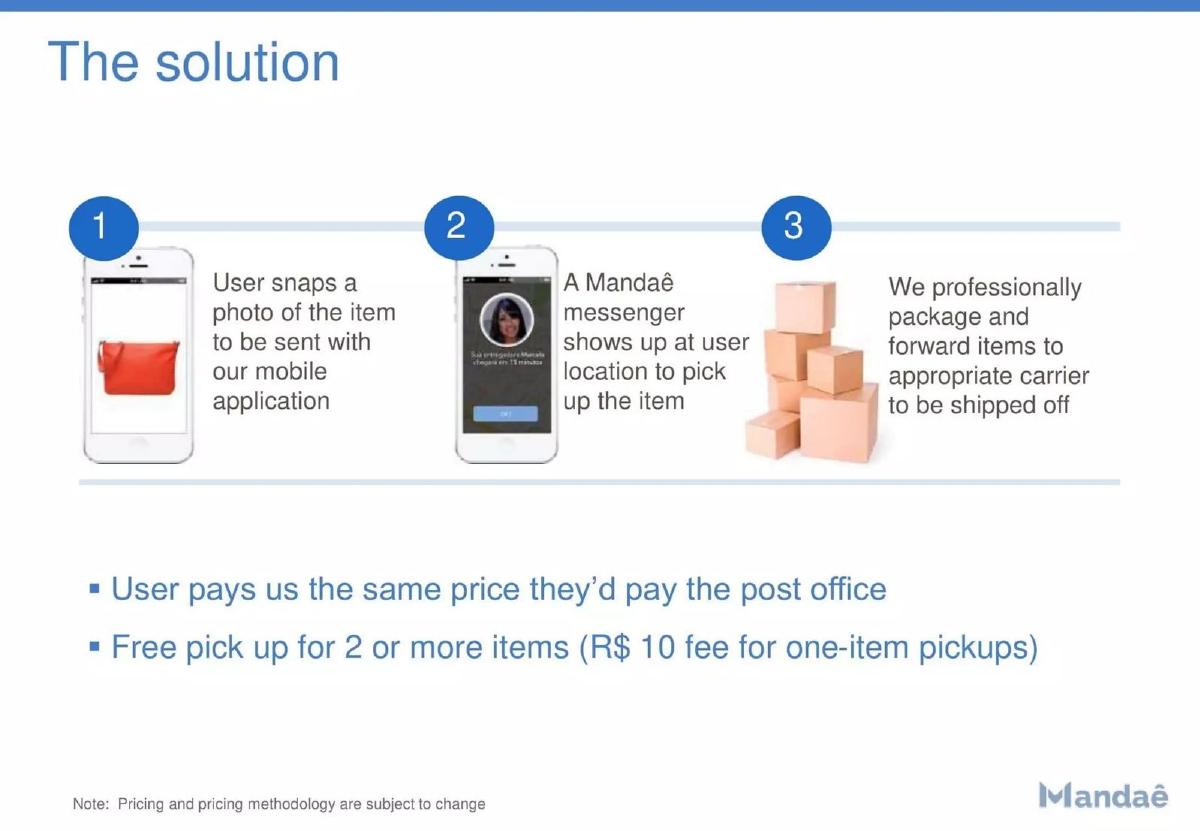
Mandaê solution slide — slide 5
Parcel pickup and shipping for small online sellers in Brazil. Three numbered steps with phone screens, then the price.
Mandaê deck, slide 5. Exact stored slide matched to this analysis.
Our analysis: Each step replaces one step from its problem slide (packaging, carrying to the post office, queuing), and the price answers "is it more expensive?"
Evidence and limitation: Prices shown; footnote says pricing is subject to change.
What a founder can adapt: Number your steps, name who does each, and compare your price with today's alternative.
Supporting analysis
What the deck claims: "The solution." 1: "User snaps a photo of the item to be sent with our mobile application." 2: "A Mandaê messenger shows up at user location to pick up the item." 3: "We professionally package and forward items to appropriate carrier to be shipped off." "User pays us the same price they'd pay the post office." "Free pick up for 2 or more items (R$ 10 fee for one-item pickups)."
Presentation choice: The route, who does each step and the price fit on one slide, so investors can see the operation and the margin question at once.
When it does not fit: Add one result, such as minutes saved per parcel or repeat pickups per merchant.
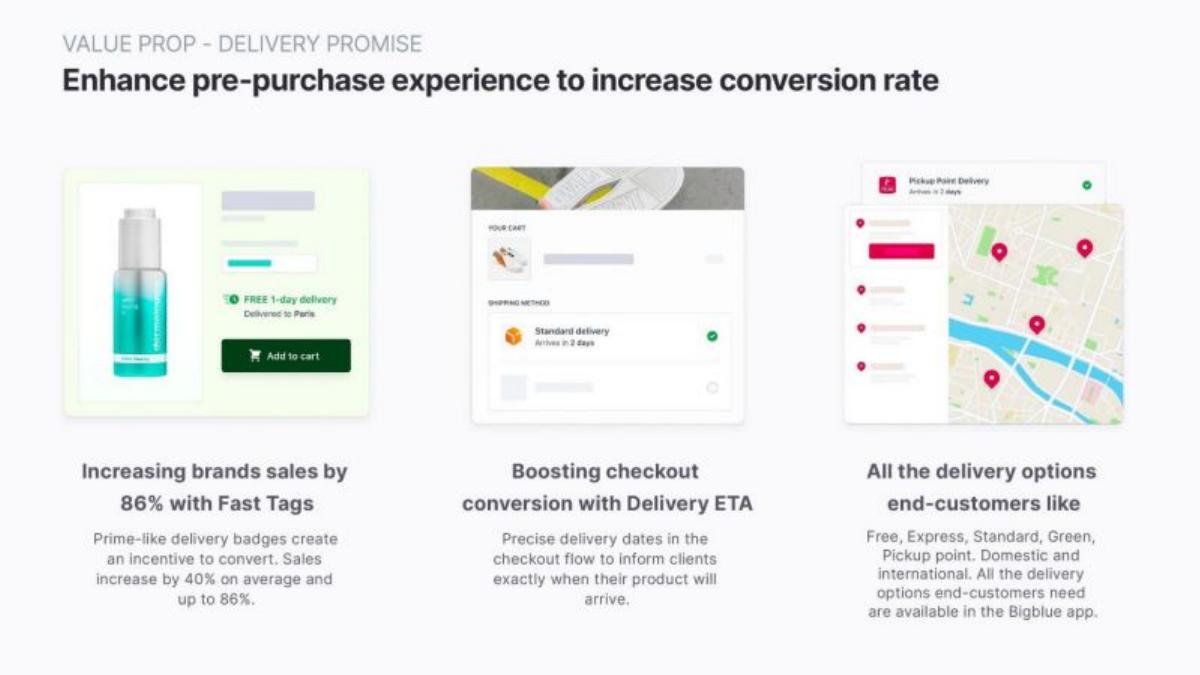
E-commerce fulfilment. Three product screens, each with a result for the merchant.
Bigblue deck, slide 6. Exact stored slide matched to this analysis.
Our analysis: It shows fulfilment through what the shopper sees before buying, and ties it to the merchant's sales.
Evidence and limitation: 40% average and 86% maximum sales increase; not sourced.
What a founder can adapt: Show where your logistics service appears to the end customer and the metric it moves for your buyer.
Supporting analysis
What the deck claims: "Value prop - Delivery promise." "Enhance pre-purchase experience to increase conversion rate." "Increasing brands sales by 86% with Fast Tags" ("Prime-like delivery badges... Sales increase by 40% on average and up to 86%"). "Boosting checkout conversion with Delivery ETA." "All the delivery options end-customers like" ("Free, Express, Standard, Green, Pickup point").
Presentation choice: Linking a warehouse service to the merchant's conversion rate turns an operations cost into revenue.
When it does not fit: Lead with the average (40%), not the maximum (86%), and say how it was measured.
Pickup for e-commerce sellers in Indonesia. Three steps on a timeline.
Mose Delivery deck, slide 5. Exact stored slide matched to this analysis.
Our analysis: It answers its problem slide (carriers won't pick up) with step 3, a courier who picks up and hands over to the carrier.
Evidence and limitation: No figures.
What a founder can adapt: Show where you sit between the customer and existing carriers, step by step.
Supporting analysis
What the deck claims: "Timeline of Service." "Step 1 - Filling the information: After the users download the app, they have to fill in the information about their store as the sender to the buyer." "Step 2 - Choose the service and the nearest courier." "Step 3 - Send the product: The courier would pick up and send the product to the shipment company."
Presentation choice: The steps show the company sits between seller and carrier rather than competing with carriers.
When it does not fit: Add the price and how fast pickup happens; both decide whether sellers switch.
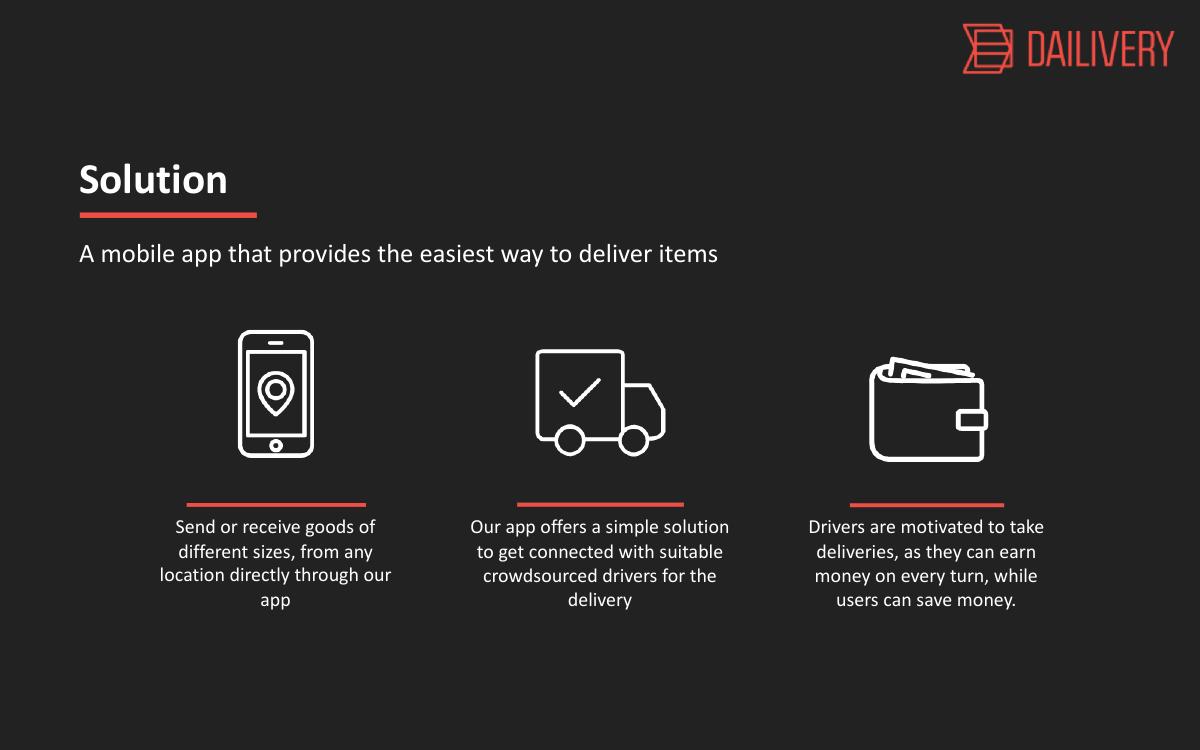
Delivery of large items between people. Three icons: sender, matching, driver.
Dailivery deck, slide 3. Exact stored slide matched to this analysis.
Our analysis: It names both sides (senders and crowdsourced drivers) and why each takes part.
Evidence and limitation: No figures.
What a founder can adapt: If you rely on drivers or partners, give their reason to join next to the customer's.
Supporting analysis
What the deck claims: "A mobile app that provides the easiest way to deliver items." "Send or receive goods of different sizes, from any location directly through our app." "Our app offers a simple solution to get connected with suitable crowdsourced drivers for the delivery." "Drivers are motivated to take deliveries, as they can earn money on every turn, while users can save money."
Presentation choice: For a crowdsourced model, saying why drivers join is as important as saying why senders do.
When it does not fit: Show one delivery end to end, with the price compared with a van rental or mover.
Dispatch software for taxi operators. A feature table marking which of customer, driver and operator each feature serves.
Taxi Call deck, slide 6. Exact stored slide matched to this analysis.
Our analysis: The table maps features to each side, which answers its two-sided problem slide, but it shows no route and no result.
Evidence and limitation: Feature list; no results.
What a founder can adapt: If your product serves several parties, a table works; then pick the top feature for the payer and show its result.
Supporting analysis
What the deck claims: "Product solves ALL these problems." Features include "Easy ordering with Start and End address prompt", "Route Planning & Navigation", "Time and Cost forecast", "Billing based on true distance and actual time spent", "Supply forecast based on historical, weather and public data", "Taxi sharing opportunities", with ticks for Customer, Taxi Driver and Taxi Operator.
Presentation choice: A feature-by-user table is a quick way to show a product serves several parties.
When it does not fit: "Solves ALL these problems" invites doubt; show one problem solved with a number.
Marine cargo booking. Combines two solutions (long and short distance) into one.
Naugo deck, slide 6. Exact stored slide matched to this analysis.
Our analysis: It shows how the short-distance platform (boat availability) feeds long-distance dispatch, one system serving both.
Evidence and limitation: No figures.
What a founder can adapt: If your product has two parts, draw the arrow that shows how one feeds the other.
Supporting analysis
What the deck claims: "Combined." "Long distance: Utilize small boats" → "Dispatch available boats." "Short distance: Provide a platform (boats <> customers)" → "Know each boat's availability."
Presentation choice: Showing how two parts of the product reinforce each other answers "why one company for both?"
When it does not fit: Name the route and customer, and give one result such as sailings added or price per shipment.
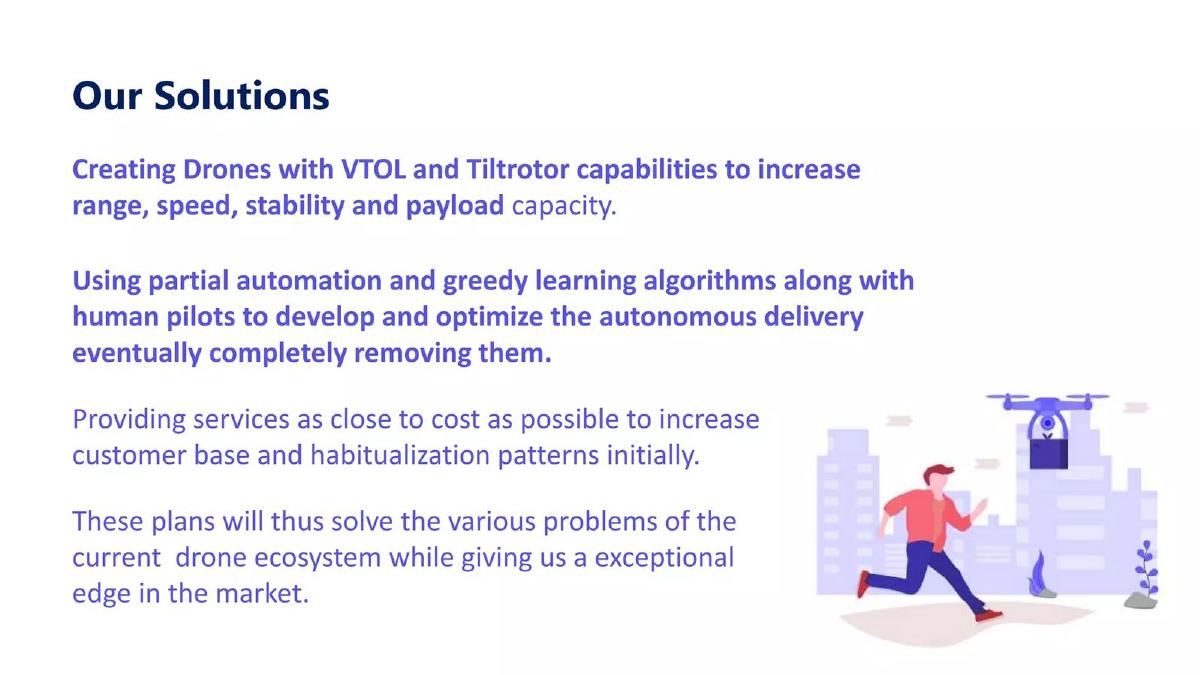
Drone delivery. A partial example: describes the technology and plan rather than the delivery.
Drone Package Delivery Automation deck, slide 4. Exact stored slide matched to this analysis.
Our analysis: It describes how the drones work and the pricing plan, but never who orders, where the drone flies or how long delivery takes.
Evidence and limitation: No figures.
What a founder can adapt: Start with one delivery (who orders, from where, how many minutes), then the technology.
Supporting analysis
What the deck claims: "Our Solutions." "Creating Drones with VTOL and Tiltrotor capabilities to increase range, speed, stability and payload capacity." "Using partial automation and greedy learning algorithms along with human pilots... eventually completely removing them." "Providing services as close to cost as possible to increase customer base and habitualization patterns initially."
Presentation choice: It shows the difference between a technology slide and a solution slide.
When it does not fit: "Close to cost" pricing needs a number and a path to margin.
Electric scooter sharing in Poland. A weaker example, included on purpose: three benefits, no route, no result.
Scoosh deck, slide 4. Exact stored slide matched to this analysis.
Our analysis: It names the service and three benefits but not the trip, the price or how it answers the traffic problem on its previous slide.
Evidence and limitation: No figures.
What a founder can adapt: Show one trip (find, unlock, ride, park), the price per minute and the time saved compared with a car.
Supporting analysis
What the deck claims: "Solutions." "City electric scooter sharing system." "Location, reservation and start from the app." "No commitments, pay only for driving time." "Eco-friendly."
Presentation choice: It shows the minimum a transport solution slide needs: one trip, a price and a result.
When it does not fit: "Eco-friendly" needs a measure, such as grams of CO2 per trip compared with a car.
Before: An AI-powered platform that optimises last-mile delivery.
After: 1. The shop books a pickup in the app. 2. Our rider collects within two hours. 3. We hand over to the cheapest carrier for the route. Price: the carrier's rate plus £0.50. Result: pilot shops cut late deliveries from 12% to 4%.
What improved: Our illustrative rewrite; the figures are invented for the example. It shows the route, who does each step, a price and a result.
What this guide adds
The general solution slide guide covers any business, and the logistics problem guide shows how these startups describe what breaks. This guide covers the next slide: how the shipment moves once the product exists. Logistics investors look for the operational detail that decides margins: who picks up, who packs, which carrier carries it, and what the customer pays.
Four of these companies (Mandaê, Dailivery, Mose Delivery, Naugo) also appear in the logistics problem guide, so problem and solution can be read side by side.
Three things a logistics solution slide proves
The route: numbered steps from order to delivery (Mandaê, Mose Delivery), or a split by distance (Naugo).
Who does each step: the user, a company messenger, a crowd of drivers, partner carriers (Mandaê, Dailivery, Mose Delivery).
Price and result: the price against today's alternative (Mandaê) and a measured result (Bigblue). Most slides skip both.
Common mistakes
Technology instead of the route. Show one delivery before the drones or algorithms.
No one named per step. Say who picks up, packs and carries; it decides your margins.
No price. Compare your price with what the customer pays today.
"Solves all problems". Show one problem solved with a number instead.
Benefits list. "Eco-friendly" and "no commitments" are not a route or a result.
Diagnostic checklist
The route is shown as numbered steps.
It is clear who does each step.
The price is compared with today's alternative.
One result is given in the payer's units.
It answers the problem slide directly.
Frequently asked questions
How we chose these examples
Corpus: published pitch deck teardowns on StartupFundraising.com. Founder-uploaded private decks are excluded.
Selection (2026-09-25): we read slides 3–7 of the decks in the logistics problem guide and other delivery, shipping and transport decks, searching for solution, product and how-it-works slides. Twelve stored images were inspected. Bigblue's slide 4 was set aside because it describes market context, not the product. Mose Delivery's slide 3 was set aside in favour of slide 5. Glyde's slide was set aside as private air travel rather than logistics. Farm Bazaar's solution slide has no stored image. Scoosh is kept as a weaker contrast.
Overlap check: none of these eight slides appears in another guide. Six of the companies appear in the logistics problem guide with different slides.
Review: all eight stored slide images were inspected on 2026-09-25 and matched to company, deck and slide number (editorial model review). No person has yet completed an editorial review of this page.
Claims are as shown on the slides; we have not verified them. We make no claim that any slide caused a fundraising outcome.