Real Estate Solution Slide: Real Pitch Deck Examples
How real estate and proptech startups present the solution in a pitch deck: say who acts, what changes in the property deal, and what proof exists.
Real Estate Solution Slide: Real Pitch Deck Examples
Eight solution slides from real estate and proptech startups, shown in full, compare how each explains who uses the product, what changes in the property deal, and what evidence backs the claim.
TL;DR
A proptech solution slide should answer three questions: who in the property deal acts differently, what step of the deal changes, and what proof shows it works? Divvy Homes explains its model in three numbered steps: "Tenant picks out the home", "Divvy purchases it for them", "Tenant buys out our equity position over time." Giraffe360 shows the flow from a camera to "ready-to-use content formats" in one row. Reesio puts a real listing on the slide with the note that the property was updated "in real time." The Co-Own Company lists three features over three renderings and never says who pays or how ownership is shared.
Proptech solution slides from real pitch decks
Each example shows the exact stored slide above its analysis and links to the full teardown. Claims are as shown on the slides; we have not verified them.
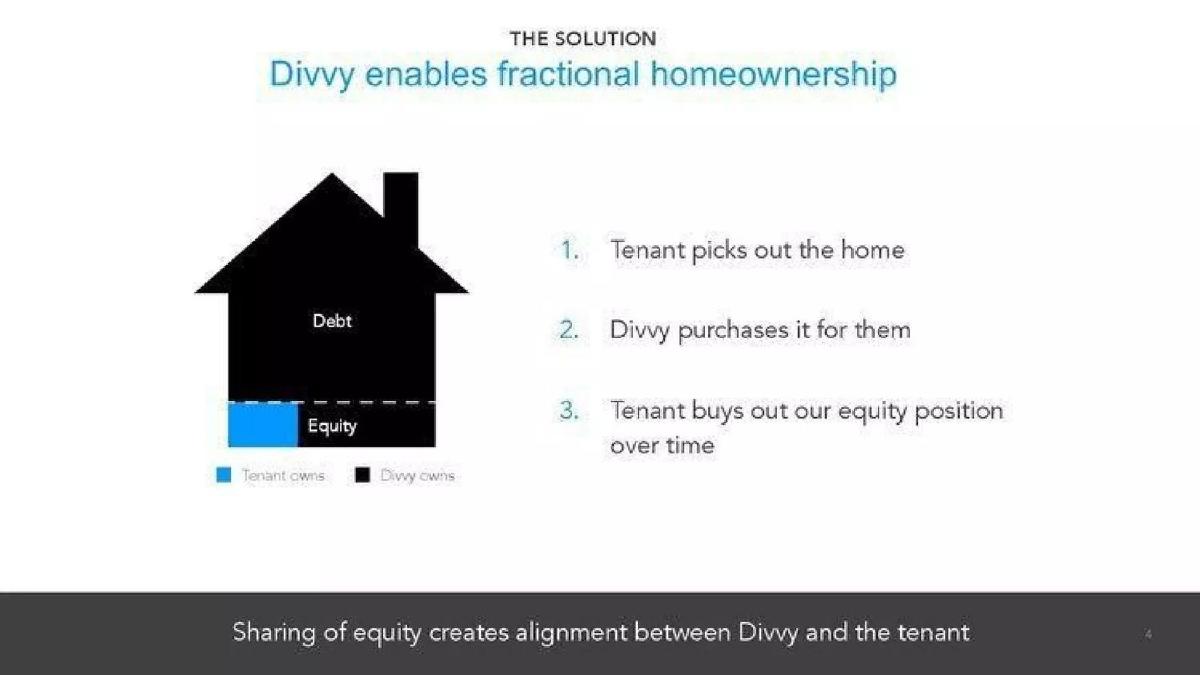
Divvy Homes solution slide — slide 4
Rent-to-own homes. Three numbered steps beside a house diagram split into debt and equity.
Divvy Homes deck, slide 4. Exact stored slide matched to this analysis.
Our analysis: The whole business fits in three steps, and the diagram shows who owns what.
Evidence and limitation: No figures; the model is explained, not measured.
What a founder can adapt: If your model is a new kind of transaction, number the steps and name who acts in each.
Supporting analysis
What the deck claims: "THE SOLUTION. Divvy enables fractional homeownership." "1. Tenant picks out the home. 2. Divvy purchases it for them. 3. Tenant buys out our equity position over time." "Sharing of equity creates alignment between Divvy and the tenant."
Presentation choice: It says who acts at each step, including that Divvy buys the house, which tells investors the model needs capital.
When it does not fit: Add the terms a tenant sees: deposit, monthly payment, and how long the buyout typically takes.
Real estate transaction software for agents. A real listing screenshot with a callout.
Reesio deck, slide 4. Exact stored slide matched to this analysis.
Our analysis: It answers the problem slide point for point: Zillow's data is days old; Reesio's changed hours ago.
Evidence and limitation: A product screenshot; the accuracy claim is not measured against other sites.
What a founder can adapt: Show the exact screen where your answer to the problem is visible, and point to it.
Supporting analysis
What the deck claims: "SOLUTION: REESIO OWNS THE MOST ACCURATE PROPERTY DATA ANYWHERE." A listing marked "Active Contingent", "Last Updated: about 11 hours ago", with the callout "Property updated in real time: 1) It's for sale, 2) It's in contract, and 3) It's no longer accepting offers."
Presentation choice: Showing one real record is more convincing than describing a data advantage.
When it does not fit: Back "most accurate anywhere" with a comparison: average data age against the listing sites.
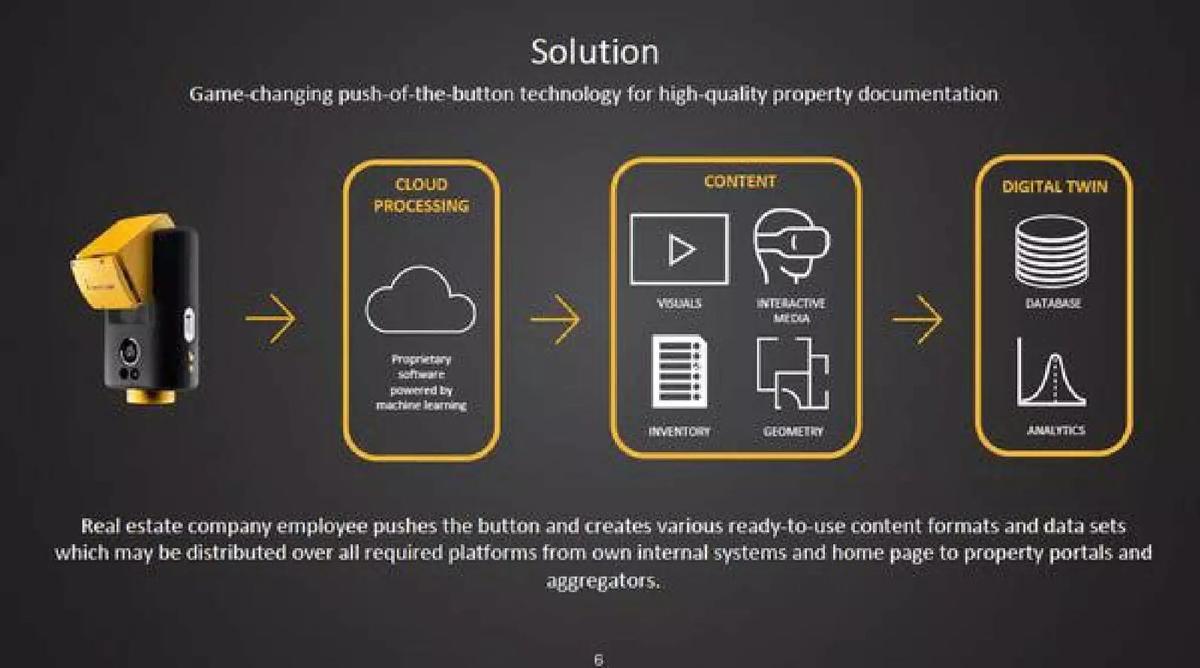
Property photography hardware and software. A left-to-right flow from camera to outputs.
Giraffe360 deck, slide 6. Exact stored slide matched to this analysis.
Our analysis: It says who operates it (an agency employee, not a photographer) and shows every output.
Evidence and limitation: No figures.
What a founder can adapt: Show the flow from input to outputs, and say who presses the button.
Supporting analysis
What the deck claims: "Solution. Game-changing push-of-the-button technology for high-quality property documentation." Camera → "Cloud processing" → "Content" (visuals, interactive media, inventory, geometry) → "Digital twin" (database, analytics). "Real estate company employee pushes the button and creates various ready-to-use content formats and data sets."
Presentation choice: The flow makes the step it removes obvious: booking a specialist photographer.
When it does not fit: Add time and cost per listing compared with a photographer, and drop "game-changing".
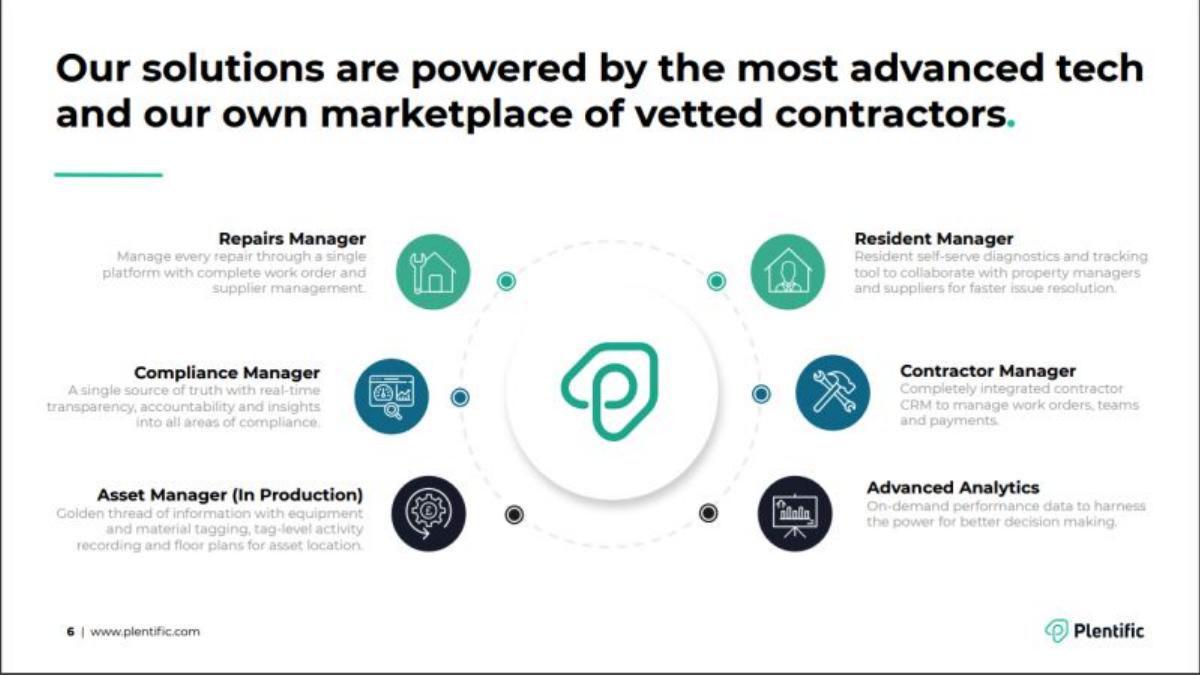
Property maintenance software for landlords and property managers. Six modules around the logo.
Plentific deck, slide 6. Exact stored slide matched to this analysis.
Our analysis: It shows the breadth of the product and is honest that one module is not yet live.
Evidence and limitation: No figures; one module marked as in production.
What a founder can adapt: If you have several modules, label each one's status and say which one customers start with.
Supporting analysis
What the deck claims: "Our solutions are powered by the most advanced tech and our own marketplace of vetted contractors." Modules: Repairs Manager, Resident Manager, Compliance Manager, Contractor Manager, Asset Manager "(In Production)", Advanced Analytics.
Presentation choice: Marking Asset Manager "(In Production)" separates what exists from what is planned.
When it does not fit: Six modules at equal weight hides the core; lead with the one that solves the problem slide's pain.
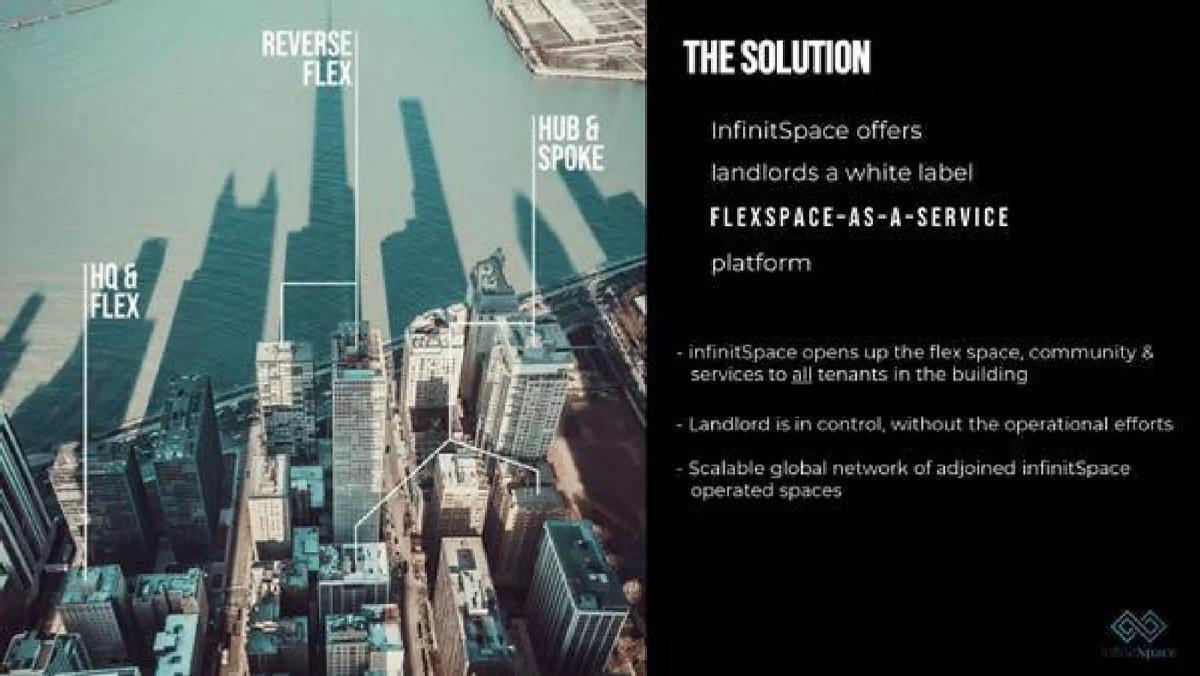
Flexible office space run for building owners. A city photo with three labelled models and three lines of text.
InfinitSpace deck, slide 6. Exact stored slide matched to this analysis.
Our analysis: It names the customer (landlords) and what they keep (control) and lose (operational work).
Evidence and limitation: No figures.
What a founder can adapt: Say which party pays, what they keep, and what you take off their hands.
Supporting analysis
What the deck claims: "THE SOLUTION. InfinitSpace offers landlords a white label FLEXSPACE-AS-A-SERVICE platform." "infinitSpace opens up the flex space, community & services to all tenants in the building." "Landlord is in control, without the operational efforts." "Scalable global network of adjoined infinitSpace operated spaces."
Presentation choice: "White label" and "landlord is in control" answer the landlord's first objection to flex operators.
When it does not fit: Explain the photo labels ("Reverse flex", "Hub & spoke") or remove them, and add one building where it runs.
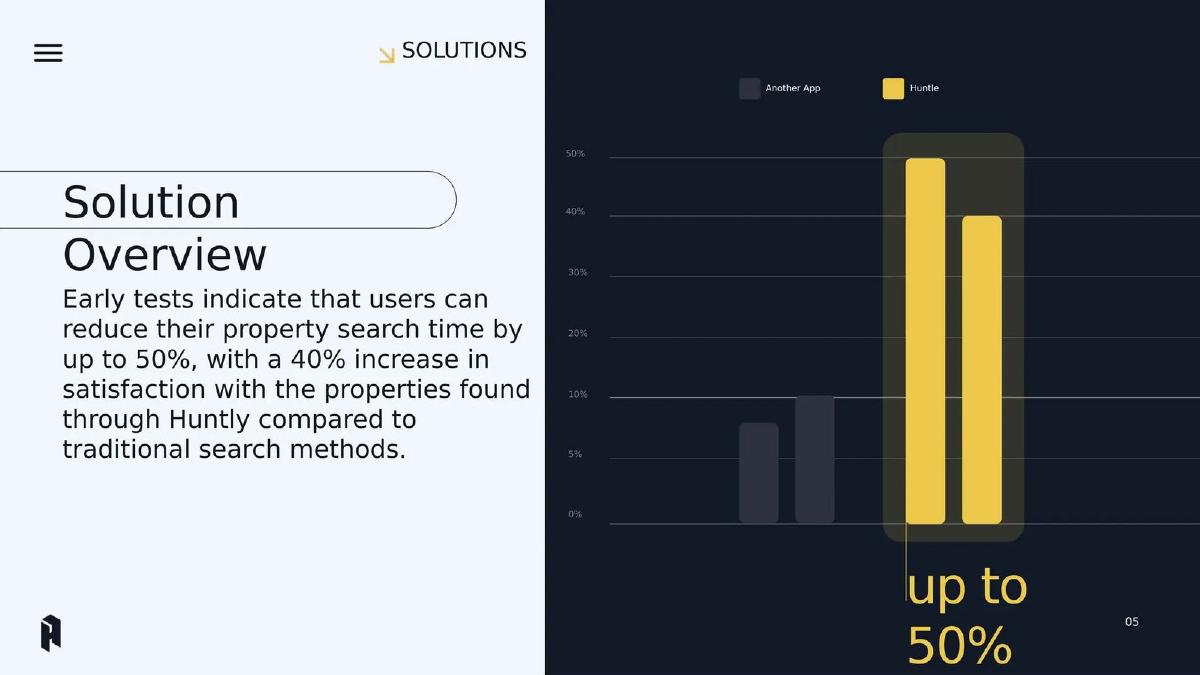
Property search app. A partial example: test results and a bar chart, but no product.
Huntly deck, slide 6. Exact stored slide matched to this analysis.
Our analysis: It leads with proof, which most solution slides lack, but never shows what the app does.
Evidence and limitation: "Early tests" with no sample size or method; chart axis unlabelled.
What a founder can adapt: Put your test result on the slide, with how many users and how it was measured.
Supporting analysis
What the deck claims: "Solution Overview. Early tests indicate that users can reduce their property search time by up to 50%, with a 40% increase in satisfaction with the properties found through Huntly compared to traditional search methods." Chart labelled "Another App" and "Huntly"; "up to 50%".
Presentation choice: A number on the solution slide is useful; this one needs its source to count.
When it does not fit: Show the product, name the comparison instead of "Another App", and replace "up to" with the average.
Shared urban home ownership. A weaker example, included on purpose: three features over three renderings.
The Co-Own Company deck, slide 3. Exact stored slide matched to this analysis.
Our analysis: It lists what the homes are like, not how co-ownership works or what a buyer pays.
Evidence and limitation: None; renderings, not built units.
What a founder can adapt: Explain the transaction: who owns what share, what a buyer puts in, and how they exit.
Supporting analysis
What the deck claims: "OUR SOLUTION. Shared equity co-ownership of new units. Urban, high-tech, net-zero energy design. Easy and hassle-free onboarding."
Presentation choice: Compare it with Divvy: both sell a new route to ownership, but only Divvy explains the steps.
When it does not fit: Label the images as renderings and replace "hassle-free" with the actual onboarding steps.
Whether each slide names who acts, shows what changes in the deal, and gives proof.
Example
Who acts
What changes
Proof shown
Divvy Homes
Yes (tenant, Divvy)
Yes (three steps to ownership)
No
Reesio
Partly (buyers, agents)
Yes (live listing status)
Partly (screenshot)
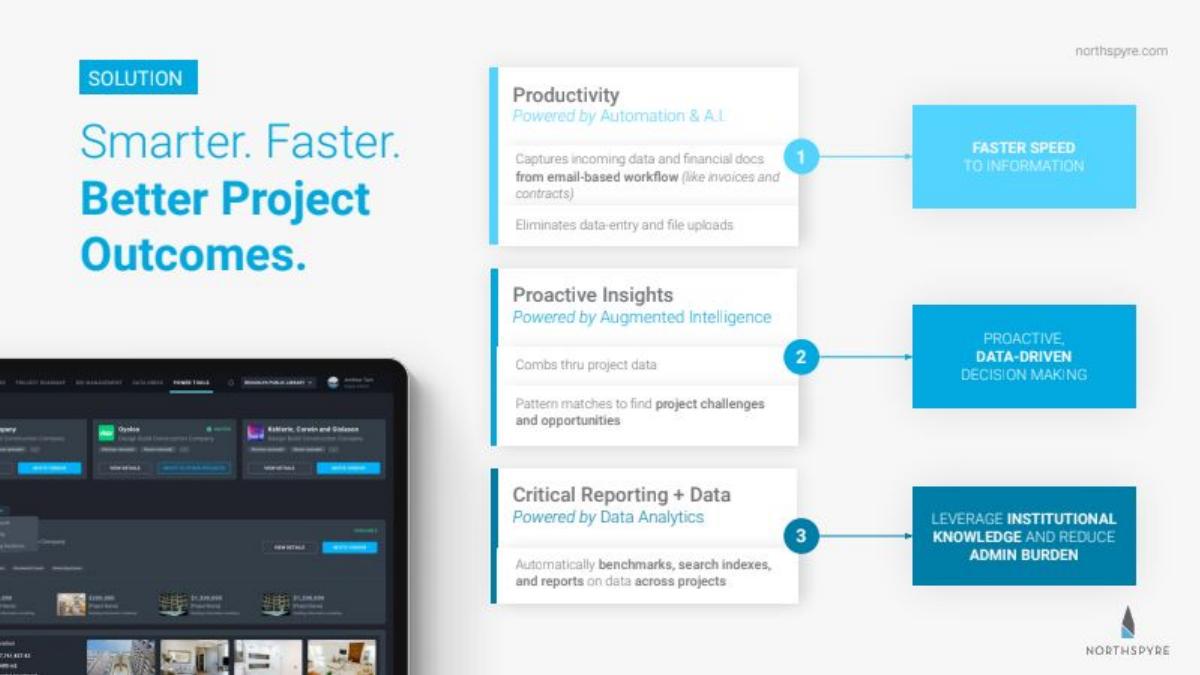
Northspyre
Partly (developers)
Yes (three outcomes)
Partly (screenshot)
Giraffe360
Yes (agency employee)
Yes (camera to content)
No
Plentific
Partly (property managers)
Partly (six modules)
No
InfinitSpace
Yes (landlords)
Yes (flex without operations)
No
Huntly
Partly (searchers)
No
Partly (unsourced tests)
The Co-Own Company
No
No
No
Key Takeaways
Answer the problem slide directly: the same party, the same step of the deal, the same number.
Show the sequence. Property deals happen in steps; number them, as Divvy does.
Show the product or the property, not just icons. Reesio and Northspyre show real screens.
Say who does the work: the landlord, the tenant, the agent, or the startup's own team.
Put one proof point on the slide, and say where it comes from.
Build your proptech solution slide
Same party as your problem slide, the steps that change, one proof point.
Party. Who acts differently because of your product? Use the same party as your problem slide.
Steps. Which step of the property deal changes? List the new sequence in three steps or fewer.
Model. Do you buy, lease or manage property, or only sell software? Say so; investors will ask.
Proof. What one screen, pilot result or customer number shows it works? Where is it from?
Copyable framework: [Party] now [new step] instead of [old step], so [problem-slide cost] falls to [result, source].
Illustrative example 1 — written by us
Before: An AI-powered end-to-end platform revolutionizing rentals.
After: Small landlords list once; we screen every lead and book viewings, so vacancy between tenants fell from 38 to 19 days across 40 pilot units.
What improved: Our illustrative rewrite; the figures are invented for the example. It names the party, the changed step and a sourced-style proof point.
What this guide adds
The general solution slide guide covers any business. Property solutions raise questions investors ask every time: does the startup own or lease buildings (capital heavy) or sell software (capital light), which party changes behaviour, and at what step of the transaction. This guide compares how proptech decks answer those questions on one slide.
It pairs with the real estate problem slide guide: Northspyre, Reesio and The Co-Own Company appear in both, so you can see how each deck moves from problem to solution.
Three things a proptech solution slide proves
Who acts: the named party and what they now do (Divvy's tenant, Giraffe360's agency employee, InfinitSpace's landlord).
What changes: the step of the deal that is faster, cheaper or possible for the first time (Reesio's data, Northspyre's reporting, Plentific's repairs).
Proof: a real screen, a number or a result (Reesio's listing, Huntly's test figures).
Common mistakes
Features without the deal. Say which step of the transaction changes, not just what the product includes.
Hiding the capital model. If you buy or lease property, say so; it changes how investors value you.
Renderings as product. Label concept images; investors assume photos are built.
Unsourced "up to" numbers. Give the average, the sample and the method.
Disconnected from the problem. Use the same party and number as the problem slide.
Diagnostic checklist
The party matches the problem slide.
The changed steps of the deal are shown in order.
The slide says whether you hold property or sell software.
A real screen or product image is shown.
One proof point with a source is included.
Frequently asked questions
How we chose these examples
Corpus: published pitch deck teardowns on StartupFundraising.com. Founder-uploaded private decks are excluded.
Selection (2026-09-25): we searched extracted text of slides 2–6 for solution slides in decks whose recorded sector is real estate, proptech or property, excluding fintech. Thirteen candidates were read. Doorkee's solution slides were set aside because the deck is marked confidential. iSprout (icons only, repeated elsewhere in its deck), nuwo (office furniture, not a property customer) and ALAF (a long text block about one building type) were set aside as weaker than those chosen. The Co-Own Company is kept as a weaker contrast.
Overlap check: none of these eight slides appears in another guide. Divvy Homes, Northspyre, Reesio and The Co-Own Company appear elsewhere with different slides.
Review: all eight stored slide images were inspected on 2026-09-25 and matched to company, deck and slide number (editorial model review). No person has yet completed an editorial review of this page.
Claims are as shown on the slides; we have not verified them. We make no claim that any slide caused a fundraising outcome.