Real Estate Business Model Slides: 6 Real Proptech Examples
How proptech startups show who pays and for what: contingency fees on savings, pay-per-lead, commissions on rent, monthly subscriptions and co-ownership fees.
Real Estate Business Model Slide: Who Pays, and When
Real estate has many possible payers: owners, buyers, landlords, tenants, agents, developers and lenders. Money also moves at very different moments, from a one-off purchase to monthly rent or a resale years later. The six slides below show how proptech startups explained who pays them, for what, and when.
TL;DR
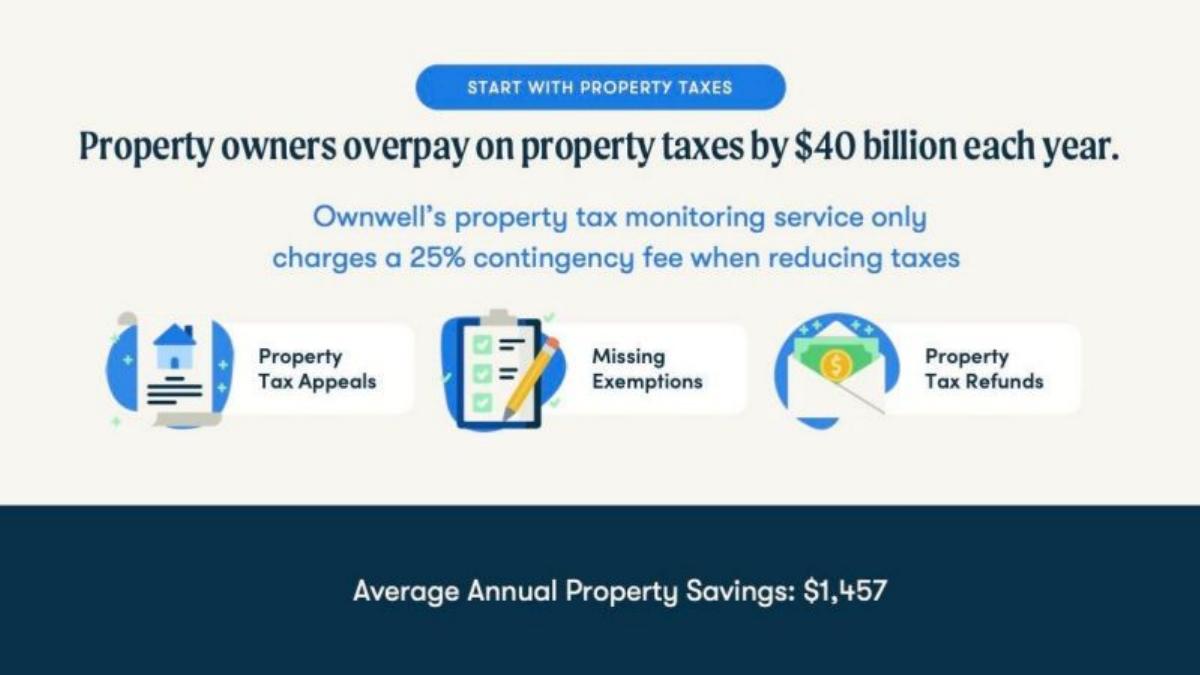
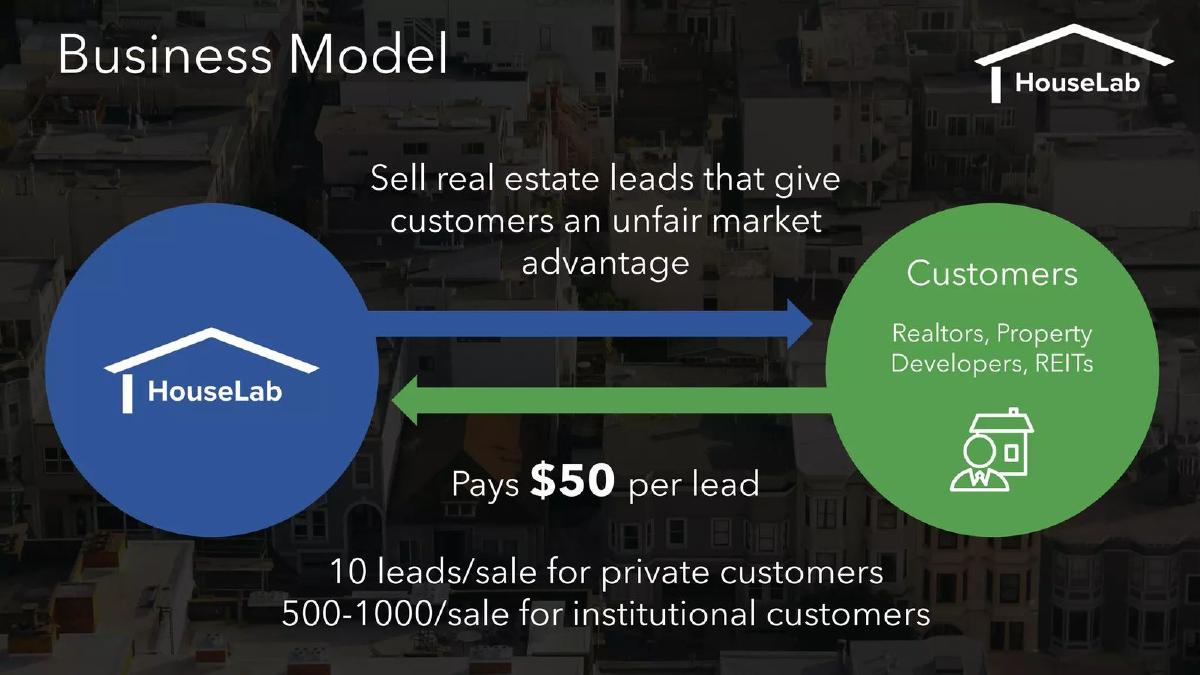
Name the payer, what they pay for and when. Ownwell does this in one line: property owners pay a 25% contingency fee only when their tax bill goes down. HouseLab gives a price per lead ($50) and how many leads each kind of customer needs to make a sale. Weaker slides name a fee type but no price.
Real estate business model slides from real pitch decks
Each example shows the slide above its analysis and links to the full teardown. Slides with a clear payer and price come first. Claims are as shown on the slides; comments and calculations are ours.
Ownwell business model slide — slide 4
Property tax appeals and monitoring for owners, US.
Ownwell deck, slide 4. Exact stored slide matched to this analysis.
Our analysis: Owner pays a share of the saving, only when there is one.
Evidence and limitation: Payer, trigger and rate in one sentence, plus an average saving. Our calculation: 25% of $1,457 is about $364 per property a year, if that average applies to paying customers. The slide doesn't say how many owners use it or how often appeals succeed.
What a founder can adapt: "[Payer] pays [X]% of [saving], only when [event]; average [saving] = $[Y] each."
Supporting analysis
What the deck claims: "Start with property taxes." "Property owners overpay on property taxes by $40 billion each year." "Ownwell's property tax monitoring service only charges a 25% contingency fee when reducing taxes." Services: "Property Tax Appeals", "Missing Exemptions", "Property Tax Refunds". "Average Annual Property Savings: $1,457."
Presentation choice: The price is tied to the result the customer wants.
When it does not fit: A percentage fee without the typical amount it applies to.
Real estate lead data for agents, developers and REITs.
HouseLab deck, slide 5. Exact stored slide matched to this analysis.
Our analysis: Price per lead, with leads needed per sale.
Evidence and limitation: A named customer group, a price per unit and how many units lead to a sale. Our calculation: $500 of leads per sale for private customers and $25,000–50,000 for institutional ones, if they buy that many. It doesn't say how many leads a customer buys a month.
What a founder can adapt: "[Customer] pays $[price] per [unit]; needs [n] per [outcome]."
Supporting analysis
What the deck claims: "Business Model." "Sell real estate leads that give customers an unfair market advantage." Customers: "Realtors, Property Developers, REITs." "Pays $50 per lead." "10 leads/sale for private customers." "500-1000/sale for institutional customers."
Presentation choice: Lets an investor estimate what each customer type spends.
When it does not fit: Leaving out how often customers buy.
Infinitspace deck, slide 7. Exact stored slide matched to this analysis.
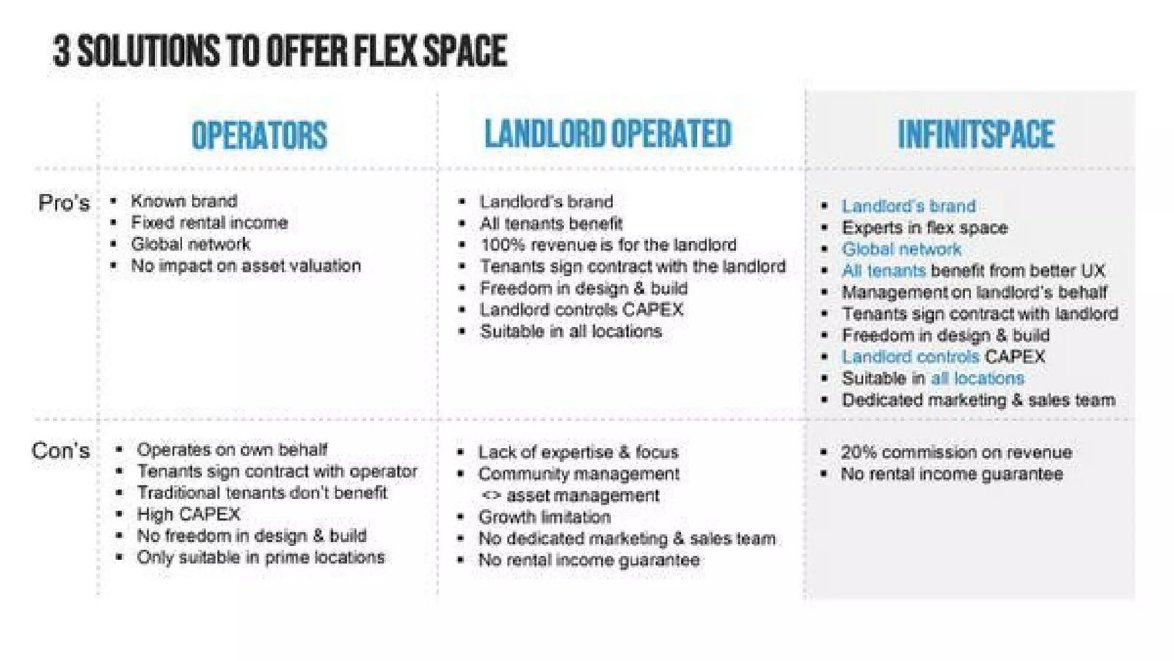
Our analysis: Commission on rent, compared with the other ways a landlord could run flex space.
Evidence and limitation: The fee (20% of revenue) appears honestly as a con for the landlord, next to two alternatives. It doesn't say what revenue a typical building earns, so the fee in money isn't shown.
What a founder can adapt: "Landlord keeps [X]%, we take [Y]% of revenue; typical site $[Z] a year."
Supporting analysis
What the deck claims: "3 solutions to offer flex space." Columns compare "Operators", "Landlord operated" and "Infinitspace". Operators: "Fixed rental income", "High CAPEX", "Only suitable in prime locations". Landlord operated: "100% revenue is for the landlord", "Lack of expertise & focus". Infinitspace pros include "Landlord's brand", "Management on landlord's behalf", "Tenants sign contract with landlord", "Landlord controls CAPEX"; cons: "20% commission on revenue", "No rental income guarantee".
Presentation choice: Shows the payer's choice and what they give up.
When it does not fit: Comparing models without an example revenue figure.
Pacaso deck, slide 10. Exact stored slide matched to this analysis.
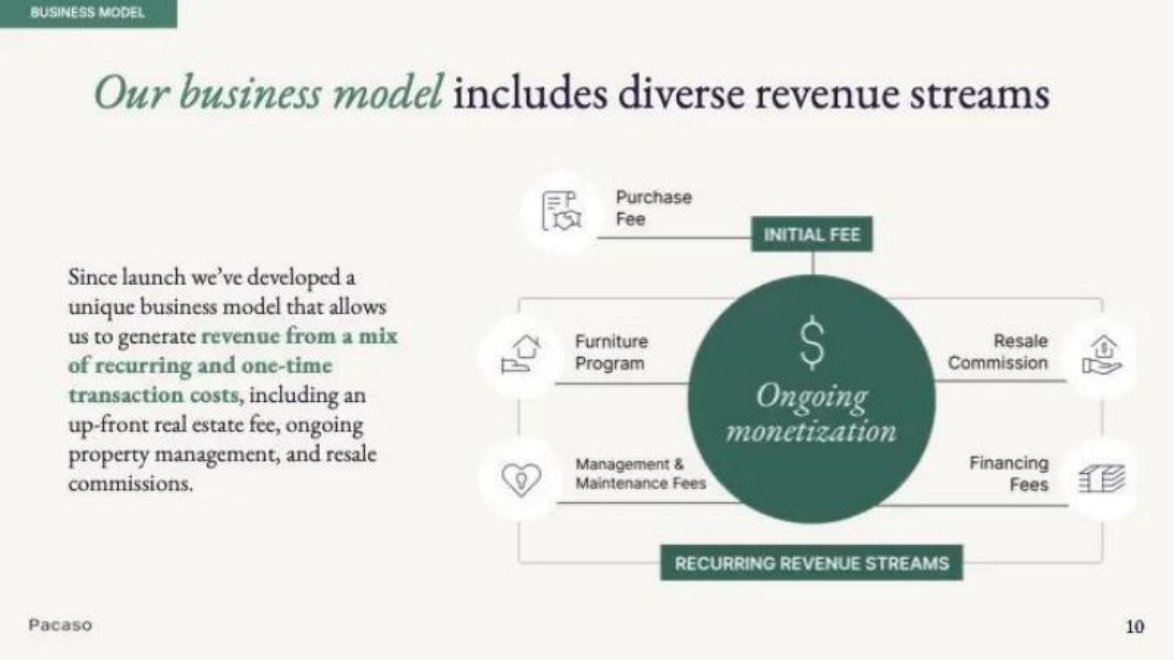
Our analysis: Map of when money comes in over an owner's life.
Evidence and limitation: Separates the one-off purchase fee from recurring streams. No rates, prices or mix are shown on this slide.
What a founder can adapt: "Up front: [X]% of price. Every year: $[Y] management. On resale: [Z]%."
Supporting analysis
What the deck claims: "Our business model includes diverse revenue streams." "Since launch we've developed a unique business model that allows us to generate revenue from a mix of recurring and one-time transaction costs, including an up-front real estate fee, ongoing property management, and resale commissions." Diagram: "Initial fee: Purchase Fee"; "Recurring revenue streams: Furniture Program, Management & Maintenance Fees, Resale Commission, Financing Fees"; centre: "Ongoing monetization".
Presentation choice: Makes clear the company earns after the sale, not just at it.
When it does not fit: Listing streams without any rate.
Robotic camera and virtual tours for property listings.
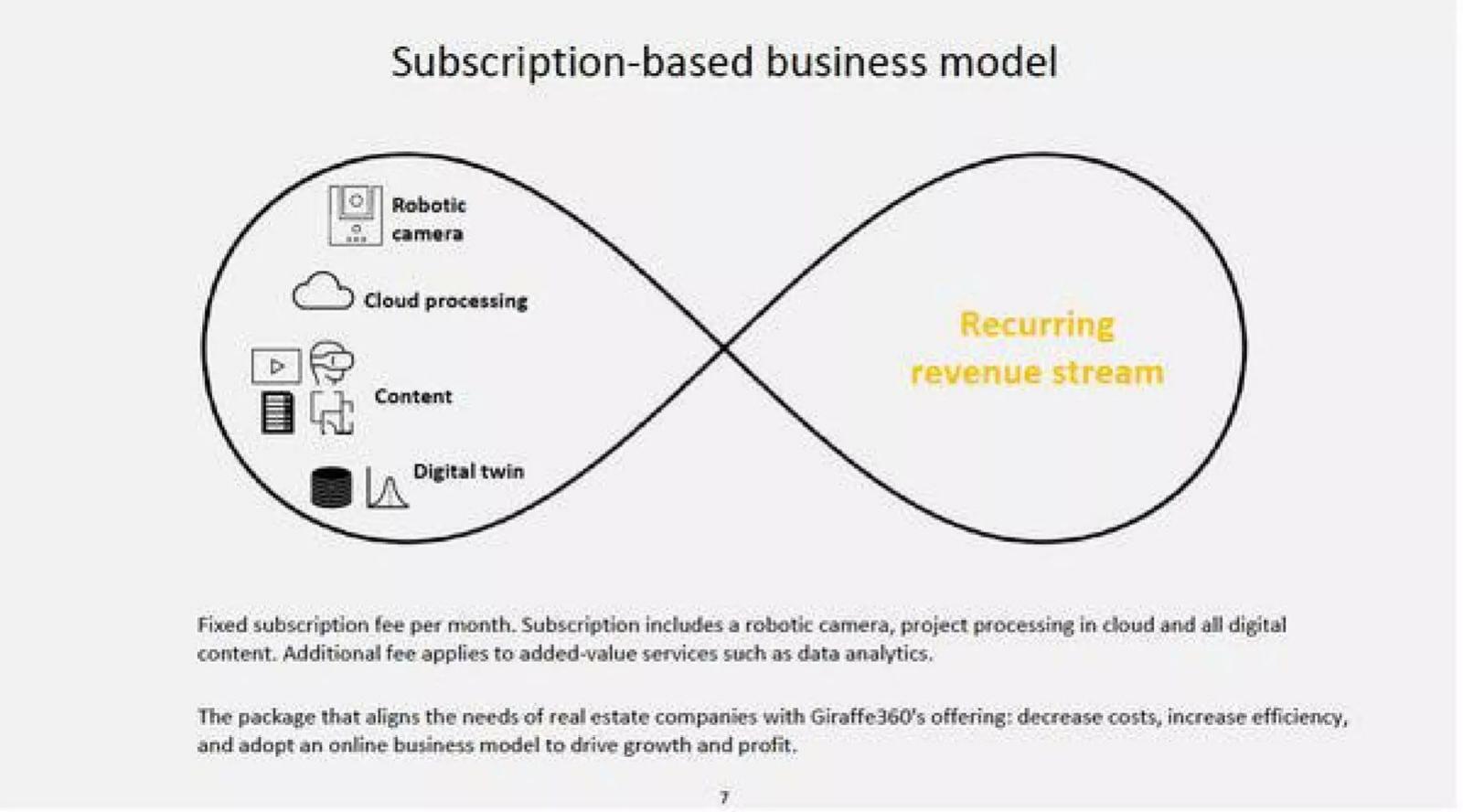
Giraffe360 deck, slide 7. Exact stored slide matched to this analysis.
Our analysis: Hardware plus service sold as one subscription.
Evidence and limitation: Says hardware is bundled into a monthly fee, with add-ons. The monthly price isn't shown.
What a founder can adapt: "$[X] a month includes [hardware + service]; add-ons $[Y]."
Supporting analysis
What the deck claims: "Subscription-based business model." Items: "Robotic camera", "Cloud processing", "Content", "Digital twin"; "Recurring revenue stream." "Fixed subscription fee per month. Subscription includes a robotic camera, project processing in cloud and all digital content. Additional fee applies to added-value services such as data analytics."
Presentation choice: Explains why an agency pays monthly rather than buying a camera.
When it does not fit: Calling it a subscription without a price.
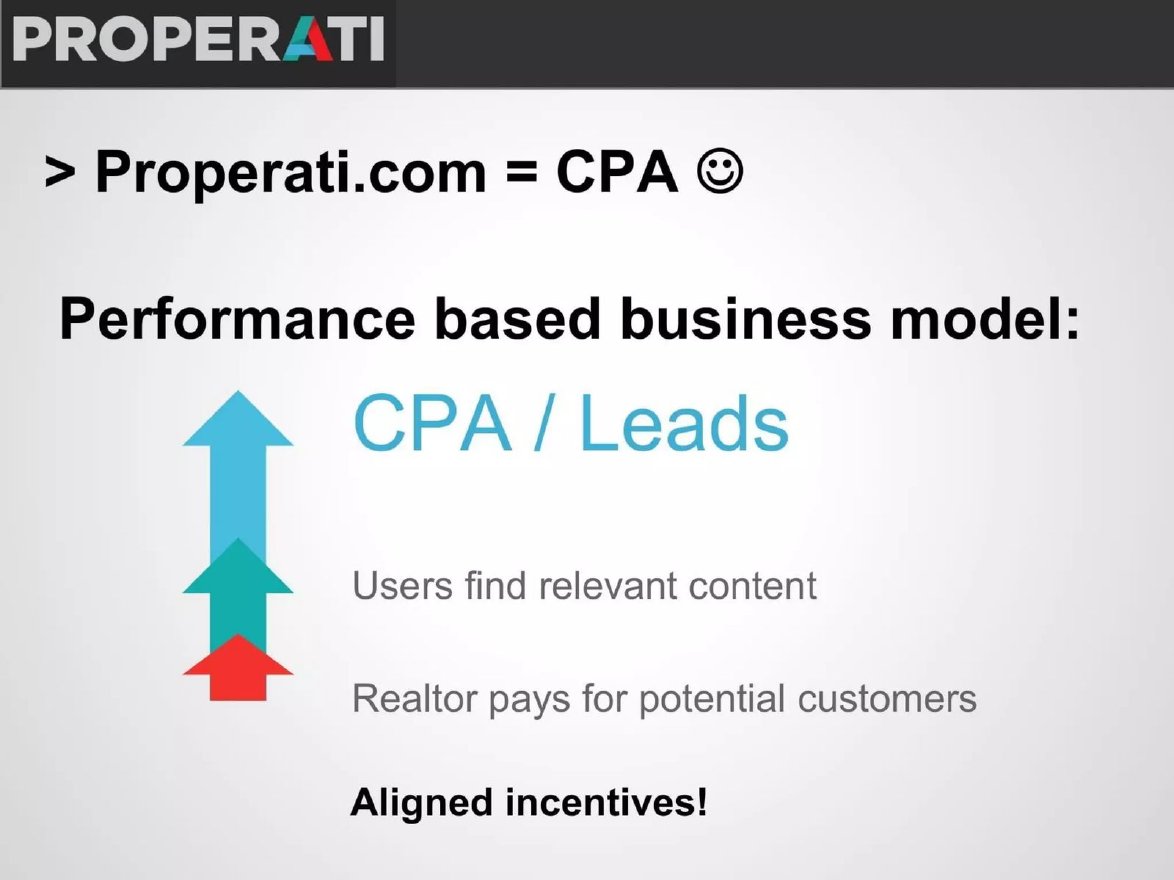
Properati deck, slide 7. Exact stored slide matched to this analysis.
Our analysis: Pay per lead instead of pay per listing.
Evidence and limitation: Weaker example. It names the payer (the realtor) and the unit (a lead), and contrasts it with paid listing tiers, but gives no price per lead or conversion rate.
What a founder can adapt: "Agents pay $[X] per lead instead of $[Y] per listing a month."
Supporting analysis
What the deck claims: "Properati.com = CPA." "Performance based business model:" "CPA / Leads." "Users find relevant content." "Realtor pays for potential customers." "Aligned incentives!" The page before (p6) shows the old way: "Traditional real estate sites: CPM" with tiered plans from "Super Gold-Platinum" to "Normal", and "Not the best ROI for the realtor."
Presentation choice: The contrast with the old model is easy to follow.
When it does not fit: Explaining the model without a price.
Which kind of real estate business model slide answers which question.
Approach
Example
Answers
Leaves open
Share of a saving
Ownwell
Payer, trigger, rate
Customer count
Price per lead
HouseLab
Spend per sale
Purchase frequency
Commission on rent
Infinitspace
Payer's trade-off
Fee in money
One-off + recurring map
Pacaso
When money arrives
Rates
Bundled subscription
Giraffe360
What is included
Price
Pay per lead vs listing
Properati
Why the model differs
Price
Key Takeaways
Name the payer: owner, buyer, landlord, tenant, agent or developer.
Say what triggers payment: a saving, a lead, a sale, a month or rent collected.
Put a number on the fee or rate.
Separate one-off fees from recurring ones.
Showing a competitor's pricing is not the same as showing yours.
Write your real estate business model slide
Answer these before you design the slide.
Payer. Who pays: owner, buyer, landlord, tenant, agent or developer?
Trigger. What event makes them pay: a saving, lead, sale, month or rent collected?
Rate. What is the fee, percentage or monthly price?
Timing. Which fees are one-off and which recur?
Example. What does one typical customer pay you in a year?
Copyable framework: [Payer] pays [fee] when [trigger]; a typical [customer] pays $[X] a year, [Y]% of it recurring.
Illustrative example 1 — written by us
Before: "Subscription-based business model. Fixed subscription fee per month."
After: "Agencies pay $[X] a month for camera, processing and content; analytics add $[Y]."
What improved: Our illustrative rewrite of Giraffe360's slide; bracketed text is a placeholder, not company fact.
What's different about real estate business models
Property deals are large but rare, so a fee tied to a sale can be big but slow and irregular. Rent, management and subscriptions arrive every month. Investors want to know which kind of money the company earns and who writes the cheque.
What investors check
Who pays, and whether they are the same person who uses the product. What event triggers the payment. The fee or rate as a number. How much is one-off and how much recurs.
How we read each slide
We quote the text on the slide images and mark our own arithmetic as ours. We have not checked any figure on the slides. Page numbers are pages in the original deck files. Two images were already stored and were checked against fresh renders of the decks; four were rendered from the deck files and stored on 2026-09-26.
Common mistakes
Fee type without a number. Say the rate or price.
Only the competitor's pricing. Show your own model, not just what's wrong with theirs.
One-off and recurring mixed. Split them; investors value them differently.
No payer named. Owners, agents and tenants pay differently.
Diagnostic checklist
Payer named.
Trigger for payment.
Fee or rate as a number.
One-off vs recurring split.
Typical yearly spend per customer.
Frequently asked questions
What should a proptech business model slide show?
Who pays, what triggers the payment, and the rate. Ownwell: owners pay 25% of the tax saving, only when there is one.
Is a commission on transactions a good model for real estate?
It can be large per deal but irregular. Pacaso shows one way to add recurring fees after the sale; say which part of your revenue repeats.
How we chose these examples
Corpus: published pitch deck teardowns on StartupFundraising.com. Founder-uploaded private decks are excluded.
Selection (2026-09-26): we searched teardown slide text for business-model wording together with real estate terms, reviewed about twenty slides and kept six.
Excluded: Keyway p6 (says "no fees" without explaining how it earns), HomeHub (furniture search, not property), Bridge Software (construction supply), Mint House p3 (a summary list), Properati p6 (used only as context for p7).
Page numbers are pages in the original deck files. Ownwell and HouseLab images were already stored and were checked against fresh renders on 2026-09-26; Pacaso, Giraffe360, Infinitspace and Properati were rendered from the deck files and stored the same day.
Figures are quoted from the slides and not independently verified. Calculations are ours and marked as such.
Review: slide images were checked on 2026-09-26 and matched to company, deck and page (editorial model review). No person has yet completed an editorial review of this page. We make no claim that any slide caused a fundraising outcome.