Properati's 12-slide deck from 2013 serves as a masterclass in identifying and solving specific regional market inefficiencies. The company targeted the Latin American real estate sector, which was then dominated by cluttered, 'analog-ported' web portals using outdated CPM (Cost Per Mille) advertising models. Properati proposed a clean, mobile-first UX and a CPA (Cost Per Action) business model, aligning their revenue with actual lead generation for brokers. With 200k properties listed and 10k leads generated monthly at the time of the pitch, the deck provided strong traction evidence. The in…
Key takeaways
- The deck identifies a specific UX failure in traditional real estate sites, contrasting cluttered legacy portals with Properati's 'Simple & Clean' interface (Slide 3, 4).
- Properati differentiates itself by moving from a CPM model to a performance-based CPA/Leads model to align incentives with realtors (Slide 6, 7).
- The team slide highlights deep domain expertise, noting the founders' previous work with Sumavisos, which reached 12 million monthly visits (Slide 8).
- Traction is quantified with clear milestones: 200k properties listed and 10k leads generated per month across two countries (Slide 10).
- The deck provides an unusually transparent cap table, showing founders retained 68% ownership prior to the Series A (Slide 11).
- Fund allocation is specific, with 45% of the $2 million ask dedicated to Online Marketing (TAC) to drive further growth (Slide 11).
- The roadmap outlines aggressive geographic expansion, planning launches in Mexico, Colombia, and Chile within one year (Slide 9).
- The deck uses a Fred Wilson quote to frame the problem of 'analog' models failing in a digital world (Slide 2).
The Properati Pitch Deck: A Strategic Shift to Performance Real Estate
Properati’s 2013 pitch deck is a concise 12-slide presentation that successfully navigated the transition from a seed-stage startup to a Series A contender. Headquartered in Buenos Aires, the company sought to disrupt the Latin American real estate market by focusing on two pillars: superior user experience and a performance-based revenue model. This teardown examines how the founders used clear metrics and a transparent financial ask to secure $9.7 million in total funding.
The Hook and the Problem Statement
Slide 1: Title Slide The deck opens with a clear value proposition: "Real Estate Market Place in Latin America." It identifies the presenter as Gabriel Gruber, Co-Founder & CEO, and notes the context of the presentation at the NXTP Labs Demo Day in Mountain View, September 2013. The branding is professional, and the sub-text "LatAm Invades Silicon Valley Now" sets a bold tone for the pitch.
Slide 2: The Philosophical Frame Properati uses a quote from Fred Wilson of Union Square Ventures: "Taking a model that was optimized for the analog world and porting it to the internet is almost always suboptimal." This is a strategic move. Instead of just saying their competitors are bad, they use an industry authority to explain why they are bad. It frames the entire real estate portal industry as an outdated relic of the newspaper era.
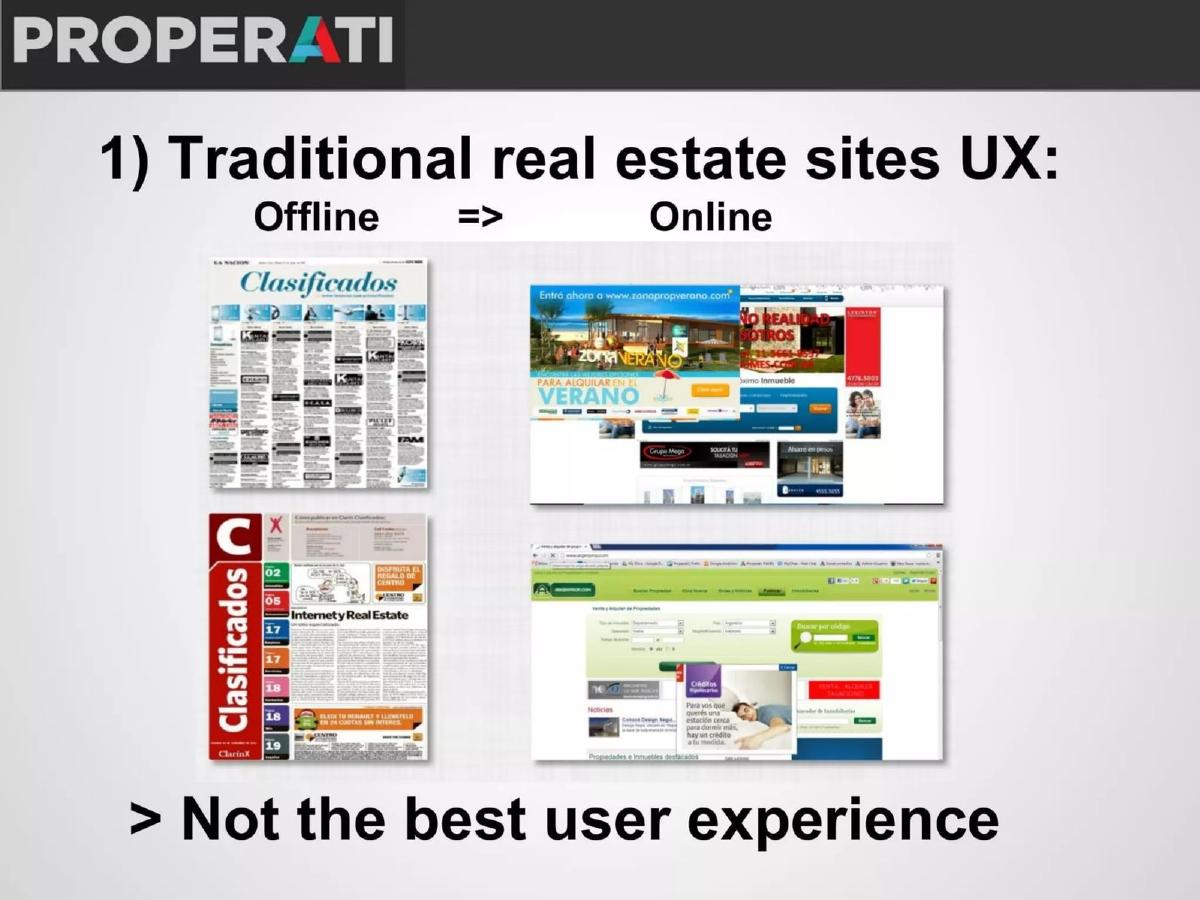
Slide 3: The Visual Problem Slide 3 provides the evidence for the Fred Wilson quote. It shows side-by-side comparisons of traditional newspaper classifieds and current real estate websites. The visual clutter is obvious. The slide explicitly states: "Traditional real estate sites UX: Offline => Online > Not the best user experience." This slide effectively builds tension by showing a problem that is easy to see but hard for incumbents to fix without rebuilding their entire tech stack.
The Solution and Product Showcase
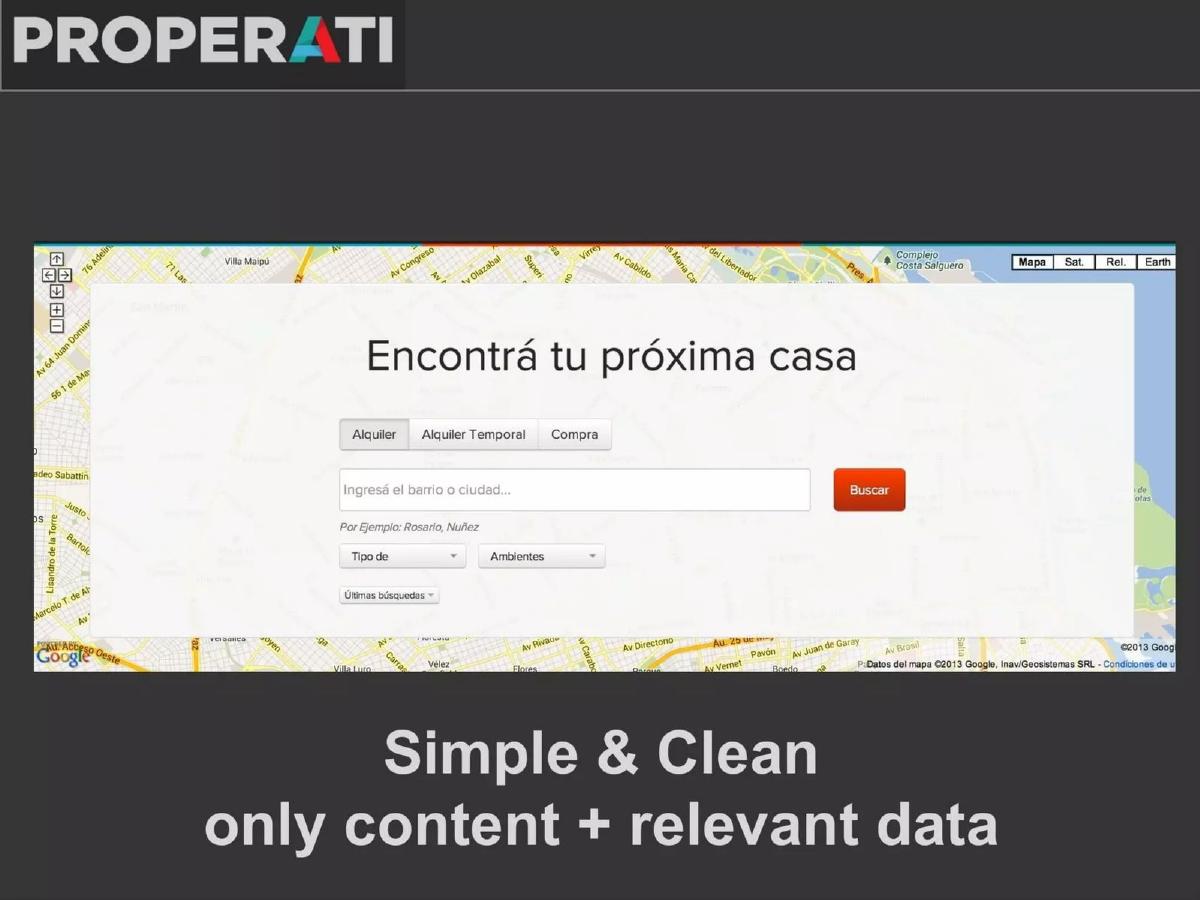
Slide 4: The Desktop Solution Properati presents its answer to the clutter: a "Simple & Clean" interface. The screenshot shows a minimalist search bar over a map, reminiscent of the early Airbnb or Google Search aesthetic. The text emphasizes "only content + relevant data," positioning Properati as the modern, user-centric alternative to the legacy portals shown on the previous slide.
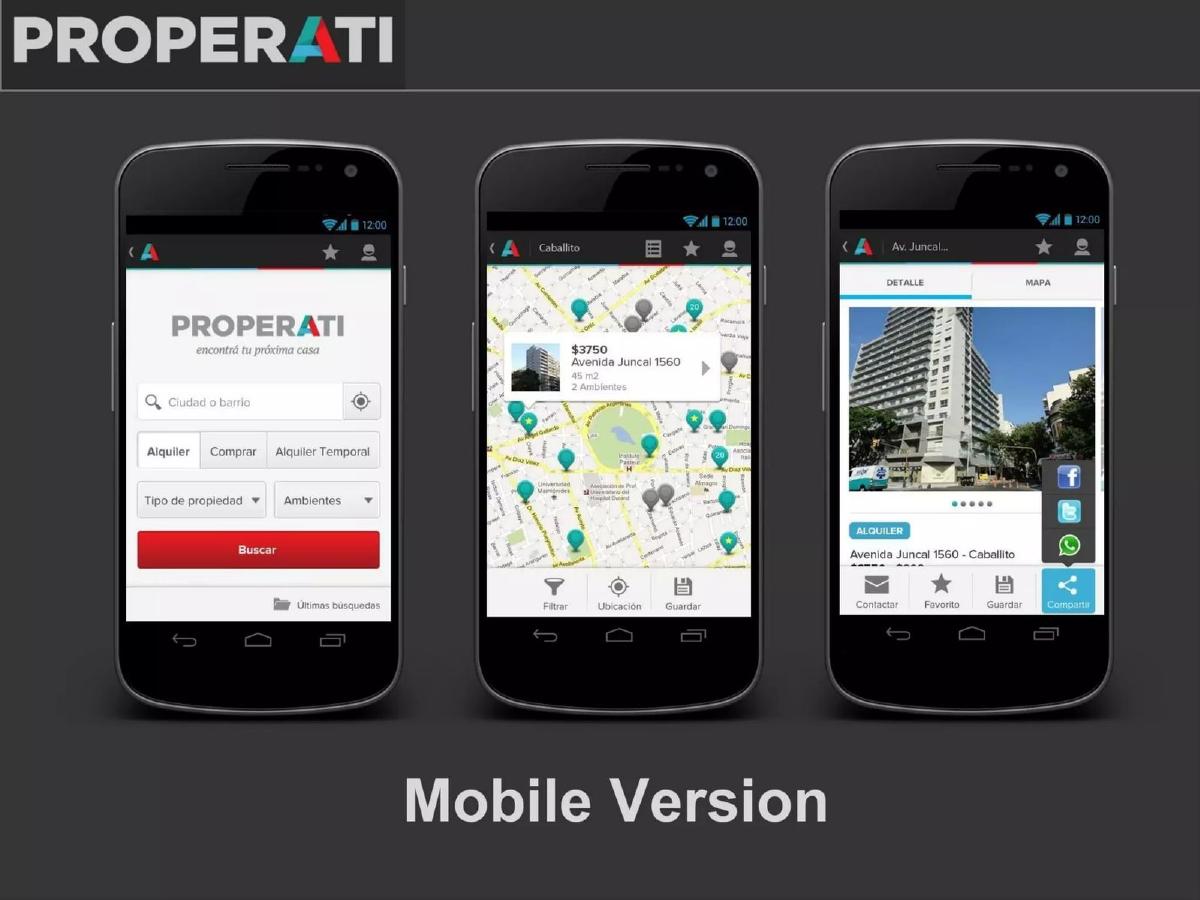
Slide 5: Mobile-First Strategy In 2013, mobile was the frontier. Slide 5 showcases three screens of the Properati mobile app. It highlights map-based searching, property details, and social sharing features. By dedicating a full slide to mobile, the founders demonstrate they are building for the future of consumer behavior, not just catching up to the present.
Business Model Innovation
Slide 6: The Revenue Problem The deck shifts from UX to economics. Slide 6 critiques the "Traditional real estate sites: CPM" model. It mocks the tiered pricing structures (Super Gold-Platinum, Gold, Silver, etc.) with a frowny face and the note: "Not the best ROI for the realtor." This identifies a pain point for the supply side of the marketplace (the brokers), who are paying for impressions rather than results.
Slide 7: The CPA Solution Properati introduces its "Performance based business model: CPA / Leads." By charging for potential customers rather than ad impressions, they claim "Aligned incentives!" This is a powerful argument for investors because it suggests a more defensible and scalable revenue stream. If the platform delivers leads, the brokers will continue to pay; if it doesn't, the brokers lose nothing. This lowers the barrier to entry for new listings.
Team and Execution Roadmap
Slide 8: The Team The team slide is strong because it highlights a previous success. Above the founders' photos is the logo for "Sumavisos," with the note: "30 countries, 8 langs, 12MM visits / month." This proves the team knows how to build and scale a global marketplace. The individual bios for Gabriel Gruber, Martin Sarsale, and Lorenzo Raggio emphasize a mix of tech, economics, and real estate expertise. The bottom of the slide lists supporting entities like NXTP Labs and Eastpoint Ventures.
Slide 9: The Roadmap Slide 9 uses a timeline to show rapid execution. It tracks the journey from launch in May 2012 to hitting 100k listings in Brazil by May 2013. The forward-looking part of the timeline is aggressive, planning launches in Mexico, Colombia, and Chile by July 2014. This slide demonstrates momentum—a key requirement for a Series A round.
Traction and The Ask
Slide 10: Traction Metrics This is the "proof" slide. It uses large, bold numbers: 200k properties listed, 800 new developments, 130k monthly visitors, and 10k leads generated per month. It also displays logos of major partners like RE/MAX and Baigún. These figures validate that the CPA model isn't just a theory; it is already functioning at scale across two countries.
Slide 11: The Series A Ask and Cap Table This is one of the most transparent slides in the deck. Properati explicitly states they are raising a "$2 million Series A round at an $8 million pre-money valuation." It includes a table showing the current ownership: Founders (68%), Stock Options (12%), and Seed (20%). Furthermore, a donut chart breaks down the fund allocation: 45% for Online Marketing (TAC), 30% for Sales, 15% for Product, and 10% for Operations. This level of detail gives investors confidence that the founders have a disciplined plan for the capital.
Slide 12: Conclusion The deck ends by repeating the title slide information, providing contact details for Gabriel Gruber. It brings the presentation full circle, leaving the audience with the core message: Properati is the future of LatAm real estate marketplaces.
What Works in This Deck
Clarity of the Pivot: The deck does an excellent job of explaining the shift from CPM to CPA. By framing it as an alignment of incentives, they make the business model seem inevitable rather than experimental.
Visual Contrast: The use of Slide 3 to show the "ugly" reality of competitors makes the "clean" solution on Slide 4 much more impactful. It’s a classic "Before and After" marketing tactic applied to a pitch deck.
Financial Transparency: Including the pre-money valuation and the current cap table is rare in a public-facing deck. It signals that the founders are sophisticated and ready for the due diligence process of a Series A.
What Is Missing
Unit Economics: While the deck mentions the CPA model, it does not specify the average cost per lead or the lifetime value (LTV) of a broker. Investors would likely want to know the margins on those 10,000 monthly leads.
Competitive Landscape: The deck implies that all competitors are "analog," but it doesn't name specific digital-native rivals who might also be moving toward a CPA model. A competitive matrix would have helped define their moat.
Churn Metrics: With 4,000 brokers providing content, the deck lacks information on broker retention. In a marketplace, the cost to acquire a broker vs. their retention rate is a critical metric for long-term sustainability.
What a Founder Should Copy
The "Analog to Digital" Framing: Using a quote from a respected VC to validate your market thesis is a great way to build instant credibility. It moves the conversation from "we think this is a problem" to "the industry leaders agree this is a problem."
Specific Fund Allocation: Don't just ask for money; show exactly where it goes. The donut chart on Slide 11 is a perfect example of how to communicate a growth strategy. By putting 45% into marketing, they are telling investors, "We have the machine built; we just need fuel to make it go faster."
Milestone-Based Timelines: The roadmap on Slide 9 is effective because it mixes past achievements with future goals. It shows a consistent cadence of delivery, which reduces the perceived risk for new investors.
Frequently asked questions
- What was the primary problem Properati aimed to solve?
- Properati targeted two main issues: poor user experience and misaligned business models. Slide 3 shows how traditional sites were merely digital versions of newspaper classifieds, resulting in cluttered interfaces. Slide 6 highlights that legacy sites used CPM models that didn't guarantee ROI for realtors. Properati solved this with a clean, mobile-optimized UI and a CPA model where brokers pay for actual leads.
- How did Properati demonstrate market traction?
- Traction was presented through a combination of listing volume and user engagement. Slide 10 notes that within 12 months, the platform listed 200,000 properties and 800 new developments. More importantly, it showed utility by generating an average of 10,000 leads per month for 4,000 participating brokers, proving the business model's viability.
- What was the team's background in this sector?
- The team had significant experience in scaling web platforms. Slide 8 mentions 'Sumavisos,' a project involving the founders that operated in 30 countries with 12 million monthly visits. The leadership included Gabriel Gruber (CEO/Economist), Martin Sarsale (CTO/Hacker), and Lorenzo Raggio (COO/Real Estate), providing a mix of technical and industry-specific expertise.
- What were the specific terms of the Series A ask?
- According to Slide 11, Properati sought $2 million at an $8 million pre-money valuation. The deck was remarkably transparent about the existing capital structure, showing $180k from founders and $200k from seed investors. They also detailed exactly how the $2 million would be spent, with the largest portion (45%) going toward traffic acquisition.
- Why did the deck emphasize a mobile version?
- Slide 5 is dedicated entirely to the 'Mobile Version.' In 2013, the shift toward mobile search was a critical differentiator against legacy desktop-only portals. By showing a functional, map-based mobile interface, Properati positioned itself as a modern alternative to the 'analog' competitors mentioned in the Fred Wilson quote on Slide 2.