Propel IP’s 2016 pitch deck for Catch Commander focuses on a specific hardware pain point: the manual, cumbersome process of logging fish catches. The company positions itself as a premium alternative to existing low-end Bluetooth scales, leveraging a patent-pending design that prioritizes fish health through a non-piercing clamp. With a modest $300,000 ask, the deck leans heavily on the founders' deep industry experience and existing relationships with major retailers like Bass Pro Shops and Cabela’s. While the financial projections are aggressive—forecasting a jump from 1,000 units in 2016…
Key takeaways
- The company identifies a target market of 46 million U.S. anglers, narrowing down to 1.2 million 'Super Users' in bass fishing leagues (Slide 4).
- Catch Commander uses Bluetooth to automatically sync weight, length, GPS, and weather data to a smartphone app (Slide 6).
- The hardware features a one-handed trigger and a non-piercing clamp to improve fish survivability compared to traditional hooks (Slide 6).
- Management claims interest from major retailers including Dick’s Sporting Goods, Bass Pro Shops, and Cabela’s (Slide 7).
- The deck lists specific intellectual property, including U.S. Pat. No. 7,173,197 and two pending utility applications (Slide 10).
- The funding ask is $300,000, primarily for finalizing engineering, purchasing tooling, and stocking initial inventory (Slide 11).
- Pro-forma financials project revenue growing from $0 in 2016 to $16.96 million by 2020 (Slide 15).
- The team possesses significant domain expertise, including a COO who previously sold a fishing accessory company to Jarden (Slide 13).
Propel IP Pitch Deck Analysis
Propel IP, Inc., based in Raleigh, NC, presented this deck in May 2016 to secure seed funding for its flagship product, the Catch Commander. The deck is a classic example of a hardware-plus-software play targeting a passionate hobbyist niche. It focuses heavily on the physical utility of the device and the professional pedigree of the founding team.
Slide 1-2: Introduction and Company Overview
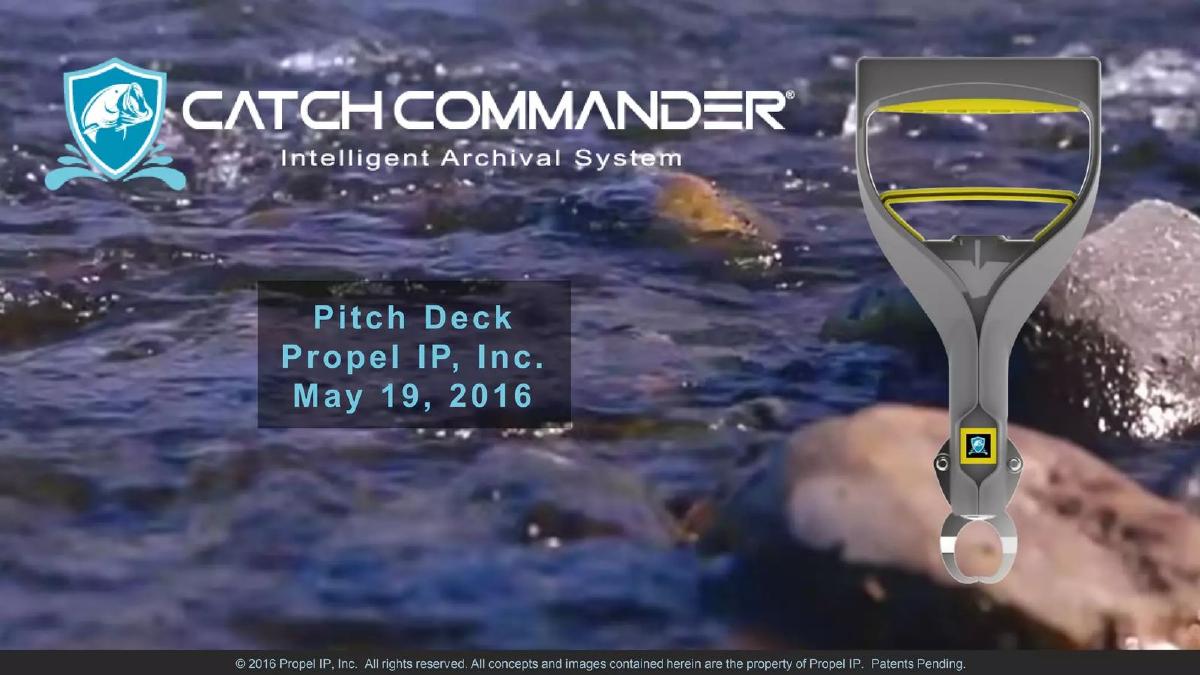
The deck opens with a high-resolution render of the Catch Commander device against a river background. Slide 2 introduces Propel IP as an 'emerging technology company' focused on the North American sporting goods industry. The core value proposition is defined as a 'family of Bluetooth fish scales' paired with proprietary software. Notably, the company immediately names a competitor, Connect Scale, positioning them as a low-end player while claiming Propel IP’s holdings will 'inhibit' future competition. This is an aggressive start, signaling that the founders view their intellectual property as a primary moat.
Slide 3: Traction
The traction slide lists several qualitative milestones. The company has presented to 'top industry retailers' and claims that over 200 independent dealers have requested stock. A significant highlight is the recognition of Catch Commander as a 'best-in-class product' at iCast 2015. The slide also mentions a 'significant investment' closed on April 15, 2016, though it does not disclose the amount or the valuation. This slide serves to prove that the industry has already validated the concept before the product has even hit mass production.
Slide 4: Market Opportunity
Propel IP segments the market clearly. They start with a broad top-of-funnel figure of 46 million U.S. anglers but quickly narrow their focus to 1.2 million 'Super Users' (FLW and BASS league members) and 750,000 'Highly Dedicated Users.' By identifying that tournament members are 'required to use a scale,' they establish a non-discretionary need for their product. They estimate the total U.S. scale market at 800,000 units per year, providing a realistic ceiling for hardware sales.
Slide 5-6: Problem and Solution
Slide 5 details the friction in current angling workflows: 'dog-eared notebooks' and 'fragmented systems.' It also highlights a biological problem: piercing hooks and excessive handling lead to fish mortality. Slide 6 presents the Catch Commander as the solution. The device automates data capture (GPS, weather, length, weight) via Bluetooth, reducing manual entry. The hardware design—specifically the one-handed trigger and non-piercing clamp—is positioned as a way to improve fish health, which is a major selling point for conservation-minded tournament organizers.
Slide 7-8: Sales Channels and Revenue Drivers
The distribution strategy is traditional retail. Slide 7 lists heavy hitters like Cabela’s, Dick’s Sporting Goods, and Bass Pro Shops as interested parties. Slide 8 explains how they will drive demand, focusing on 'grass roots' marketing and providing products as rewards for the 50,000 domestic fishing tournaments held annually. This is a smart, low-cost customer acquisition strategy that puts the product directly into the hands of influencers.
Slide 9-10: Competition and Competitive Edge
Slide 9 lists general market leaders like Garmin and Lowrance but focuses its competitive ire on Connect Scale. The company suggests a potential licensing play, noting they could 'potentially license the technology to Connect Scale' due to patent infringement. Slide 10 reinforces this by listing specific patent numbers and trademark filings. For a hardware startup, this emphasis on IP is intended to reassure investors against rapid commoditization by overseas manufacturers.
Slide 11: Use of Funds
The ask is $300,000. The allocation is straightforward: finalizing engineering, purchasing manufacturing tooling, and stocking inventory. This is a relatively small ask for a hardware company, suggesting they are looking for just enough capital to reach their first major production run. The slide also lists existing investors: Thomas Wye and Blue Flip, LLC.
Slide 12-14: Management Team and Advisors
The team slides are the strongest part of the deck. Robert and Brenda Jones bring 20+ years of manufacturing and marketing experience. However, the inclusion of Dickie Herbst (COO) is the standout; his history of building and selling a fishing accessory company to a major industry conglomerate (Jarden) provides significant credibility. Mike Blocher’s role as Director of Marketing is also strategic, as he operates a major tournament circuit, providing a built-in testing ground and marketing channel.
Slide 15: Pro-forma Financial Summary
The financials project a rapid scale-up. They forecast selling 1,000 units in 2016, jumping to 39,875 in 2017, and reaching 161,875 by 2020. Revenue is projected to grow from $0 in 2016 to $16.964 million by 2020. The EBITDA projections are healthy, moving from a $369,000 loss in the launch year to a $4.395 million profit by year five. The deck concludes with an 'Overall Return on Investment' projection of 508%, which is a bold claim to include in a pitch deck.
What Propel IP Does Well
The deck excels at identifying a specific, high-value niche. By focusing on 'Super Anglers' and tournament requirements, they move the product from a 'nice-to-have' gadget to a 'must-have' tool for competitive play. The hardware design is clearly explained, and the biological benefits (fish survivability) provide a unique emotional and ethical hook that competitors lack. Furthermore, the team’s deep industry ties and previous exit history make the execution risk seem manageable.
What is Missing from the Deck
The most glaring omission is a detailed look at the software ecosystem. While the 'archival system' is mentioned, there is no discussion of software monetization (e.g., subscription features for tournament directors) or how the app will retain users once the hardware is purchased. The deck also lacks a clear breakdown of unit costs versus retail price points, making it difficult to verify the 58% gross margin implied in the pro-forma. Finally, there is no mention of a 'Plan B' if major retailers like Bass Pro Shops decide not to carry the product after the initial presentation.
What a Founder Should Copy
Founders should emulate the way Propel IP uses its competition to define its own value. Instead of ignoring Connect Scale, they use them as a benchmark to highlight their own 'premium' features and IP protection. The 'Traction' slide is also a good model; it uses industry awards and retailer interest to build a narrative of inevitability. Lastly, the team bios are excellent—they don't just list titles; they list specific achievements (like 'sold company in 2006 to Shakespeare/K2') that are directly relevant to the current venture's success.
Frequently asked questions
- What is the primary problem Propel IP is solving?
- According to slide 5, the primary problem is that creating a fish log is a 'time consuming and cumbersome process.' Anglers currently rely on paper journals or manual app entry. Additionally, traditional scales often use piercing hooks that harm fish health, which is a critical issue for tournament anglers where fish mortality results in penalties.
- How does Catch Commander differentiate itself from competitors like Connect Scale?
- Slide 2 and slide 9 state that Connect Scale caters to the 'lower end of the market' and uses a 'common market design' that existed for 10+ years without Bluetooth. Propel IP claims their hardware is superior due to its ergonomic one-handed operation and non-piercing clamp, and they suggest Connect Scale may be infringing on their patents.
- What is the specific go-to-market strategy?
- The strategy is retail-heavy. Slide 7 lists 'large national sporting goods chains' and 'hundreds of small independent dealers' as primary channels. They also plan to use fishing tournaments as a marketing vehicle, providing products as rewards for some of the 50,000 domestic tournaments held annually (Slide 8).
- What are the projected unit economics and margins?
- Slide 15 provides a pro-forma summary. In 2017, the first year of significant sales, they project $4.478 million in revenue against $1.85 million in COGS, implying a gross margin of approximately 58%. By 2020, they expect an EBIT margin of 27%.
- Who are the key members of the management team?
- The team is led by Robert A. Jones (President) and Brenda S. Jones (CEO). Crucially, the team includes Dickie Herbst as COO, who founded XTOOLS LLC and sold it to Jarden/Shakespeare, and Mike Blocher, who operates the Xtreme Fishing Series tournament circuit (Slides 12-13).